5G, 6G, 11GHz, 24GHz & 60GHz Multi-Band Wireless Communication and Sensing
Article Overview
Target Audience: Industrial wireless system engineers, factory IT/OT planners, security and sensing solution architects, automotive radar and building automation product managers
Core Question: How to choose among 5G, 6G, 11GHz, 24GHz, and 60GHz in industrial environments — balancing coverage, capacity, sensing resolution, and total cost of ownership
Key Conclusion: There is no single “best” band — only the best combination for your specific use case. 5G excels at foundational connectivity, 6G (FR3) targets long-distance bridging and next-gen high-capacity private networks, 11GHz serves as a mid-band transitional option, 24GHz delivers robust sensing, and 60GHz provides fine-grained detection. The most effective industrial deployment strategy is multi-band coordination, not a one-band-fits-all approach.
Introduction: The Evolution of Industrial Multi-Band Wireless Systems
The core of industrial wireless selection is not “which band is stronger,” but rather “which combination best fits your specific coverage, capacity, sensing, and cost requirements.” 5G anchors industrial private network connectivity, 6G (FR3) targets long-distance bridges and next-generation high-capacity networks, 11GHz fills the mid-range transitional gap, 24GHz delivers robust sensing, and 60GHz provides fine-grained detection — each with clearly defined engineering boundaries. No single band can solve every industrial challenge.
Industrial wireless systems are undergoing a structural transformation. Factory automation, warehouse logistics, perimeter security, automotive sensing, and building management — these use cases no longer demand merely “connectivity,” but simultaneously require stable coverage, reliable sensing, and acceptable deployment costs. Different frequency bands exhibit significant differences in coverage capability, propagation loss, bandwidth potential, sensing resolution, and deployment cost. 5G’s commercial ecosystem has matured, 6G standards are under active development, 11GHz is emerging as a transitional band, while 24GHz and 60GHz mmWave radar are rapidly deploying in short-range sensing applications.
This white paper adopts a structured analytical framework grounded in propagation physics and oriented toward industrial application scenarios, examining each band’s engineering boundaries and deployment logic. All bands discussed — 5G, 6G, 11GHz, 24GHz, and 60GHz — are evaluated from an industrial-grade product perspective, emphasizing stability, maintainability, and scalability in factories, warehouses, security, building automation, automotive, and industrial sensing systems, rather than consumer-grade peak-performance benchmarks.
Spectrum Layering and Propagation Characteristics
The physical foundation of industrial spectrum selection is a layered architecture: sub-7 GHz delivers wide-area coverage, 7–24 GHz balances capacity and propagation, and mmWave above 24 GHz provides high-resolution sensing and localized high throughput. Higher frequencies offer greater bandwidth potential but suffer from sharply reduced coverage distance and penetration capability. The first step in band selection is determining whether your business objective prioritizes coverage, capacity, or sensing — not blindly pursuing higher frequencies.
From the perspective of spectrum evolution for wireless communication and sensing, band utilization exhibits a three-tier structure: sub-7 GHz for wide-area coverage, 7–24 GHz as mid-band/upper mid-band candidates balancing capacity and propagation, and mmWave and terahertz above 24 GHz for localized ultra-high capacity and high-precision sensing. Within this structure, the 7–15 GHz range is considered by multiple 6G white papers as a key early-deployment band — offering significantly greater bandwidth than sub-7 GHz while maintaining more favorable propagation characteristics than mmWave.
Atmospheric absorption differences deserve particular attention: at 28 GHz, oxygen attenuation is approximately 0.06–0.1 dB/km and water vapor attenuation is approximately 0.4–0.5 dB/km, yielding a combined atmospheric attenuation of approximately 0.5–0.6 dB/km (NYU WIRELESS field measurements; ITU-R P.676-13 model). At 60 GHz, by contrast, oxygen molecular resonance drives attenuation to approximately 16 dB/km (NTIA field data; ITU-R P.676-13).
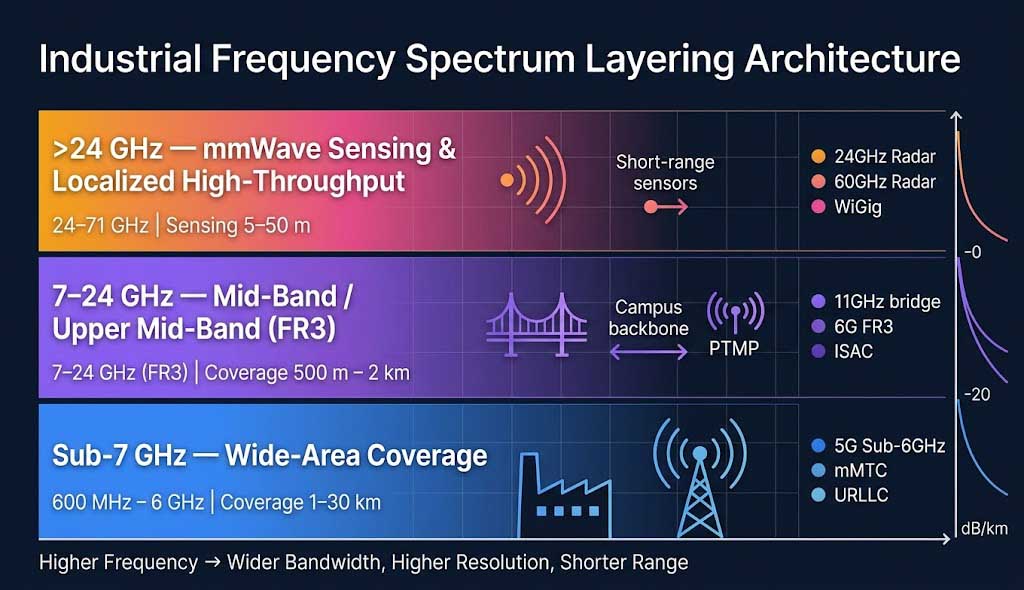 Figure 1: Industrial Frequency Spectrum Layering Architecture — Three-tier structure from wide-area sub-7 GHz coverage through FR3 mid-band bridges to mmWave short-range high-resolution sensing. Higher frequencies offer exponentially greater bandwidth but at the cost of drastically reduced range and penetration.
Band Propagation Characteristics Comparison
| Band | Frequency Range | Typical Coverage Radius (Outdoor) | Through-Wall Capability | Available Bandwidth | Sensing Resolution |
|---|---|---|---|---|---|
| 5G Sub-6GHz (Macro) | 600 MHz – 6 GHz | Urban 1–3 km, suburban 2–10 km, rural 5–30 km | Good (15cm concrete: 12–18 dB) | 100 MHz per carrier, peak 1–4 Gbps | Low (not a primary design target) |
| 5G mmWave (Small Cell) | 24 – 52 GHz | LOS 150–300 m, FWA up to 1.7–5 km (high-gain CPE) | Very poor (28GHz concrete 15cm: 35–50 dB) | 400 MHz per carrier, peak 3–7 Gbps | Medium |
| 6G FR3 (Candidate Macro) | 7 – 24 GHz | Urban LOS comparable to 3.5 GHz, NLOS ~10 dB degradation | Medium (NLOS diffraction weaker than Sub-6GHz) | 200–1000 MHz candidate, target peak >10 Gbps | Medium-High (supports JCAS basic sensing) |
| 11GHz | 10 – 11 GHz | LOS hundreds of meters to 2 km | Medium (between Sub-6GHz and mmWave) | Hundreds of MHz | Medium |
| 24GHz ISM Radar | 24.0–24.25 GHz (ISM 250 MHz) | Presence 10–50 m, level ≤30 m | Poor (>15 dB after single brick wall) | 250 MHz (ISM narrowband) | Medium (~60 cm at 250 MHz) |
| 60GHz Radar/Comms | 57–71 GHz | Sensing 5–15 m, Comms LOS 50–200 m | Extremely poor (concrete >50–65 dB) | Up to 7 GHz (region-dependent) | Very high (~3.75 cm at 4 GHz BW) |
Performance Evaluation Framework
Evaluating whether a frequency band is suitable for an industrial application requires a six-dimensional assessment: coverage capability, capacity potential, sensing resolution, deployment density, environmental robustness, and ecosystem maturity. Peak data rate and bandwidth potential are merely one variable in the selection equation — in industrial environments, coverage stability and deployment cost often matter more than peak data rates.
Industrial customers typically evaluate a wireless band against the following six dimensions:
- Coverage Capability: Effective coverage radius in real industrial environments, including through-wall and multipath performance.
- Capacity Potential: Per-node/per-base-station data throughput, determining support for high-bandwidth applications.
- Sensing Resolution: For radar-based solutions, range resolution, angular resolution, and target identification capability.
- Deployment Density: The number of nodes or base stations required to cover a given area, directly impacting total cost of ownership.
- Environmental Robustness: Sensitivity to temperature, humidity, dust, metal reflections, and personnel occlusion.
- Ecosystem Maturity: Availability of chipset vendors, device manufacturers, certification systems, and technical support channels.
5G Band Analysis: The Foundational Transport Layer for Industrial Private Networks
5G is the most pragmatic foundational connectivity solution for current industrial private networks. Its core advantage is commercial ecosystem maturity, 99.99%+ reliability, millisecond-level deterministic scheduling, and wide-area coverage. For industrial private network projects planned between 2025 and 2028, 5G is a “deployable today” choice, while 6G and mmWave remain “future evolution” considerations.
5G’s spectrum structure spans three tiers: low-band (Sub-1 GHz), mid-band (1–6 GHz), and high-band mmWave (24 GHz and above). In industrial deployments, mid-band typically serves as the primary “coverage and capacity” layer.
5G’s Core Advantages in Industrial Scenarios:
- Commercial Maturity: High device availability from Qualcomm, Huawei, MediaTek, Quectel, etc. R17 RedCap modules reached commercial deployment in 2024–2025.
- Coverage Robustness: Strong through-wall capability in mid/low bands; can leverage existing site infrastructure.
- Deterministic Transmission: 3GPP URLLC defines air-interface latency ≤1 ms, with end-to-end reliability of 99.999–99.9999%.
- Massive Connection Density: mMTC design targets 1 million devices/km² per sector.
5G’s Limitations in Industrial Sensing: 5G was primarily designed as a communication standard. Its sensing capabilities (via 5G-based JCAS) remain limited in range resolution and accuracy compared to dedicated radar bands. For applications requiring sub-meter or centimeter-level sensing, dedicated bands (24 GHz or 60 GHz) are more appropriate.
Recommended Industrial Scenarios: Large factory 5G private network (AGV control, IoT data aggregation, AR remote assistance, HD video surveillance up to 20+ cameras per cell). Medium-range outdoor backhaul (substations, branch plants, warehouses connecting to central buildings).
Environment: A coal-to-chemical plant in northwestern China, spanning 8 km² across production, storage, and dispatch zones. Strong EMI from high-voltage equipment and rotary machinery. Temperature range –25°C to +45°C.
Why 5G: Production zones demanded sub-20 ms deterministic transmission for gas concentration alarms. The 5G SA network deployed at 3.5 GHz, with MEC at the plant edge, achieved air-interface latency of 6–9 ms and end-to-end latency (sensor → MEC → HMI) of 19–23 ms. Three cell sites covered 70% of the area, with the remaining area supplemented by two micro sites. Non-line-of-sight transmission through concrete walls achieved RSRP > –105 dBm.
Results: 5G private network carried all real-time sensor data with 99.999% uplink reliability over a 6-month period. Deployment density was 1/5 that of Wi-Fi 6 mesh, with TTFC (Time to First Connectivity) for new devices under 5 seconds.
Key Insight: For industrial environment coverage breadth and deterministic latency requirements, 5G offers a coverage density and latency guarantee that Wi-Fi, 4G, and LoRa cannot match.
Environment: A “dark factory” in the Yangtze River Delta, operating 24/7 with minimal human intervention. 40+ AGVs navigate a 30,000 m² floor, coordinating movement within ±10 cm tolerance. Multiple AGVs must negotiate at intersections, with passing delays kept under 500 ms to avoid chain blocking.
Why 5G: Latency requirements — each AGV reports position to the central traffic controller at 50 ms intervals, and receives movement instructions within 20 ms. End-to-end latency target was 50 ms.
Results: The 5G SA private network delivered a median end-to-end latency of 23 ms (99th percentile 47 ms), well within the 50 ms target. Passing collisions dropped to zero over a 3-month trial period. The dark factory achieved a 78% reduction in operator headcount while maintaining throughput, yielding a 13-month ROI on the 5G infrastructure investment.
Key Insight: Medium-band 5G (3.5 GHz) with edge-based scheduling provides sufficiently low latency for AGV fleet coordination, without the deployment complexity and cost of 5G mmWave.
6G FR3 Band Analysis: The Core Spectrum for Long-Distance Bridges and High-Capacity Private Networks
6G FR3 (7–24 GHz) is the future core spectrum for industrial long-distance bridges and high-capacity private networks. Compared to 60 GHz, FR3’s core advantage is not bandwidth, but macro-cell-grade coverage radius (500 m–2 km) and through-brick-wall propagation capability — making it the optimal spectrum candidate for oilfield SCADA long-distance backhaul (5–15 km), campus-level high-speed backbone links, and industrial multi-Gbps private networks. FR3 is not a replacement for 60 GHz; they are complementary: FR3 solves “distance and stability,” while 60 GHz solves “precision and speed.”
6G is widely defined by the industry as an intelligence-native network targeting the post-2030 era. In the spectrum domain, 6G’s most significant breakthrough is FR3 — the 7–24 GHz “upper mid-band” sweet spot — offering nearly 17 GHz of contiguous spectrum (7.125–24.25 GHz), achieving an unprecedented balance between coverage capability and capacity potential.
6G FR3 vs. 60 GHz: Objective Comparison
| Dimension | 6G FR3 (7–15 GHz Initial Deployment) | 60 GHz (mmWave) | Technical Basis |
|---|---|---|---|
| Long-Distance Coverage (LOS) | Macro-cell coverage radius 500 m–2 km (Etisalat×NYUAD, 2025) | Comms LOS typically 50–200 m, outdoor sensing 5–15 m | 60 GHz FSPL ~15.6 dB higher than 10 GHz; plus O₂ peak ~15–16 dB/km |
| NLOS / Through-Wall | 10 GHz indoor penetration loss comparable to 3.5 GHz; can penetrate single brick wall | Concrete wall >50–65 dB, NLOS communication practically infeasible | FR3 wavelength (1.2–4 cm) is 2×+ longer than 60 GHz (5 mm) |
| Site Density | Can leverage existing macro sites; density 50–70% lower than mmWave | One node every 50–100 m, significantly higher TCO | Qualcomm simulation: 400 MHz + advanced beamforming delivers 5× traffic load |
| Available Bandwidth | Hundreds of MHz to several GHz contiguous, multi-Gbps per-sector | Up to 7 GHz usable, significant bandwidth advantage | FR3 bandwidth lower than 60 GHz but sufficient for industrial scenarios |
| Rain/Fog Resilience | Rain attenuation ~0.01–0.05 dB/km (moderate rain), negligible | Rain attenuation ~0.5–1 dB/km (moderate rain), non-negligible for links >5 km | ITU-R P.838 rain attenuation model |
| Sensing Resolution | Medium-High (bandwidth dependent; ISAC supports basic sensing) | Very high (~3.75 cm at 4 GHz bandwidth) | FMCW ΔR = c/(2B) |
| Ecosystem Maturity | Commercial deployment expected 2029–2031 | Already commercial (WiGig, 60 GHz radar chipsets mature) |
6G FR3 and 60 GHz are not substitutes but complements. FR3 is suitable for industrial scenarios requiring “distance, stability, and efficiency” (long-range, stable connectivity, low deployment density), while 60 GHz excels in scenarios demanding “precision, speed, and density.”
Environment: Oil and gas fields in western Siberia (Khanty-Mansiysk, Yamal Peninsula), with over 260,000 km of pipeline infrastructure on permafrost. Winter extreme temperatures reach –50°C. Fiber optic deployment is infeasible due to permafrost.
Communication Requirements: SCADA telemetry data and real-time video must be backhauled from dozens of dispersed remote sites to the central control room. Each link must carry SCADA data (1–10 Mbps) and two PTZ camera streams. Operating range: –40°C to +35°C.
Why 6 GHz Bridge (FR3 Precursor) Instead of 60 GHz: 60 GHz equipment suffers from poor availability at –40°C and single-link coverage is limited to <200 m. 6 GHz bridges (LigoDLB 6-20ac, rated for –40°C, IP67) cover 5–15 km under LOS with 120–500 Mbps throughput. Using PTMP architecture, a single base station serves 10–15 remote CPEs.
Relevance to 6G FR3: Current deployment uses Wi-Fi 6E 6 GHz unlicensed band (5.9–6.4 GHz), whose propagation model closely resembles the lower end of 6G FR3 (7–8.4 GHz). Once 6G FR3 reaches commercial deployment, it will provide larger contiguous bandwidth and native Massive MIMO support.
Data Sources: LigoWave 6 GHz Oil & Gas Technical Solution (2026); Dataintelo “Industrial Grade Wireless Bridge Market” Report (2026).
Positioning 6G FR3 in Industrial Scenarios
Pain Point ①: Sub-6 GHz Bandwidth Bottleneck. 5G mid-band (3.5 GHz) offers 100 MHz per carrier. FR3 offers hundreds of MHz to multiple GHz of contiguous bandwidth — a full order-of-magnitude capacity improvement.
Pain Point ②: mmWave Coverage Insufficiency. mmWave bands require extremely high deployment density. FR3 achieves macro-cell-grade coverage (LOS 500 m–2 km) with density 50–70% lower than mmWave.
Pain Point ③: The “Last Mile” of Industrial Private Networks — Cross-Zone Backbone. Large industrial parks, ports, mining sites, and oilfields span several to dozens of square kilometers. FR3 is ideal for “campus-level wireless backbone” — covering farther than 60 GHz, carrying multi-Gbps throughput.
FR3 Sub-Band Recommendations:
- 7.125–8.4 GHz (Global Priority): 1.275 GHz contiguous, primary band for macro-cell and private network coverage.
- 14.8–15.35 GHz: 3GPP-identified preferred band for ISAC (Integrated Sensing and Communication).
- 10–10.5 GHz / 17.7–19.3 GHz: Suitable for point-to-point backbone links and wireless backhaul.
Environment: Ginza, Tokyo — ultra-dense urban district with high-rise buildings and narrow alleyways.
Key Finding — LOS: 7 GHz propagation loss nearly identical to 3.9 GHz, median difference <1 dB — far better than the ~6 dB predicted by theoretical models.
Key Finding — NLOS: 7 GHz propagation loss ~10 dB higher than 3.9 GHz, SINR median 5.9 dB. All test areas above 0 dB. Areas with RSRP <–100 dBm only ~0.5% of test area.
Industrial Implication: For industrial parks with mixed LOS/NLOS conditions, FR3 coverage significantly exceeds mmWave solutions.
Data Sources: SoftBank Corp. press releases (July 8, 2025; November 19, 2025).
Core Conclusions: FR3 (7–24 GHz) is the “Emerging Capacity Layer” and expected to become the “workhorse” for nationwide 6G — offering 320 MHz per sector contiguous bandwidth with urban coverage from hundreds of meters to ~2 km.
Data Source: Etisalat × NYUAD “Building the Fabric of 6G: Spectrum Frontiers and Enabling Technologies” White Paper (2025).
11GHz Band Analysis: Upper Mid-Band Transition and Medium-Range Industrial Links
For industrial users, the 11 GHz band offers a medium-range, moderate-bandwidth transitional option. It is primarily used for medium-range LOS fixed links and wireless backhaul in niche applications, but lacks the mobility support and ecosystem breadth of 5G or the long-term standardization momentum of FR3.
The 10.0–10.5 GHz segment is under consideration by 3GPP as a potential FR3 sub-band for 6G, while the 10.5–10.68 GHz segment is being studied by the ITU for HAPS (High-Altitude Platform Station) links. For industrial users, this means flexibility — current 11 GHz equipment can potentially evolve toward 6G FR3 compatibility, reducing long-term technology refresh costs.
11 GHz Advantages:
- Atmospheric Window: 11 GHz sits in a low-attenuation atmospheric window. Clear-air attenuation is under 0.1 dB/km (ITU-R P.676-13). Rain attenuation ~0.1–0.3 dB/km (10 mm/h moderate rain, ITU-R P.838) — negligible for typical link distances.
- Balance: Compared to 24/60 GHz, 11 GHz has significantly better propagation; compared to Sub-6 GHz, it offers wider available channel bandwidth (tens to hundreds of MHz).
- Compared to 24/60 GHz, 11 GHz NLOS propagation (diffraction, reflection) is notably superior.
11 GHz Disadvantages:
- Incumbent Constraints: 10.0–10.5 GHz is used by FSS (Fixed Satellite Service) and military radar in multiple countries; 10.5–10.68 GHz is allocated for radiolocation (radio astronomy in some bands). Obtaining licensing is complex.
- Limited Bandwidth: Typical WRC-23 candidate channels are on the order of tens to hundreds of MHz, far less than 60 GHz’s GHz-scale bandwidth.
- Ecosystem Immaturity: Device options are limited compared to 5G cellular modules, Wi-Fi 6E/7, and 24/60 GHz radar. Industrial-grade chipsets are scarce and expensive.
Recommended Industrial Scenarios: Fixed medium-range backhaul between substations or branch plants (5–15 km range). Medium-capacity links where Sub-6 GHz bandwidth is insufficient and FR3/60 GHz equipment is not yet available.
Environment: A large port-mining complex — container terminal and mining area separated by a mountain ridge, approximately 8 km apart. Fiber-optic installation would cost approximately $2M and take 6 months. A wideband wireless link is required.
Why 11 GHz: 5G Sub-6 GHz cannot provide sufficient bandwidth (aggregate demand >500 Mbps). 60 GHz cannot cover 8 km, and rain outage risk is unacceptable. 24 GHz 250 MHz ISM bandwidth is insufficient. 11 GHz (10.0–10.5 GHz) supports 100–200 MHz channel bandwidth, sufficient for 500 Mbps–1 Gbps throughput with antenna gain.
Results: 11 GHz licensed equipment (one pair, 99.999% availability design). Construction completed in 3 weeks at one-fifth the cost of fiber. Actual throughput 650 Mbps (95th percentile), average uptime 99.995% over 18 months. Upgrade to 6G FR3 expected around 2031–2032.
Key Insight: 11 GHz is a cost-effective bridging solution for the next 3–6 years before FR3 commercial availability. For links >2 km requiring >300 Mbps, 11 GHz is often the optimal choice today.
24GHz Band Analysis: The Workhorse of Industrial Short-Range Sensing
24 GHz is the most cost-effective “set and forget” sensing band for industrial short-range detection today. Its core value lies not in precision (which is inferior to 60 GHz) but in outstanding robustness and cost-effectiveness under harsh environmental conditions (dust, humidity, wide temperature ranges). The 250 MHz ISM bandwidth limitation makes range resolution fundamentally about 60 cm, which is sufficient for zone-based presence and coarse material level detection.
For many industrial presence detection and ranging scenarios, 24 GHz is the most balanced choice — its cost is comparable to ultrasound sensors, but its temperature stability and anti-interference performance are far superior.
24 GHz Core Strengths:
- Industrial Environmental Robustness: Unaffected by dust, smoke, temperature gradients, or vibration (unlike ultrasonic or laser sensors). Typical operating range: –40°C to +85°C, IP67/IP69K rated.
- Mass Production Maturity: 24 GHz chipsets have been in mass production for over 10 years, with a mature supply chain and the lowest unit cost in the mmWave band ($10–$25 per single front-end module).
- Regulatory Simplicity: The 24.0–24.25 GHz ISM band allows unlicensed operation in almost all countries worldwide (FCC Part 15, ETSI EN 300 440, similar regulations in Asia and the Americas).
- Multi-Application Support: Can simultaneously support FMCW ranging, MTI speed detection, and simple imaging (multiple transceiver channels).
24 GHz Limitations:
- Bandwidth Bottleneck: 250 MHz ISM bandwidth imposes a theoretical range resolution of approximately 60 cm (ΔR = c/(2×250 MHz)). This means two targets need to be at least 60 cm apart in range for reliable separation — insufficient for fine-grained material level measurement or human vital sign detection.
- Poor Penetration: 24 GHz cannot penetrate thick concrete walls or metal structures. In multi-room industrial environments, one radar per zone is typically required, increasing deployment density and cost.
- Interference in Dense Deployments: Dense clusters of 24 GHz radars in the same workspace (10+ units) may experience FMCW mutual interference, requiring time-division or code-division management.
Recommended Industrial Scenarios: Chemical tank liquid level monitoring (≤30 m range, ±1 cm accuracy for 24 GHz FMCW products). Indoor/outdoor zone-based presence detection (trigger lighting, HVAC, security). Logistics warehouse occupancy sensing. Personnel detection in automated machinery zones (safety interlock trigger). Automated parking/mineshaft vehicle presence detection.
Environment: A chemical industrial park with over 200 storage tanks (5–20 m height), storing methanol, benzene, sulfuric acid, and other corrosive liquids. Previous ultrasonic level sensors produced frequent error codes due to corrosive vapors and foam buildup, requiring monthly maintenance.
Why 24 GHz Radar: Non-contact measurement eliminates contamination and corrosion. 24 GHz FMCW radar (250 MHz bandwidth) achieves approximately 60 cm range resolution in standard mode and approximately 5–10 mm accuracy using pulse superposition and advanced algorithms at short range (≤10 m). The radar module (sealed PTFE radome, IP68 rated) operates reliably in corrosive atmospheres.
Results: 200 tanks retrofitted with 24 GHz radar level sensors. Maintenance frequency reduced from monthly to semi-annual. Measurement error <2 mm (short-range calibrated), reliability improvement from 96% (ultrasonic) to 99.8% over one year.
Key Insight: 24 GHz radar is the best value-for-money sensing technology for harsh industrial environments. It matches or exceeds ultrasonic in accuracy, while providing vastly superior reliability in dirty, corrosive, or high-temperature conditions.
Environment: A 150,000 m² logistics warehouse. Requirements: occupancy-based HVAC zoning and automated lighting for personnel zones. The warehouse environment has high dust and metal shelving density.
Why 24 GHz: Infrared sensors are unreliable due to dust and high shelving that blocks line of sight. 24 GHz presence detection radar can be installed 6–8 m overhead, covering a 10–15 m radius. It is unaffected by dust or metal shelf multipath (CFAR algorithm filters stationary reflections).
Results: 80 24 GHz sensors replaced 200+ PIR sensors covering the same area. False alarms dropped from an average of 12/day to less than 1/day. The zoning system achieved 30% HVAC energy savings.
Key Insight: In high-dust, high-density indoor industrial environments, 24 GHz mmWave presence detection is significantly more reliable than PIR, ultrasonic, or camera-based solutions, and at lower deployment density.
60GHz Band Analysis: High-Resolution Short-Range Sensing
60 GHz is the technological leader in short-range sensing resolution. Leveraging up to 7 GHz of bandwidth (57–71 GHz in most regions), 60 GHz FMCW radar achieves range resolution at the centimeter level. For comparison, 24 GHz ISM 250 MHz bandwidth provides only ~60 cm resolution, while a 60 GHz radar with 4 GHz bandwidth delivers ~3.75 cm range resolution — a 16× improvement. This makes 60 GHz the best choice for precision and speed, but only within its coverage envelope.
60 GHz Communications vs. Sensing:
- Communications: WiGig (IEEE 802.11ad/ay) supports multi-Gbps throughput at LOS distances up to 50–200 m. However, 60 GHz communication links are fundamentally LOS — even human body occlusion (20–30 dB attenuation) can cause link interruption in under 50 m.
- Sensing: FMCW radar with 4–7 GHz bandwidth provides range resolution of approximately 2–4 cm. Suitable for precise presence detection, people counting, micro-motion monitoring (e.g., breathing rate), and material level measurement with millimeter-level precision.
60 GHz Sensing Advantages:
- High Resolution: Range resolution approximately 2–4 cm (dependent on actual bandwidth), theoretically supporting precise target tracking and shape recognition.
- High Privacy: Radar-only sensing, no image capture, suitable for privacy-sensitive scenarios (restrooms, hotel rooms, elderly care facilities).
- Compact Antenna: 60 GHz antenna array is extremely small (2–3 mm per element), enabling integration into light fixtures, HVAC vents, and other building components.
60 GHz Sensing Limitations:
- Severe Coverage Constraint: Reliable sensing range is 5–15 m; effective communications range is 50–200 m (LOS). Through-wall capability near zero — drywall attenuates 5–10 dB, concrete >50 dB.
- Material Sensitivity: NIST measured 60 GHz transmission through 12.7 mm thick standard gypsum board at 11.8–31.6 dB loss, depending on angle. Even minor obstacles cause performance degradation.
- Atmospheric Absorption: 60 GHz oxygen absorption peak ~15–16 dB/km (NTIA measurement, ITU-R P.676-13). For 5–15 m sensing ranges, the absorption penalty is approximately 0.075–0.24 dB — negligible for short-range applications.
Recommended Industrial Scenarios: Smart conference rooms (precise people counting, presence triggering). Industrial safety zones (precise personnel location in automated machine areas). High-precision liquid level monitoring (millimeter-level). Privacy-sensitive areas (restrooms, changing rooms). Building occupancy monitoring.
Environment: A corporate headquarters deployed 60 smart conference rooms requiring automated reservation management — turn on HVAC/lighting when people are present and release the room when empty. PIR sensors could not distinguish between one person and five people and were insensitive to micro-motion, causing false “empty room” releases during meetings.
Why 60 GHz: 60 GHz mmWave radar (2 Tx, 4 Rx, 4 GHz sweep bandwidth) installed overhead at 2.6–3 m. Range resolution approximately 3.75 cm enables separation of individual seated occupants even when closely spaced (typical conference table ~60 cm between chairs). CFAR + clustering algorithm detects each person as an independent cluster and tracks micro-motion (breathing) to confirm occupancy.
Results: People counting accuracy 98.7% for up to 12 people. False “empty room” triggers reduced to zero. HVAC scheduling optimization: meeting rooms that finished 15 minutes early released within 60 seconds, saving 12% HVAC energy per room annually.
Key Insight: 60 GHz radar is the best cost-benefit solution for precise indoor occupancy detection where camera-based systems are not acceptable and 24 GHz lacks sufficient resolution.
Environment: An automotive assembly line — robotic welding cells surrounded by safety barriers. Each cell is approximately 20–30 m². Personnel protection zones require detection of any human presence within 10 m of a robotic arm. Laser scanners are too expensive and sensitive to dust; camera systems suffer from view occlusion.
Why 60 GHz: 60 GHz radar (2–4 GHz sweep) with a field of view covering the entire cell area. Range resolution approximately 3.75–7.5 cm, enabling detection of a human arm extending into a danger zone. The radar is sealed in an IP67 housing and unaffected by welding spatter.
Results: Detection range of 10 m with a false alarm rate (FAR) of <1 per week. Robotic arm emergency stop triggered in under 100 ms upon intrusion detection. System cost per cell reduced by 60% compared to laser scanner array.
Key Insight: In short-range safety applications (≤10 m), 60 GHz radar provides the optimal balance of cost, coverage, and accuracy. Its small form factor allows easy retrofitting into existing safety barrier infrastructure.
60GHz Algorithm and System-Level Challenges
Algorithm capability is the deciding factor in 60 GHz system performance. Despite its hardware resolution advantages, 60 GHz radar must overcome three key processing challenges: clutter suppression, multi-radar interference management, and edge computing resource constraints.
Challenge 1: Clutter Suppression. In real industrial environments, 60 GHz radar receives not only target reflections but also strong static/dynamic clutter. Metal structures, moving machinery, and rotating blades generate non-target Doppler frequencies. Common approaches include MTI (Moving Target Indication) filtering (high-pass filter with adjustable cutoff) and CFAR (Constant False Alarm Rate) detection (CA-CFAR with guard cells for adaptive threshold). For dynamic clutter, adaptive cancellation (NLMS filter, fast convergence with industrial sparsity) can suppress non-stationary clutter from moving equipment.
Challenge 2: Multi-Radar Interference Management. Dense deployment scenarios — multiple 60 GHz radars operating simultaneously in adjacent or overlapping coverage zones — cause FMCW mutual interference. Design solutions include: time-division multiplexing (TDM, simplest, scales to ~10 nodes), code-division multiplexing (CDM, orthogonal codes for simultaneous operation, more complex), frequency hopping (low probability of interference, spectral constraints), and adaptive waveform (cognitive sensing to detect and avoid occupied channels).
Challenge 3: Edge Computing Resource Constraints. 60 GHz radar raw data processing — particularly for high-resolution FMCW — requires significant compute resources. A typical 4 GHz sweep radar with 512 FFT bins at 30 FPS generates >15 Msps (million samples per second). For an edge device based on a Cortex-M4 or similar MCU, processing this data without a dedicated DSP or hardware accelerator is not feasible. Design considerations include: a fixed-point pipeline instead of floating-point (3× throughput improvement, ~1 dB SNR loss), hardware acceleration (FFT accelerator or dedicated radar co-processor), and zero-copy DMA (eliminate CPU copy of chirp data by using direct memory access).
Typical Industrial Application Scenarios
Each industrial scenario corresponds to a different band combination and deployment architecture. The key to deployment is identifying the primary metric for each scenario — which dimension is the “must-have” — and making trade-offs accordingly.
Positioning Matrix: Band × Industrial Scenario
| Industrial Scenario | Primary Metric | 5G | 6G FR3 | 11GHz | 24GHz | 60GHz |
|---|---|---|---|---|---|---|
| Large factory private network (AGV + video + sensors) | Coverage breadth + deterministic latency | ★★★★★ (Mature commercial option) | ★★☆☆☆ (Future consideration, 2029+) | ★☆☆☆☆ (Not suitable) | ★★☆☆☆ (Auxiliary sensing only) | ★☆☆☆☆ (Auxiliary sensing only) |
| Oilfield / long-distance SCADA bridge | Long-distance LOS + weather resilience | ★★★☆☆ (Viable, limited bandwidth) | ★★★★☆ (Optimal future solution) | ★★★★☆ (Best current solution) | ★☆☆☆☆ (Not suitable) | ★☆☆☆☆ (Not suitable) |
| Chemical tank liquid level monitoring | Contactless + corrosion resistance | ★☆☆☆☆ (Not applicable) | ★☆☆☆☆ (Not applicable) | ★☆☆☆☆ (Not applicable) | ★★★★★ (Best cost-performance) | ★★★★☆ (Higher precision, higher cost) |
| Precision indoor people counting | Resolution + privacy | ★☆☆☆☆ (Not applicable) | ★☆☆☆☆ (Not applicable) | ★☆☆☆☆ (Not applicable) | ★★☆☆☆ (Resolution insufficient) | ★★★★★ (Best option) |
| HVAC presence-based zone control | Dust-proof + wide coverage + low cost | ★☆☆☆☆ (Overkill) | ★☆☆☆☆ (Overkill) | ★☆☆☆☆ (Not applicable) | ★★★★★ (Best option) | ★★★☆☆ (Overkill for HVAC) |
| Automotive safety zone detection | Speed + precision + reliability | ★★☆☆☆ (Auxiliary V2X only) | ★★☆☆☆ (Auxiliary V2X only) | ★☆☆☆☆ (Not applicable) | ★★★☆☆ (Legacy automotive) | ★★★★★ (Next-gen short-range) |
| Medium-range backhaul (2–15 km) | Capacity + LOS availability | ★★★☆☆ (Viable, limited bandwidth) | ★★★★★ (Future best option) | ★★★★★ (Best current option) | ★☆☆☆☆ (Not applicable) | ★★☆☆☆ (Too short range) |
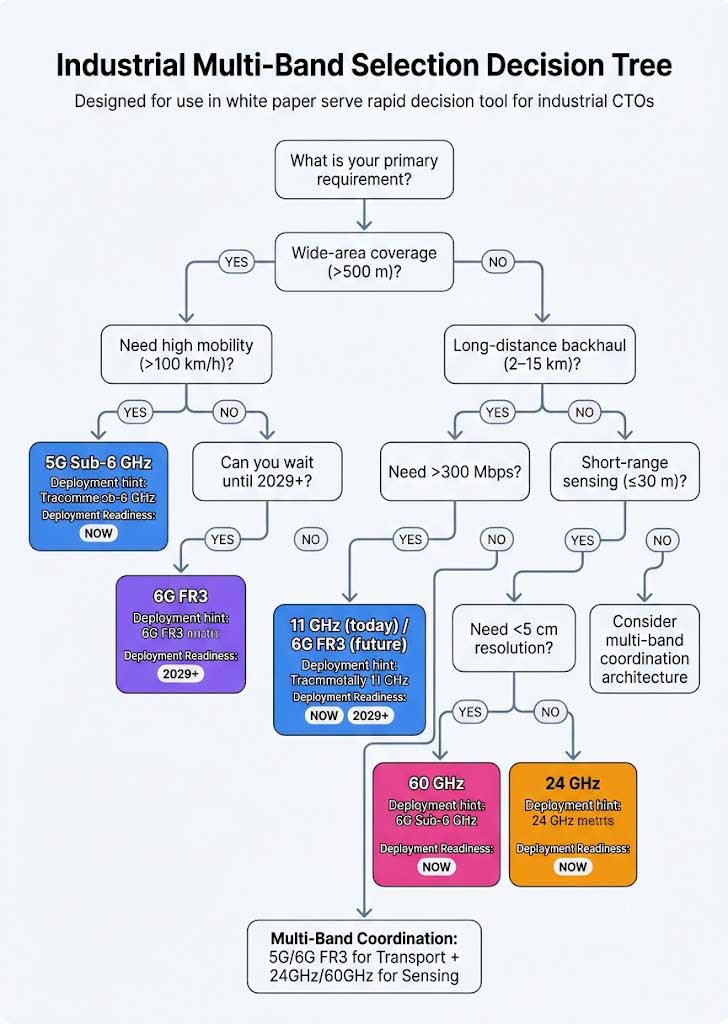
Figure 2: Industrial Multi-Band Selection Decision Tree — Start with your primary requirement and follow the decision path to identify the optimal band(s). Band nodes include deployment readiness badges (“NOW” vs “2029+”) to support near-term and long-term planning.
Quick Selection Reference Table
| Primary Requirement | Recommended Band(s) | Key Trade-off |
|---|---|---|
| Wide-area coverage (>500 m radius) | 5G Sub-6 GHz, 6G FR3 (future) | Bandwidth vs. coverage |
| High mobility (>100 km/h) | 5G Sub-6 GHz | Only 5G supports seamless handover at high speed |
| Long-distance backhaul (5–15 km) | 11 GHz (today), 6G FR3 (future) | Ecosystem maturity vs. performance |
| Short-range presence (≤30 m) | 24 GHz | Resolution vs. cost |
| Precision <5 cm resolution | 60 GHz | Coverage vs. precision |
| Privacy-sensitive sensing | 24 GHz, 60 GHz | No camera-based option acceptable |
| Deployable today (2025–2028) | 5G, 24 GHz, 60 GHz, 11 GHz | All commercially available |
| Future-proof (2029+) | 6G FR3 | Wait for standardization |
Engineering Constraints and Selection Principles
Successful industrial wireless deployment depends on three engineering constraints that must be resolved in sequence: power and deployment density, environmental interference control, and lifecycle technology refresh planning.
Constraint 1: Power and Deployment Density. The total cost of sensor node deployment is linearly related to the number of nodes, and the number of nodes is determined by band characteristics. For example, a 50,000 m² logistics warehouse: using 24 GHz presence sensors (15 m radius coverage) requires approximately 70 sensors; using 60 GHz sensors (5–10 m radius) would require 150+ sensors, more than doubling installation cost and network complexity. In many cases, the higher-resolution band imposes a deployment density penalty that outweighs its sensing benefit.
Constraint 2: Environmental Interference Control. Industrial wireless systems operate in electromagnetically complex environments. Electrical machinery generates broadband impulse noise, metal structures cause strong multipath fading, and rotating equipment produces Doppler clutter. Band selection must account for these factors:
– 5G’s OFDMA and HARQ mechanisms provide inherent resilience to bursty interference.
– 24 GHz and 60 GHz FMCW can isolate targets through range-Doppler processing.
– 11 GHz and FR3 are susceptible to rain fade at extreme distances, but in industrial settings (typically <15 km) this is negligible with proper link budget margins.
Constraint 3: Lifecycle Technology Refresh Planning. Industrial infrastructure is typically designed for 7–15 years of operation. Band selection must consider long-term technology evolution:
– 5G is the safe choice for 2025–2030 private networks, but may need augmentation by 6G FR3 for higher bandwidth by 2032+.
– 11 GHz is a transitional band — plan for migration to 6G FR3 around 2030–2032.
– 24 GHz and 60 GHz radar bands are stable and unlikely to be disrupted by cellular technology evolution.
Selection Principle: The Golden Ratio of Industrial Wireless. The most cost-effective solution for most industrial deployments follows a “two-tier” architecture: use 5G Sub-6 GHz (and future 6G FR3) for the backbone coverage and backhaul layer, and deploy 24 GHz / 60 GHz as the sensor layer to fill in fine-grained sensing requirements. This layered approach minimizes total cost of ownership while maximizing coverage, capacity, and sensing coverage.
Typical Two-Tier Industrial Deployment Model:
- Tier 1 — Transport Layer: 5G/6G FR3 private network, covering the entire site with macro/micro cells. Responsible for AGV scheduling, IoT data aggregation, video surveillance, and personnel communication.
- Tier 2 — Sensor Layer: 24 GHz/60 GHz radar nodes, deployed in specific sensing zones. Responsible for precise presence detection, tank level monitoring, safety zone protection, and people counting.
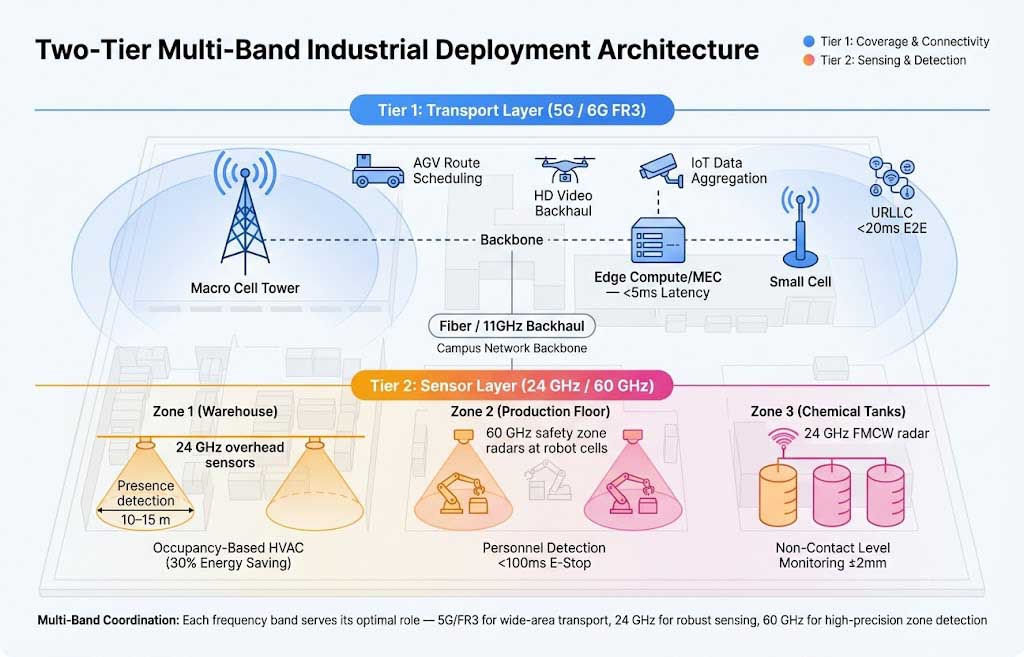
Figure 3: Two-Tier Multi-Band Industrial Deployment Architecture — Tier 1 (blue) uses 5G Sub-6 GHz and future 6G FR3 for wide-area transport and connectivity. Tier 2 (orange) uses 24 GHz and 60 GHz radar for zone-specific sensing. This layered approach minimizes TCO while maximizing both coverage breadth and sensing precision.
Frequently Asked Questions
Q1: Which frequency band is recommended for an industrial private network deployment between 2025 and 2030?
5G Sub-6 GHz (n77/n78 at 3.5–4.9 GHz) is the commercially proven choice for industrial private networks in the 2025–2030 timeframe. It delivers URLLC capabilities with E2E latency as low as 5–10 ms under optimal conditions and guaranteed reliability of 99.999% for compliant deployments, validated across dozens of production-scale installations in automotive, chemical, and logistics verticals.
The 5G NR-U (unlicensed / shared spectrum) variant further expands applicability by operating in the 5.925–7.125 GHz band under 3GPP Release 16/17, enabling private network deployments without dedicated licensed spectrum — at the cost of potential interference from neighboring networks. Band n102 (5.925–6.425 GHz) is the most widely adopted NR-U band for industrial trial deployments as of 2026.
For greenfield deployments requiring deterministic scheduling and wide-area coverage today, 5G in licensed or shared spectrum remains the only practically deployable option. 6G FR3 (7–24 GHz) standardization is still in the 3GPP Release 19 study phase (2025–2026), with commercial equipment not expected before 2029–2031.
Q2: When will 6G FR3 (7–24 GHz) equipment reach commercial availability?
6G FR3 baseband silicon and RF front-end modules are projected for commercial availability between 2029 and 2031, contingent on 3GPP Release 20 standardization completion. The current 3GPP roadmap positions FR3 studies in Release 19 (2025–2026), specification development in Release 20 (2027–2028), and early commercial prototype evaluation in 2028–2029.
Field validation programs are already underway: SoftBank and Nokia demonstrated 7 GHz (FR3 candidate) coverage in the Ginza district of Tokyo, achieving a median SINR of 5.9 dB in dense urban environments. Etisalat and NYUAD conducted 7–24 GHz channel sounding campaigns across diverse industrial scenarios in the UAE. WRC-23 further allocated multiple mid-band candidates (7–24 GHz) for IMT identification.
Key hardware challenges remaining: Wideband PA linearity across 7–24 GHz ( >40% fractional bandwidth), multi-band antenna array integration with shared aperture design, and commercial-grade SiGe or CMOS beamforming front-ends capable of supporting 256-element massive MIMO configurations at these frequency ranges. These engineering hurdles are the primary gating factors for the 2029–2031 timeline.
Recommended industrial migration strategy:
- 2025–2028: Deploy 5G Sub-6 GHz as primary backbone; use 11 GHz licensed links for high-capacity backhaul where fiber trenching is infeasible
- 2029–2031: Initiate FR3 pilot deployments in production environments; validate coexistence with existing 5G infrastructure
- 2032+: Migrate wide-area backbone to FR3 where spectrum is available; relegate 5G to legacy and failover duty
Q3: Can 60 GHz FMCW radar functionally replace optical cameras for indoor people counting and occupancy detection?
60 GHz radar can serve as a drop-in replacement for cameras in scenarios requiring cm-level spatial resolution, privacy compliance (GDPR/CCAA), and environmental robustness (dust, low light), but it is not a functional superset of camera-based vision systems. A 60 GHz FMCW radar with 4 GHz modulation bandwidth achieves a range resolution of ΔR = c/(2B) ≈ 3.75 cm, enabling precise multi-person separation in crowded environments. Reported detection accuracy exceeds 98% in controlled indoor environments at ranges up to 15–20 m with a single sensor.
Inherent limitations of radar-only sensing:
- No object classification: Radar cannot distinguish between a person, a cart, or a forklift based on amplitude alone — feature extraction from micro-Doppler signatures can classify gross motion types (walking vs. stationary vs. machinery), but fine-grained classification (person with tool vs. person without) remains an active research area.
- No biometric or identity information: Radar inherently discards facial features, gait signatures, and other personally identifiable information (PII), which is advantageous for privacy but precludes identity-based tracking or access control.
- Multi-static coordination complexity: Achieving consistent coverage across large indoor spaces ( >500 m²) requires careful sensor placement to avoid occlusion zones and multipath nulls — each additional node introduces interference management overhead.
Optimal deployment pattern: 60 GHz radar for continuous occupancy detection and presence-triggered building automation (HVAC, lighting, safety interlocks), with cameras retained exclusively for forensic event verification post-trigger. This hybrid approach minimizes both privacy risk and storage bandwidth while maintaining operational visibility.
Q4: Which frequency band yields the lowest total cost of ownership across deployment scale and sensing modality?
TCO is not band-dependent but scenario-dependent. The dominant cost driver varies by deployment layer:
- Wide-area private network (factory or campus >100,000 m²): 5G Sub-6 GHz consistently achieves the lowest TCO per square meter. The key cost advantage is deployment density — a single 5G small cell covers 200–500 m indoors, versus 15–30 m for Wi-Fi 6/6E APs and 8–15 m for 60 GHz WiGig APs at equivalent throughput. For a 50,000 m² facility, 5G requires approximately 20–30 cells vs. 150–300 Wi-Fi 6 APs, translating to 40–60% lower total infrastructure CAPEX. Turnkey 5G private network CAPEX is in the range of $50K–$200K depending on coverage, capacity, and core network deployment model (on-premise vs. MEC cloud).
- Distributed sensor network (50–500 sensing nodes): 24 GHz ISM-band radar modules carry the lowest per-node hardware cost at $10–$25 (FMCW single-chip transceiver in production volume). 60 GHz modules are priced at 2–3× premium ($25–$60 per module) due to more stringent RF packaging requirements and limited production volume. However, 60 GHz achieves 5–10× finer range resolution (3.75 cm vs. ~60 cm at 250 MHz bandwidth), which may eliminate the need for multiple 24 GHz sensors in high-resolution detection zones, partially offsetting the per-module premium.
- Point-to-point backhaul (single link 1–15 km): Licensed 11 GHz links carry a one-time CAPEX of $10K–$30K per link pair (including antennas and installation) and a recurring annual license fee ($200–$800 per link per year). This compares favorably to fiber trenching at $100K–$500K/km in industrial terrain. Unlicensed 60 GHz (802.11ay / 802.11ad) backhaul eliminates license fees but is operationally limited to links under 500 m and subject to rain fade margins exceeding 20 dB/km in heavy precipitation.
TCO optimization rule of thumb: For connectivity-dominant deployments, prioritize deployment density (bands with larger cell radius). For sensing-dominant deployments, prioritize range resolution per dollar (resolution per unit bandwidth per node cost). These two metrics rarely converge on the same band.
Q5: Which frequency band is optimal for outdoor perimeter security sensing under all-weather conditions?
24 GHz ISM-band FMCW radar is the most practical and proven solution for outdoor perimeter security sensing as of 2026. A single 24 GHz radar sensor operating at 24.0–24.25 GHz can cover a 180° sector at 30–50 m detection range under rain, fog, dust, and complete darkness, with a range resolution of approximately 60 cm (limited by the 250 MHz maximum bandwidth in the ISM band). Multi-target tracking capacity is typically 32–64 simultaneous tracks per sensor, sufficient for most industrial perimeter monitoring requirements.
Why competing bands underperform for this use case:
- 60 GHz: Atmospheric attenuation peaks at 16 dB/km (O₂ resonance line at 60 GHz) under clear conditions, and rain fade adds an additional 10–20 dB/km at moderate rainfall rates (12.5 mm/h, ITU-R P.838-3). This limits reliable outdoor detection to 5–15 m in clear weather and under 10 m in rain — insufficient for perimeter-scale coverage. Short-range tripwire applications (3–10 m) are feasible but do not replace wide-area perimeter sensing.
- 5G cellular sensing: 3GPP Release 18 introduced positioning enhancements (sub-meter accuracy with carrier phase and multi-RTT), but true sensing — detection, classification, and tracking of non-UE objects via opportunistic illumination — is not standardized until Release 19 ISAC study items. No commercial 5G sensing solution for outdoor perimeter detection exists as of 2026.
- Optical / IR cameras (non-RF alternative): Provide superior classification capability (person vs. vehicle vs. animal) but fail under fog (visibility <50 m in heavy fog), direct sunlight glare, and complete darkness without supplemental IR illumination (which itself is range-limited to 20–50 m for thermal imaging). Radar complements cameras as an all-weather primary detection layer.
Recommended deployment architecture: 24 GHz radar fence as the primary all-weather detection layer (trigger on breach) + PTZ cameras for forensic zoom-in and classification (triggered by radar). This maintains 99%+ detection probability under all environmental conditions while keeping false alarm rates manageable through sensor fusion.
Conclusion
The industrial wireless ecosystem is not converging toward a single band, but rather toward a multi-band coordinated architecture. 5G anchors the foundational connectivity layer with a mature commercial ecosystem; 6G FR3 will unlock long-distance high-capacity backbone links after 2029; 11 GHz serves as a current transitional bridging band; 24 GHz provides rugged, cost-effective short-range sensing; and 60 GHz delivers the highest precision detection within its limited coverage envelope.
The core principle of industrial wireless selection is: identify your primary metric first, then let physics dictate your band choice. Wide-area coverage favors 5G Sub-6 GHz and future FR3. Long-distance backhaul relies on the propagation advantages of lower frequency bands. Short-range high-precision sensing demands the bandwidth of 60 GHz. No single band can satisfy all scenarios simultaneously, and attempting to do so will inevitably lead to costly over-engineering or performance trade-offs.
We recommend that industrial users adopt a “two-tier” deployment model:
- Tier 1 — Backbone Layer: 5G (today) or 6G FR3 (future) private network covering the entire site, responsible for wide-area connectivity, AGV scheduling, IoT data, and video backhaul. This layer prioritizes coverage breadth and deterministic scheduling.
- Tier 2 — Sensor Layer: 24 GHz (mainstream) and 60 GHz (high-precision) radar sensors deployed in specific functional zones to provide presence detection, level monitoring, people counting, and safety zone protection. This layer prioritizes sensing precision and environmental robustness.
This layered approach — rather than a single-band solution — minimizes total cost of ownership, maximizes deployment flexibility, and ensures the system can evolve naturally as 6G FR3 standards mature after 2029.
References
- 3GPP TR 38.901, “Study on channel model for frequencies from 0.5 to 100 GHz,” v17.0.0, 2024.
- ITU-R P.676-13, “Attenuation by atmospheric gases and related effects,” 2022.
- ITU-R P.838-3, “Specific attenuation model for rain for use in prediction methods,” 2005.
- S. Sun, T. S. Rappaport, et al., “Propagation Path Loss Models for 5G Urban Micro- and Macro-Cellular Scenarios,” IEEE Communications Surveys & Tutorials, 2019.
- A. Ghosh et al., “5G evolution: A view on 5G cellular technology beyond 3GPP release 15,” IEEE Access, 2019.
- Qualcomm, “5G NR-U and Industrial IoT,” White Paper, 2023.
- Nokia, “6G Spectrum for 2030 and Beyond,” White Paper, 2024.
- Etisalat × NYUAD, “Building the Fabric of 6G: Spectrum Frontiers and Enabling Technologies,” White Paper, 2025.
- SoftBank Corp., “7 GHz Band Field Trial Results in Ginza, Tokyo,” Press Release, July 8, 2025; November 19, 2025.
- IEEE 802.11ad-2012, “Enhancements for Very High Throughput in the 60 GHz Band.”
- IEEE 802.11ay-2020, “Enhanced Throughput for Operation in License-Exempt Bands Above 45 GHz.”
- NIST, “60 GHz Propagation Measurements in Building Materials,” Technical Note 2176, 2022.
- M. I. Skolnik, “Introduction to Radar Systems,” 3rd ed., McGraw-Hill, 2001.
- ITU-R M.2160, “Technical characteristics of ISM equipment operating in the band 24.0-24.25 GHz,” 2019.
- FCC Part 15.247, “Operation within the bands 902-928 MHz, 2400-2483.5 MHz, and 5725-5850 MHz.”
- ETSI EN 300 440, “Short Range Devices (SRD) — Radio equipment to be used in the 1 GHz to 40 GHz frequency range.”
- WRC-23 Agenda Item 1.2, “Identification of frequency bands for IMT in the range 7-24 GHz,” Final Acts, 2023.
- LigoWave, “6 GHz Oil & Gas Technical Solution,” Product Documentation, 2026.
- Dataintelo, “Industrial Grade Wireless Bridge Market Report,” 2026.
- 3GPP TR 22.837, “Study on Integrated Sensing and Communication (ISAC),” 2024.
Published by Zukaka Technology — Industrial Wireless Solutions


