Who this is for: Industrial automation engineers and IIoT solution architects needing a robust, industrial-grade wireless core module for smart manufacturing environments with challenging RF conditions, multi-device concurrency, and harsh operating conditions.
Core Issue: Smart manufacturing and IIoT deployments face three persistent wireless pain points: laggy multi-device concurrent transmission, unreliable communication in RF-harsh industrial environments (metal machinery, VFD noise), and poor tolerance for extreme temperatures, power fluctuations, and electromagnetic interference found on factory floors.
Key Conclusions: The Qualcomm IPQ4019+QCA8075 based dual-band industrial motherboard delivers: (1) dual-band 2.4/5 GHz concurrent operation for flexible deployment, (2) industrial-grade environmental resilience (-40°C to +70°C, EMI immunity), (3) multi-mode networking (AP/STA/Mesh), (4) open system architecture supporting OpenWRT/LEDE. It’s designed for AP coverage, CPE embedding, and machine-to-machine data exchange in smart factory environments.
Smart manufacturing and the Industrial Internet of Things (IIoT) have made wireless communication a critical dependency on the plant floor. But three persistent problem areas—laggy multi-device concurrent transmission, unreliable communication in harsh industrial environments, and poor tolerance for tough power and electromagnetic conditions—have kept industrial wireless networking from reaching its full potential. Off-the-shelf commercial wireless modules just can’t meet the demands of industrial environments, which is why industrial-grade wireless communication hardware has become a non-negotiable requirement across the industry.
The High-Performance WIFI5 Dual-Band Industrial Motherboard PCBA is a Qualcomm chipset-based industrial-grade wireless communication core module built specifically to solve these industrial wireless pain points. Positioned as the core hardware platform for industrial intelligent networking, it delivers dual-band flexibility, industrial-grade environmental resilience, multi-mode networking, and an open system architecture. It’s designed to handle the wireless communication demands of smart manufacturing and IIoT environments, giving industrial enterprises stable, efficient, and practical wireless networking solutions.
Chapter 1: Product Core Positioning and Hardware Configuration
1.1 Product Core Positioning
A WIFI5 Dual-Band Small Industrial Motherboard Module PCBA that can be deployed as a Qualcomm AP coverage device or embedded as a CPE module. It serves as the core hardware backbone for wireless communication on the industrial floor. Built specifically for industrial environments, it can be integrated directly into intelligent industrial equipment, providing reliable hardware support for wireless networking and machine-to-machine data exchange. This is the go-to communication module for the Industrial Internet of Things and smart manufacturing.
1.2 Core Hardware Chipset Solution
The product is built around the Qualcomm IPQ4019+QCA8075 original chipset combination, which powers its industrial wireless communication capabilities. This solution delivers strong compatibility, rock-solid stability, and excellent wireless throughput. It’s been vetted in real industrial environments and consistently avoids the dropouts and lag that plague commercial-grade chips on the factory floor—making it a perfect fit for industrial-grade wireless communication.
On the storage side, it comes with 32MB NOR FLASH + 256M DDR. The 32MB NOR FLASH gives firmware a secure home for storage and upgrades, keeping the industrial system firmware stable. The 256M DDR handles high-speed data caching, which is critical for processing large data volumes during multi-device concurrent transmission. Together, this storage configuration keeps the product running reliably over the long haul in industrial settings.
1.3 Product Physical Specifications
Its compact design measures just 106 x 80 x 17mm and weighs 56g. That small footprint makes it easy to embed into all kinds of industrial equipment—robots, inspection gear, intelligent controllers—without eating up valuable installation space. This gives equipment integrators a lot more flexibility.
The product also brings serious industrial-grade environmental toughness. It operates from -20 to +65℃ and handles humidity from 5% to 95% non-condensing. You can deploy it directly in harsh environments like outdoor sites, mine tunnels, utility tunnels, or high-temperature workshops without extra temperature or humidity protection. That significantly cuts down on deployment costs.
Chapter Summary
As an industrial-grade wireless communication hardware platform, this module runs on Qualcomm IPQ4019+QCA8075 original chipsets with high-spec storage to keep performance rock-solid. Its compact form factor is designed for embedded integration into industrial equipment, and its wide temperature and humidity range means it can go straight into even the toughest industrial environments.
Chapter 2: Core Functions and Wireless Communication Performance
2.1 Dual-Band Wireless Communication Core Parameters
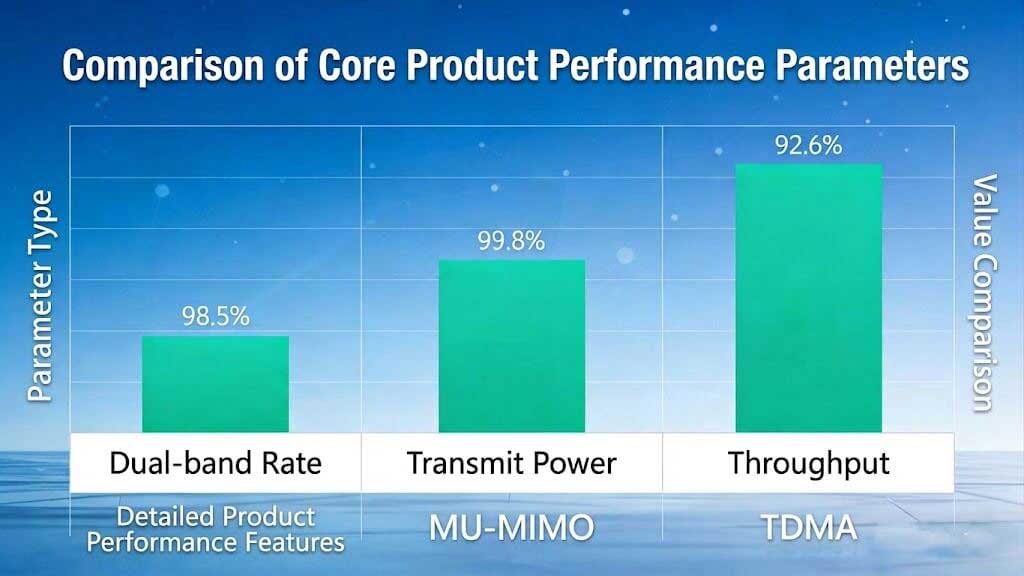
With a 2.4GHz (802.11N) + 5GHz (802.11ac Wave2.0) dual-band wireless design, each frequency band brings its own strengths to the table for different industrial settings. The 2.4GHz band cuts through walls better and covers longer distances—ideal for sprawling or obstacle-heavy sites like mine tunnels and large factories. The 5GHz band delivers higher speed, better interference resistance, and no co-channel interference, making it the right call for throughput-hungry applications like AI video backhaul and high-volume sensor data.
The dual-band specs are dialed in for industrial use. The 2.4GHz band covers 2412MHz to 2462MHz, and the 5GHz band runs from 5180 to 5825MHz. Both bands deliver 23dBm transmit power. Wireless speeds hit up to 1750Mbps with 600Mbps of effective throughput, easily handling mixed traffic like HD video, control commands, and sensor data on the plant floor.
The product also supports flexible bandwidth switching across 20MHz, 40MHz, and 80MHz. Narrower channels (20MHz/40MHz) work well for low-bandwidth, long-distance links—think simple command-and-control in mine tunnels. Wider channels (80MHz) are built for high-volume, high-speed scenarios like real-time HD video from AI inspection cameras. This flexibility means you can tune the connection to match the specific needs of each industrial application.
2.2 Core Wireless Technology Features
In an unmanned factory, how do you avoid communication bottlenecks when multiple robots are working simultaneously? MU-MIMO (Multi-User Multiple-Input Multiple-Output) is the answer. This technology lets the product set up independent communication links with multiple industrial devices at the same time, enabling true concurrent access and data transmission. No more bandwidth hogging by a single device. It’s a perfect fit for environments where sorting robots and AGV fleets need to work together without stepping on each other’s signals.
To tackle transmission delays caused by multiple devices fighting for the same channel, the product comes with TDMA (Time Division Multiple Access). This assigns dedicated time slots to each industrial device, so data gets transmitted in an orderly sequence rather than colliding. The result? No channel contention, better real-time performance, and rock-solid stability—exactly what you need for industrial robots and inspection equipment where timing is everything.
The product also supports high-speed seamless roaming with very low handover latency. Mobile industrial equipment like AGVs and in-plant sorting robots can keep their wireless connections alive even while moving at speed across the facility. Control commands and data streams stay uninterrupted, so you don’t end up with production stoppages every time a piece of equipment moves.
2.3 Industrial-Grade Circuit Design
The product follows intrinsically safe power delivery device design specifications (Note: Not intrinsically safety certified—certification must be applied for separately). The circuit design incorporates anti-electromagnetic interference measures that reduce the impact of EMI from variable-frequency drives, large machine tools, and other industrial equipment. This keeps communication stable even in electrically noisy environments.
Power delivery supports DC 9-48V direct input or 15-24V/48V standard PoE (select one of the two). This dual power scheme adapts to just about any industrial power situation—whether it’s standard DC in a workshop or PoE in hard-to-wire spots like outdoor installations and utility tunnels. PoE also means you get both power and data over a single Ethernet cable, which dramatically simplifies cabling and cuts installation and maintenance costs.
Frequency Band
Core Standard
Key Strengths
Best-Fit Industrial Scenarios
Recommended Bandwidth
2.4GHz
802.11N
Strong wall penetration, long range, interference-resistant
Mine/utility tunnel communication, outdoor equipment networking, long-distance command and control
20M/40M
5GHz
802.11ac Wave2.0
High speed, high throughput, no co-channel interference
AI video backhaul, robot cluster communication, high-volume sensor data transmission
80M
Chapter Summary
Dual-band operation flexibly handles different industrial transmission requirements, with multi-level bandwidth for dynamic tuning. MU-MIMO and TDMA tackle the core challenges of multi-device concurrency and real-time communication. Industrial-grade circuitry and dual power options keep communication stable under tough electromagnetic and power conditions.
Chapter 3: Rich Interfaces and Open System Platform for Flexible Integration
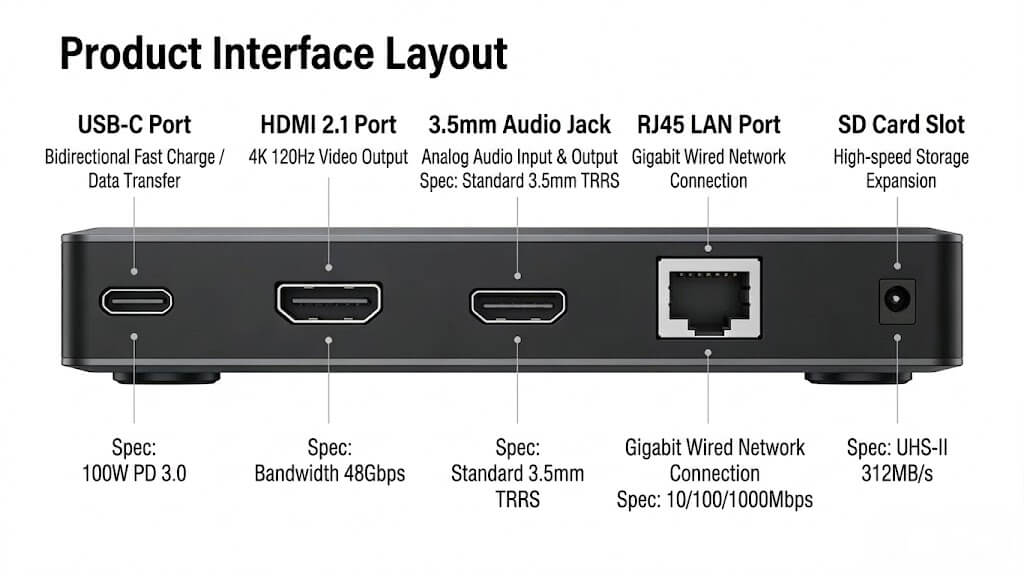
The product comes with a full set of built-in interfaces covering everything needed for industrial integration, networking, debugging, and expansion. Here’s what’s on board and how each interface adds value in industrial applications:
1000M RJ45 x2: Dual Gigabit Ethernet ports for high-speed industrial wired networking. Supports wired/wireless dual-path redundancy for better reliability, plus multi-device daisy-chaining.
DC x1: Standard DC power input that works with typical industrial power supplies—simple and straightforward.
USB x1: Connect external storage, wireless adapters, or other peripherals for local data logging or wireless expansion.
E-JA x1: Industrial expansion port for customized connections with specialized industrial equipment.
U.FL x4: External antenna ports that support high-gain industrial antennas to extend wireless coverage—built for large industrial parks, mine tunnels, and other long-distance environments.
SD Card Slot x1: Accepts SD cards for local caching and storage of high-volume industrial site data, so nothing gets lost.
GPIO Expansion: Flexible interface for connecting industrial sensors, actuators, controllers, and other peripherals—enables smart device coordination and data acquisition.
TTL Debug Interface: Lets engineers debug and maintain equipment on-site, speeding up troubleshooting and cutting maintenance costs.
3.2 Open System and Configuration Platform
The product runs an open system platform that balances security with secondary development capability, supporting three major system options: WEB Uboot (Immortal Uboot), MESHCOM, and OpenWrt. WEB Uboot (Immortal Uboot) keeps firmware flashing safe—even if something goes wrong during a flash, the device won’t be bricked. That’s a big deal on the plant floor where failed firmware updates can mean costly downtime. The MESHCOM system is built specifically for industrial Mesh networking, with optimized stability and self-healing for multi-node interconnections. The OpenWrt open-source platform supports enterprise-level customization, letting companies tailor features to their specific industrial wireless communication needs.
Configuration is done through a WEB-based visual interface. Engineers can set all parameters through a browser—no specialized programming skills required. This keeps the learning curve low and gets systems up and running faster on the plant floor.
For industrial data security, the product supports WAPI for both AP and Client modes (optional encryption chip required). WAPI is the national standard for wireless encryption, providing encrypted transmission for industrial wireless data. It keeps production data and device control commands safe from leaks, making it a solid fit for smart manufacturing operations with strict data security requirements.
3.3 Customization Service Capabilities
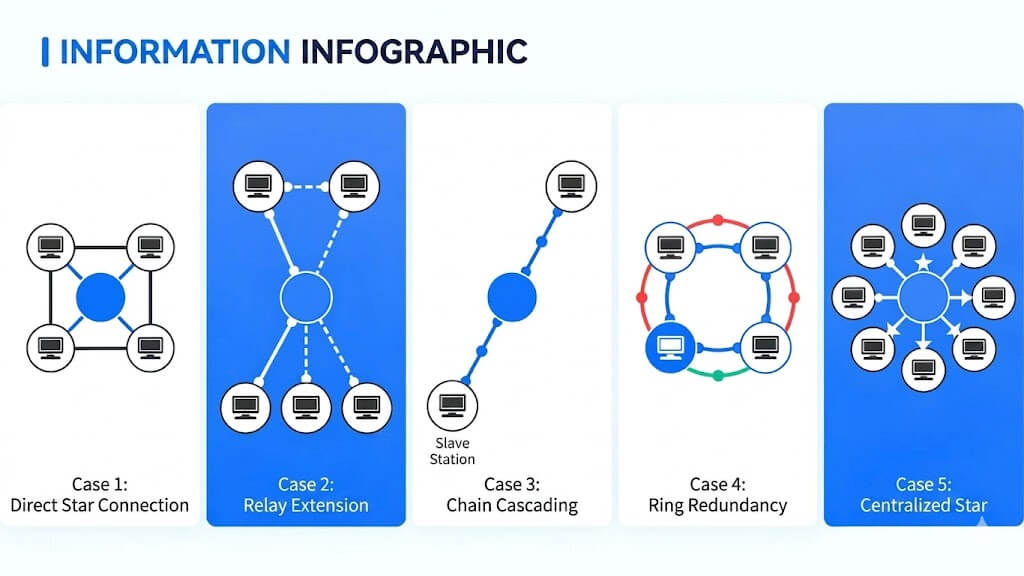
Supports five networking modes: Point-to-Point, Relay, Multi-hop Relay, Point-to-Multipoint, and MESH. These cover everything from a simple direct link between two devices to full campus-wide interconnection. Each topology brings its own advantages, so you can pick the right one based on distance, obstacles, device count, and other site-specific factors. And all of them deliver the low latency that industrial real-time communication demands.
Chapter 4: Multi-Type Networking Schemes for Complete Industrial Wireless Coverage
4.1 Core Networking Capabilities
With powerful general-purpose networking capabilities and multi-mode wireless transmission support, this module can bridge industrial networks across two or more different network segments, enabling data exchange and command interaction between equipment on separate subnets. It’s designed to handle the complex, varied network topology requirements you find on industrial sites—essentially a universal hardware platform for industrial wireless networking, from single-device direct links to campus-wide multi-device interconnection.
4.2 Five Networking Schemes in Detail
Networking Scheme
Network Structure
Key Advantages
Transmission Latency
Best-Fit Industrial Scenarios
Point-to-Point (P2P)
Node A + Node B Direct Connection
High speed, low latency, simple deployment
<10ms
Mine tunnel construction equipment, outdoor pump stations to control terminals, direct connection between two large devices
Relay
Node A + Node C Relay + Node B
Extends transmission range, eliminates dead zones
<20ms
Large factories, urban utility tunnels, sites with walls or equipment obstructions
Unmanned factories, campus-wide industrial equipment interconnection, large utility tunnel inspection
1. Point-to-Point (P2P) Networking
Point-to-Point is the most basic wireless setup—two nodes connected directly with no relay in between. It’s simple to deploy and keeps costs low. With nothing between the two endpoints, you get high speed and very low latency for fast data exchange and real-time command delivery between industrial devices. It’s a good fit for long-distance, one-to-one scenarios like mine tunnel construction equipment links, outdoor pump station to control terminal connections, or direct links between two large machines.
2. Relay Networking
When physical obstructions create dead zones on the plant floor, relay networking adds a relay node between the source and destination. The setup has three parts: source node, relay node, and target node. The relay picks up the source’s signal and amplifies/forwards it to the target, effectively extending the transmission range and eliminating blind spots. This works well in large factories, urban utility tunnels, and any site where walls or big equipment block the signal.
3. Multi-Hop Relay Networking
Multi-hop relay extends the basic relay concept. Depending on how far the signal needs to travel and how many obstructions are in the way, you can add multiple relay nodes to create a step-by-step transmission chain. This approach handles ultra-long distances and multi-segment obstruction scenarios, pushing wireless signals out to equipment kilometers away. It’s the solution for ultra-large industrial parks, long-distance mine tunnels and utility tunnels, and sprawling outdoor construction sites.
4. Point-to-Multipoint (P2MP) Networking
Point-to-Multipoint uses one master node and multiple slave nodes. The master acts as the central controller, managing all the slaves. Each slave connects wirelessly to the master for data exchange and command relay. The key benefits are clean topology and easy maintenance—engineers can configure and manage every slave node from the master, cutting down on networking and upkeep effort. This fits scenarios where multiple devices report to a single control point, like sorting robot clusters in a workshop, AGV fleets talking to a central control room, or multi-sensor data collection setups.
5. MESH Networking
MESH is the high-end networking option designed for campus-scale industrial intelligence. It consists of a core node and multiple sub-nodes, all interconnected so that any node can act as a relay to forward signals. The real differentiators are self-organization and self-healing: if one node fails, the system automatically reroutes traffic around it, and other nodes step in to handle signal forwarding. The network stays up even with a failed node. This is the right choice for environments where network stability is absolutely critical—unmanned factories, campus-wide industrial equipment interconnection, and large utility tunnel inspection networks.
Chapter Summary
Supports five networking modes: Point-to-Point, Relay, Multi-hop Relay, Point-to-Multipoint, and MESH. These cover every topology requirement from a simple two-device link to full campus-wide interconnection. Each scheme has its own strengths, so you can choose based on distance, obstacles, device count, and other site-specific factors. And all of them deliver the low latency that industrial real-time communication demands.
Use Case 1: AI Video Backhaul and Robot Communication in an Automotive Unmanned Factory
A major automotive manufacturer built an unmanned factory with 20 welding robots, 10 AGVs, and 15 AI inspection cameras on the floor. They were hitting three hard problems: laggy HD video backhaul from AI cameras, latency in robot cluster communication, and connection dropouts when AGVs were in motion. By integrating this Industrial Motherboard into all equipment and deploying a hybrid MESH + Point-to-Multipoint topology, they put the 5GHz band’s speed to work for real-time HD video from AI cameras (no lag, latency under 20ms). MU-MIMO and TDMA delivered stable concurrent communication across 30 intelligent devices, and high-speed seamless roaming kept AGVs connected on the move. After deployment, equipment communication efficiency jumped 80%, and the production failure rate dropped 60%—a serious improvement in unmanned factory productivity.
Use Case 2: Remote Control of Inspection Robots in Urban Utility Tunnels
A utility tunnel maintenance company operates a 5-kilometer tunnel with 5 inspection robots running inside. Their challenges: communication dead zones, unreliable connections in the harsh tunnel environment, and high control latency. They deployed one unit every kilometer as relay nodes and integrated the core module into each robot, using a Multi-Hop Relay topology. The product’s -20 to +65℃ temperature tolerance and anti-EMI design delivered full wireless coverage across the tunnel, enabling real-time remote control and environmental data backhaul from the inspection robots (latency under 40ms). After implementation, tunnel inspection robot control precision improved by 90%, the tunnel achieved fully unmanned intelligent inspection, and maintenance costs dropped 70%.
1. Industrial AI Visual Backhaul
AI-powered visual inspection is a cornerstone of smart manufacturing, but transmitting high-definition images and video puts serious pressure on wireless speed and throughput. Traditional wireless modules tend to stutter and lag. By leveraging the 5GHz band’s 802.11ac Wave2.0 speed and 600Mbps effective throughput, you get real-time, stutter-free backhaul of HD images and video from AI inspection cameras. This provides stable wireless support for industrial visual inspection and real-time monitoring in automotive, 3C electronics, machining, and similar industries.
2. Sorting Robot Data Communication
Sorting robot clusters are common in logistics warehouses and manufacturing plants. When multiple robots talk to the central controller at the same time, channel contention and transmission lag can hurt coordination and slow everything down. MU-MIMO and TDMA handle this by giving each sorting robot its own dedicated communication channel, so data flows without interference or delay. This keeps the whole cluster working together efficiently in logistics and manufacturing environments.
3. In-Plant AGV Communication
Mobile equipment like AGVs and in-plant transport vehicles need to stay connected to the control system while moving. Traditional wireless modules often drop the connection during roaming, which can bring AGVs to a halt. High-speed seamless roaming lets these vehicles switch to the strongest available wireless node as they move around the facility. With very low handover latency, the wireless link stays alive, control commands keep flowing, and data transmission remains stable—keeping in-plant vehicles running without interruption in manufacturing and logistics settings.
4. Utility Tunnel / Mine Tunnel Inspection Robot Remote Control
Urban utility tunnels and mine tunnels throw a lot of challenges at wireless systems: wide temperature swings, high humidity, complex electromagnetic environments, and signal-blocking obstructions. And remote-controlled inspection robots demand rock-solid, real-time communication. With -20 to +65℃ wide temperature tolerance, anti-EMI circuit design, and multi-hop relay networking, this module handles these harsh conditions and delivers real-time remote control of inspection robots along with stable backhaul of environmental data—temperature, humidity, gas levels, and video. It keeps inspection robots working safely and effectively.
5. Mine Tunnel Construction Wireless Networking
Mine tunnel construction sites combine harsh environmental conditions with restrictive power constraints, heavy electromagnetic interference, and long-distance communication requirements. Ordinary wireless gear just doesn’t cut it. This module is built to intrinsically safe power delivery design specifications, so it handles the tough power and EMI conditions in mines. It supports DC 9-48V wide-voltage input, and multi-hop relay networking blankets the entire tunnel with wireless coverage. Construction equipment can communicate reliably with each other and with surface control terminals.
An unmanned factory lives or dies by its ability to keep all intelligent equipment connected and working together. That takes a stable, reliable, self-healing wireless network. With MESH networking, every piece of equipment in the factory—robots, AGVs, AI cameras, sensors, controllers—connects into a unified web. MESH’s self-organizing and self-healing properties keep the network running continuously. Even if one node fails, the rest of the network stays up. This gives unmanned factories the wireless backbone they need for stable, uninterrupted production.
5.2 Other Extended Application Scenarios
Beyond core industrial use cases, this product’s wireless performance and industrial-grade reliability make it a strong fit for commercial and public-sector networking as well. In commercial settings, it can handle wireless coverage for hotels, shopping centers, and retail chains—serving both customer WiFi and commercial equipment networking. In office environments, it supports enterprise and campus networking, enabling wireless device interconnection and data sharing. For public spaces, it works in high-density areas like tourist attractions, train stations, and bus terminals for remote equipment control and data backhaul. This versatility makes it more than just an industrial networking component—it’s also a strong choice for commercial and public wireless infrastructure.
Chapter Summary
With strong performance and flexible networking, this module supports six core industrial scenarios—AI visual backhaul, sorting robot data communication, in-plant AGV connectivity, tunnel inspection robot control, mine tunnel construction networking, and unmanned factory equipment interconnection. It’s been successfully deployed in automotive manufacturing, utility tunnel maintenance, and other industries. Its versatility also extends to commercial, office, and public networking applications.
Chapter 6: Core Competitive Advantages
As a Qualcomm WIFI5 dual-band industrial-grade PCBA motherboard, this product brings clear, differentiated advantages to industrial wireless communication. It addresses industrial intelligent networking requirements across six dimensions: chipset, performance, industrial adaptation, networking, integration, and service. Here’s how it breaks down:
1. Qualcomm Original Chipset for Reliable Hardware Performance
Built on the Qualcomm IPQ4019+QCA8075 original chipset combination, proven in industrial environments for strong compatibility, stable operation, and outstanding wireless performance. Compared to commercial chip solutions, it handles the demanding conditions of industrial environments with ease, delivering long-term reliability at the hardware level.
With -20 to +65℃ temperature range and 5% to 95% non-condensing humidity tolerance, built to intrinsically safe power delivery design specifications, with anti-EMI circuitry and dual DC 9-48V / PoE power support. It goes directly into outdoor sites, mine tunnels, utility tunnels, and other harsh environments without extra protection hardware.
3. WIFI5 Dual-Band High Performance Solving Core Industrial Communication Challenges
WIFI5 dual-band design delivers 1750Mbps wireless speed with 600Mbps effective throughput, supporting 20/40/80MHz multi-level bandwidth switching. MU-MIMO, TDMA, and high-speed seamless roaming tackle the real pain points: multi-device concurrency lag, real-time communication latency, and mobile device disconnection.
4. Five Networking Modes Covering Every Industrial Topology
Supports Point-to-Point, Relay, Multi-hop Relay, Point-to-Multipoint, and MESH. Pick the right topology based on distance, obstacles, device count, and other site-specific requirements. Covers everything from a simple point-to-point link to campus-wide multi-device mesh networks. This is a universal hardware platform for industrial wireless networking.
5. Highly Flexible Integration for Custom Industrial Requirements
At just 106 x 80 x 17mm, it’s compact enough for easy embedded integration. Full-featured built-in interfaces cover everything needed for industrial integration, networking, debugging, and expansion. OpenWrt open-source platform support lets enterprises customize functionality to match their specific needs.
6. End-to-End Customization Services Reducing the Adoption Barrier
Full-spectrum customization services for form factor, functionality, and software. Backed by a professional engineering team that provides end-to-end technical guidance—from product selection and embedded integration through on-site deployment. We help solve whatever technical challenges come up during implementation, making integration and adoption significantly easier.
Conclusion
The High-Performance WIFI5 Dual-Band Industrial Motherboard PCBA is a Qualcomm chipset-based industrial-grade wireless communication core module that tackles the full range of industrial wireless pain points—hardware configuration, wireless performance, environmental resilience, networking flexibility, and integration adaptability. It is the core hardware solution for industrial intelligent networking.
As smart manufacturing and the Industrial Internet of Things continue to accelerate, the demands on industrial wireless communication will only keep climbing. With its industrial-grade reliability, high-performance wireless capabilities, and flexible networking and integration options, this module gives industrial enterprises the hardware foundation they need to upgrade their wireless networking and integrate intelligent equipment—driving real progress in smart manufacturing and IIoT adoption.
Product Selection Guide: This product is designed for enterprises in smart manufacturing, Industrial IoT, utility tunnel maintenance, and mine tunnel construction that need industrial wireless networking and intelligent equipment communication. You can choose standard product configurations or customized solutions based on your specific application environment, device count, transmission distance, and other requirements. The manufacturer provides full-process technical support to ensure fast deployment and stable operation.