Key Overview
Who this is for: Hardware engineers and product managers evaluating WiFi 6 (802.11ax) wireless bridge PCBA mainboards for long-range PTP/PTMP applications in security surveillance, campus networking, industrial IoT, and outdoor coverage.
Core Issue: Running cable is impractical in many situations — difficult terrain, high cost, long construction timelines. The PCBA mainboard inside a wireless bridge determines everything: range, throughput, reliability, and environmental adaptability. Buyers need to understand the core technology, performance drivers, and OEM customization options before making design decisions.
Key Conclusions: This WiFi 6 11ax series wireless bridge PCBA is built on IEEE 802.11a/n/ac/ax standards as a customizable core board (not a finished product). OEM customization covers: hardware interfaces, software features, frequency bands, and power levels. Performance targets: MU-MIMO support for multi-client concurrency, OFDMA for reduced latency, 1024-QAM modulation for higher throughput, and backward compatibility with WiFi 5/4 clients. Paired with your choice of enclosure, antennas, and power supply, it provides a complete wireless bridge solution with dramatically reduced R&D time.
When it comes to long-range wireless communication, running cable just isnt practical in a lot of situations. Terrain, cost, and construction timelines get in the way, especially for security surveillance, campus networking, industrial IoT, and extending coverage in outdoor environments. A wireless bridge is really what makes long-distance data transmission possible, and how well it performs comes down to one thing: the PCBA mainboard inside. This article breaks down the WIFI6 11ax series wireless bridge PCBA mainboard from every angle. We cover the core technology, what drives performance, and where it fits in the real world. Youll also get a clear picture of our OEM customization process and full-scenario deployment options. Whether youre an engineer, a product manager, or handling procurement, this walkthrough will help you understand exactly what makes this PCBA board the central piece of any wireless communication link.
1. Introduction: Why the PCBA Mainboard Is the Heart of a Wireless Bridge
A wireless bridges main job is to handle Point-to-Point (PTP) and Point-to-Multipoint (PTMP) long-distance data transmission without the constraints of physical wiring. But that capability doesnt come from the enclosure or add-on components. It comes from whats inside: the PCBA mainboard. Think of it as the brain and central nervous system rolled into one. It manages RF transmission and reception, data processing, network interfaces, protocol handling, and basically everything that determines how far, how fast, and how reliably a wireless bridge performs.
The WIFI6 11ax series wireless bridge PCBA mainboard were covering here is purpose-built for high-performance long-range wireless communication. What sets it apart from off-the-shelf bridges is that its built for customization. With full OEM support, we can tailor it to fit whatever your industry or use case demands. From hardware design through software tuning, we partner with you to bring a wireless bridge product to market that aligns with your exact positioning.
Image Suggestion: High-level diagram of wireless communication link applications, with key use cases highlighted (outdoor security surveillance, campus building interconnectivity, industrial plant data transfer, mountain-area coverage). Arrows show data flow direction, reinforcing the idea of replacing wired connections with wireless. Caption: Figure 1 Core Application Scenarios for Wireless Bridge PCBA
2. Core Concepts: Understanding the WIFI6 11ax Wireless Bridge PCBA Mainboard
2.1 What It Is and Where It Fits
The WIFI6 11ax series wireless bridge PCBA mainboard is a high-performance communication board built on the IEEE 802.11a/n/ac/ax standards. Its designed to go inside wireless bridge equipment and handles the heavy lifting: wireless signal transmission and reception, data processing, link management, and network integration. In short, its the hardware foundation for any PTP or PTMP wireless link.
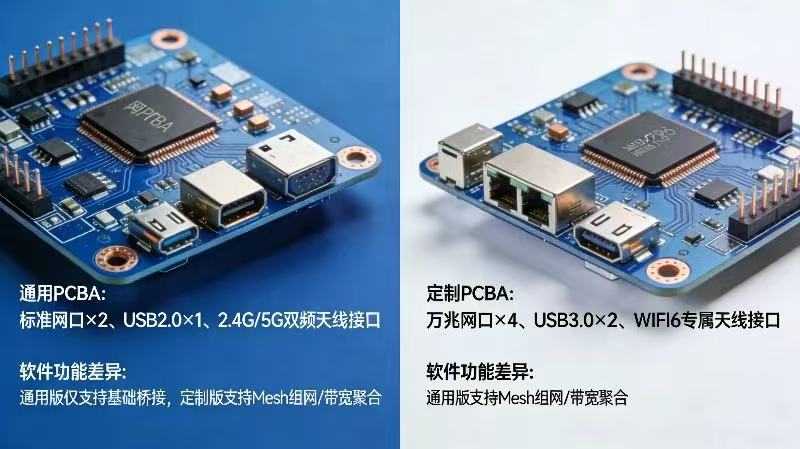
One important distinction: this isnt a finished wireless bridge you can just unbox and deploy. Its a customizable core board. Through our OEM services, you can tailor the hardware interfaces, software features, frequency bands, and more to match your specific needs. Pair it with your choice of enclosure, antennas, and other components, and you can quickly build a finished wireless bridge that meets your exact requirements. That approach dramatically cuts down R&D time and cost compared to building from scratch.
2.2 Core Functions: The Central Nervous System of Your Wireless Link
The PCBA mainboard plays four critical roles in a wireless communication link. Each one matters, and together they make it clear why this is far more than just a collection of components soldered onto a board:
- Signal Transmission and Reception: The integrated RF module handles sending and receiving wireless signals for long-range data transfer. The 5.1-5.8GHz version supports links up to 30km, while the 5.9-7.1GHz version is built for more specialized band requirements;
- Data Processing: A built-in dual-core processor handles data parsing and computation, supporting throughput up to 1.5Gbps. That means HD video streams and large industrial data sets move in real time without lag or latency issues;
- Network Integration: Dual Ethernet ports, including one 2.5Gbps and one gigabit port with PoE input and output support, let you connect directly to cameras, switches, servers, and other devices. Power and data travel over a single cable, making integration straightforward across different network setups;
- Management and Orchestration: The onboard software handles everything from routing and bridge mode switching to security protocols, spectrum analysis, and diagnostics. This keeps the wireless link stable and reduces the maintenance burden down the road.
2.3 How This Stands Apart from Traditional Bridge Boards
Compared to older WIFI5 and earlier generation bridge boards, the WIFI6 11ax series brings two big improvements: a genuine technology generational leap and real flexibility for customization. Heres how they stack up, and why this matters for the market:
| Comparison Dimension | Traditional Bridge Board | WIFI6 11ax Series Bridge PCBA |
|---|---|---|
| Wireless Standard | WIFI5 (802.11ac) and older | WIFI6 (802.11ax), backward compatible |
| Throughput | Up to 867Mbps | Up to 1.5Gbps (73% improvement) |
| Transmission Distance | Typically under 10km | Up to 30km (5.1-5.8GHz) |
| Modulation | 256-QAM | 1024-QAM (25% efficiency gain) |
| Channel Width | 80MHz | 160MHz (bandwidth doubles) |
| Multi-Device Concurrency | Poor (lag with multiple devices) | OFDMA, smooth concurrency |
| Power Consumption | Relatively high | TWT low-power optimization |
| Customization | Limited or none | Full OEM (hardware + software + band) |
Image Suggestion: 1. Front and back HD close-up photos of the PCBA board with key components labeled (dual-core processor, RF module, 2.5G port, MCX antenna interface, PoE interface). Caption: Figure 2 WIFI6 11ax Series Wireless Bridge PCBA Mainboard and Key Components; 2. Side-by-side comparison photo of this board vs. a traditional bridge board, highlighting differences in size and interface layout. Caption: Figure 3 WIFI6 11ax Board vs. Traditional Bridge Board
3. Deep Dive: Core Technology and Performance Specs That Define This PCBA
A wireless bridge PCBA is only as good as its technical foundation and specs. In this section, we look at three angles: the underlying technology, the key performance parameters, and how the modules come together. This should give you a clear understanding of how this board achieves 30km range and 1.5Gbps throughput, and more importantly, what that means in practice.
3.1 Core Technology: WIFI6 Makes Long-Range High-Speed Transmission Possible
The standout technological feature here is WIFI6 (802.11ax), combined with several high-performance transmission technologies that work together to create a stable, fast wireless link. Heres a breakdown that balances technical depth with practical understanding:
3.1.1 WIFI6 (802.11ax) Core Advantages
WIFI6 is the next step in wireless communication standards, and it brings real improvements over WIFI5 in four areas: higher throughput, lower latency, better support for multiple devices, and stronger interference resistance. All of these matter in long-range wireless applications:
- 1024-QAM Modulation: Compared to WIFI5s 256-QAM, this delivers 25% better modulation efficiency. With the same channel width, you get a meaningful boost in data rate, pushing single-stream speeds up to 1.2Gbps;
- 160MHz Channel Width: Support for up to 160MHz channels, double the 80MHz standard on older generations. That effectively doubles the data pipeline, which matters when youre moving HD video or large data sets;
- OFDMA (Orthogonal Frequency Division Multiple Access): By splitting a channel into smaller sub-channels, multiple devices can transmit simultaneously. This eliminates the lag and congestion youd normally see in multi-device setups, which is especially useful in PTMP deployments;
- TWT (Target Wake Time): Devices can go into sleep mode when theyre not actively transmitting. This reduces power consumption and cuts down on signal interference between devices, both of which are important for outdoor, low-power installations.
3.1.2 2×2 MIMO RF Technology
This board uses a 2×2 MIMO (Multiple-Input Multiple-Output) RF design with two transmitting and two receiving antennas. The result is higher data rates, wider coverage, and better resistance to interference.
Unlike a single-antenna setup, 2×2 MIMO uses spatial diversity to send two data streams at the same time. That doubles the throughput and helps combat signal fading and interference. In outdoor long-range scenarios, where terrain and electromagnetic noise are real challenges, this multi-antenna approach keeps the link stable. Its one of the key reasons this board can push out to 30km.
3.1.3 Dual-Band Support
The board comes in two frequency versions, so you can pick the one that fits your regions regulations and your specific application:
- 5.1-5.8GHz Version: Broad compatibility with most regulatory frameworks worldwide. Supports links up to 30km, making it a strong fit for outdoor surveillance, campus connectivity, and mountain-area communications;
- 5.9-7.1GHz Version: Designed for regions or applications with specific band requirements. Less interference and stronger link stability, ideal for industrial IoT and specialized communication use cases where reliability is critical.
3.2 Full Performance Spec Breakdown
Specs tell the real story. Below, we walk through the wireless, hardware, software, and physical parameters and explain what each one means in practice. The full parameter table is included so you have everything in one place for easy reference, with differences between the frequency versions clearly noted:
3.2.1 Key Parameter Details
- Wireless: Supports IEEE 802.11a/n/ac/ax, dual-band 5.1-5.8GHz (30km range) and 5.9-7.1GHz; max transmit power of +26dBm (adjustable per local regulations), receiver sensitivity from -96dBm (HE20, MCS0) to -55dBm (HE160, MCS11). Transmit power drives distance; receiver sensitivity determines how well the board handles interference. Together, they make long-range links reliable;
- Hardware: Dual-core processor for fast data handling; 1x 2.5Gbps Ethernet port (PoE Input) + 1x Gigabit Ethernet port (PoE Output, software-controlled). The 2.5G port handles high-throughput needs, while PoE Input/Output means power and data run over a single cable. Thats a big advantage in outdoor locations where power is hard to come by. The MCX external antenna interface lets you pair the board with different gain antennas to fine-tune range and coverage;
- Software: Supports Bridge/IPv4/IPv6 Routing modes to fit different network architectures; DHCP Server/NAT/Static Routing/Port Forwarding for flexible network configuration; up to 8 SSIDs per radio for multi-device access; 802.1q VLAN and QnQ for traffic isolation and security; Site Survey, Spectrum Analysis, and Packet Analysis tools for troubleshooting and maintenance; WPA/WPA2/WPA3 security; supports Web, Infinity Controller, and SNMP v1/v2c/v3 management for remote control and lower operational overhead;
- Physical: Dimensions 135mm x 100mm x 15mm, compact enough to fit into a variety of bridge enclosure designs; operating temperature range of -20C to +70C, suitable for deployment in harsh outdoor environments, from freezing winters to high-heat summer conditions.
3.2.2 Parameter Comparison Table (Highlighting Differences Between Frequency Versions)
The table below covers the full parameter set so you can quickly reference and compare. Differences between the 5.1-5.8GHz and 5.9-7.1GHz versions are called out where they apply.
| Category | Parameter | 5.1-5.8GHz Version | 5.9-7.1GHz Version |
|---|---|---|---|
| Wireless | Standard | 802.11a/n/ac/ax | 802.11a/n/ac/ax |
| Frequency Range | 5.1-5.8GHz | 5.9-7.1GHz | |
| Max Throughput | 1.5Gbps | 1.5Gbps | |
| Max Transmission Distance | 30km | Application-dependent | |
| Max Transmit Power | +26dBm (adjustable) | +26dBm (adjustable) | |
| Receiver Sensitivity | -96 to -55dBm | -96 to -55dBm | |
| Modulation | 1024-QAM | 1024-QAM | |
| Channel Width | 20/40/80/160MHz | 20/40/80/160MHz | |
| MIMO | 2×2 MIMO | 2×2 MIMO | |
| Hardware | Processor | Dual-core | Dual-core |
| Ethernet Ports | 1x 2.5G (PoE In) + 1x GbE (PoE Out) | 1x 2.5G (PoE In) + 1x GbE (PoE Out) | |
| Antenna Interface | MCX x2 | MCX x2 | |
| Reset Button | Yes | Yes | |
| LED Indicators | Power, LAN1, LAN2, WLAN | Power, LAN1, LAN2, WLAN | |
| Software | Operating Modes | Bridge / IPv4 Routing / IPv6 Routing | Bridge / IPv4 Routing / IPv6 Routing |
| Management | Web / Infinity Controller / SNMP v1/v2c/v3 | Web / Infinity Controller / SNMP v1/v2c/v3 | |
| Security | WPA / WPA2 / WPA3 | WPA / WPA2 / WPA3 | |
| VLAN | 802.1q VLAN / QnQ | 802.1q VLAN / QnQ | |
| Diagnostics | Site Survey / Spectrum Analysis / Packet Analysis | Site Survey / Spectrum Analysis / Packet Analysis | |
| Physical | Dimensions | 135 x 100 x 15mm | 135 x 100 x 15mm |
| Operating Temp | -20C to +70C | -20C to +70C | |
| Power Supply | PoE 802.3at | PoE 802.3at |
Image Suggestion: HD annotated photo of the PCBA board highlighting the processor, RF module, Ethernet ports, MCX antenna connectors, and PoE interface. Caption: Figure 4 WIFI6 11ax Wireless Bridge PCBA Mainboard Component Layout
4. Product Core Advantages: Performance, Flexibility, and Simplicity
Weve covered the technology and the specs. Now lets talk about what that actually means for you. The real value of this PCBA shows up in four areas: raw performance, frequency flexibility, deployment simplicity, and day-to-day manageability. And on top of all that, the OEM customization options mean you arent locked into a one-size-fits-all solution.
4.1 Four Core Advantages at a Glance
Advantage 1: High Performance. Stable Long-Range, High-Speed Transmission.
With WIFI6 at the core, along with 2×2 MIMO, 160MHz channels, and 1024-QAM modulation, this board delivers up to 1.5Gbps throughput. The 5.1-5.8GHz version reaches 30km. Combined with a max transmit power of +26dBm and strong receiver sensitivity, the link stays solid even in tough outdoor conditions rough terrain, electromagnetic interference, you name it. No lag, no packet loss. HD video and large industrial data sets move the way they should.
Advantage 2: Dual-Band Support. More Options for More Scenarios.
Choose between the 5.1-5.8GHz or 5.9-7.1GHz version based on your regional regulations and use case. The 5.1-5.8GHz version covers the broadest set of applications outdoor networking, surveillance, mountain communications. The 5.9-7.1GHz version steps in where you need lower interference and higher stability, like industrial environments or specialized communications. Between the two, you can handle virtually any long-range wireless requirement.
Advantage 3: Dual PoE Ports. Simpler Deployments.
With one 2.5Gbps PoE Input port and one Gigabit PoE Output port (software-controlled), power and data run over a single cable. No need for extra power runs. That alone cuts down on installation time and cost, especially in outdoor locations. The PoE Output can even power a connected camera or other device, which simplifies the whole setup. And the 2.5G port makes sure your bandwidth is future-proof as data demands grow.
Advantage 4: Integrated Management. Lower Operating Costs.
The onboard software suite covers Bridge, IPv4, and IPv6 Routing modes, so you can match whatever network architecture youre working with. Built-in tools like Site Survey, Spectrum Analysis, and Packet Analysis make it easy to diagnose issues without sending a truck. Remote management through Web, Infinity Controller, or SNMP means you can monitor and configure devices from anywhere, which keeps operational costs down. And with WPA/WPA2/WPA3, your data stays secure.
Image Suggestion: Infographic-style comparison chart showing “Before & After” deployment scenarios with and without this PCBA board, highlighting installation complexity, cost, and performance differences. Caption: Figure 5 WIFI6 11ax PCBA Deployment Advantages Overview
4.2 Core Competitiveness: Full OEM Customization
On top of the hardware advantages, this PCBA is built from the ground up for customization. We offer full OEM services that cover hardware interfaces, software features, and frequency bands, so you can bring a product to market that fits your brand and your customers needs without the cost and time of building from scratch.
4.2.1 Hardware Customization
We can adjust the board dimensions, interface types, Ethernet port count and speed, antenna interfaces, LED indicators, and more depending on your enclosure and target application. Whether you need a compact board for a small-form-factor bridge or specific connector types for industrial equipment, we can make it work.
4.2.2 Software Customization
The entire software stack can be tailored: custom UI branding (logo, colors, device name), feature selection (enable or disable specific protocols and tools), language localization, and even custom management protocols. We can also integrate proprietary features to differentiate your product in the market.
4.2.3 Frequency Band Customization
We can tune the frequency range to match regional regulatory requirements or specific application needs. Whether you need to operate in the standard 5.1-5.8GHz band for broad compatibility or the 5.9-7.1GHz band for specialized use cases, the board can be calibrated accordingly. This also includes configuring transmit power limits to stay compliant with local regulations.
4.2.4 Why Customization Matters
Customization isnt just about differentiation. It means your wireless bridge is purpose-built for your users environment. A pre-built, off-the-shelf bridge forces compromises in hardware, software, or compliance. With OEM customization, you control exactly what goes into the product. This results in better performance in your target use case, lower total cost of ownership, and a stronger market position.
5. Full-Scenario Application Solutions
The WIFI6 11ax series wireless bridge PCBA mainboard is designed to perform across different environments and use cases. Below are four common scenarios where this board makes a meaningful difference.
5.1 Outdoor Security Surveillance
Surveillance systems in large areas like industrial parks, border zones, and city perimeters need to transmit HD video feeds over long distances. A wired setup is often impractical or too expensive. With the 5.1-5.8GHz version, this PCBA supports links up to 30km and throughput up to 1.5Gbps, which means multiple HD cameras can transmit video back to a central monitoring station in real time. The dual PoE design simplifies installation cameras can be powered through the bridge, eliminating separate power runs. And with WPA/WPA2/WPA3 encryption, the video feed stays secure.
5.2 Campus and Enterprise Networking
Connecting buildings across a campus or corporate park is a classic wireless bridge use case. This board can be deployed in a PTP or PTMP configuration to link multiple buildings to a central network core. With support for up to 8 SSIDs per radio and 802.1q VLAN/QnQ, you can segment traffic for different departments or security levels. The remote management capabilities let IT monitor and troubleshoot without physically visiting each building.
5.3 Industrial IoT (IIoT)
Industrial environments like mines, oil fields, and large factories need reliable data transmission for sensors, monitoring equipment, and control systems. The 5.9-7.1GHz version is well suited here because it operates in a cleaner frequency range with less interference from consumer devices. OFDMA technology handles multiple device connections simultaneously, which is critical in sensor-dense environments. And the rugged operating temperature range of -20C to +70C means it can handle extreme conditions.
5.4 Outdoor Communication Coverage Extension
For rural areas, mountain regions, or temporary event venues where wired infrastructure is limited or nonexistent, the WIFI6 11ax PCBA provides a way to extend network coverage over long distances. With PTP links spanning up to 30km, you can connect remote sites to a backbone network. The low power consumption from TWT technology makes it suitable for solar-powered or battery-backed deployments.
Image Suggestion: Four-panel diagram showing each application scenario (surveillance, campus networking, industrial IoT, rural coverage) with deployment illustrations and data flow arrows. Caption: Figure 6 WIFI6 11ax Wireless Bridge PCBA Application Scenarios
6. OEM Customization Service Detail: From Requirement to Mass Production
Weve talked about the technology and the applications. Now heres how we actually work with you to create a custom product. Our OEM process is designed to be transparent and efficient, from initial discussion to mass production.
6.1 Core Process: Six Steps from Concept to Delivery
Heres what the typical OEM engagement looks like:
- Requirement Analysis: We sit down with your team to understand your target market, technical requirements, regulatory environment, and timeline. We define everything from frequency bands and throughput targets to interface types and software features;
- Feasibility Assessment and Proposal: Based on the requirements, our engineering team evaluates the technical feasibility and provides a detailed proposal covering hardware modifications, software customization, testing plans, and delivery milestones;
- Sample Development and Testing: We develop prototype samples based on the agreed specifications and run internal testing for performance, stability, and compliance. Once ready, samples are sent to you for validation in your own environment;
- Trial Production: After sample approval, we run a small-batch trial production to validate the manufacturing process, quality control procedures, and supply chain readiness. This step catches any production-level issues before full-scale manufacturing;
- Mass Production: Once the trial run clears, we move to full mass production with established quality control checkpoints at each stage. Our production capacity can handle volumes ranging from thousands to tens of thousands of units per order;
- Logistics and After-Sales Support: We handle shipping and delivery based on your timeline. After delivery, our support team is available for technical questions, firmware updates, and any ongoing needs.
6.2 Core Guarantees: Quality, Compliance, and Reliability
Every PCBA board goes through rigorous quality control, including RF performance testing, burn-in testing, and functional verification. We ensure compliance with regulatory standards for the target markets, including FCC, CE, and others as needed. Our manufacturing processes follow ISO quality management standards, and we provide full traceability documentation with each batch.
6.3 Who This Is For
This OEM service is designed for wireless bridge manufacturers, security equipment integrators, telecommunications equipment providers, industrial automation companies, and any organization looking to develop a branded wireless bridge product without building the core technology in-house. Whether you need a few thousand units for a specific project or ongoing supply for a product line, we can scale to meet your needs.
If youre evaluating a wireless bridge PCBA for your next product or deployment, we can help. Contact our sales and engineering team to discuss your requirements, and well work with you to find the right solution.