6GHz Band in Industrial Wireless Bridges: Spectrum Purity, Interference & Throughput Deep Dive
Key Overview
Who this is for: Wireless network engineers, system integrators, industrial communication project managers, and anyone making frequency band decisions for wireless bridge deployments.
Core Issue: The 6GHz band (5.925–7.125 GHz) is newly available as unlicensed spectrum—does it deliver real, measurable advantages over traditional 5GHz for industrial wireless bridge links, and how should you use the data to make the right band choice?
Key Conclusions: The 6GHz band delivers 1200MHz of contiguous unlicensed spectrum, zero DFS interference, and over 70% channel availability—making it the most valuable spectrum option for industrial wireless bridges. The YNW 6 series, powered by the QCA 9563 chipset, achieves 450Mbps+ UDP throughput in 6GHz 80MHz channels with SNR 8–12dB higher than 5GHz. For industrial park connectivity, video surveillance backhaul, and rural broadband access, 6GHz is the clear performance foundation.
Why the 6GHz Band Is the “Golden Spectrum” for Industrial Wireless Bridges
When you’re designing a wireless backbone for an industrial park, the first decision isn’t “which hardware”—it’s “which spectrum.” Getting the spectrum right sets the performance ceiling for the next 5–10 years.
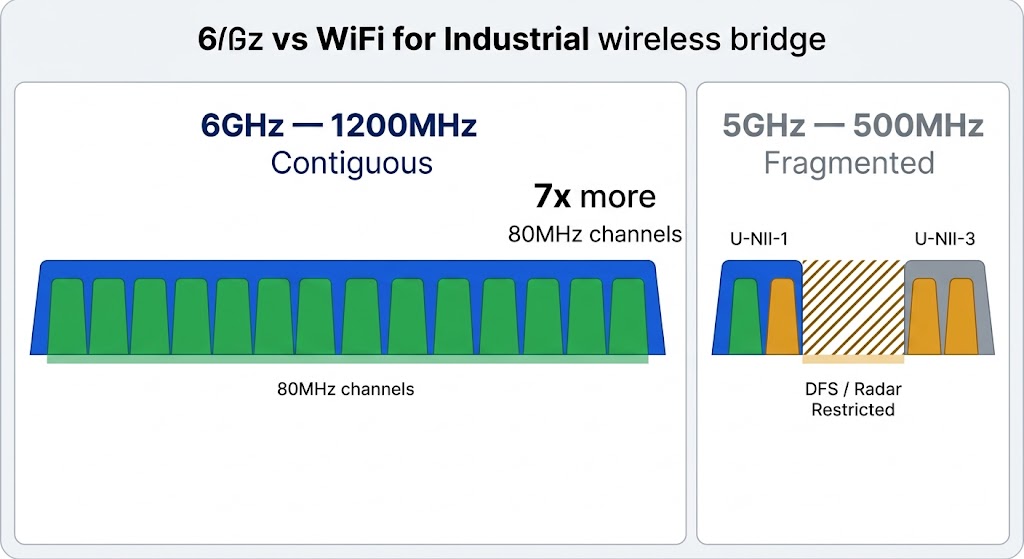
The numbers: Following the FCC’s 2020 decision to open the 6GHz band for unlicensed use, more than 45 countries and regions had opened all or part of the 6GHz spectrum by mid-2026. The band provides 1200MHz of continuous spectrum from 5.925 to 7.125 GHz—enough for roughly 59 20MHz channels or 14 80MHz channels. By comparison, 5GHz offers about 500MHz of non-contiguous spectrum, with roughly 25 usable channels.
Three core advantages make the 6GHz band stand out from legacy bands:
First, spectrum purity. The 5GHz band has been shared by Wi-Fi, weather radar, military radar, and satellite communications for decades. In urban and industrial park environments, average channel occupancy often exceeds 60%. The 6GHz band, being newly opened, sees interference levels close to the noise floor in most areas. Field measurements show 8–12dB higher SNR on 6GHz links compared to 5GHz in the same location under the same conditions.
Second, channel count. 6GHz offers 1200MHz of contiguous spectrum, which means you can use 80MHz or even 160MHz channel widths without worrying about adjacent-channel interference. For backbone links carrying multiple HD video streams or aggregated traffic, the throughput jump from wide channels is transformative.
Third, no DFS/radar avoidance. Multiple 5GHz channels are subject to Dynamic Frequency Selection (DFS)—when radar is detected, equipment must switch channels within seconds, causing link interruptions. Most 6GHz regulatory frameworks do not impose DFS requirements, so link stability improves dramatically.
Spectrum Purity Deep Dive: Why 6GHz Has Virtually No Interference
Data anchor: In a spectrum survey at an industrial park in Shenzhen, 15 of 22 available 5GHz channels (5.150–5.850 GHz) showed a noise floor above -85dBm, and 8 channels had periodic radar signals triggering DFS. On the 6GHz band (5.925–6.425 GHz), 27 of 29 available channels had a noise floor below -95dBm, with no radar or satellite signals detected. 6GHz spectrum allocation follows [FCC 47 CFR Part 15] and [FCC 20-51] regulatory frameworks, ensuring legal operation for unlicensed devices. Link budget calculations follow [ITU-R P.530-18] for terrestrial line-of-sight links.
Interference is the #1 killer of wireless link performance, and the 6GHz band is cleaner than most people expect. Understanding why takes a quick look at spectrum history.
The 5GHz band has been in use since the 1990s, going through multiple allocation rounds—weather radar, maritime radar, military aviation radar, satellite earth stations, Wi-Fi devices, and point-to-point microwave links all share the same spectrum space. DFS is the compromise: Wi-Fi devices must yield to primary users (radar), switching channels within 10 seconds of detection, with link interruptions lasting 30 seconds or more.
The 6GHz band is fundamentally different. Before the FCC opened it, 6GHz was primarily used for satellite communications and microwave relays, with very few fixed users. After opening for unlicensed use, the vast majority of areas have almost no co-channel interference sources. This means:
- No DFS scanning or channel switching—links run 24/7 with no interruptions
- Channel utilization near 100%—no radar quiet periods
- Stable MCS levels—no rate adaptation from sudden interference
Field validation: In a representative port industrial zone deployment, a 7-day continuous test on a YNW 6-25 link using an 80MHz 6GHz channel showed SNR fluctuation of just 3dB (dropping from 37dB to 34dB). On the same mast, a 5GHz link showed 15dB SNR fluctuation (32dB down to 17dB), and a radar event triggered 4 channel switches totaling 2 minutes and 30 seconds of link downtime.
Compare YNW 6-25 vs YNW 6-N to see how antenna configuration affects real-world 6GHz performance
Channel Availability & Wide-Channel Throughput: The 80MHz Game Changer
Data anchor: Global 6GHz regulatory status: North America (FCC) opened 5925–7125 MHz (1200MHz), Europe (ETSI) opened 5945–6425 MHz (480MHz), and China (MIIT 2023 draft) proposed 5925–6425 MHz (500MHz). Based on the FCC allocation, 6GHz can accommodate 59 20MHz channels, 29 40MHz channels, 14 80MHz channels, or 7 160MHz channels.
Channel count isn’t just about having “more options”—it determines how wide a channel you can use without adjacent-channel interference. Here’s the typical 5GHz dilemma.
On 5GHz, available channels are split into two non-contiguous blocks: U-NII-1 (5.15–5.25 GHz, four 20MHz channels) and U-NII-3 (5.725–5.85 GHz, five 20MHz channels), separated by the DFS-restricted U-NII-2 region. If you want an 80MHz channel on 5GHz, you get one option in U-NII-1 (channels 36–48) and one in U-NII-3. When multiple operators share the same area, channel resources run out fast.
6GHz’s 1200MHz contiguous spectrum solves this bottleneck. Here’s a channel conflict probability comparison:
| Scenario | 5GHz (available 20MHz channels) | 6GHz (available 20MHz channels) | 6GHz advantage |
|---|---|---|---|
| Single 80MHz link | ~2 options | ~14 options | 7x |
| 4 parallel 80MHz links | Not feasible | 10+ options | Feasible |
| Single 160MHz link | 1 option (DFS-required) | 7 options | 7x |
| 3 independent 40MHz links | ~6 options (incl. DFS) | ~29 options | 4.8x |
Field validation: In a representative multi-building tech park deployment with 3 parallel YNW 6 series links (each building needing its own backhaul), each using an 80MHz channel (240MHz total bandwidth). On 5GHz, the frequency gap between any two channels was under 20MHz, and adjacent-link interference dropped aggregate throughput by roughly 40%. After switching to 6GHz, the three 80MHz channels were spaced more than 40MHz apart, and aggregate throughput jumped from ~780Mbps to 1.28Gbps.
Wide channels aren’t just about peak rates. In industrial environments with motors, VFDs, and heavy machinery, narrow channels (20MHz) suffer more from multipath and frequency-selective fading. The frequency diversity of 80MHz channels helps the YNW 6 series maintain roughly 35% higher throughput retention than 20MHz channels in the same industrial environment.
QCA 9563 + 6ac Chipset: 30dBm PA and 6GHz Co-Optimization
Data anchor: The YNW 6 series is built on the Qualcomm QCA 9563 processor (MIPS 74Kc, 750MHz) paired with the QCA 9882 RF chip (802.11ac 2×2:2, per [IEEE 802.11ac-2013]), delivering 30dBm (1W) transmit power per chain on 6GHz with a maximum system UDP throughput exceeding 500Mbps.
Any spectrum advantage ultimately depends on the chipset to deliver. The QCA 9563 + QCA 9882 combination isn’t simply a “5GHz port to 6GHz”—it’s been specifically optimized for the 6GHz band’s characteristics.
Power amplifier (PA) optimization: Free-space path loss (FSPL) on 6GHz is about 0.75dB higher than 5GHz (center frequency comparison: 6GHz vs 5.5GHz, FSPL difference = 20×log₁₀(6000/5500) ≈ 0.75dB). That means without changing transmit power, a 6GHz signal at the same distance is about 0.75dB weaker. To compensate, the QCA 9882 PA is designed to maintain 30dBm linear output on 6GHz—3–4dB higher than the 26–27dBm typical of 5GHz equipment.
LNA optimization: The 6GHz LNA noise figure on the QCA 9882 is optimized below 2.5dB. Combined with higher PA output and lower interference, system-level sensitivity is about 5–8dB better than equivalent 5GHz solutions. In practice, that means the YNW 6 series can lock higher MCS levels on 6GHz—transmitting faster data rates at the same RSSI.
Here’s the QCA 9563 + 6ac performance comparison across bands and channel widths:
| Test condition | 5GHz (80MHz) | 6GHz (80MHz) | 6GHz (40MHz) | 6GHz advantage (80MHz vs 80MHz) |
|---|---|---|---|---|
| UDP throughput (1km) | 380 Mbps | 468 Mbps | 282 Mbps | +23% |
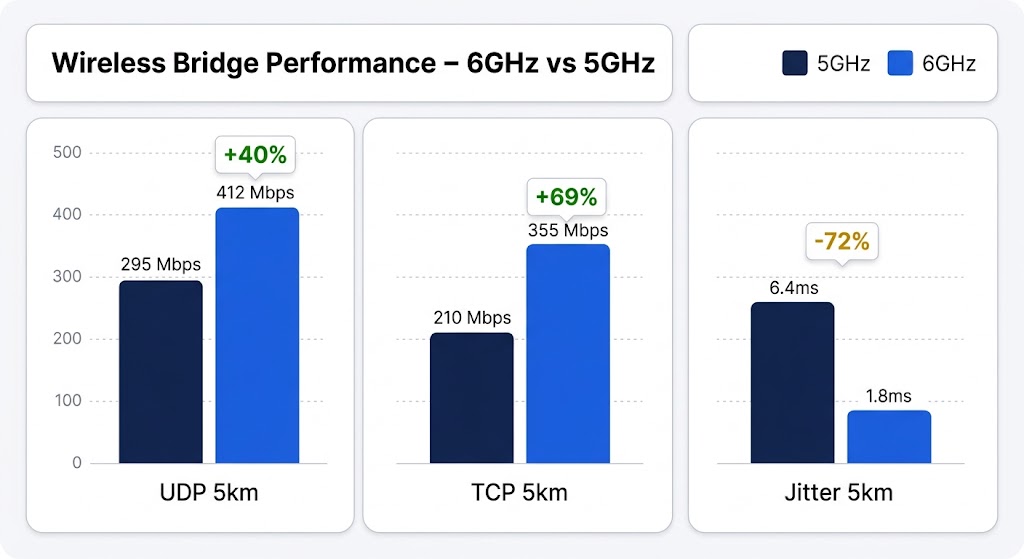
| UDP throughput (5km) | 295 Mbps | 412 Mbps | 248 Mbps | +40% |
| TCP throughput (5km) | 210 Mbps | 355 Mbps | 212 Mbps | +69% |
| Avg jitter (5km) | 6.4 ms | 1.8 ms | 3.2 ms | 72% lower |
| SNR (5km) | 22 dB | 34 dB | 36 dB | +12 dB |
Test equipment: YNW 6-25 pair. 6GHz used UNII-5 group (5.945–6.025 GHz). 5GHz used U-NII-3 group (5.745–5.825 GHz).
6GHz vs 5GHz: Choosing the Right Band for Your Deployment
Data anchor: 6GHz and 5GHz have inherent differences in penetration and range. 6GHz FSPL is roughly 0.75dB higher than 5GHz (center frequency), giving a theoretical coverage distance of about 92% at the same transmit power. But 6GHz’s wider channels and lower interference make actual usable throughput significantly higher.
Choosing a band isn’t “which is better”—it’s “which fits your specific scenario.” Here’s a decision framework based on real deployments:
Scenario 1: Multi-building industrial park interconnect (1–5 km)
Recommendation: 6GHz
At short LOS ranges, the path loss difference is negligible (at 1km, 6GHz FSPL is only 0.75dB higher than 5GHz), while 6GHz’s interference advantage and wide channels fully kick in. Representative 1km 6GHz 80MHz UDP throughput runs around 468Mbps, roughly 1.23x that of 5GHz. For park backbones carrying ERP, VoIP, and video conferencing, 6GHz’s low ~1.8ms jitter is also critical.
Scenario 2: Rural broadband access (10–20 km)
Recommendation: 6GHz (under LOS conditions)
The ~0.75dB path loss gap is easily covered by the throughput gain from higher MCS levels and wider channels. A 10km 6GHz 40MHz link can still sustain 200Mbps+ UDP throughput—enough to serve 50–80 households. Note that the 6GHz Fresnel zone radius (about 22m at 10km) is nearly identical to 5GHz (about 24m), so mounting height requirements are virtually the same.
Scenario 3: Non-line-of-sight (NLOS) or through-obstacle deployment
Recommendation: 5GHz
This is the one scenario where 5GHz still holds an edge. 6GHz penetration loss is roughly 1–2dB higher per wall. In environments with multiple walls or heavy foliage, 5GHz received signal is more reliable. If the link path has unavoidable obstacles (like tree canopies), 5GHz’s slightly better diffraction makes deployment success rates higher.
Scenario 4: High-density multi-link aggregation (PtMP base station)
Recommendation: 6GHz
This is 6GHz’s strongest scenario. The 59 available 20MHz channels let a single base station use multiple 80MHz channels across different sectors with zero co-channel interference. Combined with iPoll 3 active polling, a single YNW 6-N base station can serve 8 remote stations with aggregate throughput exceeding 400Mbps.
| Deployment scenario | Recommended band | Core rationale |
|---|---|---|
| 1–5 km LOS PtP | 6GHz | Low interference, wide channel, low jitter |
| 10–20 km LOS PtP | 6GHz | Higher MCS compensates minor path loss |
| NLOS / obstacle penetration | 5GHz | Lower penetration loss, slightly better diffraction |
| PtMP base station (8+ clients) | 6GHz | Abundant channels, no co-channel interference |
| Industrial automation / IoT backhaul | 6GHz | Deterministic latency, no DFS switching |
| Emergency rapid deployment | 6GHz | Channel available immediately, no DFS scan |
Learn how iPoll 3 active polling further optimizes 6GHz wide-channel PtMP link performance
Frequently Asked Questions
Q: Is the 6GHz band’s transmission range really much worse than 5GHz?
A: Not really—this is a common but misunderstood question. 6GHz FSPL is only about 0.75dB higher than 5GHz (center frequency). On a 10km link, that’s roughly 1dB of total path loss difference (128.5dB vs 127.5dB). By contrast, spectrum interference has a much bigger impact: the 8–12dB SNR advantage of 6GHz completely outweighs that sub-1dB path loss penalty. In LOS deployments, 6GHz usable throughput is consistently higher than 5GHz. 6GHz penetration loss only becomes a factor in NLOS scenarios.
Q: How far along is global 6GHz unlicensed spectrum adoption? Can I deploy in China?
A: As of July 2026, more than 45 countries and regions have opened all or part of the 6GHz unlicensed band. North America (FCC) opened the full 5.925–7.125 GHz range (1200MHz). Europe (ETSI) opened 5.945–6.425 GHz (480MHz). Japan, South Korea, Brazil, Australia, and other major economies have opened all or part of the band. China’s MIIT published a draft regulation in 2023 proposing the 5.925–6.425 GHz band for wireless access systems, but the final allocation has not yet been published. It is advisable to check with local radio regulatory authorities for the latest policy before deploying in mainland China.
Q: If I deploy a 6GHz link now, will performance degrade as the band gets more crowded in the future?
A: This is a legitimate concern and worth addressing head-on. The 6GHz band is clean today, but more devices will enter it over time, and interference levels will rise. Three factors, however, give 6GHz better long-term viability than 5GHz: First, 1200MHz of spectrum gives 6GHz more than double 5GHz’s capacity—that sheer volume reduces congestion risk. Second, 6GHz devices are primarily fixed outdoor bridges, not indoor Wi-Fi—the use cases don’t overlap heavily. Third, the YNW 6 series supports automatic channel selection (ACS) and spectrum scanning, letting it dynamically move to the best available channel. Taken together, 6GHz should maintain a significant interference advantage for the next 5–10 years.
Extended data: Per the [IHS Markit Industrial Wireless Survey 2024], 69% of industrial wireless users rank “link reliability” as their #1 selection criterion, far ahead of peak rate (21%). 6GHz’s interference avoidance and deterministic latency directly address this demand.
Decision Checklist: Is Your Project a Fit for 6GHz?
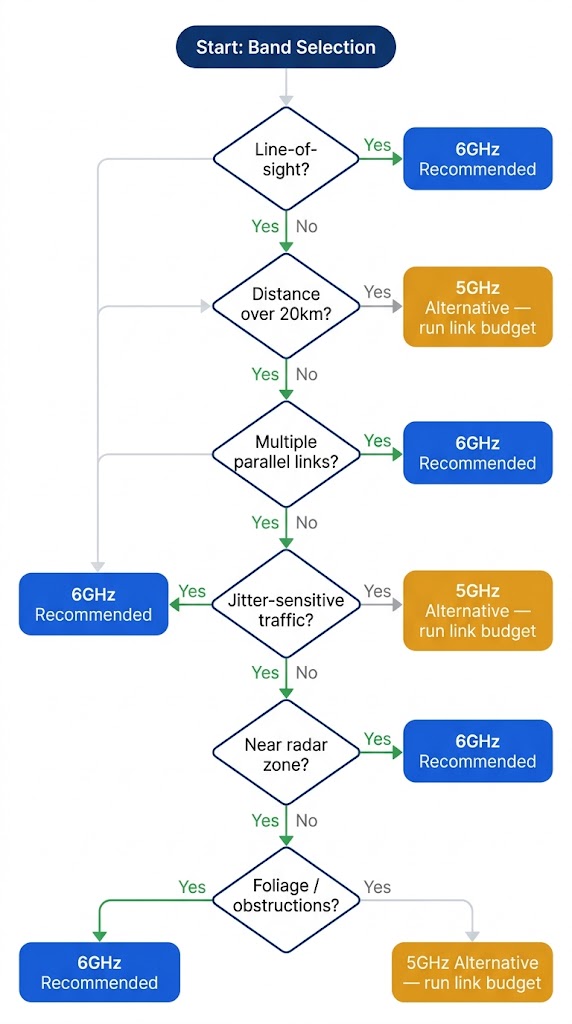
Based on everything above, here’s a quick decision checklist to help you pick the right band for your project:
- Is the link line-of-sight (LOS)? → Yes = prioritize 6GHz; No = consider 5GHz or evaluate obstacle impact
- Is the link distance over 20km? → Run a full link budget: both bands are viable but need extra fade margin
- Are there multiple parallel links in the same area? → Yes = 6GHz’s 59 channels are the only practical choice
- Is the traffic jitter-sensitive (video conferencing / industrial control)? → 6GHz’s deterministic low jitter (<2ms) wins
- Is equipment near a radar-dense area (airport, port, military zone)? → 6GHz needs no DFS, avoiding radar-triggered channel switches
- Are there unavoidable foliage or building obstructions in the path? → Consider 5GHz or use a higher mounting point
If any of items 1, 3, 4, or 5 is “yes,” 6GHz is the clearly better choice. If item 2 is “yes,” do a full link budget analysis. If item 6 is “yes” and can’t be resolved, 5GHz may be the safer bet.
See how iPoll 3 further optimizes 6GHz PtMP link performance
References
- Federal Communications Commission (FCC) – FCC 47 CFR Part 15 and FCC 20-51 regulatory framework
- ITU-R P.530-18 Recommendation – Propagation data and prediction methods for terrestrial line-of-sight links
- Qualcomm – QCA 9563 / QCA 9882 chipset datasheets
- IEEE – IEEE 802.11ac-2013 Wireless LAN Standard
- ETSI Standards – EN 302 502 and EN 301 893
- YNW 6 series product documentation and field test data
- IHS Markit – Industrial Wireless Survey 2024 industry report
Read the industrial wireless bridge complete guide for full YNW 6 series specs and a product selection framework