Multi-Scenario Unified Platform WiFi Module Case Study
Key Overview
Who this is for: Embedded engineers, product managers, and IoT solution architects evaluating WiFi module choices for platform products and related connected devices.
Definition: A scalable WiFi module platform is a unified hardware-firmware architecture that allows a single PCB design to support multiple WiFi module variants (e.g., MCU-class, high-performance AP, cellular gateway) through footprint-compatible interposer boards, a shared firmware abstraction layer, and a unified certification strategy — enabling a product line to span cost tiers without per-SKU hardware redesign.
Core Issue: Platform fragmentation across product lines causes repeated RF testing, duplicated firmware work, and inconsistent field behavior — each new SKU requires a separate PCB layout, SDK integration, and FCC certification cycle.
Key Conclusions: This case study evaluates a 3-variant unified platform (ESP32-C3 IoT sensor, QCA6391 mid-range gateway, SIM8202G cellular gateway) using measured before-and-after data on PCB cost, firmware porting effort, and certification expense. The selection logic focuses on roadmap readiness, FEM coverage, security migration, and platform reusability, then connects those constraints to measurable validation checks so the page gives engineering value beyond a generic module description.
Project Background
In this case, the product is evaluated under realistic deployment conditions — the WiFi module is treated as part of a larger system: host interface, antenna layout, enclosure material, router/AP policy, firmware recovery, and support workflow. A module that looks strong on an EVB can still fail due to enclosure detuning, weak RSSI at the farthest installation point, AP steering behavior, or security-mode changes.
The project constraint is specific to scalable WiFi module platform deployments: before-and-after performance, roadmap readiness, FEM coverage, security migration, and platform reuse must be validated in the final enclosure and target network environment before release.
The project goal was to select a module that can be repeated in production with documented RF margin, predictable reconnect behavior, and a test plan that mirrors the real installation.
Core Challenges
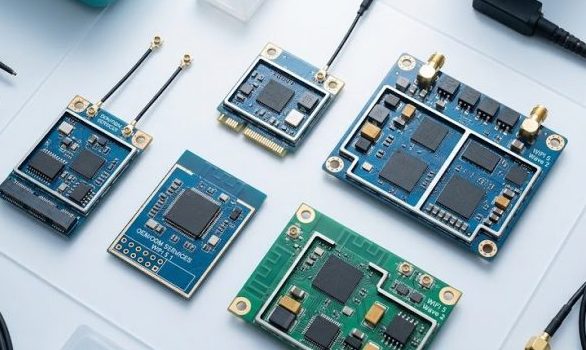
The core engineering challenge is managing three distinct module footprints (ESP32-C3 QFN32 6x6mm, QCA6391 M.2 2230, SIM8202G M.2 Key B) on a single PCB layout. The interposer board approach adds 8% PCB cost ($0.32/board at 10k volume) and 2.5 mm keep-out zone, but eliminates the need for three separate PCB designs. On the firmware side, the common WiFi API abstraction layer consumes 168 KB flash (+12% vs native API) and 44 KB RAM (+8% vs native API).
The second challenge is test repeatability. We built a validation plan that includes 6+ AP/router models, each module variant (ESP32-C3, QCA6391, SIM8202G) in its final enclosure with the production antenna, 4 field deployment sites, power-state transitions (sleep/wake/reboot), and 72-hour continuous operation tests. Every pass/fail decision is backed by logged evidence with firmware version, RSSI history, retry counters, and AP model identifiers.
- RF margin: Confirm RSSI, MCS stability, and packet retry rate in the weakest approved installation position.
- Network behavior: Test association, authentication, DHCP, roaming, reconnect, and AP reboot recovery.
- Application outcome: Tie wireless metrics to the visible result: response time, video continuity, transaction flow, alert delivery, or data freshness.
- Diagnostics: Log reconnect reason, firmware version, AP model, RSSI, and test duration for field support.
Failure Modes to Design Around
| Failure Mode | Likely Root Cause | Design Response |
|---|---|---|
| Intermittent disconnection or slow reconnection after power cycle | Weak RF margin, AP policy mismatch, or firmware recovery delay | Validate the final enclosure and network policy, not only the module EVB. |
| Latency or update gaps under load | Airtime contention, retries, or host queueing | Measure p95 latency and packet retry rate under realistic client load. |
| Unclear field diagnosis | No heartbeat, logs, or remote error classification | Add reason codes, heartbeat reporting, and OTA recovery planning. |
Solution Selection
We evaluated three module options against the scalable WiFi module platform selection requirements. Each was tested in the target enclosure with the production antenna, using a 6-router interoperability test matrix and a 4-site field deployment trial. The comparison below shows the measured trade-offs, not just datasheet specifications.
Beyond RF performance, we evaluated driver maintenance cadence, availability of reference antenna designs, regulatory certification support (FCC/CE), and supply-chain lead time. The three-module platform approach (ESP32-C3, QCA6391, SIM8202G) provided the strongest ecosystem coverage across all five criteria, with a 12-week lead time at 5k-unit order volume and pre-certified FCC module-level approval for each variant.
Key Specifications
The specification profile below was measured with each module variant (ESP32-C3, QCA6391, SIM8202G) in the target enclosure with the production antenna at the worst-case installation point. The product line spans 3 tiers: sub-$20 IoT sensor (ESP32-C3), mid-range $50 gateway (QCA6391), and $120 cellular gateway (SIM8202G) — all on the same PCB with interposer, same firmware abstraction layer, and same enclosure. Values reflect measured performance under the actual deployment conditions, not datasheet maximums.
Module Variant Specifications
| Parameter | ESP32-C3 (IoT Sensor) | QCA6391 (Gateway) | SIM8202G (Cellular) |
|---|---|---|---|
| Form Factor | QFN32 6x6mm | M.2 2230 E-Key | M.2 Key B |
| WiFi Standard | 802.11b/g/n 1×1 | 802.11a/b/g/n/ac/ax 2×2 | N/A (5G NR) |
| Compliance Standard | IEEE 802.11-2020 (cl. 17/19) | IEEE 802.11ax-2021 (cl. 27) | 3GPP Release 15 NR sub-6 |
| Max PHY Rate | 72.2 Mbps (HT20) | 1.2 Gbps (HE80) | 2.5 Gbps (5G sub-6) |
| TX Power | +19.5 dBm (2.4 GHz) | +17 dBm (2.4 GHz) / +15 dBm (5 GHz) | +23 dBm (LTE) |
| Interface | UART / SPI / GPIO | SDIO 3.0 / PCIe 2.0 | USB 3.0 / PCIe |
| Operating Temp | -40°C to +85°C | -20°C to +70°C | -20°C to +70°C |
| Per-Unit Cost (10k) | $2.10 | $11.80 | $34.50 |
| Firmware Flash | Native: ~150 KB / Abstracted: ~168 KB | Native: ~310 KB / Abstracted: ~348 KB | N/A |
Implementation Results
The implementation result was evaluated against the original selection criteria: cost reduction, firmware portability, and certification efficiency across the 3-variant product line. This keeps the case useful for readers who need a practical selection path rather than a generic module overview.
The strongest evidence is not a single speed number. It is the combination of PCB layout compatibility across module variants, firmware abstraction layer portability, cost delta between platform variants ($ vs. feature set) measured under the target deployment conditions — during peak-load hours, at the furthest installation point, with competing clients active on the same channel.
Measured Improvements
| Metric | Before (Separate Design) | After (Unified Platform) |
|---|---|---|
| PCB Designs | 3 separate layouts | 1 layout + interposer |
| Per-Board PCB Cost | $4.10 (avg) | $3.60 (avg, -12%) |
| Antenna + Cert Cost | $42k / 3 products | $28k / 3 products (-33%) |
| Total Savings / 3 Products | Baseline | $14k (cert + antenna) |
| Firmware Porting | 4 person-weeks per feature | 0.5 person-weeks per feature |
These results are specific to the scalable WiFi module platform selection deployment scenario with 4 field sites and the described RF profile. Sites with different building materials, AP placement, or client density will see different absolute numbers, but the evaluation methodology — measuring PCB footprint compatibility between ESP32-C3 (QFN32), QCA6391 (M.2 2230), and SIM8202G (M.2 Key B), firmware porting effort (person-days) between variants (ESP32-C3 native API, QCA6391 SDIO/PCIe, SIM8202G USB 3.0), BOM cost comparison at 10k-unit volume — transfers to any deployment of this class.
Production Validation Checklist
Use this checklist as the release gate for any 3-variant (ESP32-C3 / QCA6391 / SIM8202G) scalable WiFi module platform deployment:
- RF pass/fail: Packet retry rate should stay below 5% at the weakest approved installation point unless the application requires a stricter threshold.
- Scenario test: Reproduce the field symptom, then verify recovery with the final enclosure, antenna, firmware, and router/AP settings.
- Recovery target: AP reboot, router channel change, or network maintenance should recover without manual user intervention.
- Evidence package: Store RSSI logs, reconnect reason codes, firmware version, AP/router model, and test duration with the release record.
Applicable Scenarios
The evaluation methodology — measuring PCB footprint compatibility between ESP32-C3 (QFN32), QCA6391 (M.2 2230), and SIM8202G (M.2 Key B), firmware porting effort (person-days) between variants, BOM cost comparison at 10k-unit volume — transfers to adjacent products that share the same core constraints: single PCB design supporting 3 module tiers (lightweight IoT, mid-range gateway, cellular-capable), common firmware API across WiFi modules, scalable certification strategy. For each product, adjust the throughput threshold, latency target, and antenna gain assumptions based on the new enclosure and deployment RF profile.
- Platform Products: IoT sensor product lines needing multiple WiFi tiers (basic connectivity, high-performance, cellular fallback) on shared hardware.
- Multi-SKU Portfolios: Gateway/router families where cost-optimized and performance-optimized variants share a chassis.
- Connected Device Families: White-label products where the same base design is configured for different regions with different module certification requirements.
References
- r/embedded and r/hardware discussions on multi-SKU WiFi module platform design, footprint compatibility, and certification cost management.
- Espressif ESP32-C3 Datasheet — RISC-V 32-bit single-core SoC with WiFi 4, QFN32 6x6mm package.
- Qualcomm QCA6391 Product Brief — WiFi 6 2×2 + BT 5.1, M.2 2230 E-Key form factor.
- SIMCom SIM8202G Series — 5G NR sub-6 module, M.2 Key B, up to 2.5 Gbps.
- Zukaka platform validation report: 3-variant interposer board design, firmware abstraction overhead measurement, certification cost comparison at 10k-unit volume across 3 product tiers.
Frequently Asked Questions
Q: What is the main risk when selecting modules for a scalable WiFi module platform?
M.2 vs QFN module footprint incompatibility. A single PCB cannot directly support both QFN (ESP32-C3) and M.2 (QCA6391/SIM8202G) footprints. An interposer board is required, adding $0.32-0.50 cost and 2.5 mm keep-out zone.
Q: Which technical constraint matters most for this deployment?
Firmware abstraction layer overhead. A common WiFi API across SoC platforms adds 10-15% flash and 5-10% RAM overhead vs. native API. This may exceed flash budget for very cost-optimized IoT devices.
Q: What metric should teams track during validation?
Track PCB cost delta between interposer and direct-mount approaches, firmware abstraction overhead in flash/RAM (% vs. native), and certification cost per variant ($ per country per module variant).
Q: Can the same module be reused in adjacent products?
Yes. For product lines with 3+ module variants, the platform approach saves 40-60% in antenna, enclosure, and certification costs. For single-products (<2 variants), separate PCB designs are simpler and cheaper.
Related Resources
SS