Compex Replacement WiFi Modules for WISP CPE & Outdoor Wireless Bridge
Blog 2026-06-04
Compex Replacement WiFi Modules for WISP CPE & Outdoor Wireless Bridge
Key Overview
This guide is for: WISP operators, outdoor wireless network engineers, and OEMs building CPE or backhaul equipment who use Compex WiFi modules and want qualified alternatives for supply chain resilience, customization, or OEM branding.
Core Issue: Outdoor wireless deployments demand high TX power (20-26 dBm), reliable thermal performance across wide temperature ranges, and stable driver support on QSDK or OpenWrt. Compex modules are widely used in this space, but single-sourcing creates risk. Engineers need alternatives that maintain the same link budget, the same regulatory compliance, and the same drop-in compatibility.
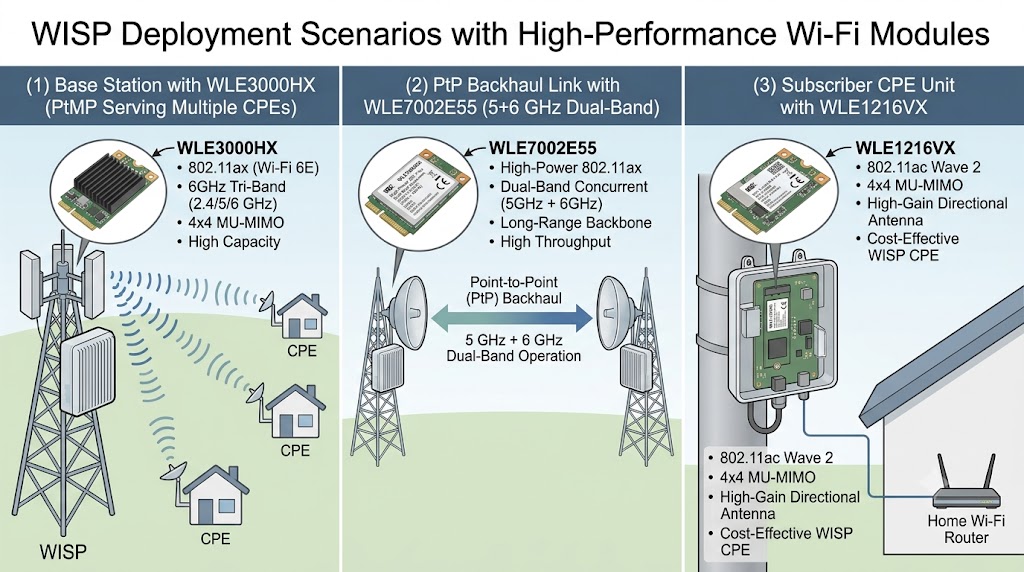
Key Conclusions: Zukaka provides direct drop-in alternatives for the three most critical Compex modules used in WISP and outdoor bridge applications: WLE1216VX (QCA9984/9994, 26 dBm), WLE3000HX (QCN9074, 20 dBm), and WLE7002E55 (QCN9274, 5+6 GHz backhaul). Our modules use the exact same Qualcomm reference designs (CAS03, PN02.1, WK03.2), ensuring identical TX power, sensitivity, and thermal behavior — with the added benefits of ODM customization, OEM branding, and dedicated FAE support.
What Makes a WiFi Module Suitable for WISP & Outdoor Bridge
Outdoor wireless networks operate under conditions that consumer or enterprise indoor modules are not designed for. The three most important selection criteria for WISP-grade WiFi modules are:
- High TX power (+20 dBm or higher). Link budget is everything in outdoor wireless. Every extra dBm of TX power translates to either longer range, higher modulation rate at a given range, or margin against rain fade. Compex modules like the WLE1216VX at 26 dBm and WLE3000HX at 20 dBm are preferred in WISP exactly because of their power output.
- Wide operating temperature range. WISP CPE enclosures on towers and rooftops experience extreme temperature swings. A module rated for -40°C to +85°C (I-Temp) is essential for outdoor deployments. Standard commercial-temperature modules (-20°C~+70°C) can fail in winter or direct-sun exposed installations.
- QSDK and OpenWrt driver support. Most WISP base stations run on QSDK or OpenWrt derivatives. Modules using Qualcomm ath10k/ath11k/ath12k driver families integrate directly into these firmware environments without custom driver development.
Module Comparison: Compex vs Zukaka for Outdoor Use
| Compex Module | Zukaka Alternative | Chipset | WiFi Gen | Best For |
|---|---|---|---|---|
| WLE1216VX (std) | ZK-WLE1216VX | QCA9984 | WiFi 5 (802.11ac Wave 2) | Subscriber CPE, PtP CPE |
| WLE1216VX I-Temp | ZK-WLE1216VX-I | QCA9994 | WiFi 5 (802.11ac Wave 2) | Extreme outdoor CPE (-40°C~+85°C) |
| WLE3000HX | ZK-WLE3000HX | QCN9024 / QCN9074 | WiFi 6 (802.11ax) | PtMP base station, sector AP |
| WLE7002E55 | ZK-WLE7002E55 | QCN6274 / QCN9274 | WiFi 7 (802.11be) | PtP backhaul, 5+6 GHz dual-band link |
WLE1216VX / QCA9984-9994 — High-Power 802.11ac Wave 2
The WLE1216VX is one of the most widely deployed Compex modules in the WISP industry. Its 26 dBm TX power per chain gives it a significant link budget advantage over standard 17-20 dBm modules, making it the go-to choice for CPE equipment that needs to maintain a reliable connection to a base station miles away. Both Compex and Zukaka source the same QCA9984 (standard temp) and QCA9994 (industrial temp) chipsets from Qualcomm and build on the same CAS03 reference design.
Key Specifications
| Parameter | WLE1216VX (Standard) | WLE1216VX I-Temp |
|---|---|---|
| Chipset | QCA9984 | QCA9994 |
| Form Factor | Mini PCIe | Mini PCIe |
| Frequency Band | 2.4 + 5 GHz concurrent | 2.4 + 5 GHz concurrent |
| MIMO Configuration | 4×4:4 (both bands) | 4×4:4 (both bands) |
| TX Power (2.4 GHz) | 20 dBm per chain | 20 dBm per chain |
| TX Power (5 GHz) | 19 dBm per chain | 19 dBm per chain |
| Max Data Rate | 1.73 Gbps (5 GHz, 4×4) | 1.73 Gbps (5 GHz, 4×4) |
| Operating Temp | -20°C ~ +70°C | -40°C ~ +85°C |
| Interface | PCIe 2.0 | PCIe 2.0 |
| Driver Support | ath10k | ath10k |
Why WISP Engineers Choose This Module
Three factors make the WLE1216VX the dominant WISP CPE module:
- 26 dBm combined output: The PA design on the CAS03 reference delivers the highest TX power of any standard Mini PCIe module. For a PtP link at 10+ km, every dBm matters for maintaining QAM256 or QAM1024 modulation.
- I-Temp reliability: The QCA9994 variant with -40°C~+85°C rating is the standard for outdoor CPE. Most WISP CPE manufacturers specify I-Temp exclusively because standard-temp modules have elevated failure rates in tower installations.
- ath10k maturity: The ath10k driver stack is battle-tested across thousands of WISP deployments. It supports all key WISP features including 160 MHz channel width, beamforming, and MU-MIMO.
WLE3000HX / QCN9074 — WiFi 6 PtMP Base Station
For WISPs upgrading from WiFi 5 (802.11ac) to WiFi 6 (802.11ax) base stations, the WLE3000HX is the most common Compex module choice. Built on the Qualcomm QCN9074 (PN02.1 reference design), it delivers 2.4 Gbps per 4×4 radio — a 40% increase over the WLE1216VX — while maintaining the same 20 dBm TX power that PtMP base stations need for adequate sector coverage. Zukaka’s ZK-WLE3000HX is an identical implementation of the same PN02.1 reference design.
Key Specifications
| Parameter | WLE3000HX / ZK-WLE3000HX |
|---|---|
| Chipset | QCN9024 / QCN9074 |
| Form Factor | Mini PCIe |
| Frequency Band | 2.4 GHz or 5 GHz (single-band selectable) |
| MIMO Configuration | 4×4:4 (single band) |
| TX Power | 20 dBm per chain |
| Max Data Rate | 2.4 Gbps (5 GHz, 4×4, 160 MHz) |
| Power Consumption | 9W typical |
| Interface | PCIe 3.0 |
| Driver Support | ath11k |
WLE3000HX vs WLE3002HX for WISP
The WLE3000HX and WLE3002HX use the same QCN9074 chipset family and the same PN02.1/PN02.6 reference designs. The key difference is power budget. The WLE3000HX at 9W is designed for base stations where power is available and duty cycle is high. The WLE3002HX at 6.6W is better suited for power-constrained or thermally constrained designs. For PtMP base stations, the WLE3000HX’s higher power budget supports sustained TX without thermal throttling under heavy load.
WLE7002E55 / QCN9274 — WiFi 7 5+6 GHz Backhaul
The WLE7002E55 represents a new category of WISP backhaul module. Unlike the WLE3000HX which is single-band selectable, the WLE7002E55 offers true dual-band concurrent operation on 5 GHz and 6 GHz simultaneously. This is enabled by the QCN9274’s DBDC architecture, which allows a single chipset to drive two independent 2×2 radios on different frequency bands. For PtP backhaul, this means one module can simultaneously run a long-range 5 GHz link (better propagation) and a high-capacity 6 GHz link (more spectrum, shorter range). Zukaka’s ZK-WLE7002E55 is built on the exact same Waikiki WK03.2 reference design.
Key Specifications
| Parameter | WLE7002E55 / ZK-WLE7002E55 |
|---|---|
| Chipset | QCN6274 / QCN9274 |
| Form Factor | Mini PCIe |
| Band Configuration | 5 + 6 GHz DBDC |
| MIMO Configuration | 2×2:2 per band |
| TX Power | 18 dBm per chain (both bands) |
| Max Data Rate | 4.32 Gbps per band (2×2, 160 MHz) |
| Power Consumption | 8.7W |
| Interface | PCIe 3.0 |
| Driver Support | ath12k |
Why 5+6 GHz for Backhaul
The 5+6 GHz dual-band configuration is uniquely suited for PtP backhaul. The 5 GHz band provides better range and penetration through foliage or rain — critical for the primary backhaul link. The 6 GHz band offers 1200 MHz of additional unlicensed spectrum (in the US and countries that have adopted 6 GHz rules), providing a high-capacity overlay channel. This DBDC architecture lets WISPs use the 5 GHz link for long-range backhaul while dedicating the 6 GHz link to high-throughput traffic or as a redundant path.
Deployment Scenarios: PtMP, PtP, Subscriber CPE
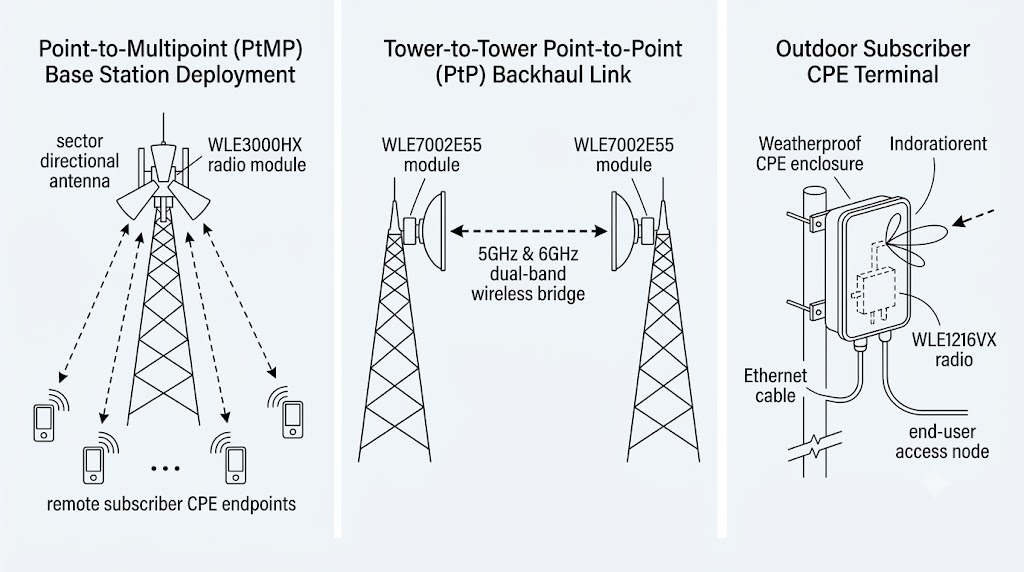
Scenario 1: PtMP Base Station with WLE3000HX
A WISP deploying a 5 GHz PtMP sector base station needs a single-band 4×4 module with high TX power. The ZK-WLE3000HX (QCN9074, 20 dBm per chain) is ideal for this role:
- 4×4 MU-MIMO supports up to 16-32 simultaneous client connections depending on sector width
- 20 dBm per chain provides adequate link budget for CPE units at 3-8 km range with 17 dBi sector antennas
- ath11k driver support in QSDK enables all WISP features: airtime fairness, bandwidth steering, and client isolation
Scenario 2: PtP Backhaul with WLE7002E55
For a PtP link between two towers, the ZK-WLE7002E55 (QCN9274, 5+6 GHz DBDC) provides a future-proof WiFi 7 solution:
- 5 GHz primary link with 18 dBm TX power connected to a 23 dBi dish antenna achieves 30+ km links at QAM256
- 6 GHz secondary link provides additional 1.2 GHz of spectrum for traffic aggregation or link redundancy
- MLO (multi-link operation) in WiFi 7 can bond both bands for >8 Gbps aggregate throughput on future QSDK releases
Scenario 3: Subscriber CPE with WLE1216VX
For subscriber CPE units, the ZK-WLE1216VX (QCA9984) or ZK-WLE1216VX-I (QCA9994) is the proven choice:
- 26 dBm combined TX power in 4×4 configuration provides maximum uplink budget — critical for maintaining QAM256 on the return path
- I-Temp variant specified for outdoor CPE enclosures with passive cooling
- ath10k driver compatibility with all major WISP CPE firmware platforms (MikroTik RouterOS, OpenWrt, QSDK, Ubiquiti airOS)
Frequently Asked Questions
Q: Is the Zukaka WLE1216VX a drop-in replacement for the Compex version?
Yes. Zukaka’s ZK-WLE1216VX uses the same QCA9984 (standard) or QCA9994 (I-Temp) chipset on the same Qualcomm CAS03 reference design. Pinout, PCIe interface, driver support (ath10k), and RF characteristics are identical. No hardware or software changes are required when switching.
Q: Does the Zukaka WLE3000HX support 160 MHz channel width?
Yes. The ZK-WLE3000HX based on QCN9074 supports 160 MHz channel width on 5 GHz, delivering up to 2.4 Gbps PHY rate per 4×4 radio. This is identical to the Compex WLE3000HX specification.
Q: Can the WLE7002E55 run 5 GHz and 6 GHz simultaneously?
Yes. The WLE7002E55 is a dual-band concurrent (DBDC) module based on QCN9274. Both the 5 GHz and 6 GHz 2×2 radios operate simultaneously and independently. This is the key advantage over single-band modules like the WLE3000HX for PtP backhaul applications.
Q: What is the lead time for Zukaka WISP-grade modules?
Standard sample orders for ZK-WLE1216VX, ZK-WLE3000HX, and ZK-WLE7002E55 ship within 3-5 business days. Production volumes depend on quantity and OEM customization requirements. Contact Zukaka for current lead times.
Q: Can I get OEM branding on WISP modules?
Absolutely. Zukaka provides OEM branding on all production orders — custom labels with your logo and part number, custom packaging, and custom documentation. This is especially valuable for WISP CPE manufacturers shipping branded equipment.
- Best Compex WiFi Module Alternatives — Category Hub — Full product mapping across all Compex Wi-Fi 5/6/7 modules
- Compex Specialty WiFi Modules Guide — WLE1216VX I-Temp, JustWiFi⁷, and WLAN+BLE modules
- Compex WiFi 6 & WiFi 6E Module Guide — WLE3000HX, WLE3002HX, WLW3000H6 coverage