Industrial Embedded WiFi Module Alternative to Compex for Robotics & IoT Gateway
Key Overview
This guide is for: Industrial embedded systems engineers designing robotics, IoT gateways, industrial controllers, and autonomous mobile robots (AMRs) — currently using or evaluating Compex WiFi 6/6E modules and seeking qualified alternatives with the same Qualcomm chipsets.
Core Issue: Industrial embedded environments impose strict constraints on WiFi modules — limited power budget, compact physical footprint, wide temperature tolerance, and reliable driver support on custom Linux or Yocto builds. Compex modules are widely used in these applications, but single-sourcing creates long-term supply risk. Engineers need drop-in alternatives that maintain the same thermal profile, power efficiency, and driver compatibility.
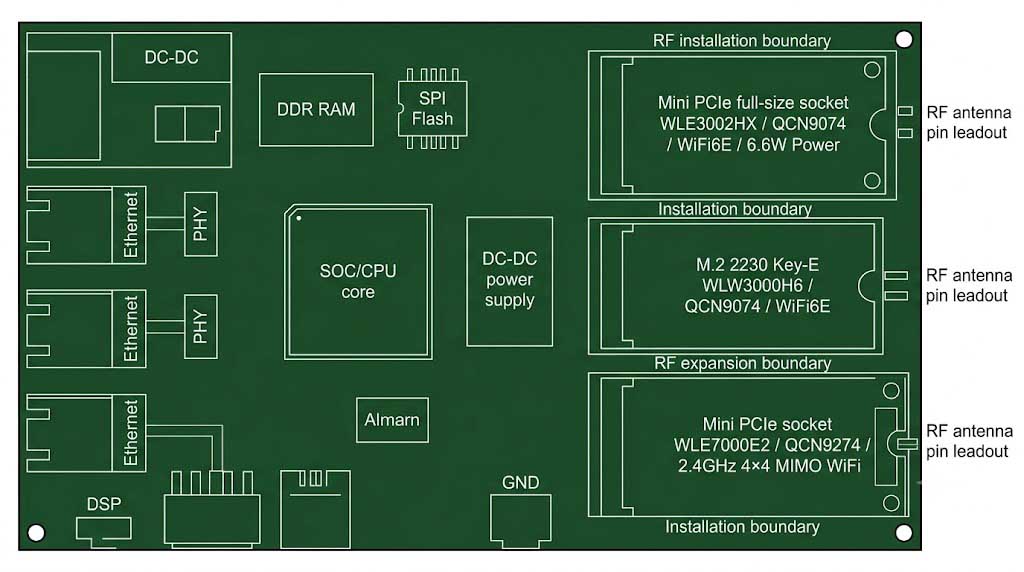
Key Conclusions: Zukaka provides direct drop-in alternatives for the three Compex modules most critical to industrial embedded applications: WLE3002HX (6.6W low-power Mini PCIe), WLW3000H6 (M.2 2230 WiFi 6E), and WLE7000E2 (2.4 GHz 4×4). Each Zukaka module uses the same Qualcomm reference design (PN02.6, WK01.5) as the Compex equivalent, ensuring identical power consumption, thermal characteristics, and RF performance — plus ODM customization for non-standard PCB shapes, connectors, and firmware.
What Industrial Embedded Applications Require from WiFi Modules
Embedded systems in robotics, IoT gateways, and industrial controllers present a different set of requirements compared to WISP or enterprise WiFi applications. The four critical factors are:
- Power efficiency (6-9W). Industrial embedded systems typically have a total power budget of 15-30W for the entire compute + wireless subsystem. A WiFi module drawing 9W+ (like the WLE3000HX) can consume a disproportionate share. Modules with lower power draw (6.6W for WLE3002HX) are preferred for power-constrained designs.
- Compact form factor. Many industrial IoT gateways and robotic controllers use M.2 2230 or Mini PCIe modules in tight enclosures where airflow is limited. Physical size constraints often drive the choice between Mini PCIe and M.2 2230.
- Thermal management in sealed enclosures. Industrial enclosures are often sealed against dust and moisture (IP54+). Without active cooling, the module must dissipate heat through the PCB and enclosure — making power efficiency directly tied to reliability. A module running at 6.6W vs 9W can be the difference between stable operation and thermal throttling at 60°C ambient.
- Custom Linux / Yocto driver integration. Most industrial embedded systems run custom Linux builds (Yocto, Buildroot, Ubuntu Core). The WiFi module must have mature ath10k/ath11k/ath12k driver support and stable firmware that can be integrated into the build system without binary blobs or proprietary drivers.
Module Overview: Compex vs Zukaka for Industrial Use
| Compex Module | Zukaka Alternative | Chipset | Form Factor | Power | Best For |
|---|---|---|---|---|---|
| WLE3002HX | ZK-WLE3002HX | QCN6024/9024 / QCN9074 | Mini PCIe | 6.6W | IoT gateway, industrial controller, power-constrained embedded |
| WLW3000H6 | ZK-WLW3000H6 | QCN9024 / QCN9074 | M.2 2230 Key E | — | Compact gateway, AMR, 6 GHz connectivity |
| WLE7000E2 | ZK-WLE7000E2 | QCN6224 / QCN9274 | Mini PCIe | 8W | 2.4 GHz heavy-duty, long-range IoT, warehouse robotics |
WLE3002HX / QCN9074 — Low-Power Mini PCIe
The WLE3002HX addresses a specific niche: applications that need the RF performance of the QCN9074 chipset but cannot accommodate the 9W power budget of the WLE3000HX. It achieves this 26% power reduction through a more efficient PA architecture and optimized PCB layout on the Qualcomm PN02.6 reference design. Zukaka ZK-WLE3002HX uses the same design, delivering identical power savings.
Key Specifications
| Parameter | WLE3002HX / ZK-WLE3002HX |
|---|---|
| Chipset | QCN6024 / QCN9024 / QCN9074 |
| Form Factor | Mini PCIe |
| Frequency Band | 2.4 GHz or 5 GHz (single-band selectable) |
| MIMO Configuration | 4×4:4 (single band) |
| TX Power | 20 dBm per chain |
| Max Data Rate | 2.4 Gbps (5 GHz, 4×4, 160 MHz) |
| Power Consumption | 6.6W typical |
| Interface | PCIe 3.0 |
| Driver Support | ath11k |
Why 6.6W Matters in Embedded Design
In a typical industrial gateway with a total power budget of 20W, reducing WiFi module power from 9W (WLE3000HX) to 6.6W (WLE3002HX) frees 2.4W for the application processor or additional sensors. In a passively cooled enclosure, that 2.4W reduction can lower internal temperature by 8-12°C — enough to eliminate thermal throttling and extend component lifespan. For battery-powered robotics operating on a shift basis, the savings translate to 15-30 minutes of additional runtime.
Trade-Offs vs WLE3000HX
The WLE3002HX matches the WLE3000HX on every specification except power budget. Both deliver 20 dBm TX power, both support 4×4 MU-MIMO with 160 MHz channels, both use the same ath11k driver. The only trade-off is thermal headroom: the WLE3002HX’s lower power budget means it reaches thermal equilibrium (junction temperature) faster under continuous heavy load. For typical industrial IoT traffic patterns (intermittent bursts, low duty cycle), this is not a concern.
WLW3000H6 / QCN9074 — M.2 2230 WiFi 6E
The WLW3000H6 is Compex’s WiFi 6E (6 GHz) solution in the M.2 2230 form factor. It uses the same QCN9074 chipset as the Mini PCIe WLE3000 series but in a physically smaller footprint optimized for compact embedded designs. The M.2 2230 Key E interface is standard on most modern embedded processors (Intel, NXP i.MX, Rockchip, Qualcomm) and eliminates the need for a Mini PCIe-to-M.2 adapter. Zukaka ZK-WLW3000H6 is a direct implementation of the same Qualcomm PN02.6 reference design.
Key Specifications
| Parameter | WLW3000H6 / ZK-WLW3000H6 |
|---|---|
| Chipset | QCN9024 / QCN9074 |
| Form Factor | M.2 2230 Key E |
| Frequency Band | 6 GHz (WiFi 6E) |
| MIMO Configuration | 2×2:2 |
| TX Power | 20 dBm per chain |
| Max Data Rate | 1.2 Gbps (2×2, 160 MHz) |
| Interface | PCIe 3.0 |
| Driver Support | ath11k |
When to Choose M.2 2230 Over Mini PCIe
The WLW3000H6 in M.2 2230 form factor is preferred over Mini PCIe in three scenarios: (1) when the embedded processor has native M.2 Key E support and space is constrained, (2) when the total height budget requires a lower-profile module (M.2 2230 is ~3mm thinner than Mini PCIe), and (3) when the design uses a carrier board with M.2 slots for multiple expansion modules (WiFi, NVMe, 5G). The trade-off is 2×2 (WLW3000H6) vs 4×4 (WLE3002HX) — the M.2 2230 form factor cannot accommodate the additional RF chains of a 4×4 module.
WLE7000E2 / QCN9274 — 2.4 GHz 4×4 Heavy-Duty
While most WiFi 7 focus is on 5 GHz and 6 GHz performance, the 2.4 GHz band remains essential for industrial applications due to its superior penetration through walls, machinery, and metal enclosures. The WLE7000E2 dedicates all four RF chains to 2.4 GHz, delivering 4×4 MU-MIMO at up to 1.15 Gbps — a significant upgrade over the 2×2 (300-600 Mbps) 2.4 GHz performance of typical dual-band modules. Zukaka ZK-WLE7000E2 uses the same Qualcomm Waikiki WK01.5 reference design.
Key Specifications
| Parameter | WLE7000E2 / ZK-WLE7000E2 |
|---|---|
| Chipset | QCN6224 / QCN9274 |
| Form Factor | Mini PCIe |
| Frequency Band | 2.4 GHz only |
| MIMO Configuration | 4×4:4 |
| TX Power | 20 dBm per chain |
| Max Data Rate | 1.15 Gbps (2.4 GHz, 4×4, 40 MHz) |
| Power Consumption | 8W max |
| Interface | PCIe 3.0 |
| Driver Support | ath12k |
Industrial Applications for 4×4 2.4 GHz
The WLE7000E2’s 4×4 2.4 GHz capability is uniquely suited for three industrial scenarios:
- Warehouse robotics: AMRs operating in large warehouses with metal shelving need 2.4 GHz’s penetration. 4×4 MU-MIMO allows a single AP module to serve multiple robots simultaneously, reducing gateway count.
- Industrial IoT sensor hubs: Dense sensor networks using 2.4 GHz protocols (802.11ax IoT mode, Thread/BLE coexistence) benefit from the additional spatial streams for capacity.
- 2.4 GHz-only regulatory domains: Some industrial deployments operate in regions where 5 GHz spectrum is restricted or licensed. The WLE7000E2 maximizes the available spectrum in the unlicensed 2.4 GHz band.
ODM Customization for Embedded Designs
Industrial embedded systems frequently require WiFi modules that deviate from standard catalog offerings. Zukaka ODM capability is a key differentiator versus Compex for these scenarios:
- Custom PCB dimensions and connector placement. If your enclosure only has space for a rectangular module with an offset connector, Zukaka can design a custom PCB shape while keeping the same chipset and RF design.
- Tuned RF front-end for specific antennas. If your product uses a PCB trace antenna or a specific off-board antenna, Zukaka can tune the PA matching network for optimal TX power and EVM with that specific antenna load — reducing radiated spurious emissions and improving range.
- Custom firmware features. Zukaka can implement custom ath12k firmware features for specific industrial protocols, timing synchronization, or power management modes.
- OEM branding. Full custom labeling, packaging, and documentation with your brand identity.
Frequently Asked Questions
Q: Is the Zukaka WLE3002HX a direct replacement for the Compex version?
Yes. The ZK-WLE3002HX uses the same QCN9074/QCN6024 chipset on the same Qualcomm PN02.6 reference design. Power consumption, TX power, driver compatibility, and mechanical dimensions are identical. No hardware or software changes required.
Q: What is the power consumption difference between WLE3002HX and WLE3000HX?
The WLE3002HX draws 6.6W typical vs 9W for the WLE3000HX — a 26% reduction. Both modules use the same QCN9074 chipset architecture. The WLE3002HX achieves this through a more efficient PA implementation on the PN02.6 reference design.
Q: Does the Zukaka WLW3000H6 support 6 GHz (WiFi 6E)?
Yes. The ZK-WLW3000H6 is a dedicated 6 GHz (WiFi 6E) module based on QCN9074, supporting the full unlicensed 6 GHz spectrum band. It operates exclusively on 6 GHz — if you need 2.4 or 5 GHz, use the WLE3002HX (Mini PCIe) or a dual-band alternative.
Q: Can I get a custom PCB shape for my embedded design?
Yes. Zukaka offers full ODM customization including custom PCB dimensions and connector placement. This is a key differentiator — Compex does not offer this level of customization for standard modules. Contact Zukaka with your mechanical requirements.
Q: What driver support do Zukaka industrial modules use?
ZK-WLE3002HX and ZK-WLW3000H6 use the ath11k Linux driver. ZK-WLE7000E2 uses the ath12k Linux driver. All are mainline Linux kernel drivers with standard QSDK support. No proprietary or binary-only drivers are required.
- Best Compex WiFi Module Alternatives — Category Hub — Full product mapping across all Compex Wi-Fi 5/6/7 modules
- Compex WiFi 6 & WiFi 6E Module Guide — WLE3000HX, WLE3002HX, WLW3000H6 coverage
- Industrial WiFi Modules for IoT, Robotics, and WISP Applications — Pillar guide covering form factor selection and chipset comparison