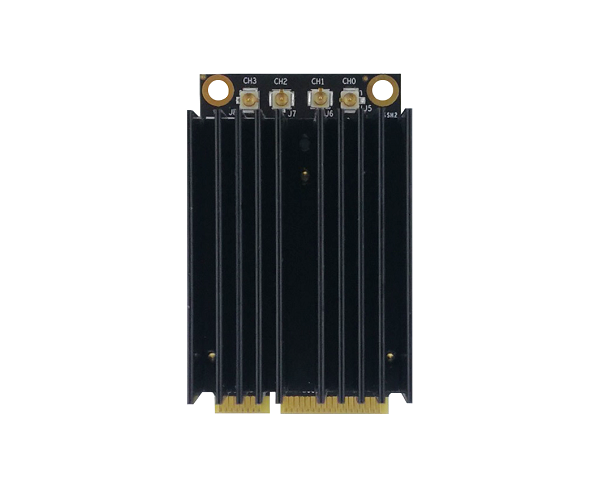
A 4×4 MU-MIMO module that covers both 5GHz and 6GHz bands. Built on Qualcomm’s Pine series chipsets, this unit delivers up to 4.8Gbps through 4 spatial streams with 160MHz channel support. MiniPCIe form factor keeps integration straightforward for APs, gateways, and industrial equipment.
Target Users: Enterprise WLAN vendors, Industrial IoT system integrators, Security appliance manufacturers
Core Strengths: Dual-band 5GHz + 6GHz coverage, 4T4R MIMO, PCIe 3.0 interface, FIPS L2 on QCN9074
Typical Applications: Tri-band access points, WiFi 6E client adapters, Industrial wireless gateways, Secure government/military communications
| Parameter | Specification |
|---|---|
| Chipset | Qualcomm QCN9024 (Commercial) / QCN9074 (Industrial) |
| WiFi Standard | 802.11ax (WiFi 6E) |
| Frequency Bands | 5GHz (5.150-5.850GHz) + 6GHz (5.925-7.125GHz) |
| MIMO Configuration | 4×4 MU-MIMO, 4 spatial streams |
| Max Data Rate | 4804Mbps (5GHz or 6GHz), 160MHz bandwidth |
| Output Power | 18dBm per chain (typical, both bands) |
| Modulation | Up to 4096-QAM (OFDMA) |
| Antenna Connectors | 4× U.FL connectors |
| Host Interface | PCIe 3.0 (MiniPCIe 52-pin) |
| Operating Voltage | 3.3V DC |
| Power Consumption | 8.8W maximum |
| Dimensions | 30 × 51 mm (MiniPCIe form factor) |
| Operating Temperature | -20°C to +70°C (Commercial grade, QCN9024) / -40°C to +85°C (Industrial grade, QCN9074) |
| Certifications | CE (EU Region) |
| Environmental | RoHS (EU), REACH (USA) |
| Security (QCN9074 only) | FIPS L2 cryptographic support |
Covers 5GHz and the new 6GHz band simultaneously. Users can hop between bands to avoid congestion—6GHz offers pristine spectrum with minimal interference from legacy devices.
Four concurrent spatial streams combined with OFDMA let the module talk to multiple clients at once. Handles dense deployment scenarios where traditional APs struggle.
Highest modulation density available in WiFi 6E. Packs more data per transmission cycle—real-world throughput jumps compared to 1024-QAM setups.
Standard 30×51mm form factor with PCIe 3.0 interface. Drops into existing MiniPCIe slots without custom hardware. Works with Intel x86, NXP, Marvell, and other ARM platforms.
Industrial-grade QCN9074 variant includes FIPS 140-2 Level 2 cryptographic security. Essential for government, defense, and financial applications.
Runs as both access point and station simultaneously. One module handles backhaul traffic while serving clients—no need for separate hardware.
| Model | Chipset | Grade | Temperature Range | FIPS L2 |
|---|---|---|---|---|
| WLE3000H56-Q2 | QCN9024 | Commercial | -20°C to +70°C | No |
| WLE3000H56-Q9 | QCN9074 | Industrial | -40°C to +85°C | Yes |
Contact our engineering team for pricing, sample requests, or technical questions.
QCN9024 is commercial grade, rated for -20°C to +70°C. QCN9074 is industrial grade with extended temperature range (-40°C to +85°C) and adds FIPS L2 cryptographic security. Both are 4×4 MIMO and support the same 5GHz + 6GHz bands.
Yes. The WLE3000H56 supports concurrent AP and STA operation. Use one virtual interface for client access and another for wireless backhaul—this is common in mesh nodes and gateway designs.
There’s no native driver support for Raspberry Pi’s Broadcom WiFi stack. For MiniPCIe-capable ARM boards (like some NXP or Marvell-based systems), you’ll need to verify driver availability. Check with your hardware vendor for specifics.
With 160MHz channel width and 4×4 MIMO on 5GHz or 6GHz, you get up to 4804Mbps theoretical. Real-world throughput depends on distance, antenna setup, client device capability, and environmental interference. Expect 60-70% of theoretical in typical deployments.
The QCN9074 industrial grade supports -40°C to +85°C, making it suitable for outdoor enclosures. However, the module itself is not weatherproof—you’ll need a properly rated housing. Direct outdoor exposure without protection will void most warranties.
Four U.FL RF connectors (one per spatial stream). You’ll need external antennas with U.FL pigtails or an adapter board. MHF4 or MHF5 compatible—confirm with your antenna supplier.
Basic driver integration support is available for qualifying projects. For custom board bring-up or driver modifications, our FAE team can assist. Contact your regional sales manager for escalation paths.