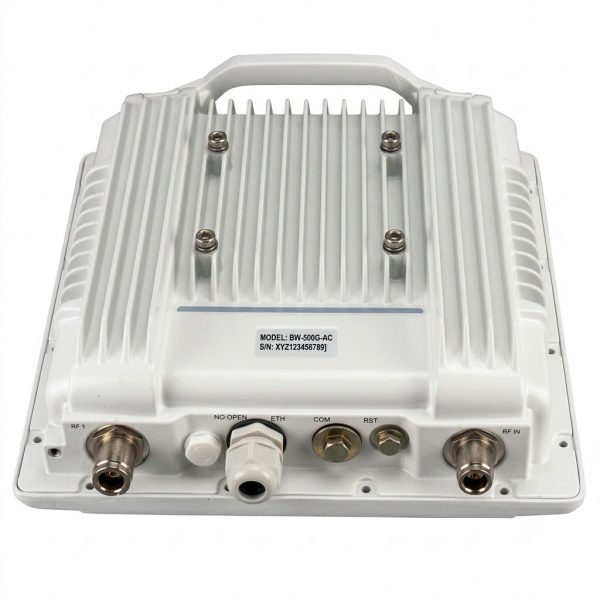
YNW-5800 Intelligent Ad-Hoc MESH Wireless Transmission
YNW-5800 enterprise outdoor MESH transceiver. 2.4/5GHz dual-band, 300Mbps per radio (2x2 MIMO), 260km/h auto-roaming, centerless Ad-Hoc, IP67. Get specs & quote now.
ModelYNW-5800
Product NameIntelligent Ad-Hoc MESH Wireless Transmission Equipment
SeriesYNW-5800 Series MESH Intelligent Ad-Hoc Equipment
Core TechnologyIEEE802.11 a/b/g/n · Dual-band Multi-module · MESH Intelligent Ad-Hoc Network
1. Product Overview
The YNW-5800 series is the latest MESH intelligent Ad-Hoc wireless transmission product developed by our company. With powerful performance, this series supports multiple communication combinations to suit different application scenarios. It can be installed at fixed points or rapidly deployed on moving vehicles, vessels, personnel, robots, and other mobile locations. The product integrates base station (BS) communications, client (CP) communications, point-to-point communications, as well as a powerful MESH Ad-Hoc capability and automatic roaming function, distinguishing it from most conventional MESH Ad-Hoc devices on the market.
Based on an advanced MESH design philosophy, the device does not require a central gateway when forming a network — any unit can self-organize into a network. Should any device within a group go offline, other devices within effective antenna coverage will automatically continue communications to ensure the network never drops. In practical applications, a ring network topology can be adopted without worrying about ring-network congestion. Moreover, in addition to the wireless MESH function, the device’s two wired Ethernet ports also support MESH operation, allowing flexible selection according to actual deployment requirements. The multi-mode MESH design also provides redundancy to guarantee better link quality in complex environments.
The YNW-5800 series supports up to a dual-module design, accommodating two RF modules on a single main board for more flexible combination in real-world applications. The product features roaming capability: while in motion, it autonomously determines and switches between different base stations based on signal strength, supporting mobile speeds greater than 260 km/h. It is therefore well suited for roadside, mining, and tourism areas that require vehicle-based mobile monitoring.
The YNW-5800 series can be customized to high-power variants with transmission power rated up to 3W, without degrading throughput in high-power operation. Leveraging its inherent characteristics, the equipment supports Point-to-Multipoint, Point-to-Point, Roaming, and MESH Ad-Hoc topologies, and is widely applied to both fixed and mobile surveillance in forest fire prevention, urban wireless Internet coverage, pristine forests, rivers and lakes, mining areas, unmanned aerial vehicles (UAVs), robots, pipelines, large industrial zones, roadways, power plants, electric utilities, fire brigades, public security, vehicles, and maritime vessel law-enforcement operations.
- Core Selling Points: Dual-band multi-module design (2.4GHz/5GHz), centerless-gateway MESH intelligent Ad-Hoc networking, automatic roaming (speed >260 km/h), and customizable high-power output (3W)
- Target Users: Wireless system integrators, telecom operators, security/surveillance contractors, and private/industrial network operators
- Typical Applications: Outdoor campus coverage, wireless surveillance backhaul, plant backbone transmission, urban coverage, and mobile monitoring for mining/roadway/scenic areas
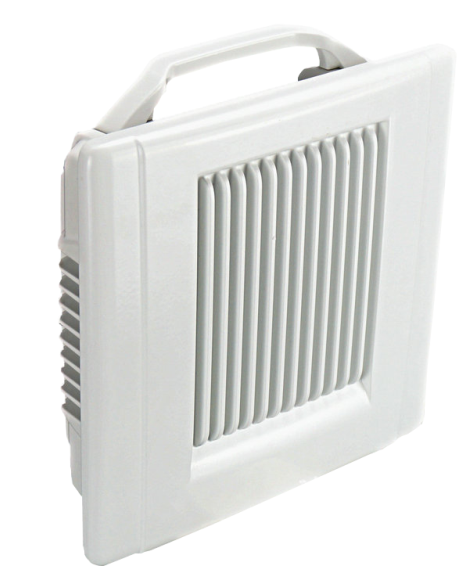
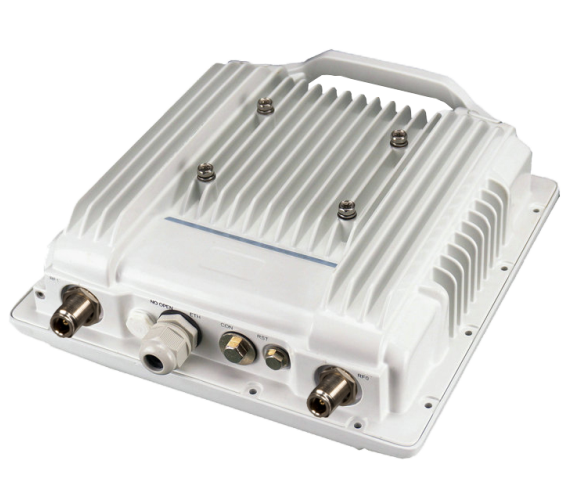
2. Product Views
3. Key Features
4. Technical Specifications
4.1 Major Components
| Category | Parameter | Specification | Custom Option |
|---|---|---|---|
| Major Components | Processor | Atheros AR7161 (680MHz) | — |
| Flash Memory | 16MBytes | — | |
| RAM | 128MBytes | — |
4.2 RF & Wireless
| Category | Parameter | Specification | Custom Option |
|---|---|---|---|
| RF & Wireless | Operating Frequency | 4900 ~ 6100MHz; 2212 ~ 2542MHz | — |
| Standards | IEEE802.11a/b/g/n CSMA/CA | — | |
| RF Type | HTOFDM | — | |
| Transmit Power | 26dBm, 35dBm | Customizable (up to 3W) | |
| Antenna Type | 2×N-type (1 radio module) / 4×N-type (2 radio modules) | — | |
| Receive Sensitivity | -95dBm@6Mbps; -79dBm@54Mbps, PER<10%; -94dBm@MCS0/8; -76dBm@MCS7/15, HT20; -90dBm@MCS0/8; -74dBm@MCS7/15, HT40 | — | |
| Modulation | 64QAM 3/4, 64QAM 2/3, 16QAM 3/4, 16QAM 1/2, QPSK 3/4, QPSK 1/2, BPSK 3/4, BPSK 1/2 | — | |
| Channel Bandwidth | 2.5/3/3.5/4/5/6/7/8/10/12/14/15/20/30/40/52MHz | — | |
| Antenna Connector | N-type: 2 connectors (1 module) / 4 connectors (2 modules) | — |
4.3 Network & Management
| Category | Parameter | Specification | Custom Option |
|---|---|---|---|
| Network & Management | Network Interface | Ethernet 10/100/1000 Mbps | — |
| Encryption | WEP, TKIP, AES; Open System, Shared Key WPA/WPA-PSK, WPA2/WPA2-PSK; 802.1x (PEAP/TLS/TTLS), WAPI | — | |
| Management | Web GUI (English/Chinese), Telnet management | — | |
| Reset | Software reset, built-in hardware reset | — | |
| Network Functions | VLAN, DHCP, NAT, ARP, TCP, UDP, IGMP, HTTP, STP, NTP, Firewall, Virtual Bridge (up to 128 SSIDs), IPv6, Packet Analysis & Filtering, Advanced Traffic Control (QoS), etc. | — | |
| Roaming | Client automatic roaming/handover | — | |
| Operating Modes | Base Station, CPE, P2P (Bridge), MESH | — | |
| Network Utilities | Ping command, network detection / site survey | — | |
| Positioning | Online map, GPS antenna positioning, manual coordinate input | — |
4.4 Electrical
| Category | Parameter | Specification | Custom Option |
|---|---|---|---|
| Electrical | Operating Voltage | 9~24VDC, or standard PoE powering | — |
| Power Consumption | Single module <10W / Dual module <20W | — | |
| Watchdog | Hardware watchdog | — |
4.5 Physical & Environmental
| Category | Parameter | Specification | Custom Option |
|---|---|---|---|
| Physical & Environmental | Operating Temperature | -30°C ~ 75°C | — |
| Humidity | 0% ~ 95% Non-condensing | — | |
| Storage Temperature | -40 ~ 85°C | — | |
| Ingress Protection | Outdoor IP67 rated | — | |
| Dimensions / Weight | 265 × 265 × 100 (mm) / 3.25Kg | — |
5. Features & Functions
5.1 Hardware Architecture
- Dual-band Multi-module Interface Design: Each module provides 2.4GHz/5GHz dual-mode transmission and switches to an alternate frequency band when subject to interference;
- Wireless Standards: Compliant with IEEE802.11a/g/n, operating at 2.212~2.542GHz and 4.900~6.100GHz;
- Transmission Technology: 2 × 2 MIMO;
- Data Rates: 1 radio card 300Mbps×1 with 180Mbps transmission bandwidth; 2 radio cards 300Mbps×2 with 280Mbps transmission bandwidth;
- Higher-grade Hardware: CPU Atheros AR7161 (680MHz), 16MB SPI flash, 128MB DDR SDRAM, capable of handling high-quality video transmission;
- IP67-rated waterproof and dustproof;
- -30~75°C operating temperature;
- Hardware watchdog support;
- Independent VLAN and Ethernet switching at the data-link layer, or router interconnection;
- Corrosion-resistant metal housing.
5.2 WiFi Standards & Advanced Functions
- Dynamic multi-mode exit/interface allocation for the wireless network to handle multi-link relay and aggregated traffic transmission;
- Wireless client bandwidth control to manage wireless transmission traffic;
- AP/CPE/Bridge/MESH operating functions;
- Multiple bidirectional bandwidth management tools to manage wireless transmission traffic;
- Configurable channel / transmit power / rate / maximum distance for transmission link stability;
- Advanced wireless parameter tuning to optimize RF signal quality and transmission stability;
- Wireless node (client) information retrieval to verify antenna alignment (built-in antenna alignment function);
- Wireless client connection limit;
- Client user isolation;
- Redundant backbone backup link via relay hops;
- Roaming and handover capability;
- Client CPE connectivity (interoperable with other vendors’ products);
- Automatic CPE discovery and connection;
- Built-in GPS displaying connection status coordinates on the UI;
- Bandwidth adjustment: 2.5MHz, 3MHz, 3.5MHz, 4MHz, 5MHz, 6MHz, 7MHz, 8MHz, 10MHz, 12MHz, 14MHz, 15MHz, 20MHz, 30MHz, 40MHz, 52MHz;
- Frequency adjustment in steps as fine as 2.5MHz.
5.3 Data Security & System Management
- SSID security mechanism with on/off/broadcast control;
- Fixed AP MAC Address binding to prevent intrusion and restrict connectivity;
- MAC Address Filtering wireless security mechanism;
- WPA/WPA2 PSK / AES (128-bit) encryption;
- Web-based management via HTTP WEB GUI;
- Telnet configuration support;
- SSH encrypted configuration;
- Command-line Interface (CLI) commands;
- Simple Network Management Protocol (SNMP) v2c/v3 with standard/private MIBs;
- System logging (Syslog);
- Management VLAN tagging;
- NTP client for network time synchronization;
- Firmware upgrade / rollback (upgrade / downgrade);
- Dual firmware images;
- Multiple-level management.
5.4 MESH Network Functions
- OSI Layer 2 Mesh Network: OSI Layer 2 data-link-layer MESH data transmission for fast data forwarding and self-healing links, reducing path-selection delay and multi-hop relay bandwidth attenuation;
- Automatic optimal path discovery;
- Automatic link-recovery path finding on disconnection;
- Automatic network traffic balancing;
- Automatic system node information updates;
- Automatic system configuration updates via gateway or server;
- Rapid automatic path transmission;
- High-speed roaming transmission using signal- and data-rate-based logic.
6. Applications
Built for wireless system integrators and public-security project teams, the YNW-5800 is an enterprise- and carrier-grade outdoor MESH transceiver. Its centerless Ad-Hoc design forms instant PtP, PtMP and Hotzone topologies, while the 2.4GHz/5GHz dual-band multi-module engine delivers the bandwidth needed for long-range video backhaul, wide-area wireless sensing and carrier-grade data trunking without depending on any fixed infrastructure.
1. Border & Coastal Defense MESH Ad-Hoc Wireless Communications
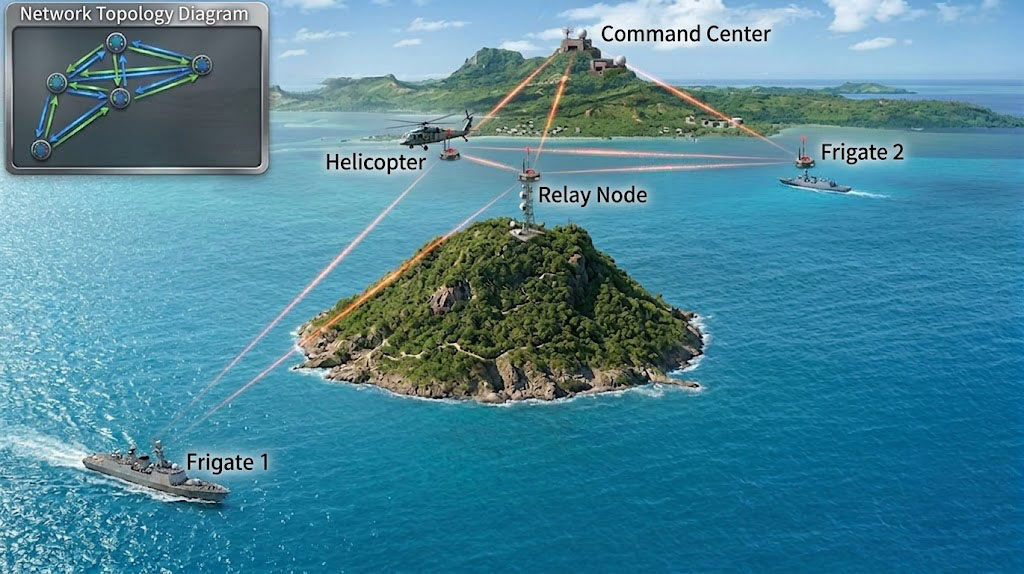
Border patrol, coastal surveillance, port inspection and maritime law-enforcement formations across mountains, deserts, jungle and island terrain where public networks are absent, demanding a dedicated broadband channel for command and dispatch.
Deployment Solution
- Dual-band cascade backbone: the 2.4GHz/5GHz dual-module YNW-5800 multi-hop cascades along borderlines or coastlines into a long-range, centerless private MESH; a node going offline is bypassed automatically so the resilient network never drops.
- Mixed fixed & mobile nodes: outpost, patrol-boat, command-vehicle and handheld terminals join one free Ad-Hoc domain, fusing ‘shore-sea-air’ situational coverage.
- Ring-friendly topology: loop structures deploy without congestion concerns, boosting redundancy and service continuity.
Application Value
Real-time HD video, voice intercom and data backhaul keep border outposts, patrol boats and command vehicles linked even where no public network exists, giving the command center continuous border and maritime situational awareness to sharpen rapid response and coordinated joint operations.
2. Convoy MESH Ad-Hoc Wireless Communications
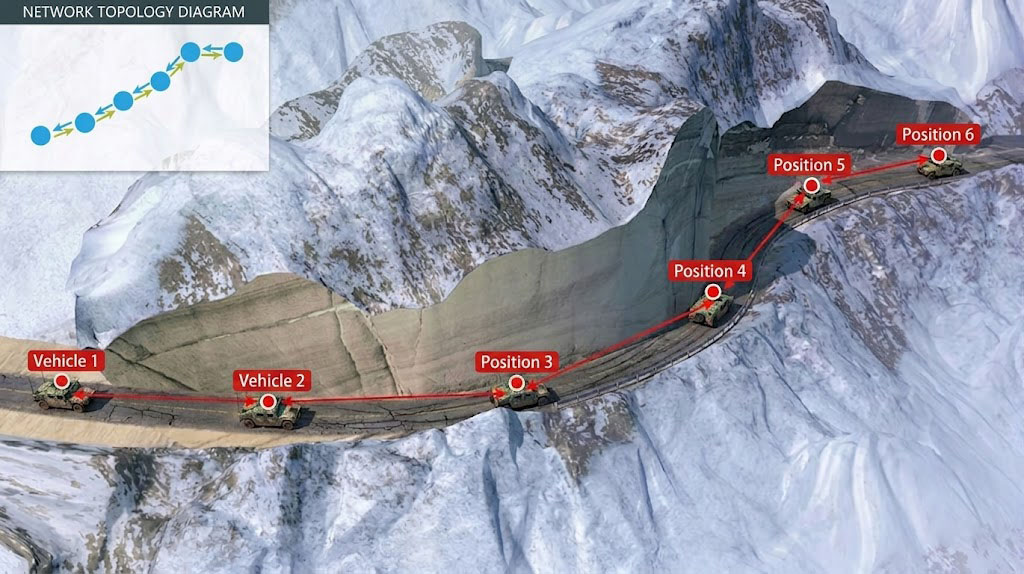
Convoy movements, material transport, mining-area dispatch, tourism-zone monitoring and logistics fleet coordination, where inter-vehicle gaps and road conditions keep changing and traditional radio cannot guarantee a stable convoy link.
Deployment Solution
- Vehicle-to-vehicle direct links: a YNW-5800 per vehicle auto-forms MESH routing with no dependence on base stations or public networks.
- Handover without signal loss: roaming is chosen by live signal strength during high-speed travel above 260 km/h, with no service gap.
- Concurrent services: HD video backhaul, push-to-talk voice and position sharing ride a 2×2 MIMO pipe that satisfies broadband needs.
- Relay scaling: multi-hop MESH relay extends seamless coverage across growing convoys.
Application Value
Moving vehicles share HD video, voice and location in real time while the command vehicle holds the full picture of the formation; it also gives mining, roadway and tourism mobile-fleet monitoring a public-network-independent dedicated channel for stronger mobile command and surveillance coverage.
3. Vessel-boarding Reconnaissance MESH Ad-Hoc Wireless Communications
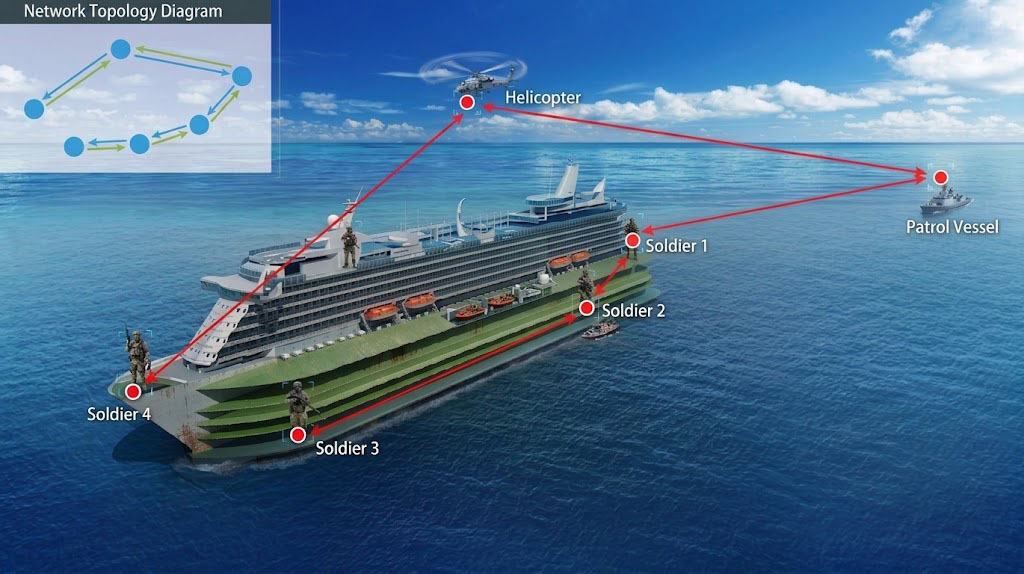
Boarding inspections, evidence gathering, cross-vessel coordination, fleet formation and coast-guard patrols on water, where wave motion, heavy sea-surface multipath and constantly changing ship positions defeat ordinary links.
Deployment Solution
- Automated vessel-to-vessel meshing: each vessel carries a YNW-5800 and broadband MESH links form autonomously for formation communication and coordinated boarding.
- Interference-resilient dual band: frequency switching under interference counters maritime multipath to preserve a stable link.
- Fast-converging roaming: as ships reorient, automatic roaming reconfigures the mesh without a break in communications.
Application Value
Stable sea-borne broadband links between vessels enable live HD video and voice backhaul during boarding, coordination and evidence collection, strengthening maritime law enforcement, search and rescue, and tactical coordination while raising safety and operational efficiency.
4. Public Security Disposal & Armed Patrol MESH Ad-Hoc Wireless Communications
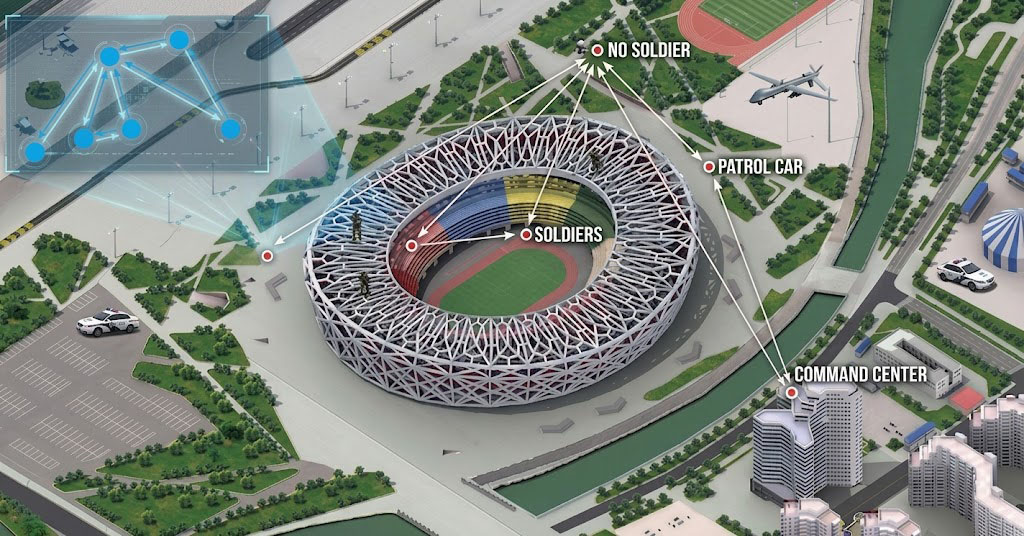
Major-event security, temporary interception and arrest, armed patrols, counter-terrorism and mass-incident handling where rapid deployment, a temporary private network, multi-stream video backhaul and immunity to public-network congestion are paramount.
Deployment Solution
- Zero-config rapid private net: the YNW-5800 grows an IP MESH on-site in seconds, fully independent of telco infrastructure.
- Centerless survivability: any node can drop out yet the network keeps routing, holding communication during congestion or outage.
- Multi-terminal convergence: body-worn, vehicle and temporary camera endpoints all converge, returning several live video streams to the command post.
- Layered encryption: WPA/WPA2-PSK/AES and 802.1x/WAPI protect sensitive enforcement traffic.
Application Value
Command staff see the on-site picture in real time during events, disposals and patrols, with stable backhaul of multi-stream HD video, voice and data; the centerless design keeps the link alive through extreme public-network failures, sharpening response and coordination.
5. Firefighting & Rescue MESH Ad-Hoc Wireless Communications
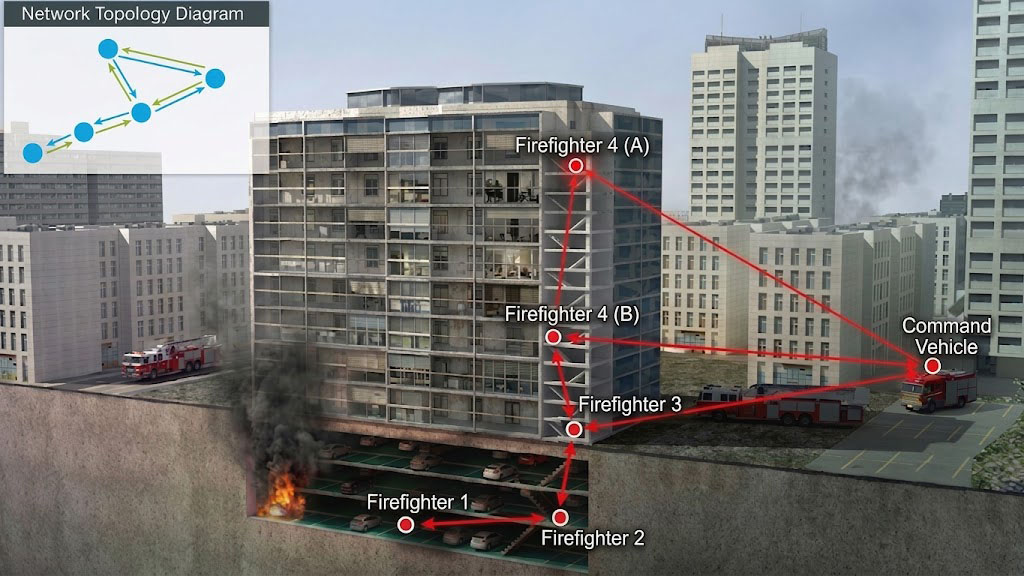
Building, forest and chemical firefighting, earthquake and accident rescue, and hazardous-material incidents where on-site public networks are often down and a dedicated rescue channel is essential.
Deployment Solution
- Instant field deployment: command vehicles, temporary base stations and body-worn units go live without infrastructure to build a dedicated broadband Ad-Hoc net.
- Body->vehicle->command ladder: rescuers carry portable MESH nodes into the scene and relay HD video back to the field command vehicle and rear center.
- Self-healing resilience: damaged or moving nodes trigger automatic route rebuild so remaining units stay connected without interruption.
Application Value
The rear command center sees the full incident picture, dispatches forces scientifically and protects savers; reliable links through the ‘golden 72-hour’ window buy vital time to save lives and maximize rescue safety and outcomes.
6. Natural-disaster Emergency Command MESH Ad-Hoc Wireless Communications
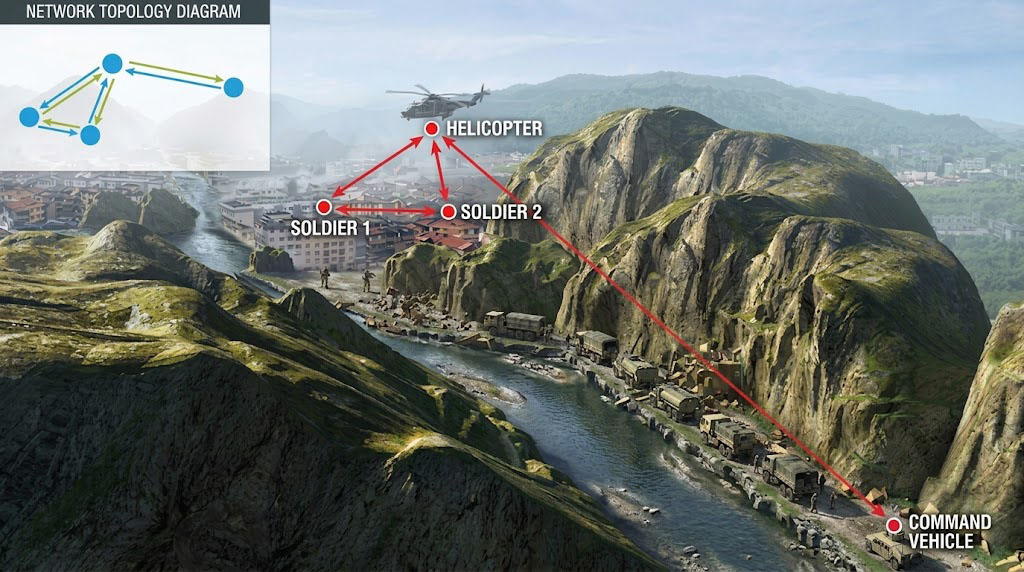
Earthquake, flood, debris-flow, landslide and typhoon emergencies that destroy communications infrastructure and strand command teams in an ‘information island’.
Deployment Solution
- Rapid disaster-zone bring-up: rescue crews carry YNW-5800 units into the area; dual-band Ad-Hoc and multi-hop relay deliver wide-area coverage fast.
- Air-ground three-dimensional net: pairing with UAV airborne relays overcomes mountains and ruins for whole-disaster-zone coverage.
- Autonomous self-healing: topology heals automatically as nodes move, fail or join, with zero manual tuning.
- Service convergence: fuses zone video backhaul, disaster-data reporting, rescue-team positions and command-issuing.
Application Value
Stable links backhaul live video, disaster data and rescue-team positions to front-line and rear commands in real time, letting the command center judge the situation, allocate forces and reduce casualties and property loss.
7. Forest Fire Prevention MESH Ad-Hoc Wireless Communications
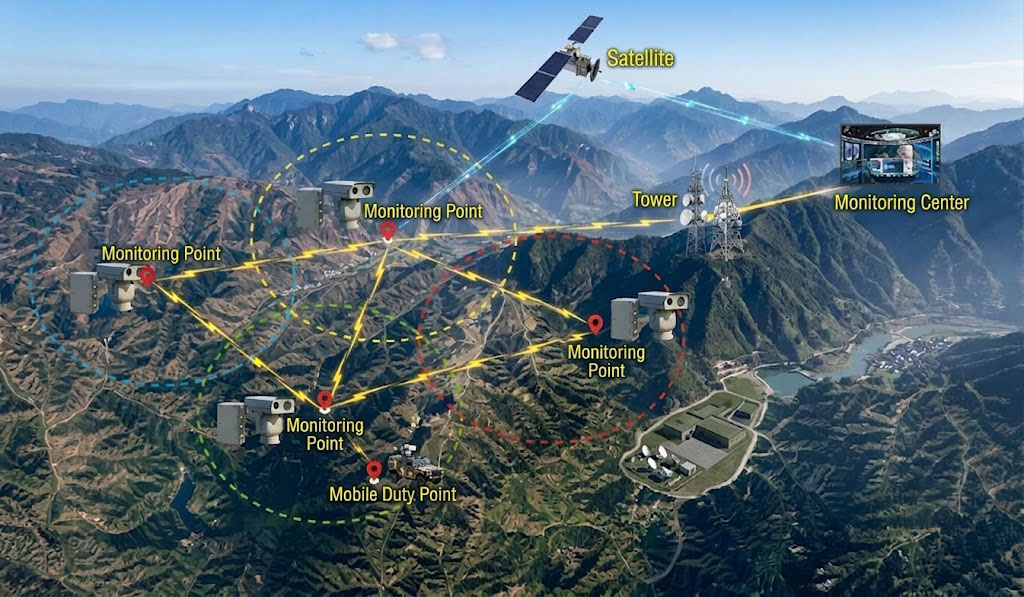
Forest-fire monitoring, patrol communication, watchtower links, frontline command, pristine-forest surveillance and forest-zone control, where vast mountainous forests with weak public coverage make fire-prevention networking historically difficult.
Deployment Solution
- Multi-point forest coverage: watchtowers, fire checkpoints and management stations each hold a YNW-5800 to form a broadband Ad-Hoc private net across wide forest areas.
- Terrain-defeating relays: multi-hop MESH and air relays overcome mountain, hill and canyon shadowing for far-reaching coverage.
- Watchtower-UAV-ground synergy: fixed watchtowers, patrolling UAVs and ground crews coordinate to return video and alarms to the prevention center live.
- Early automatic alerting: interfacing smoke and thermal sensors pushes fire alarms over the MESH for early detection, reporting and response.
Application Value
A wide air-ground MESH keeps surveillance, patrol and fire line nodes linked so fires are spotted, reported and fought early, protecting forest resources and ecological security while supporting safe frontline suppression command.


