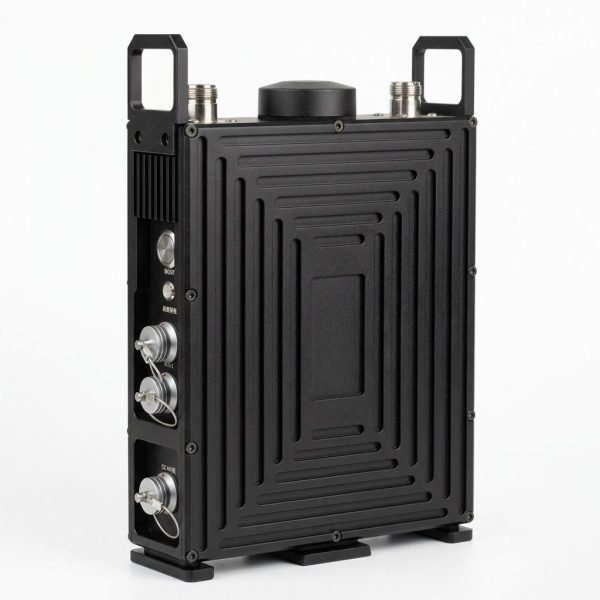
YNW-7520A-BCJ backpack/vehicle/base-station tactical MESH Ad-Hoc radio 43dBm (2x10W) 200+km
YNW-7520A-BCJ Backpack/Vehicle/Base-station Tactical Broadband Wireless MESH Ad-Hoc Network Equipment", "description": "YNW-7520A-BCJ is a backpack/vehicle/base-station tactical broadband wireless MESH Ad-Hoc network device for complex scenarios such as emergency communications, smart city, public security and firefighting, anti-terrorism special operations, and rescue and disaster relief. Based on COFDM and mobile Ad hoc network technology, it builds wireless IP MESH networks quickly without any fixed infrastructure, features self-organization, self-recovery and high survivability, and supports multi-hop transmission of multimedia services. With 43dBm (2x10W) transmit power and -103dBm receiver sensitivity, it delivers 200+ km air-to-air line-of-sight and 50+ Mbps peak throughput at 20 MHz.
ModelSF-7520A-BCJ
Product NameBackpack/Vehicle/Base-station Tactical Broadband Wireless MESH Ad-Hoc Network Equipment
English NameBackpack/Vehicle/Base-station Tactical Broadband Wireless MESH Ad-Hoc Network Equipment
Product SeriesSF-7500 Series MESH Ad-Hoc Network Equipment
Core TechnologyCOFDM + Mobile Ad hoc network + TDD + 2T2R transmit/receive diversity
1. Product Overview
The SF-7520A-BCJ backpack/vehicle/base-station radio is developed with COFDM and mobile Ad hoc network technology. It does not rely on any basic communication infrastructure and can temporarily, dynamically and rapidly build a wireless IP MESH network. With the capability of self-organization, self-recovery and high survivability, it supports multi-hop transmission of multimedia services such as data, voice and video, and can be applied in emergency communications, smart city, wireless image transmission, field operations, underground mine operations, temporary conferences, environmental monitoring, public security and firefighting, anti-terrorism special operations, rescue and disaster relief, individual-soldier collaboration, and vehicle networking.
The portable Ad-Hoc radio, combined with backpack/vehicle Ad-Hoc radios, can form a hybrid clustered, hierarchical network. Vehicle Ad-Hoc radios establish a long-distance backbone network among themselves, portable Ad-Hoc radios form platoon subnets, supporting multi-hop communication of multimedia services such as video, voice and data. IP terminals such as smartphones, tablets and PCs can access the Ad-Hoc network via an Ethernet port or WiFi AP, enabling interconnection and interworking among various IP application terminals.
- Core selling points: intelligent anti-interference adaptive frequency selection, COFDM + transmit/receive diversity ultra-long-distance communication (air-to-air line-of-sight 200+km), high throughput (peak 50+Mbps@20MHz), dynamic TDMA large network scale (64 nodes on single frequency)
- Target users: tactical communication users in military communications, public security and firefighting, anti-terrorism special operations, rescue and disaster relief, emergency communications, individual-soldier collaboration, and vehicle networking
- Applicable scenarios: emergency communications, smart city, wireless image transmission, field operations, underground mine operations, temporary conferences, environmental monitoring, individual-soldier collaboration, and vehicle networking
2. Product Views
3. Key Features
4. Technical Specifications
4.1 RF Parameters
| Item | Specification | Custom |
|---|---|---|
| Frequency Range | 1300 ~ 1500MHz, 1Hz step adjustable | 70MHz ~ 6000MHz customizable |
| Bandwidth Mode | 2.5 / 5 / 10 / 20* MHz adjustable (*optional) | — |
| Communication Waveform | TDD-COFDM + 2T2R | — |
| Carrier Modulation | QPSK / 16QAM / 64QAM / 256QAM | Adaptive or fixed configuration |
| Data Rate | Peak 25+Mbps@10MHz, 50+Mbps@20MHz | — |
| Receiver Sensitivity | -103dBm | — |
| Transmission Distance | >200km (line-of-sight) | — |
| Transmit Power | 43dBm (2*10W), 1dBm step adjustable | Power customizable |
| Anti-Interference | Adaptive frequency selection, up to 16 candidate frequencies, selection range related to PA | — |
4.2 Networking Capability
| Item | Specification | Custom |
|---|---|---|
| Networking Capability | Supports 64+ nodes | — |
| Network Scale | Up to 64 nodes on single frequency | — |
| Multi-hop Capability | Short message up to 15+ hops, voice up to 10+ hops, video up to 8+ hops | — |
| Mobility Speed | Supports high-speed mobility of 1000+ km/h | — |
| Transmission Latency | Approximately 7ms per hop | — |
| Startup Time | Less than 27s | — |
| Network Join Time | Less than 1s | — |
| Route Switching | Less than 1s | — |
4.3 Interfaces & Extension
| Item | Specification | Custom |
|---|---|---|
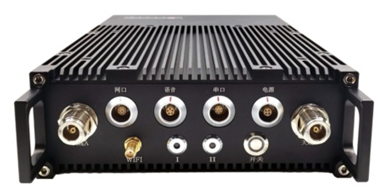
| Data Interface | Ethernet x 2, Serial x 3 | TTL / RS232 / RS422 / RS485 customizable |
| Wireless Extension | WiFi AP | — |
| Video Extension | Video encoder HDMI / SDI / CVBS* (*on demand) | — |
| Satellite Positioning | GPS / BD* (*on demand) | — |
| Voice Communication | IP voice conference / PTT intercom | Software configurable, standard PTT handset |
4.4 Electrical & Physical
| Item | Specification | Custom |
|---|---|---|
| Battery Charging | 33.6V / 1.5A | — |
| Power Consumption | 30 ~ 90W | — |
| Operating Time | 3 ~ 4 hours | — |
| Operating Temperature | -40°C ~ 65°C | — |
| Protection Rating | IP66 | — |
| Dimensions | 176 x 265 x 60 mm | — |
| Weight | 3.5kg (excluding antenna) | — |
5. Features & Functions
- Network architecture: centerless, distributed wireless IP MESH Ad-Hoc network;
- Anti-multipath interference: COFDM multi-carrier modulation provides strong anti-multipath-interference capability;
- Survivability & self-healing: the failure of individual terminals does not affect normal network operation, providing strong survivability;
- Networking modes: mesh network, chain network, point-to-point, point-to-multipoint, multipoint-to-multipoint;
- Intelligent anti-interference: adaptive frequency selection supports up to 16 preset candidate frequencies, automatically evaluating communication quality across candidates and selecting the interference-free frequency with the best quality;
- Diffraction capability: strong diffraction and penetration capability;
- MAC protocol: dynamic TDMA protocol;
- Routing protocol: optional Layer 2 / Layer 3 intelligent dynamic routing;
- Flexibility: highly extensible, nodes can dynamically join and leave;
- Link optimization: supports QoS routing and weak-link filtering to enhance network operation stability;
- Loop detection: when two radios on the same network connect to the same switch via Ethernet, normal data transmission is guaranteed;
- Secure encryption: supports DES / AES128 / AES256 channel transmission encryption, ensuring information security without affecting end-to-end throughput;
- Spectrum scanning: features spectrum scanning to inspect the noise floor and burst-interference condition of candidate frequencies, guiding working-frequency optimization;
- Configurable data rate: the modulation and coding scheme (MCS) can be configured as adaptive or fixed, suitable for asymmetric uplink/downlink rates or low-rate high-reliability applications;
- In-network multicast: supports multicast and broadcast of Ethernet IP data, blacklist and whitelist settings, and serial-to-serial point-to-point / point-to-multipoint multicast;
- IP transparent transmission: supports transparent transmission of UDP/TCP data between Ethernet-to-Ethernet, Ethernet-to-Serial and Serial-to-Serial, as well as serial parameter configuration;
- Internet extension: effectively extends Internet coverage; any terminal in the network can act as a gateway, and all nodes can access the Internet through the gateway node;
- Configuration management: configures radio communication frequency, working bandwidth, transmit power, network IP, keys and other parameters, and dynamically displays network topology, link quality, signal strength, ambient noise floor, spectrum analysis and working temperature;
- WiFi AP: provides a WiFi hotspot for smartphones, tablets, computers and other devices to access, serving as application terminals for user interaction (application terminals require users to develop the corresponding application programs);
- Network indicator: a dual-color indicator; red indicates power-on without joining the network, green indicates joined;
- Signal indicator: a tri-color indicator that displays different colors according to communication link quality.
6. Applications
Using MESH Ad-Hoc network technology, this product can be flexibly applied to military communications private networks, public safety private networks, emergency communications private networks, industry information private networks, regional broadband private networks, wireless surveillance private networks, collaborative management private networks and intelligent transmission private networks, providing stable, reliable, timely and efficient high-definition video, multi-channel data, clear voice and visualized command and dispatch for military communications, anti-terrorism emergency response, police law enforcement, security operations, rescue and disaster relief, firefighting command, forest fire prevention, forest-zone monitoring, civil air defense / earthquake, power transmission line inspection, digital oilfield, UAV swarms, fleet interconnection, naval ship formation, maritime communications, airport ground support, subway emergency, highway construction, hydrological monitoring, mobile broadcasting and medical fields.
1. Border and Coastal Defense MESH Ad-Hoc Network Wireless Communication Application
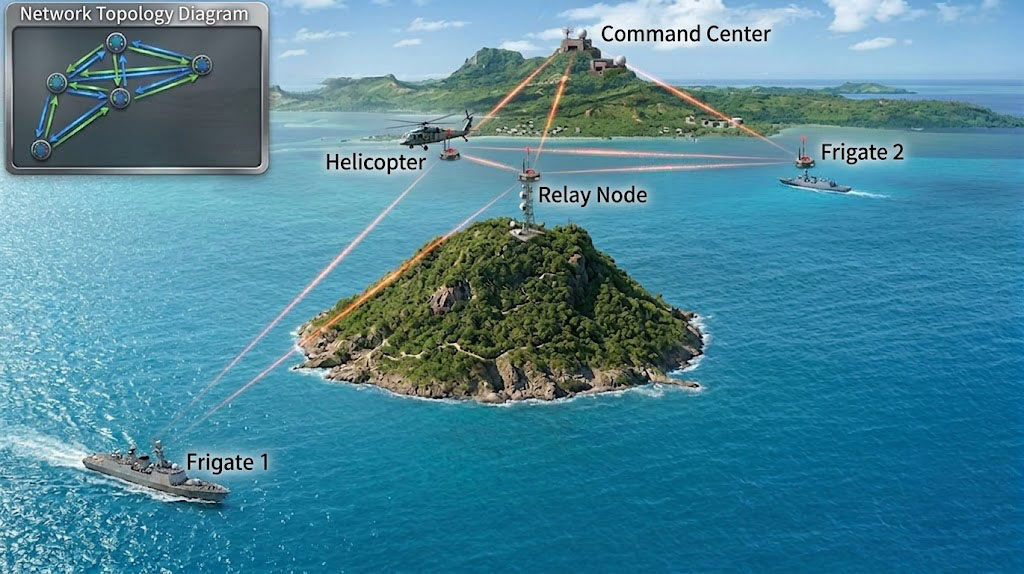
Long-distance, wide-coverage border and coastal defense communication scenarios such as border patrol, coastal defense surveillance, border port control, coastline alerting, border post interconnection and maritime law-enforcement ship formation communication. Our country's borderlines and coastlines are long with complex and diverse terrain including mountains, deserts, jungles and islands. Traditional public networks cannot fully cover them, making dedicated broadband communication a necessity for border and coastal defense command and dispatch.
Deployment Scheme
- Multi-hop cascade deployment: YNW-7520A-BCJ backpack/vehicle/base-station radios are cascade-deployed along the borderline or coastline, with an air-to-air line-of-sight transmission distance of 200+km; multi-hop relay builds a centerless broadband private network covering tens to hundreds of kilometers.
- Diverse node forms: fixed deployment at border posts, shipboard deployment on patrol boats, vehicle deployment on mobile command vehicles and manpack deployment on soldiers freely self-organize, combined with backpack/vehicle radios for hybrid clustered, hierarchical networking, realizing integrated "shore-sea-air" coverage.
- High-power long-distance: maximum 43dBm (2*10W) transmit power, combined with COFDM and transmit/receive diversity technology, achieves more stable long-distance transmission in wide-area border and coastal scenarios.
Application Value
Border posts, patrol boats and mobile command vehicles can return high-definition video, voice intercom and situational-awareness data in real time, keeping command links open even in remote areas without public-network coverage. The command center can grasp border dynamics and maritime situations in real time, effectively enhancing situational-awareness, rapid-response and coordinated-combat capability, providing reliable communication support for border and coastal defense control.
2. Convoy MESH Ad-Hoc Network Wireless Communication Application
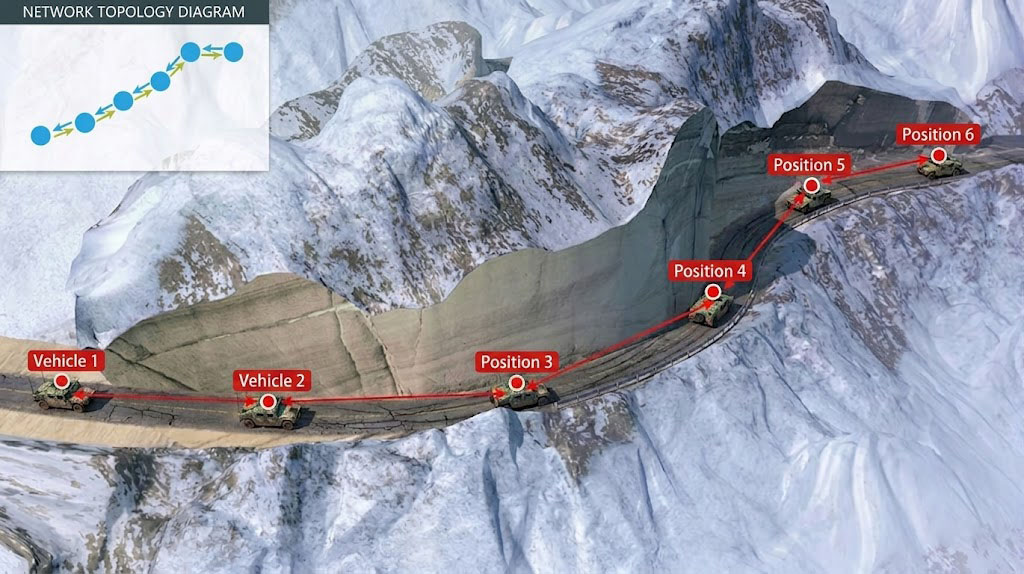
Mobility scenarios such as convoy formation movement, military escort and transportation, material transport, VIP convoy security, long-distance passenger fleet management, logistics fleet collaboration and railway engineering vehicle group communication. During movement, the distances between vehicles change constantly and road conditions are complex; traditional communication methods cannot guarantee stable real-time communication between vehicles in a convoy.
Deployment Scheme
- Direct vehicle-to-vehicle networking: each vehicle deploys a YNW-7520A-BCJ vehicle radio, and MESH links are automatically established between vehicles, with no dependence on fixed base stations or public networks.
- Dynamic route convergence: under complex conditions such as high-speed movement, changing inter-vehicle distance, road obstruction and tunnel passage, the network topology automatically reconfigures and routes converge within seconds (route switching below 1s) without communication interruption.
- Concurrent multi-service: supports concurrent transmission of vehicle high-definition video backhaul, voice intercom (IP voice conference / PTT intercom), vehicle position sharing and command-issuing, with a peak rate of 50+Mbps@20MHz meeting broadband service requirements.
- Relay expansion: when the convoy is large or terrain obstruction is severe, multi-hop relay expands coverage; video up to 8+ hops, and a single frequency supports Ad-Hoc networks of up to 64 nodes.
Application Value
During convoy mobility, high-definition video, voice intercom and position information are shared in real time among vehicles, and the command vehicle can grasp the whole fleet situation, supporting integrated formation command and coordinated dispatch. In missions such as anti-terrorism stability maintenance, armed escort and military material transport, it provides the convoy with a dedicated secure communication channel independent of public networks, significantly enhancing fleet mobility-command capability and mission-execution safety.
3. Naval Boarding & Reconnaissance MESH Ad-Hoc Network Wireless Communication Application
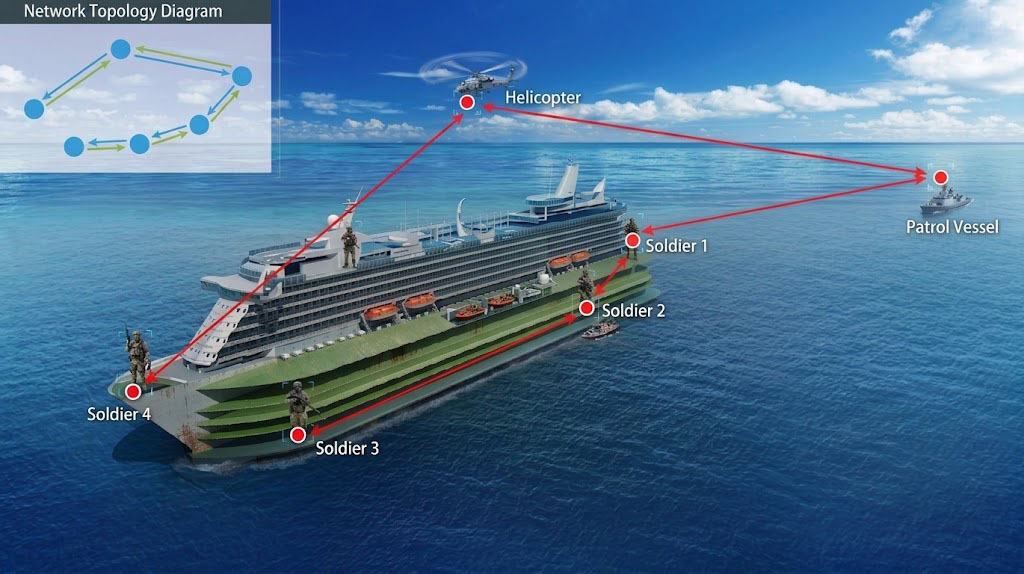
Maritime task scenarios such as naval boarding inspection, reconnaissance and evidence collection, cross-ship coordinated operations, ship formation communication, maritime law-enforcement boarding, coast guard patrol and naval tactical coordination. The maritime communication environment is special, facing challenges such as wave fluctuation, severe multipath interference and constantly changing relative positions between ships; traditional communication methods cannot provide stable support.
Deployment Scheme
- Ship-to-ship coordinated networking: multiple ships each deploy a YNW-7520A-BCJ radio, and broadband MESH links are automatically established between ships, supporting ship formation coordinated operations and comprehensive communication.
- Boarding-team extension: boarding inspection teams are equipped with backpack MESH devices that remain in constant communication with the mothership radio, returning high-definition video and voice from the boarding scene in real time to the mothership command center.
- Anti-multipath interference: COFDM modulation effectively suppresses multipath reflection interference over the sea surface, keeping the link stable under highly dynamic conditions such as wave fluctuation and ship pitching.
- Fast route convergence: the device supports fast route convergence in highly dynamic environments and 1000+km/h high-speed mobility; when relative positions between ships change, the network topology automatically adjusts without communication interruption.
Application Value
In tasks such as naval boarding inspection, reconnaissance and evidence collection and cross-ship coordination, stable maritime broadband Ad-Hoc links are established between ships and between ships and boarding teams, returning scene high-definition video and voice in real time to provide reliable communication support for maritime law enforcement, search and rescue and tactical coordination. Commanders can grasp the boarding situation in real time and make remote command decisions, significantly improving maritime law-enforcement safety and tactical-coordination efficiency.
4. Public Security Control & Armed Patrol MESH Ad-Hoc Network Wireless Communication Application
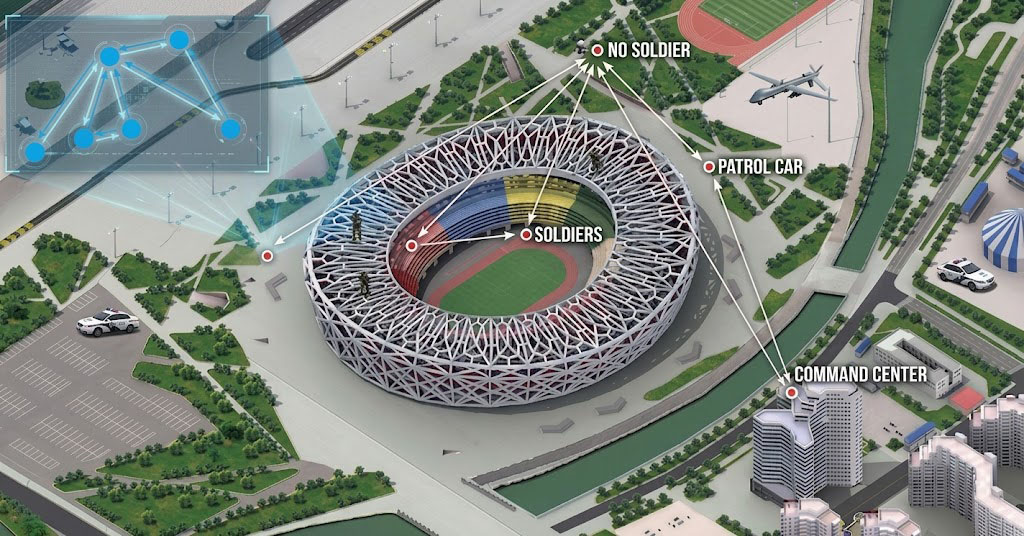
Public safety scenarios such as major-event security (meetings, competitions, performances), temporary control and arrest, armed patrol, anti-terrorism emergency response, group-event handling, VIP protection, checkpoint inspection and special operations. These scenarios place extremely high demands on fast deployment, temporary private networks, multi-channel video backhaul and resilience to public-network congestion.
Deployment Scheme
- Rapid temporary private network: YNW-7520A-BCJ can temporarily, dynamically and rapidly build a wireless IP MESH network, setting up a dedicated broadband network at the mission site without configuration and fully independent of public networks.
- Multi-terminal converged access: individual-soldier law-enforcement recorders, vehicle terminals, temporary surveillance cameras and UAV aerial relays access uniformly through the MESH Ad-Hoc network; IP terminals such as smartphones, tablets and PCs can access via Ethernet or WiFi AP, with multi-channel video returned to the command center in real time.
- Centerless architecture: the centerless Ad-Hoc architecture does not rely on public-network base stations; the failure of individual terminals does not affect normal network operation, keeping communication unblocked in emergencies such as network congestion or public-network outage (e.g., public-network congestion caused by large-event crowds).
- Intelligent anti-interference: adaptive frequency selection supports up to 16 candidate frequencies, automatically switching to an interference-free frequency to ensure transmission reliability.
- Secure encryption: supports DES/AES128/AES256 channel transmission encryption to ensure the security of public-security private-network information.
Application Value
In public safety scenarios such as major-event security, temporary control and armed patrol, it provides real-time on-site situational awareness for public-security command decisions, with stable backhaul of multi-channel high-definition video, voice intercom and data. The centerless architecture ensures uninterrupted communication under extreme conditions such as public-network outage and network congestion, providing reliable communication support for anti-terrorism emergency response and emergency command, and enhancing public-security rapid-response and coordinated-combat capability.
5. Firefighting & Rescue MESH Ad-Hoc Network Wireless Communication Application
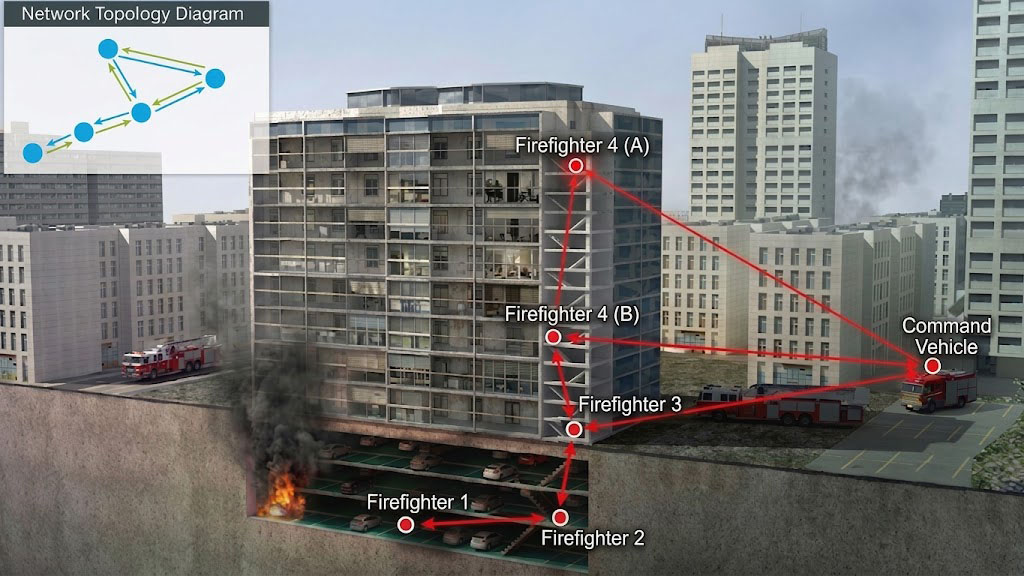
Communication support at disaster sites such as firefighting (building, forest and chemical fires), earthquake rescue, accident emergency response, hazardous-chemical leakage, traffic-accident rescue and building-collapse rescue. At disaster sites, public-network communication is often interrupted or severely congested, making dedicated communication essential for rescue command.
Deployment Scheme
- Rapid on-site deployment: YNW-7520A-BCJ can be rapidly set up at the disaster site to quickly build a dedicated broadband Ad-Hoc network among firefighters, command vehicles and temporary command posts, without requiring any infrastructure support.
- Three-level soldier-vehicle-command networking: firefighters wear backpack MESH devices and go deep into the fire scene; through vehicle/base-station radio relay, in-fire-scene high-definition video is returned in real time to the on-site command vehicle and rear command center, realizing "soldier-vehicle-command" three-level networking.
- Concurrent multi-channel video: supports concurrent backhaul of multiple high-definition video channels (video up to 8+ hops), allowing the command center to view real-time pictures of multiple fire points and multiple rescue teams simultaneously and fully grasp the on-site situation.
- Self-healing, damage-resistant: when a node device fails or moves, the network automatically reconfigures and the remaining nodes re-establish routes without communication interruption, ensuring rescue continuity.
Application Value
Helps the rear command center grasp the full picture of the scene, scientifically dispatch rescue forces and improve rescue efficiency and safety. Firefighters can receive command instructions in real time, return on-site video and communicate by voice with the command center, avoiding blind action and maximizing firefighter safety and rescue effectiveness. It provides reliable communication support within the "72-hour golden rescue window", winning precious time for life rescue.
6. Natural Disaster Emergency Command MESH Ad-Hoc Network Wireless Communication Application
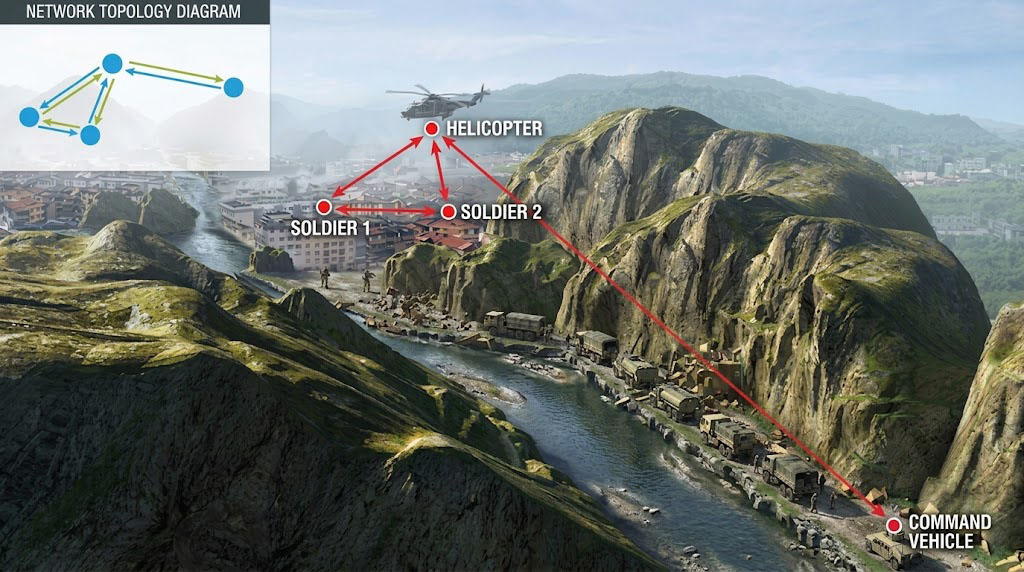
Emergency command communication support for sudden natural disasters such as earthquakes (especially strong quakes above magnitude 7), floods and waterlogging (flood peak transit, dam breach, urban inundation), mudslides, landslides, typhoons, and snow/freezing-rain disasters. Such disasters often cause large-scale damage to communication infrastructure and complete interruption of public-network communication, leaving emergency command facing an "information island" dilemma.
Deployment Scheme
- Rapid disaster-zone deployment: rescue teams carry YNW-7520A-BCJ devices into the disaster zone and rapidly establish temporary communication nodes, achieving wide-area coverage through multi-hop relay and breaking through terrain blockage.
- Air-ground integrated networking: combined with UAV aerial relay platforms, builds an "air-ground" three-dimensional Ad-Hoc network that breaks through the complex-terrain limits of mountainous areas and ruins, achieving full coverage of the disaster zone.
- Multi-hop relay wide coverage: supports 8+ video multi-hop relay with an air-to-air line-of-sight of 200+km; multi-hop cascading achieves wide-area coverage of tens to hundreds of kilometers to meet the large-area communication needs of the disaster zone.
- Self-healing, damage-resistant: the self-healing characteristic ensures the network automatically reconfigures when nodes move, devices fail or new nodes join, with no manual intervention, providing continuous and reliable communication support for emergency command.
- Multi-service fusion: supports fused transmission of on-site video backhaul, disaster-data reporting, rescue-team position sharing, command-issuing and victim assistance-requesting information.
- Front-rear linkage: the on-site disaster command post links to the rear provincial/national emergency command center via satellite links to realize real-time coordinated command between front and rear.
Application Value
Facing sudden natural disasters, it provides stable and reliable communication support for emergency command and dispatch, returning on-site video, disaster data and rescue-team positions to the front/rear headquarters in real time. The command center can fully grasp the disaster situation, scientifically schedule rescue forces, optimize rescue routes and improve rescue efficiency. It guarantees communications for life rescue within the "72-hour golden rescue window", minimizing casualties and property losses.
7. Forest Fire Prevention MESH Ad-Hoc Network Wireless Communication Application
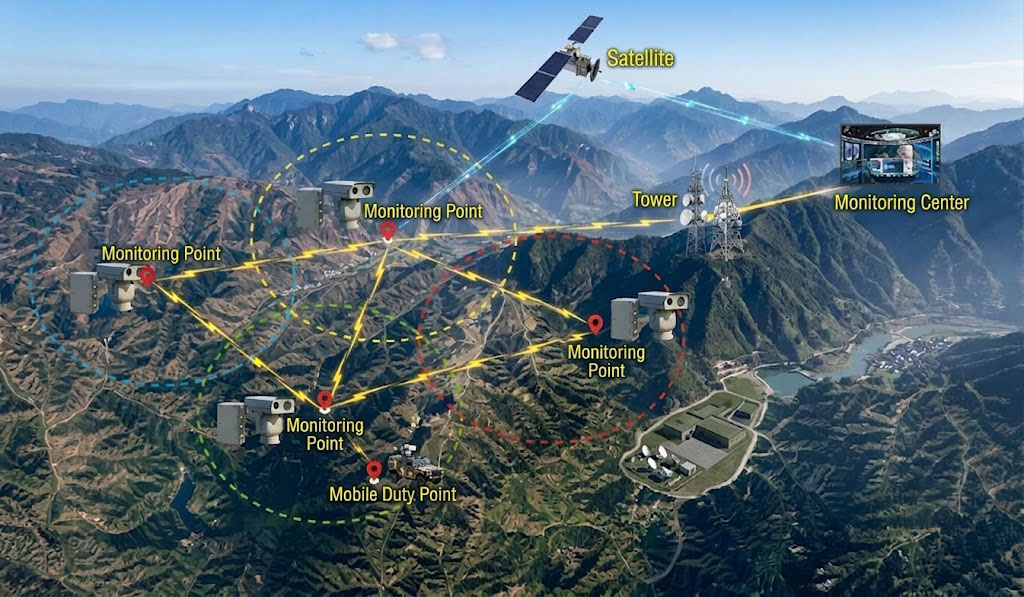
Forest scenarios such as forest fire monitoring, forest-zone patrol communication, watchtower interconnection, fire-suppression front-line command, fire-scene situation backhaul, wildlife protection in forest zones and forest-zone security control. China's vast forest resources are mostly distributed in mountainous and remote areas where public-network coverage is weak. Forest fire communication has long faced the challenges of difficult coverage, difficult networking and high cost.
Deployment Scheme
- Multi-point deployment in forest zones: YNW-7520A-BCJ can be deployed at multiple key points such as forest watchtowers, fire-prevention checkpoints and management stations to build a broadband Ad-Hoc private network covering the vast forest.
- Multi-hop relay across terrain: through multi-hop relay, terrain obstruction from forest cover and elevation changes is overcome to achieve wide-area coverage in complex terrain such as hills, mountains and canyons, with strong anti-multipath and diffraction capabilities.
- Watchtower-UAV-soldier collaboration: fixed watchtower monitoring, patrol UAV aerial inspection and fire-suppression soldiers deep in the fire front form a three-in-one collaborative network, returning video and alert information to the fire-prevention command center in real time.
- High-power long-distance: maximum 43dBm (2*10W) transmit power achieves more stable long-distance transmission over vast forest zones, reducing the number of relay nodes and lowering deployment cost.
- Automatic fire alerting: interfaces with fire-detection devices such as smoke sensors and infrared thermal imaging; automatic fire-alert information is returned to the command center in real time through the MESH network to realize early detection, early reporting and early disposal of outbreaks.
Application Value
Builds a broadband Ad-Hoc private network covering vast forests, returning video and alert information from watchtowers, patrol UAVs and fire-suppression front lines to the fire-prevention command center in real time for early detection, early reporting and early disposal of outbreaks. When fire occurs, it provides reliable communication support for fire-suppression front-line command, enhancing collaborative fire-suppression efficiency and firefighter safety, and providing solid communication support for forest-resource conservation and ecological security.


