Fire-Rescue On-Site Command & Firefighter Communications Solution: Get Into the Fire, Get the Video Back
Core Overview
Who this article is for: The communications-support departments of fire-rescue general corps and detachments, city fire services, forest fire services, dedicated fire brigades, and fire-information system integrators.
The core problem: Fire grounds, high-rise buildings, underground spaces and urban villages have complex structures where public-network coverage does not reach. Traditional narrowband two-way radios only carry voice and cannot carry video, so commanders cannot see the real-time images or environmental status of team members who have entered the fire, and the risk of a lost firefighter is high.
The core conclusion: Using a “command vehicle + backpack radio + firefighter handheld” combination over a 1.4 GHz Mesh ad-hoc network, on-site command, relay extension and firefighter backhaul are linked into a single broadband network — the backpack radio extends coverage, the handheld terminal reaches deep into the fire to backhaul real-time audio/video/thermal feeds, and the command end directs while watching, achieving “call-and-you’re-through, get in, get back out.”
Why Fire-Ground Communications “Cannot Carry Video”
The pain point scenario. In a pre-dawn fire in a high-rise residence, the command vehicle is parked in the plaza in front of the building. It can hear the two-way-radio calls of team members inside, but it cannot see the thermal image, the distribution of combustibles, or the routes the members are taking in and out. Firefighters carrying 15 kg of gear charge into the stairwell; the air-supply time of the self-contained breathing apparatus is measured in minutes. Once imagery is lost deep in the fire, any decision by the commander to “advance” or “retreat” can only wait — wait for the members to call out themselves. And with the complex light and sound environment of a fire ground, the call-out itself can be delayed or misunderstood.
Look at the timeline longer and the problem is more serious: command decisions today are not just “advance or retreat” but whether water supply is in place, whether the attack route is blocked, and whether the evacuation route is filled with smoke. These are hard to convey in a single line of two-way radio, and relayed verbally by team members they bring delay and error. What truly supports “visualized command” is a continuous stream of video and thermal imagery — and video is precisely what narrowband two-way radio cannot deliver. This is the first physical-layer reason a fire ground “cannot carry video”: business-bandwidth mismatch.
The second physical-layer reason is frequency-band propagation. Modern fire command is moving from “voice dispatch” to “visualized command,” but the physical constraints of reality are harsh: steel sheeting and reinforced-concrete walls act as “hard walls” to 2.4G/5.8G high-frequency signals. Once inside the interstitial spaces of high-rise floor slabs, underground garages, and the iron-sheet sheds of urban villages, public-network and ordinary wireless signals decay away quickly. Meanwhile, thick smoke, high temperature and structural collapse rule out any wired alternative. Here is an inescapable physical fact: the higher the frequency and the shorter the wavelength, the weaker the penetration and diffraction. The 5.8 GHz wavelength is about 5 cm and propagates almost in a straight line; a single wall or a single floor slab causes large attenuation. This is why civilian WiFi video-transmission drones and public-network phones go “offline” once they reach deep into a fire.
The third layer is public-network dependence. Public-network PTT and WeChat video calls look advanced, but their carriers all depend on operator base-station coverage. A fire ground is exactly where communications infrastructure fails most easily: blackouts, base-station overload, switching rooms flooded by smoke, and burned-out optical cables. If the public network fails, all the “visualized command” that depends on it goes to zero immediately. Fire rescue is the extreme sample of “emergency communications” — the more critical the scene, the less the lifeline can be staked on someone else’s network.
These three points combined lock in one conclusion: A fire ground needs an autonomous wireless network that carries its own broadband, depends on no public network, and can penetrate concrete and non-visual obstacles. The 1.4 GHz private band (1420–1520 MHz, wavelength about 21 cm) matches precisely — the low frequency and long wavelength give strong diffraction and excellent penetration, maintaining a stable link even under the occlusion of walls and floor slabs. The power and duty-cycle limits that [FCC 47 CFR Part 15] imposes on license-exempt high-frequency bands also restrict how much power 2.4G/5.8G devices can use in wall-penetration scenarios, which further confirms the engineering advantage of low-frequency private bands for deep coverage. This is precisely the core the fire-rescue ad-hoc network must solve: using broadband, non-line-of-sight, self-organizing equipment so that “the people who can get into the fire” can transmit the imagery “back to the command end.”
How to choose. For any scenario where “a firefighter must carry a terminal into the interior of a fire, into floor-slab interstitial spaces, or into an underground garage,” the 1.4G Mesh low-frequency wall-penetration approach is mandatory, for example the P5 handheld ad-hoc terminal (1.2 kg, IP66, 90 Mbps @ 20 MHz, 32 nodes, NLOS wall penetration). For “roaming access between hot zones such as camps, apparatus-vehicle parking areas and training grounds that already have WiFi coverage,” the YN300 WiFi roaming relay client suffices — it only does “seamless switching” within the range of an existing network and cannot handle a tens-of-kilometers cross-mountain, no-network backhaul (see the selection boundary in Chapter 7).
Citation capsule: The shortfall of fire-ground communications lies not in “cannot be heard” but “cannot be seen”: narrowband two-way radios only carry voice, whereas visualized command depends on a continuous stream of video and thermal imagery. The 1.4 GHz private band (wavelength about 21 cm) is chosen for fire ad-hoc networks precisely because the low frequency and long wavelength give stronger diffraction and penetration under the occlusion of walls and floor slabs — using broadband, non-line-of-sight, self-organizing equipment to bring the real-time imagery of the people who can get into the fire back to the command end.
— Fire-rescue on-site command & firefighter communications solution
How Is Fire Communications Actually Done in Real Scenarios?
Jishishan earthquake in Gansu: a forest-fire corps communications squad
During the M6.2 earthquake rescue in Jishishan, Gansu, the forest-fire general corps’ communications squad used a communications command vehicle to set up a forward command post, guided the task squads to join the group and maintain all-hour contact; they used VHF/UHF ad-hoc backpack and handheld stations extensively for “call-and-you’re-through,” while drones surveyed the disaster and returned 720° panoramas. The earthquake destroyed communications infrastructure on a large scale and took down the public network; the forward command post relied on this self-organizing network to open up the three-level traffic of “detachment — squad — team.”
Breaking down the key actions of this support: first, “the command vehicle establishes the FCP” — the communications command vehicle is itself a mobile core node that carries the dispatch console, the display wall and the backhaul link as a single integrated unit; the instant it reaches the site it becomes a “distributed hub with no visible center node.” Second, “backpack stations carry the broadband backbone” — backpack/heavy and handheld stations (corresponding to the P1 backpack and P5 handheld) form a “call-and-you’re-through” ad-hoc network in ruins where the public network is fully down, with terrain information such as canyons, cliffs and collapse bodies all absorbed by low-frequency diffraction. Third, “drone video transmission fills in” — drones bring the 720° panorama and the disaster imagery back to the command end, compensating for the field-of-view blind spots that ground reconnaissance cannot reach. This combination of “command vehicle builds the FCP + close-fitting self-organization + air supplements the view” is the standard playbook for fire/forest-fire emergency communications.
Urban fire service industry solution
A typical urban fire deployment: the command vehicle plus a vehicle-mounted radio acts as the on-site command center, a tethered drone relay expands the Mesh coverage, a backpack radio reaches forward as a relay, hand-held firefighter terminals go deep into the fire, and body-worn cameras join through the ad-hoc network to backhaul video. This architecture forms a three-layer coverage of “forward command post — relay — firefighter” in high-rise, underground and urban-village scenarios.
Why does urban firefighting need a “tethered relay” more than forest firefighting? The key lies in the three-dimensionality of building occlusion. Forest-fire occlusion is mainly ridges and trees — relatively “two-dimensional”; the occlusion of an urban fire ground is concrete building clusters tens of meters high and tens of floors thick — it is “three-dimensional.” A single ground backpack can only cover one or two floors; anything more requires raising nodes to “flatten out” the occlusion angles. A tethered drone (P2, 1.1 kg, 70 Mbps @ 20 MHz, air-ground 10 km+) takes the relay up to a height of tens of meters, effectively building an “elevated backhaul” for the firefighters inside — it stands above all the rooftops, looks down at the whole building, bypasses the ground-level building occlusion, and uses an almost-skyward link to bring the imagery of deep firefighters back to the command vehicle. The backpack radio (P1, MIMO 2×2, IP67, 120 Mbps @ 40 MHz, 64 nodes) is responsible for advancing coverage segment by segment into stairwells and deep corridors, connecting the “elevated backhaul” tentacle down to the bottom floor slab.
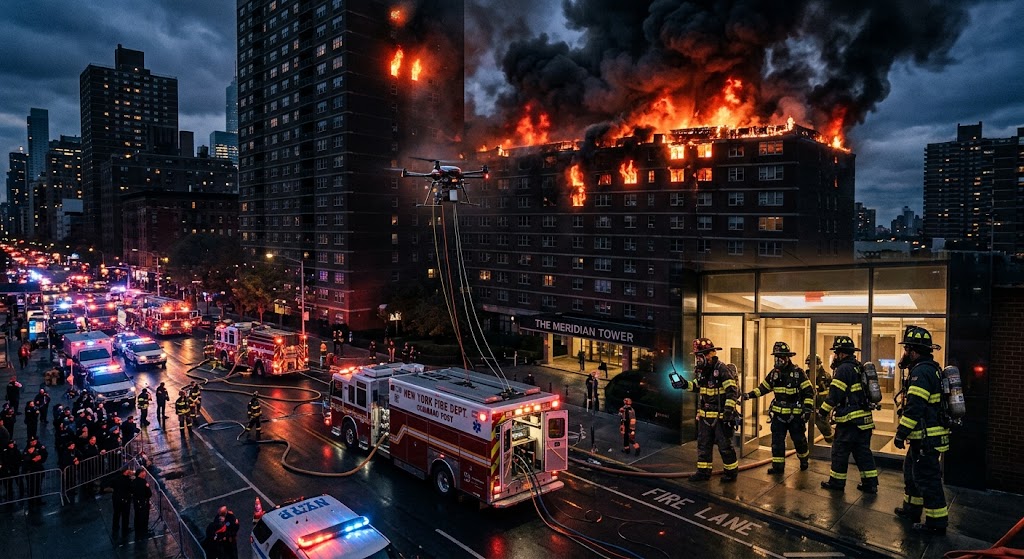
Fig. 1 | On-site command at a high-rise building fire: ground forward-command vehicle + tethered drone elevated relay + a firefighter carrying the P5 into deep stairwells, with smoke rising.
AI image prompt: photorealistic aerial-and-ground mixed view of a high-rise residential building on fire at night, dense dark smoke rising from several upper-floor windows and a burning rooftop, on the street below a fire command vehicle with open cabin serving as on-site command post, a tethered drone hovering steadily above the command vehicle as an aerial communication relay with control cables visible, team of firefighters in full turnout gear with breathing apparatus entering the building lobby holding a compact handheld wireless terminal, orange and red flames lighting the smoke, wet reflective asphalt glowing with emergency light bars in blue and red, cinematic dusk atmosphere, dramatic rim lighting, high-detail equipment textures, 8k detail, no cartoon, no text overlays
Citation capsule: The common solution for both the Jishishan earthquake and urban firefighting is the three-layer ad-hoc network of “command vehicle builds the FCP + backpack extends + handheld deepens”: the communications command vehicle is the mobile core node, the backpack radio advances the broadband backbone into ruins and buildings, and the handheld terminal brings thermal imagery and audio/video feeds back to the display wall. The only difference is the source of NLOS — forest firefighting crosses mountains via low-frequency diffraction, while urban firefighting uses a tethered drone to raise a relay and flatten the three-dimensional building occlusion — both are essentially the same technical path of low-frequency wall penetration plus ad-hoc multi-hop.
— Fire-rescue on-site command & firefighter communications solution
How Do Command Vehicle + Backpack + Firefighter Form the Network?
| Role | Equipment | Responsibility | Key capability |
|---|---|---|---|
| On-site command end | Command vehicle / portable command platform (P3) | Build the FCP, dispatch on the big screen, view imagery | 15.6-inch Win10 i7, 8G/256G, 4G/5G backhaul, GPS+BD, IP65, 32–64 nodes |
| Coverage extension end | Backpack radio (P1) + tethered drone (P2) | Tethered/raised relay pushing signal into buildings | P1: MIMO 2×2, IP67, 120 Mbps @ 40 MHz, 64 nodes; P2 drone-borne: 1.1 kg, 70 Mbps @ 20 MHz, air-ground 10 km+ |
| Firefighter terminal end | Handheld terminal (P5) + body-worn camera | Go deep into the fire, backhaul audio/video/thermal in real time | 1.2 kg, IP66, 90 Mbps @ 20 MHz, NLOS wall penetration, 32 nodes, 6 h battery life |
The concrete logic of the topology trade-off. The command vehicle (P3 portable command/dispatch platform, 15.6-inch Win10 i7, 8G/256G, 4G/5G, IP65, 14 kg, mountable on a vehicle or set up independently) parks in a safe, open area as the on-site center, with the big screen for visualized dispatch. The P1 backpack (MIMO 2×2, IP67, 120 Mbps @ 40 MHz, 64 nodes) extends coverage nearby or is raised by a tethered drone (P2, 1.1 kg, 70 Mbps @ 20 MHz, air-ground 10 km+) to “push” the signal into stairwells and deep corridors. The P5 handheld (1.2 kg, IP66, 90 Mbps @ 20 MHz, 32 nodes) is carried by firefighters entering the fire/high-rise/underground. As the firefighter goes deep, his thermal image and body-worn-camera video appear on the command-vehicle big screen in real time — the commander uses these to direct and to judge the timing of water-supply reinforcement and withdrawal.
The bandwidth accounting of this combination must be clear: the firefighter uplinks a “thermal image + body-worn camera” dual video stream; at about 4–6 Mbps per stream, one firefighter occupies about 8–12 Mbps. The P5 handheld’s 90 Mbps @ 20 MHz single-hop throughput is enough to support 8–10 key-position firefighters backhauling in parallel; the P1 backpack’s 120 Mbps @ 40 MHz, as the relay backbone, must also reserve the multi-hop bandwidth for forwarding. On-site planning is therefore not an unlimited stacking of “one backpack per floor + one video stream per firefighter,” but a capacity budget driven by the number of video streams and hops — this is the layer of fire-site communications design that goes deeper than “just place the nodes.”
Why all three layers are indispensable. A lone command vehicle cannot reach the depth with one point; a backpack relay without firefighter terminals carried inside leaves imagery frozen at the stairwell entrance; and firefighters linking directly to the command vehicle without relays drop the link tens of meters out. Only when the three layers operate on the same channel and relay hop by hop can “imagery” be shifted bit by bit from the seat of the fire back to the command end. This is the value of “the command end as backbone, the backpack end as extension, the firefighter end as tentacles.”
There is also an engineering point often overlooked: the P3 portable platform can serve not only as the “FCP big screen” but also as a 4G/5G backhaul gateway. When the site has no public network but a remote command center (general corps, detachment) needs to see the on-site imagery, the P3 aggregates the on-site Mesh video streams and uploads them to the rear platform over the 4G/5G link, forming a two-level architecture of “on-site broadband + remote backhaul.” Note that here the 4G/5G is merely the “uplink off-ramp” — on site the network is the autonomous 1.4G Mesh; the two links complement each other, and neither forms a complete graded command chain without the other.
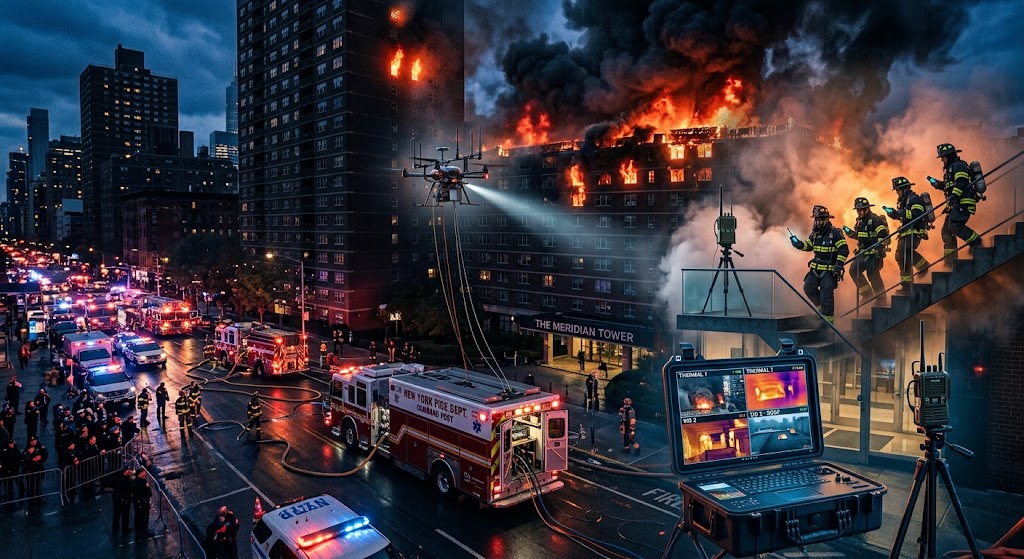
Fig. 2 | Actual node placement and multi-hop backhaul relationship of the “forward command post — relay — firefighter” three-layer network at a fireground.
AI image prompt: photorealistic wide shot of a fire scene network setup at night, in the foreground a command vehicle with a portable command console with large monitor showing live thermal and video feeds, a tethered drone relay hovering high above, two backpack relay radios mounted on tripods on an external balcony and on the street, several firefighters with handheld terminals moving up a concrete staircase with smoke billowing, network mesh concept implied by equipment placement, wet scene with fire engine water and reflections, deep blues and warm orange firelight, cinematic depth of field, 8k detail, no cartoon, no text overlays
How to choose. Inside a fire, inside a building, or in a no-public-network area, use 1.4G Mesh (P3/P1/P5) across all three layers to solve “autonomous broadband + non-line-of-sight wall penetration.” Between hot zones already covered by WiFi — such as barracks, equipment-vehicle parking areas and training grounds — where “people-and-vehicle-mobile roaming access” is needed, the YN300 WiFi roaming relay client can be layered in (client+relay dual mode, seamless roaming, low power, mountable to vehicles/robots); but YN300 only solves “handoff between coverage domains” and does not replace 1.4G Mesh’s no-network backhaul across mountains and regions.
A design tip on recommended combinations: “P1 tethered + P5 handheld” is the golden pair for an urban fire, while “P4 vehicle antenna-on-the-move + P1 backpack” suits forest/remote fires better. The city wants “three-dimensional penetration through buildings”; the forest wants “one vehicle-carried broadband trunk line spanning a several-kilometer ridge, then distributed downward.” The P4 vehicle antenna-on-the-move (30–50 km, 90 Mbps @ 20 MHz, 2×10 W, 220 V, ≥32 nodes), with its 50 km-class backhaul, keeps broadband connectivity between the forest fire’s forward command post and reinforcement, and then P1/P5 extend it stage by stage down to specific task squads.
Citation capsule: Fireground networking follows the three-layer division of “the command end as backbone, the backpack end as extension, the firefighter end as tentacles”: the P3 portable platform builds the FCP and doubles as a 4G/5G backhaul gateway, the P1 backpack and the P2 tethered drone push the signal into the building, and the P5 handheld carried by entering firefighters routes audio/video back. On the bandwidth budget, a firefighter’s dual video streams take roughly 8–12 Mbps, so capacity must be planned by video stream count and hop count rather than by stacking nodes without limit — only when the three layers interoperate on the same frequency and relay hop by hop can imagery be shifted from the seat of the fire back to the command big screen.
— Fire-rescue on-site command & firefighter communications solution
Why Does Low Frequency Let Signals Penetrate Deep into the Fire?
Fire scenarios lean hardest on “non-line-of-sight (NLOS)” capability: a firefighter enters the building while the command vehicle stays below, with floor slabs, walls and the fire’s smoke column in between. The near-straight-line propagation of 5.8 GHz fails almost completely here. The 1.4 GHz private band, with a wavelength near 21 cm, diffracts and penetrates significantly better and keeps a stable link under wall and floor-slab occlusion. The key physical mechanisms are twofold:
- Diffraction: Longer-wavelength signals “bend” around wall edges and corners more easily and keep propagating past obstacles. The diffraction-propagation model in [ITU-R P.526] shows the diffraction loss worsens markedly as frequency rises: the lower the frequency, the easier it is to clear edge obstacles. The Fresnel zone corresponding to 1.4 GHz (λ≈21 cm) is far larger than that of 5.8 GHz (λ≈5 cm), retaining more link margin at corners, doorways and stairway turns. Intuitively: turning the same door frame, far more of a 21 cm wavelength “wraps” around than of a 5 cm wavelength “slices” past, which sharply cuts the probability that a firefighter loses contact at a corridor turn or a stair landing.
- Wall penetration: Whether an electromagnetic wave penetrates a wall depends on the match between frequency and wall material, but the overall trend is that lower frequencies pass reinforced concrete more easily. The handheld terminal (P5) communicates through interior partition walls better than civilian high-frequency devices, so firefighters can move across floors without dropping the link; combined with MIMO spatial diversity, link stability improves further — [IEEE 802.11n] and later 802.11 standards use MIMO spatial diversity as the core mechanism, and MIMO 2×2 lets both ends use multiple spatial channels, so even if one channel is blocked the other compensates, giving markedly stronger anti-fading capability.
- Smoke and dust: Fireground smoke, soot and water vapor create obvious scattering and absorption in high bands and attenuate the link; at the lower frequency (1.4 GHz) attenuation in heavily particulate environments is comparatively controllable, and MIMO spatial diversity raises the link margin so “communication works even in smoke.” In practice, in a smoke-filled corridor a low-frequency ad-hoc network holds deeper penetration than 2.4G/5.8G video transmission.
- Tethered-relay gap-filling: low-frequency wall penetration alone is still finite — however many the walls and however long the latency, dense floor slabs can still break the link between the firefighter and the ground command. So a tethered drone (P2) lifts a backpack/airborne node into the sky to cross terrain and building-cluster occlusion and build an “elevated backhaul” for the firefighters inside, forming three-dimensional coverage together with the ground backpacks. NLOS is not a single technique stretched to its limit but a combination punch of “ground floor-by-floor wall penetration + air-to-air last-resort cover.”
One engineering judgment must be emphasized here: non-line-of-sight does not mean “lossless wall penetration” — it means “budgeting the wall-penetration margin.” The insertion loss of one 200 mm concrete wall is relatively fixed at the same frequency, so range design must retain margin under “number of walls × loss per wall + free-space loss.” The P5 handheld and P1 backpack use 1.4 GHz low frequency + MIMO precisely so that, within this budget, the number of penetrable floors expands from the “one or two floors” of high-frequency gear to “multiple floors + across regions.” In one sentence: every dead corner a firefighter enters is an “NLOS” problem; the 1.4G private band (1420–1520 MHz, wavelength about 21 cm) is a frequency designed for exactly such scenes — low-frequency wall penetration is the essential advantage that sets firefighter communications apart from ordinary WiFi video transmission.
Citation capsule: A fireground is mostly “invisible communications” — the firefighter and the command vehicle are separated by reinforced-concrete walls, floor slabs and smoke. NLOS capability rests on “one low and one many”: the low frequency (1.4 GHz, wavelength about 21 cm) diffracts and penetrates better, and [ITU-R P.526] shows the diffraction loss worsens as frequency rises; MIMO spatial diversity then uses multiple mutually compensating channels to fight fading. In engineering, you “budget the wall-penetration margin” rather than assume no loss, add a tethered drone elevated-backhaul last resort, and build the three-dimensional coverage of “ground floor-by-floor wall penetration + air-to-air.”
— Fire-rescue on-site command & firefighter communications solution
How to Deploy the Three Topologies for High-Rise / Underground / Urban Village
What the three topologies share: they all solve coverage by “placing nodes by geometry” rather than depending on a single center. [IEEE 802.11s] defines the self-organizing and multi-hop routing protocol of wireless mesh networks, letting nodes auto-discover and maintain topology; it is precisely this mechanism that makes every ad-hoc node a base station — the network follows wherever you go, which is exactly the operating rhythm that fire services need: “build the network on arrival, extend the coverage while fighting.”
One more unified principle for capacity and expansion: all three topologies scale node count horizontally — the P1 backpack supports 64 nodes, the P5 handheld 32, and the P4 vehicle-mounted ≥32. For a fire-company level of operations (a squad of 5–10 fighters + 1–2 relays) the node margin is ample; for a multi-detachment joint operation (multiple companies on scene at once), partition at the granularity of “one main network per fireground” to avoid routing overhead from too many nodes dragging video latency. A one-sentence principle for on-site networking: just enough is enough, deploy in layers, and always reserve a bypass.
Citation capsule: Different building forms use different topologies: the high-rise values “vertical relay” — 1–2 backpacks on the middle floors with a drone backing up the top, using raised nodes to cross floors rather than one per floor; the underground values “floor-by-floor chaining” — a T-shaped stepped network plus alternate paths reserved at corners and branch roads to prevent losing contact; the urban village values “fill gaps with node density” — trading node density for coverage continuity. All three rely on the [IEEE 802.11s] self-organizing multi-hop routing to achieve “place by geometry, every node is a base station, cover as you move.”
— Fire-rescue on-site command & firefighter communications solution
What Deployment Flow and Safety Redundancy Should You Grasp?
Safety-redundancy points
- Multi-link backup: each fighter carries both a voice and a video service; either link going abnormal triggers a proactive alarm — video drops but voice remains, so the commander can still direct retreat. Voice is the last line of defense; always keep a narrowband voice last-resort channel.
- Redundant nodes: place standby nodes at critical relay positions; if the primary relay fails, a standby auto-takes-over, and the Mesh ad-hoc network automatically reroutes around it. The standby node cannot be skipped — it is the physical basis of “one person, multiple links.”
- Power assurance: the backpack radio (P1) runs 6–12 h and the handheld (P5) 6 h; match the battery-swap plan to shift length; the tethered drone needs stable tethered-power-vehicle supply — back up the tether power in duplicate so a single power fault cannot drop the whole “elevated backhaul.”
- Dynamic grouping: support task-based group splitting to avoid cross-group interference; an important action group can take an exclusive channel to guarantee video quality. Recommended fireground grouping is “one squad per group” to avoid frequency mixing.
- Time & position synchronization: the P3 platform’s GPS+BD dual-mode sync gives every node a unified timestamp and location, so the command big screen can directly show fighters’ real-time positions on the floor plan — who is on the fire floor and who is evacuating, at a glance.
Trade-off points: “Build the network before sending people in” is the only correct order — first let the relays push coverage into place, then let the fighters go deep; otherwise the instant a team member steps inside he may be in a blind zone. And “one person, multiple links” requires every deep-penetration fighter to depend on at least one voice and one video link, reducing “lost-contact risk” from a single point to a multi-path fallback.
Drill and duty advice: fire-ground communications is not built on arrival but trained in peacetime. We recommend a quarterly “in-building ad-hoc wall-penetration drill”: randomly pick a real building, have fighters carry the P1 and P5 and measure “which floor still works and how many walls hold” on-site, turning the wall-penetration margin into the district’s “communications altitude map.” That map becomes, at a real fire, the direct basis for “which floor to place the relay and who can go deep.” Without peacetime accumulation, on arrival you are only groping.
Citation capsule: Fire-communications deployment follows two iron laws: first, “build the network before sending people in” — power up the command vehicle to build the network, and only let fighters go deep after relays have pushed coverage into the building; if a relay is not in place, no blind rush is permitted. Second, “one person, multiple links” — every deep fighter keeps at least one voice and one video link, so if video drops, voice remains and the commander can still direct retreat; narrowband voice is always the final fallback channel.
— Fire-rescue on-site command & firefighter communications solution
How to Choose Between 1.4G Mesh and the YN300 WiFi Roaming Relay
Why this boundary must be stated clearly in a fire solution. Many integrators try to carry the lower-cost WiFi roaming relay client (such as the YN300-class AVG roaming relay client board — 2.4G single-band / 5.8G single-band / dual-band modulation, client+relay dual mode, seamless roaming, low power, mountable to vehicles/robots) straight into a fireground. But its design premise is “local WiFi coverage already exists” — it does “seamless handoff” within a network that is already powered and has deployed APs; it does not create coverage itself, and still less does it solve cross-mountain/cross-region outdoor backhaul where there is no public network and no WiFi. Fire suppression often happens where the public network is down and no WiFi infrastructure exists at all; there the YN300 has nothing to attach to, and only the self-organizing capability of 1.4G Mesh can hold up a network.
| Trade-off dimension | 1.4G Mesh ad-hoc network (P1/P2/P5) | YN300 WiFi roaming relay client |
|---|---|---|
| Backhaul distance | Several km to 50 km cross-mountain/cross-region (ground 5–50 km, air-ground 10 km+) | Hundreds of meters to 1–2 km per coverage domain, depending on the existing AP high points |
| Occlusion / non-line-of-sight | Mountains/trees/smoke/building bodies NLOS wall penetration (1.4G low-frequency 21 cm wavelength) | Gentle campus occlusion only, mostly line-of-sight (2.4G/5.8G) |
| Infrastructure | Entirely no public network and no WiFi; builds the network autonomously | Depends on existing APs/upper network power and deployment |
| Mobile access | Crews/vehicles maneuver and link in multiple hops in a no-network area | Seamless roaming handoff between WiFi hot zones |
| Typical deployment | Deep inside a fire / in buildings / underground / remote across mountains | Barracks / training grounds / between already-WiFi fleet and equipment vehicles |
| Bandwidth / power | 90 Mbps @ 20 MHz (P5), 120 Mbps @ 40 MHz (P1), self-powered | Rides on AP power and existing broadband; creates no new bandwidth itself |
- For a firefighter entering the fire interior, floor-slab interstitial spaces, or an underground garage: you must use 1.4G low-frequency wall-penetration Mesh (P5 handheld 1.2 kg/IP66/90 Mbps @ 20 MHz/32 nodes/NLOS wall penetration) — this is the only autonomous-broadband choice that can carry the picture into the fire point and bring it back to the command end.
- For moving between camps, barracks, and already-WiFi fleet/equipment vehicles: you may use YN300 roaming client as a low-cost “seamless-handoff” option — but it is not a substitute for fire-communications.
Citation capsule: The boundary between 1.4G Mesh and the YN300 WiFi roaming relay is decided by “whether network infrastructure already exists”: Mesh is fully autonomous — several km to 50 km cross-mountain/cross-region, NLOS wall penetration, builds a network even with no public network and no WiFi; YN300 is a client+relay dual-mode roaming access that only does seamless handoff within an already-powered, AP-deployed network, creates no coverage itself, and is homeless in a fireground where the public network is down and there is no WiFi — for entering a fire you must choose 1.4G low-frequency wall-penetration Mesh.
— Fire-rescue on-site command & firefighter communications solution
How Does It Compare with Public-Network PTT / Digital Trunking?
| Option | Bandwidth / services | Coverage autonomy | Fireground suitability |
|---|---|---|---|
| Public-network PTT | Mostly narrowband voice | Depends on public-network coverage | Fails the moment the public network drops |
| Digital trunking (PDT / dedicated) | Narrowband, voice + short data | Depends on own base stations | Good coverage but cannot drive video |
| WiFi video transmission | Broadband but local | Depends on AP power | Weak wall penetration, cannot reach deep interiors |
| YN300 WiFi roaming relay | Broadband but rides on existing WiFi | Depends on deployed APs/upper network | Only hot-zone roaming, no networking, no wall penetration |
| 1.4G Mesh ad-hoc network | Broadband: voice + video + data | Fully autonomous, base-station-free | Low-frequency NLOS wall penetration, can enter the fire |
Trade-off points: if you only need to “hear clearly,” digital trunking may be enough; if you need to “see” — to see the thermal imaging and body-worn-camera footage of the fighters who entered the fire — then autonomous broadband networking is the only road. The mature approach is “digital trunking for voice dispatch + Mesh for broadband video backhaul,” and the two layers combine into a modern “hear clearly + see clearly” fire-command communications system.
A reminder is needed: “digital trunking + Mesh” are not substitutes but two mutually complementary “planes.” Digital trunking uses narrowband channels for high-priority voice dispatch, identity authentication and roaming, so even if the video link is damaged, the voice decision chain stays alive; the Mesh broadband network carries thermal imaging, body-worn cameras, positioning and data backhaul. The two can share the same in-vehicle equipment and the same antenna mounting base, but their protocols and bands are independent and do not interfere. Deep NLOS and cross-mountain backhaul must stay on the 1.4G Mesh side; auxiliary roaming between barracks/fleet hot zones can then be layered with the YN300 as needed, forming a complete three-layer-usage capability stack: narrowband voice, broadband Mesh, and hot-zone roaming.
Citation capsule: When inside a fire, outside the public network, and with video required, public-network PTT, digital trunking and WiFi video transmission each have shortcomings: public-network PTT fails the moment the network drops, digital trunking’s narrowband cannot drive video, and WiFi video transmission’s weak wall penetration cannot reach deep interiors. The 1.4G Mesh ad-hoc network, with its “broadband autonomy, base-station-free, low-frequency NLOS wall penetration,” is the only option that can bring the on-scene picture back. The mature practice is the “two-plane” of “digital trunking for voice + Mesh for broadband video,” whose protocols and bands are independent and complementary, not substitutive.
— Fire-rescue on-site command & firefighter communications solution
References
- Forest Fire General Corps of Gansu Province (The Paper): support bulletin of the communications squad during the Jishishan earthquake.
- Urban fire-service ad-hoc network industry solution (command vehicle + tethered drone + backpack + firefighter), public materials (Xinuaomaitian public solution / b2b168).
- Equipment manufacturer datasheets (YNWMicro P1 backpack / P2 drone-borne / P3 portable platform / P4 vehicle antenna-on-the-move / P5 handheld ad-hoc parameters; YN300 AVG roaming relay client specs).
- Ministry of Emergency Management: regulations and operation updates on fire rescue and emergency communications support.
- National Fire and Rescue Administration Law Database: legal basis for fire communications and on-site command.
Standard reference note: In this article [IEEE 802.11n] denotes the wireless-LAN multi-input multi-output (MIMO) extension standard; [IEEE 802.11s] denotes the wireless mesh (Mesh) self-organizing and multi-hop routing standard; [ITU-R P.526] denotes the ITU Radiocommunication Sector recommendation on diffraction propagation; [FCC 47 CFR Part 15] denotes the US federal regulation on license-exempt radio devices; [IEC 60529] denotes the international degree-of-protection (IP code) standard for enclosures. The above standards are used only to state technical basis and terminology sources; equipment parameters and engineering judgments in this article follow the YNWMicro public datasheets.
— Fire-rescue on-site command & firefighter communications solution
Frequently Asked Questions (FAQ)
Q: Can the signal penetrate when a firefighter enters a high-rise or a basement garage?
Yes. The 1.4 GHz private band (1420–1520 MHz, wavelength about 21 cm) penetrates and diffracts markedly better than 2.4G/5.8G; with backpack relays chaining floor by floor and a tethered drone stringing an elevated backhaul, a stable link can be kept under high-rise floor-slab and garage occlusion, and a fighter’s handheld terminal can keep calling and streaming video while moving across floors and regions. Wall-penetration performance should be budgeted by “number of walls × loss per wall,” which is exactly the point of the fire-service “communications altitude map” drill.
Q: Can a single fighter’s handheld terminal carry voice and video at the same time?
Yes. An ad-hoc network is broadband equipment: a single terminal (such as the P5, 90 Mbps @ 20 MHz) can carry voice, position, thermal imaging and body-worn-camera video in parallel back to the command end, which directs while watching for visualized command. Even if the video link is damaged, narrowband voice remains as the final fallback channel.
Q: Does it conflict with our existing digital-trunking radios?
No. Digital trunking handles routine narrowband voice dispatch, while the Mesh ad-hoc network handles broadband video and deep NLOS backhaul; the two form a “hear clearly + see clearly” two-plane architecture that networks independently and does not interfere. They may share the antenna base and in-vehicle mounting position, but their protocols and bands are mutually independent.
Q: How large a fire service can one set of equipment cover?
The backpack radio (P1) supports 64 Ad Hoc nodes, the vehicle-mounted (P4) supports 32+ nodes, and the handheld (P5) supports 32 co-channel nodes — enough to network a company’s multiple shift groups; on-scene capacity also depends on the number of video streams and hops, and can be managed by task grouping. For joint cross-detachment operations, partition at the granularity of “one main network per fireground.”
Q: Can the equipment survive high temperature and water spray at a fire?
The backpack radio (P1) is rated IP67 (dust-tight and water-immersion protected), the handheld (P5) IP66, and the vehicle-mounted (P4) is designed with 220 V mains and heat dissipation for rain, sand, and splash-exposed harsh duty; the [IEC 60529] degree-of-protection (IP code) is the unified yardstick for judging such equipment’s dust/water resistance. Near a fire point the equipment still must be placed at a relatively safe distance, carried on the firefighter’s person rather than exposed directly to open flame. The tethered drone’s power is recommended to be backed up in duplicate.
Q: If the site already has some WiFi coverage, can a cheap roaming relay fill in?
Only for mobile roaming access between hot zones such as barracks, training grounds, and already-WiFi fleet equipment vehicles (e.g., the YN300 roaming relay client). But deep in a fire, inside a building, underground, or in a cross-mountain no-network area there is no WiFi to attach to, so 1.4G Mesh autonomous networking is mandatory; the boundary between the two is judged by “whether network infrastructure already exists” — don’t let “low-cost WiFi roaming” wrongly stand in for “autonomous-broadband NLOS backhaul.”