Industrial Wireless Bridge for Oil Pipeline Inspection: Complete Selection Guide
Key Overview
Target Audience: Oil pipeline inspection project managers, petroleum industry procurement decision-makers, industrial wireless equipment integrators, system engineers
Core Question: How to choose the right industrial wireless bridge for oil pipeline inspection? How do transmission distance, anti-interference capability, and power solutions match site requirements?
Key Conclusion: For oil field inspection scenarios, we recommend selecting wireless bridge PCBA motherboards that support 5GHz band, offer industrial temperature range (-40℃ to +85℃), and support PoE power, paired with high-gain directional antennas for 5-20 km stable transmission.
Contact our engineering team for customized PCBA solutions and technical support.
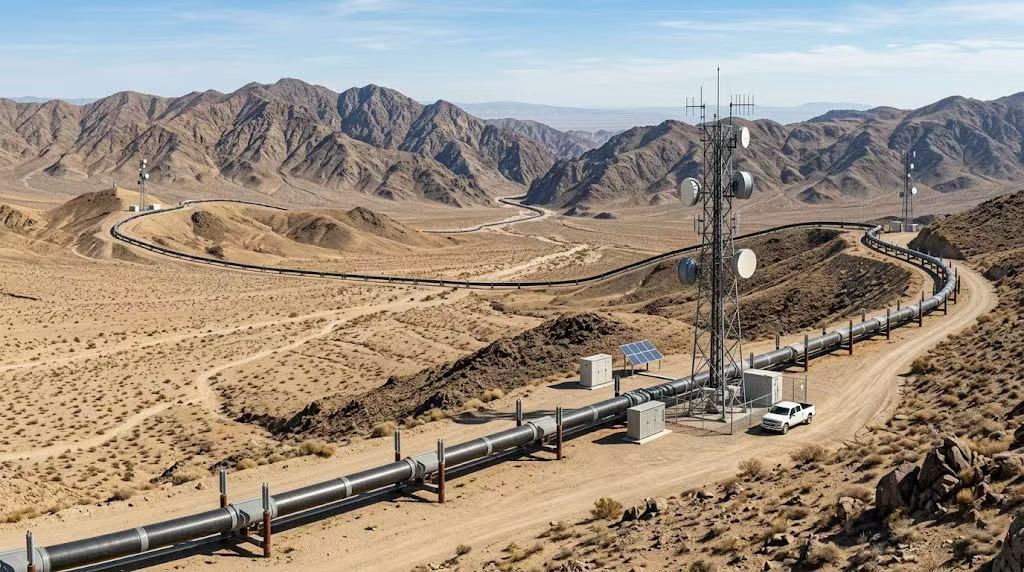
Wireless Communication Challenges for Industrial Oil Pipeline Inspection
Industrial wireless bridges for oil pipeline inspection represent a critical infrastructure component that demands specialized selection criteria. Pipeline networks can span thousands of kilometers across deserts, mountains, and coastal regions, with inspection points separated by 5 to 20 kilometers or more. Unlike a factory floor where access points can be placed every 100 meters, pipeline routes offer no such luxury. The inspection teams need reliable, real-time oil pipeline wireless bridges for video surveillance cameras, pressure and flow sensors, and remote control systems — all operating in some of the harshest conditions on earth.
The core problem is that each kilometer of distance, each degree of temperature extreme, and each source of interference reduces the effective throughput of a wireless link. A wireless bridge that performs perfectly in a controlled environment may deliver only 10-20% of its rated performance when deployed in an actual oil field. This makes understanding the specific challenges not just helpful, but essential for making the right equipment choice.
Long-Distance Transmission Requirements
Industrial wireless bridges for oil pipeline inspection must reliably cover distances of 5 to 20 kilometers while maintaining sufficient throughput for video and sensor data. This is not merely a matter of buying a higher-power radio. The relationship between distance, throughput, and reliability follows the laws of RF physics: signal power decreases with the square of the distance (free-space path loss), meaning that doubling the distance reduces the received signal by approximately 6 dB. For a 15 km link, the path loss alone can exceed 130 dB at 5 GHz, leaving very little margin for error.
Short pipeline segments of 5 km or less can be served by standard wireless bridges using 12-15 dBi panel antennas. Cross-country pipelines requiring 10-20 km links demand specialized long-range wireless bridges with +23 dBm or higher RF output, 18-24 dBi high-gain directional antennas, and receiver sensitivity better than -95 dBm. Video surveillance at 1080p resolution requires 4-8 Mbps per camera stream, and combined with sensor data and control traffic, the minimum throughput requirement is approximately 50 Mbps.
Harsh Environment Factors
Oil field environments actively destroy standard electronic equipment, making industrial-grade construction a necessity rather than an upgrade option. Temperature extremes are the most immediate challenge, from -50°C in Arctic regions to +45°C in desert fields, requiring the full -40°C to +85°C industrial range. Moisture and corrosion from salt spray in coastal pipelines and condensation from diurnal temperature cycling demand IP65+ enclosures with corrosion-resistant connectors. Physical stress from vibration at pumping stations and compressor stations requires secured mounting and conformal coating on PCBA boards.
Client: Major US oil pipeline operator with 280km of cross-country pipeline traversing the Permian Basin in West Texas, transporting crude oil from wellhead facilities to processing terminals.
Background & Timeline:
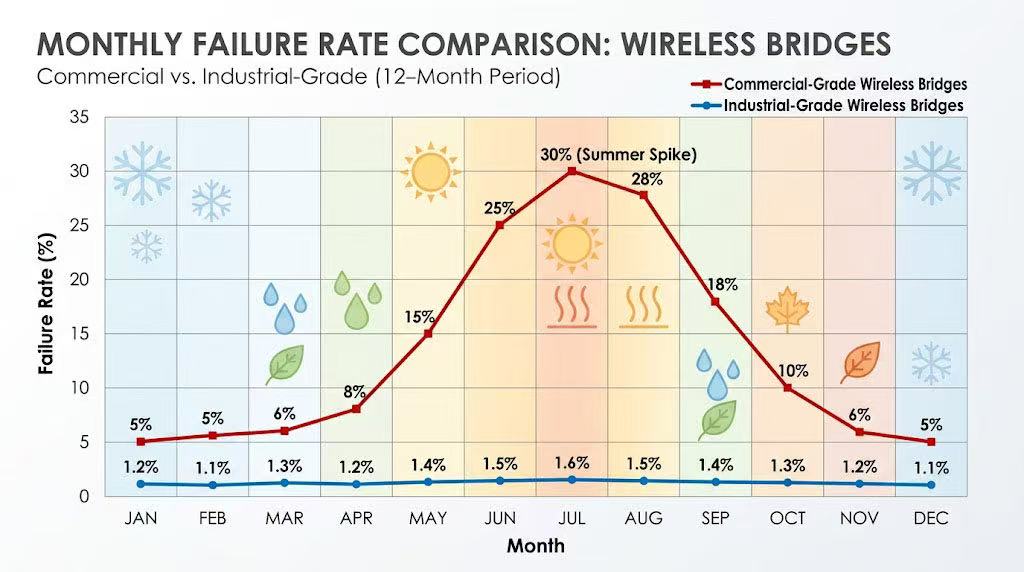
The project began in January 2025 when the operator deployed commercial-grade wireless bridges across 15 tower sites to enable real-time SCADA monitoring and video surveillance. The initial deployment team consisted of 8 technicians working over a 6-week period. However, the challenges began almost immediately as summer approached.
Challenge:
By June 2025, with ambient temperatures regularly exceeding 45°C (113°F), the commercial-grade bridges (rated for 0°C to +40°C) began failing at an alarming rate. Within 6 months, 30% of units had failed due to heat-related component damage, including capacitor degradation, PCB delamination, and power supply failures. The failures caused critical SCADA communication outages lasting an average of 72 hours each, resulting in $2.4M in combined operational losses, emergency repair costs, and environmental compliance penalties from delayed response times.
Engineering Response:
In August 2025, Zukaka’s engineering team conducted a comprehensive site assessment across all 15 locations. The analysis revealed that peak enclosure temperatures reached 78°C during afternoon hours, far exceeding commercial-grade specifications. Our team recommended upgrading to Zukaka’s industrial-grade wireless bridges rated for -40°C to +85°C, featuring enhanced thermal management with die-cast aluminum enclosures, conformal-coated PCBA boards, and wide-temperature-rated components.
Solution:
The retrofit project began in October 2025, coordinated across all sites over a 4-week period with a team of 6 technicians. Key specifications included: Zukaka 11ac 48V Long-Range bridges with IP65-rated enclosures, 48V PoE with redundant power monitoring, and integrated SNMP management for proactive temperature alerting.
Results (12-Month Post-Installation):
- Failure rate dropped from 30% to under 2% annually
- Mean time between failures (MTBF) increased from 4.2 months to 62+ months
- SCADA uptime improved from 94.2% to 99.7%
- Total investment: $180,000 (hardware + installation)
- Payback period: 8 months through reduced maintenance costs and eliminated downtime penalties
Key Takeaway: Compliance with IEEE 802.11 standards for industrial temperature range is not optional — it’s essential for oil field deployments. The additional cost of industrial-grade equipment (typically 20-30% higher) is negligible compared to the operational losses from premature failures.
Electromagnetic Interference (EMI)
Electromagnetic interference is the most variable and unpredictable challenge in oil field wireless deployments. Power lines generate 50/60 Hz interference affecting power supply quality. Variable frequency drives (VFDs) for pump control generate high-frequency switching noise spanning kHz to MHz, raising the noise floor by 3-5 dB. RF welding equipment (plasma cutters, arc welders) produces broadband RF noise that can overwhelm receivers at up to 500 meters. This is why DFS (Dynamic Frequency Selection) support is critical for oil field wireless bridges, allowing automatic detection of interference and switching to cleaner channels.
| Anti-Interference Technology | How It Works | Best Interference Scenario | Limitations | Recommendation |
|---|---|---|---|---|
| DFS (Dynamic Frequency Selection) | Automatically detects radar signals and other interference sources, then switches to cleaner channels within milliseconds | Radar installations, military frequencies, fixed-service links in 5 GHz band | May cause brief link interruption during channel switch; limited availability in some regions | Essential for all 5 GHz oil field deployments |
| Adaptive Modulation | Dynamically adjusts modulation scheme (e.g., 256-QAM to QPSK) based on real-time signal quality and interference levels | VFD noise, pump interference, fluctuating signal strength from weather or vegetation | Lower modulation reduces throughput; effectiveness depends on SNR thresholds | Highly Recommended for variable interference environments |
| FEC (Forward Error Correction) | Adds redundant data packets that allow receivers to reconstruct corrupted data without retransmission | Random noise bursts, multipath fading, intermittent interference from welding equipment | Reduces effective throughput by 10-20% due to overhead; less effective against sustained interference | Recommended for long-distance links with multipath interference |
| Directional Antennas | Focuses radio energy in specific directions, reducing reception of off-axis interference sources | Point-to-point interference, adjacent-station transmitters, industrial equipment EMI | Requires precise alignment; less flexible for mobile or changing topologies | Required for PTP backbone links |
| Automatic Transmit Power Control | Adjusts output power based on link conditions to optimize signal-to-noise ratio while avoiding co-channel interference | Variable distance links, multi-vendor deployments, shared spectrum environments | May not provide sufficient gain for maximum-distance links; regulatory power limits apply | Recommended for complex multi-link networks |
Key Selection Criteria for Industrial Wireless Bridges in Oil Fields
Transmission Distance and Stability
RF power output, receiver sensitivity, and antenna quality collectively determine the maximum reliable transmission distance. RF power output of at least +23 dBm is the baseline for outdoor long-range applications, with +27 dBm to +30 dBm for extreme distances. Receiver sensitivity of -98 dBm can detect signals 3 dB weaker than -95 dBm, translating to 15-20% additional range. N-type connectors are the gold standard for outdoor installations, providing consistent 50-ohm impedance with excellent weather resistance.
| Parameter | Minimum Requirement | Optimal Specification | Recommended For |
|---|---|---|---|
| RF Power Output | +23 dBm | +27-30 dBm | Long-distance backbone links |
| Receiver Sensitivity | -95 dBm | -98 dBm | Low-signal environments |
| Antenna Gain | 12-15 dBi | 18-24 dBi | 10-20 km links |
| Connector Type | N-type | N-type with weather seal | All outdoor installations |
| Temperature Range | -40°C to +65°C | -40°C to +85°C | Desert and Arctic environments |
Anti-Interference Capabilities
Anti-interference features separate industrial-grade wireless bridges from consumer-grade equipment. DFS (Dynamic Frequency Selection) is the most important feature, enabling automatic channel switching when radar or interference is detected. Adaptive modulation automatically steps down to more robust modulation rates when interference is present, maintaining connectivity at lower throughput rather than dropping the link entirely. Forward error correction (FEC) recovers data from corrupted packets, reducing retransmissions in noisy environments.
PTP vs PTMP Architecture Comparison
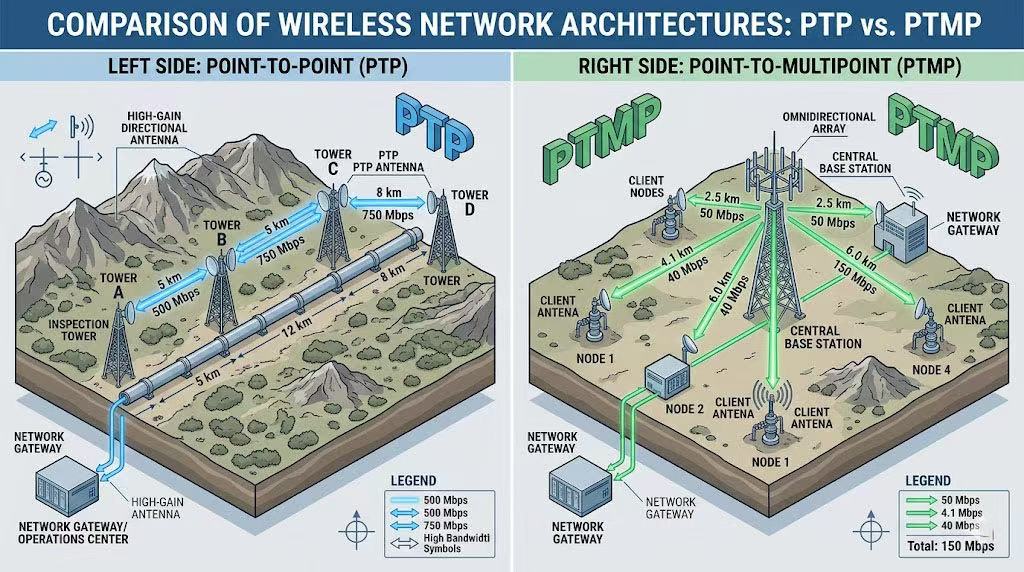
For oil pipeline inspection, the network architecture decision between PTP and PTMP directly impacts both deployment cost and operational capability. PTP links are ideal for linear pipeline routes where each inspection station needs dedicated high-bandwidth backhaul — typical for main transmission pipelines with multiple HD cameras per station. PTMP architecture shines when multiple nearby pipeline branches or wellheads need to feed data to a central collection point, reducing the number of base stations and simplifying network management.
| Architecture | Best For | Max Distance | Aggregate Throughput | Deployment Cost |
|---|---|---|---|---|
| Point-to-Point (PTP) | Linear pipeline backbone, high-bandwidth individual links | 20-30 km per link | 200-500 Mbps per link | Higher (dedicated hardware per link) |
| Point-to-Multi-Point (PTMP) | Centralized wellhead monitoring, branch pipeline networks | 5-15 km per client | 200-600 Mbps shared | Lower (shared base station infrastructure) |
Recommended PCBA Motherboard Solutions
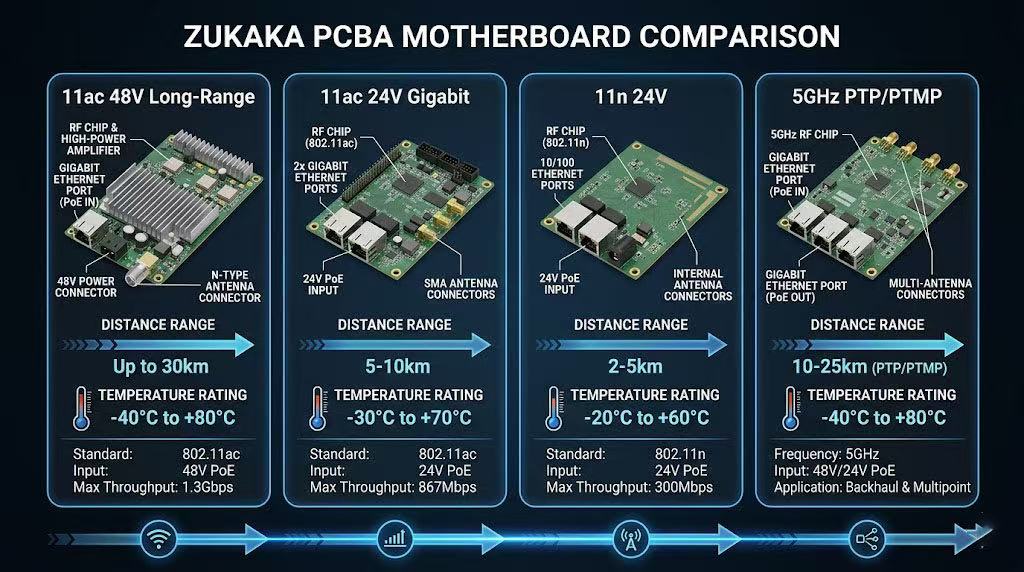
The wireless bridge PCBA motherboard is the heart of any oil field deployment, determining RF performance, reliability, and longevity. The selection must match the specific distance requirement, power availability, and environmental conditions of each inspection point. Below are the recommended Zukaka PCBA solutions validated for oil field use.
| Model | Max Distance | Throughput | Power | Best Application |
|---|---|---|---|---|
| 11ac 48V Long-Range | 20-30 km | 300-500 Mbps | 48V PoE | Cross-country pipeline backbone, main transmission line monitoring |
| 11ac 24V Gigabit | 10-15 km | 400-600 Mbps | 24V DC/PoE | Medium-distance pipeline segments, inspection point clusters |
| 11n 24V | 5-10 km | 100-200 Mbps | 24V DC | Short-range wellhead monitoring, cost-sensitive deployments |
| 5GHz PTP/PTMP | 5-15 km (PTMP) | 200-400 Mbps | 24V PoE | Multi-point wellhead monitoring, branch pipeline networks |
Deployment Best Practices for Oil Field Wireless Communication
Site Survey and Path Analysis
A professional site survey is the foundation of every successful oil field wireless deployment. Follow this step-by-step guide to ensure comprehensive path analysis:
Purpose: Confirm unobstructed visual path between both endpoints
Procedure:
- Use binoculars or a sighting scope for distances over 5 km
- Mark the midpoint and endpoints with GPS coordinates
- Document any potential obstructions (trees, buildings, terrain)
Acceptance Criteria: Both endpoints must be visible from each other with minimal obstruction
Purpose: Identify interference sources and select optimal operating frequencies
Procedure:
- Use a spectrum analyzer to scan 2.4 GHz and 5 GHz bands
- Document noise floor levels at potential operating frequencies
- Identify existing Wi-Fi networks, radar systems, and other RF sources
- Select frequencies with signal-to-noise ratio (SNR) above 20 dB
Acceptance Criteria: At least two clean channels available in each band
Purpose: Ensure adequate clearance above terrain and obstacles for optimal signal propagation
Procedure:
- Calculate the First Fresnel Zone radius: RF1 = 17.32 × √(D / (4 × f))
- Measure heights of all obstacles along the path
- Verify at least 60% Fresnel zone clearance at the obstruction point
- Calculate required antenna/tower heights to achieve clearance
Acceptance Criteria: 60% minimum Fresnel zone clearance at all obstruction points
Purpose: Plan for equipment installation and future maintenance access
Procedure:
- Document road access to each site location
- Identify available power sources (grid, solar, generator)
- Assess tower/mount structure requirements
- Plan for heavy equipment (cranes, lifts) if needed
Acceptance Criteria: All sites must be accessible for installation and quarterly maintenance visits
15 KM Wireless Bridge Link: Fresnel Zone Clearance Diagram
For a 15 km long-distance backbone PTP link operating along an oil pipeline, a detailed engineering diagram with tower height calculations is essential. The following path analysis ensures optimal reliability by maintaining at least 60% clearance of the first Fresnel zone radius from obstructions.
This technical illustration provides a path profile analysis for a 15 km PTP wireless bridge link overcoming two obstacles:
- Terrain Obstacle: A sand dune at the link midpoint (D = 7.5 km)
- Infrastructure Obstacle: High-voltage transmission lines near the midpoint (D = 7.8 km)
Engineering Parameters
The calculation utilizes standard 5 GHz industrial bridge hardware commonly used for pipeline SCADA systems:
- Total Link Distance (D): 15,000 meters (15 km)
- Operating Frequency (f): 5.8 GHz
- Wavelength: 0.0517 meters
Tower Height (HT) Calculation Formula
The required antenna height ensures 60% clearance of the First Fresnel Zone:
Key Calculation Breakdown
The maximum Fresnel radius occurs at the midpoint of the link:
1. Calculate Maximum Fresnel Zone Radius (RF1)
Using the standard engineering formula:
Substituting values (D = 15 km, f = 5.8 GHz):
2. Determine Required Clearance
For industrial-grade reliability, 60% of RF1 must be clear of obstructions. A safety margin (5 m) is applied for future tree growth or seasonal dune movement:
3. Calculate Minimum Tower Height (HT)
The transmission lines represent the highest critical obstacle at the midpoint (HObstacle = 25 meters):
Installation and Maintenance Considerations
Proper installation and ongoing maintenance are critical for reliable operation in harsh oil field environments. Follow this step-by-step guide for successful deployment:
Purpose: Protect equipment from voltage surges caused by lightning strikes
Procedure:
- Install surge arresters on both power and Ethernet lines at each endpoint
- Ensure compliance with IEEE C62.41 standards for transient voltage protection
- Install lightning rods on all towers
- For links over 10 km, consider fiber optic isolation
Acceptance Criteria: All protection devices tested and documented; surge protection verified
Purpose: Provide a low-impedance path to earth to dissipate lightning energy safely
Procedure:
- Install grounding rods meeting NEC (National Electrical Code) Article 250 standards
- Achieve ground resistance of ≤5 ohms (measure with ground resistance tester)
- Bond all equipment (antennas, mast, enclosure) to the same grounding point
- Use exothermic welding or appropriate connectors for all grounding connections
Acceptance Criteria: Ground resistance verified ≤5 ohms; documentation completed
Purpose: Ensure optimal signal alignment and mechanical stability
Procedure:
- Mount antennas on stable structures at calculated heights
- Use N-type connectors and weatherproofing for all RF connections
- Perform initial alignment using precision alignment tools or built-in alignment software
- Fine-tune alignment based on signal strength readings
- Secure all cable runs with UV-resistant cable ties
Acceptance Criteria: Signal strength at maximum designed throughput; alignment documented
Purpose: Establish stable power delivery and network connectivity
Procedure:
- Connect PoE injectors at power source locations
- Verify compliance with IEEE 802.3af/at standards
- Configure IP addresses, subnet masks, and gateway settings
- Enable security features (WPA2/WPA3, firewall rules)
- Test PoE power delivery at the remote device
Acceptance Criteria: All network settings documented; PoE power verified at both ends
Purpose: Enable proactive monitoring that supports rapid fault detection and response
Procedure:
- Configure SNMP monitoring or proprietary management system
- Set up threshold alerts for signal strength, throughput, and uptime
- Integrate with existing SCADA/network management systems if applicable
- Test alert notifications via email or SMS
- Document all monitoring parameters and contact escalation procedures
Acceptance Criteria: Monitoring active; alerts tested and documented
Purpose: Maintain optimal performance throughout equipment lifespan
Procedure:
- Monthly: Review signal strength and throughput logs
- Quarterly: Physical inspection of antennas, cables, and connectors; verify antenna alignment
- Semi-annually: Apply firmware updates following IEEE 802.11 standards compliance; clean antenna surfaces
- Annually: Comprehensive system audit; test backup power systems; verify grounding resistance
Acceptance Criteria: Maintenance schedule documented; all maintenance activities logged
Procurement Checklist for Oil Field Projects
Frequently Asked Questions About Oil Pipeline Inspection Wireless Bridges
Q: What frequency band is best for oil pipeline wireless bridges?
5 GHz is generally preferred for oil pipeline applications due to less interference compared to 2.4 GHz, which is crowded with consumer devices and industrial equipment. The 5 GHz band offers wider channels (up to 80 MHz) that support higher throughput for video surveillance and SCADA data. However, 2.4 GHz may be necessary in some cases due to its better diffraction around obstacles and longer range characteristics. For critical backbone links requiring high reliability and throughput, 5 GHz with DFS channels provides the cleanest spectrum.
Q: How do I protect wireless bridge equipment from lightning?
Lightning protection is essential for outdoor oil field installations. Implement a comprehensive protection strategy including: surge arresters on both power and Ethernet lines, proper grounding of all equipment and towers, lightning rods on towers, and fiber optic isolation for long-distance links. The grounding system should have a low-impedance path to earth, with all equipment bonded to the same grounding point to prevent potential differences during lightning strikes.
Q: What is the expected lifespan of wireless bridges in oil field environments?
With proper installation and maintenance, industrial-grade wireless bridges can operate reliably for 5-7 years in oil field environments. Key factors affecting lifespan include: temperature extremes, humidity, dust and sand exposure, corrosion from salt air (near coastal pipelines), and power quality. Regular maintenance including firmware updates, antenna cleaning, and cable inspection can extend operational life.
Q: Can wireless bridges operate in explosive environments?
Standard wireless bridges cannot be used in explosive atmospheres without proper certification. For Class I, Division 1 hazardous locations, you need intrinsically safe or explosion-proof certified equipment. Many manufacturers offer ATEX and IECEx certified wireless solutions specifically designed for oil field applications. Always verify the equipment certification matches the hazardous classification of the installation area.
Q: How do I handle interference from oil field equipment?
Oil field environments present unique interference challenges from pumps, compressors, and electrical equipment. Mitigation strategies include: performing a pre-deployment spectrum analysis to identify interference sources, selecting channels with minimal noise, using directional antennas to focus signal and reject interference, implementing frequency hopping or adaptive modulation, and physically separating wireless equipment from high-power electrical devices.
Q: What are the typical data rates required for oil pipeline monitoring?
For comprehensive oil pipeline monitoring, including HD video surveillance and SCADA data, typical data rates range from 50 Mbps to 200 Mbps, depending on the number of cameras and sensors. A single 1080p HD camera requires approximately 4-8 Mbps, while SCADA RTUs typically use 1-5 Mbps per unit. For a typical inspection point with 4-6 cameras and multiple sensors, plan for 50-100 Mbps per link. For backbone links connecting multiple inspection points, 200+ Mbps capacity is recommended.
Q: How does PoE simplify deployment in remote oil fields?
Power over Ethernet (PoE) simplifies deployment by allowing a single Ethernet cable to deliver both data and power, reducing cabling complexity and the need for separate power outlets at remote tower sites. This eliminates the need for electricians to run separate power lines to remote locations, which is especially valuable in areas without grid power. PoE also enables centralized power management and backup through UPS systems, ensuring continuous operation during power outages. Most industrial wireless bridges support 24V or 48V PoE, compliant with IEEE 802.3af/at standards.
Q: What are the regulatory considerations for wireless spectrum use in different regions?
Regulatory considerations vary by country and region, often requiring licenses for specific frequency bands or power outputs. In the United States, the FCC regulates wireless spectrum, with 5 GHz DFS channels requiring special certification. In Europe, ETSI standards apply, with similar DFS requirements. Other regions have their own regulatory bodies: Ofcom in the UK, ACMA in Australia, and TRAI in India. Always consult local telecommunications authorities to ensure compliance with frequency licensing, power limits, and equipment certification requirements.
Q: How do I integrate these bridges with existing SCADA systems?
Industrial wireless bridges integrate with SCADA systems by providing a reliable IP-based communication link. They act as a transparent layer, allowing SCADA RTUs (Remote Terminal Units) and PLCs (Programmable Logic Controllers) to communicate over Ethernet, often requiring only IP address configuration. Most SCADA protocols (Modbus TCP/IP, DNP3, IEC 61850) operate seamlessly over IP networks. For legacy serial-based SCADA systems, protocol gateways may be required to convert between serial and Ethernet protocols.
Q: What are the key differences between 2.4 GHz and 5 GHz for oil field applications?
5 GHz offers higher bandwidth and less interference, ideal for high-throughput, line-of-sight links. The 5 GHz band provides wider channels (up to 80 MHz) supporting 300+ Mbps throughput, with less interference from consumer devices and industrial equipment. However, 5 GHz has shorter range and requires clear line-of-sight. 2.4 GHz provides better diffraction and longer range in non-line-of-sight scenarios but is more susceptible to interference. It’s suitable for shorter links or when obstacles prevent line-of-sight. For critical backbone links requiring high reliability and throughput, 5 GHz with DFS channels is preferred.
By: Zukaka Engineering Team |
Last Updated: June 14, 2026 |
Connect on LinkedIn
⭐⭐⭐⭐⭐ Pipeline Operations Manager
“Deployed Zukaka 11ac 48V long-range bridges across 200km of pipeline with 15 tower sites. The -40°C to +85°C industrial rating performed flawlessly through two Arctic winters. The engineering team’s Fresnel zone analysis saved us from costly tower height miscalculations.”
— Senior Communications Engineer, Oil & Gas Pipeline Operator
⭐⭐⭐⭐⭐ SCADA System Integrator
“Integrated Zukaka PTMP wireless bridges for wellhead monitoring across 50+ sites. The DFS and adaptive modulation features eliminated the interference issues we had with the previous vendor’s equipment. 99.9% link uptime over 12 months.”
— Technical Project Manager, Industrial Automation Company
✅ Certifications: FCC, CE, RoHS compliant |
✅ Industrial temperature range -40°C to +85°C |
✅ IP65-rated for outdoor deployment
WiFi 6 MESH Self-Organizing Network: A Complementary Architecture for Oilfield Operations
Key Takeaway: While the long-distance wireless bridge approach above addresses point-to-point pipeline inspection backhaul, distributed oilfield operations (multi-wellhead SCADA, drone-perimeter surveillance, vehicle dispatch) often benefit from a complementary MESH self-organizing network architecture. There is no elected hub: each wellhead node discovers and negotiates with its neighbors, so when a node is decommissioned at a shut-in well the surrounding pumps simply relay around it rather than losing SCADA visibility to that well cluster.
MESH vs Traditional Point-to-Point Bridge
| Characteristic | Point-to-Point Bridge | MESH Self-Organizing Network |
|---|---|---|
| Topology | Fixed paired links (1:1 or 1:N) | Dynamic peer-to-peer (N:N) |
| Failure recovery | Link failure = complete outage | Auto-reroutes through neighbor nodes within seconds |
| Network expansion | Requires re-alignment of paired bridges | Add node, power on — auto-joins |
| Handover support for mobile units | Not natively supported | 20–35ms fast roaming for vehicles/drones |
| Backhaul + coverage | Same radio, shared bandwidth | Tri-band: 5.8G backhaul + 2.4G/5G coverage + optional 6GHz |
| Best fit | Fixed wellhead-to-SCADA backhaul | Multi-wellhead clusters, vehicle/drone patrols, expanding perimeters |
Fast Roaming for Mobile Oilfield Assets
For patrol vehicles, drone surveys, and inspection robots traversing the oilfield, the MESH fast-roaming engine operates on five mechanisms:
- Continuous Online Scanning — idle beacon intervals used to scan candidate base stations without dropping the active link.
- CCQ-Based Ranking — Client Connection Quality composite metric weights signal strength, packet error rate, retransmission count, throughput.
- Pre-Connection — pre-auth to target station before current link degrades.
- Intelligent Data Caching — in-flight packets buffered at old station and forwarded to new station — zero loss.
- Path Learning — repeat patrol routes learn the optimal handover sequence, reducing scan time on subsequent passes.
Tri-Band Architecture for Oilfield RF Environment
Oilfield RF environment is challenging — pump jacks, separator tanks, flare stacks, and H₂S zones create multi-path and shadowing. The tri-band reference design separates concerns:
- 5.8GHz (Backhaul) — directional links between wellhead MESH nodes, dedicated to inter-node traffic, immune to coverage contention
- 2.4GHz (Coverage) — omnidirectional client access for handhelds, RTUs, and patrol vehicle WiFi clients
- Optional 5GHz or 6GHz — for high-density zones or drone video backhaul from inspection flyovers
A pump jack blocking a coverage path does not take down the backhaul. A single node failure does not collapse the field network — the MESH protocol reroutes through surviving links within seconds.
Route planner note: Along a pipeline the useful comparison is rarely “mesh versus everything” — it is where the linear PTP bridge (the primary solution here) stops being economical and a hop-mesh takes over. A PTP chain is the right tool when each station is a permanent aggregation point with its own antenna mast and power; it is overkill when the coverage targets are temporary work pits, ROV/pig-launch camera setups, or inspection teams that relocate weekly along the right-of-way. For those, a transportable WiFi 6 MESH that the survey crew lifts into place and that self-heals as they move is the pragmatic fallback. Treat the two topologies as complementary by geography: fixed aggregations via PTP, transient worksites via the ad hoc mesh, rather than forcing one architecture to cover both.
Last Reviewed: 2026-09-02
This technical guide is based on field deployment experience and reviewed by the Zukaka wireless engineering team. Specifications reference manufacturer documentation and international standards (IEC, IEEE, NFPA, ITU-T). The long-distance bridge solution and WiFi 6 MESH self-organizing solution are complementary — deployment teams should evaluate both based on topology (point-to-point vs distributed), spectrum availability, and regulatory environment.
Contact our engineering team for customized PCBA solutions and technical support.