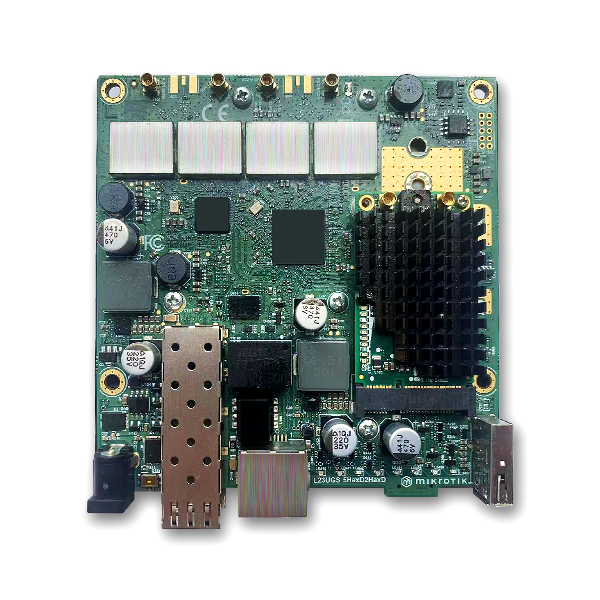
Qualcomm QCN9274 WiFi 7 Module | Drop-In Compex WLE7002E25/E26/E55/E56 Alternative
Blog 2026-06-04
QCN9274 WiFi 7 Module Alternative to Compex WLE7002 Series
Key Overview
This guide is for: System architects, hardware engineers, and procurement teams evaluating WiFi 7 module options based on the Qualcomm QCN6274/QCN9274 chipset (Waikiki reference design) — specifically those currently using or qualifying Compex WLE7002 series modules (Mini PCIe and M.2).
Core Issue: The WLE7002 series (WLE7002E25/E26/E55/E56) represents the leading edge of Compex’s WiFi 7 Mini PCIe lineup, built on Qualcomm’s Waikiki WK01.5 and WK03.2 reference designs with the QCN6274/QCN9274 chipset. These modules deliver DBDC (dual-band concurrent) WiFi 7 at 4.32 Gbps per band. But relying on a single source for cutting-edge WiFi 7 modules carries elevated supply risk given the early stage of the WiFi 7 module market.
Key Conclusions: Zukaka offers exact drop-in equivalents for every WLE7002 model — in both Mini PCIe (ZK-WLE7000 series, WiFi 7 Mini PCIe) and M.2 (ZK-WLTE7000/ZK-WLTB7000 series, WiFi 7 M.2). All modules use the identical Qualcomm Waikiki reference design, the same QCN6274/QCN9274 chipset options, and deliver the same 4.32 Gbps per band DBDC performance. Zukaka differentiates with ODM customization, OEM branding, and dedicated FAE support during the design-in phase.
QCN6274 / QCN9274 Chipset Architecture
The WLE7002 series is built on Qualcomm’s Waikiki platform, which comprises reference designs WK01.5 (2.4+5 GHz) and WK03.2 (5+6 GHz / 2.4+6 GHz). The QCN6274 and QCN9274 are the two chipset variants within this platform:
- QCN6224 / QCN6274: The standard WiFi 7 chipset for 2×2 DBDC configurations. The QCN6224 handles 2.4+5 GHz bands, while the QCN6274 handles 2.4+6 GHz and 5+6 GHz configurations. Both deliver 4.32 Gbps PHY rate per band with 160 MHz channels and 4096-QAM.
- QCN9274: An enhanced variant of the QCN6274 that adds additional hardware acceleration for advanced WiFi 7 features. This is the chipset used when the module needs to support the full WiFi 7 feature set including preamble puncturing and enhanced MLO scheduling.
Key Architecture Features
| Feature | QCN6224 / QCN6274 | QCN9274 |
|---|---|---|
| WiFi Generation | 802.11be (WiFi 7) | 802.11be (WiFi 7) |
| MIMO per Band | 2×2:2 | 2×2:2 |
| Max Channel Width | 160 MHz | 160 MHz (320 MHz capable) |
| Max Modulation | 4096-QAM | 4096-QAM |
| Peak Data Rate (2×2) | 4.32 Gbps | 4.32 Gbps |
| DBDC Architecture | Dual-band concurrent on one die | Dual-band concurrent on one die |
| MLO Support | Yes | Yes, with enhanced scheduling |
| Preamble Puncturing | Basic | Advanced |
| Interface | PCIe 3.0 | PCIe 3.0 |
| Driver Support | ath12k | ath12k |
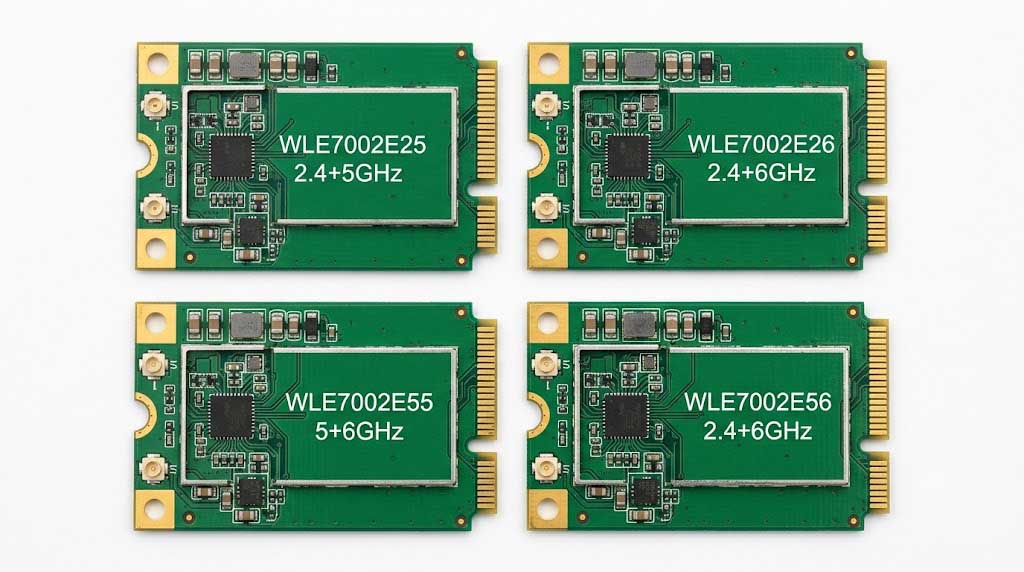
WLE7002 Series Model-by-Model Breakdown
| Model | Chipset | Band Config | MIMO | TX Power | Power | Best Use Case |
|---|---|---|---|---|---|---|
| WLE7002E25 | QCN6224 / QCN9274 | 2.4+5 GHz DBDC | 2×2:2 per band | 20 dBm (2.4G) / 18 dBm (5G) | 8W | General WiFi 7 AP/CPE, dual-band coverage |
| WLE7002E26 | QCN6274 / QCN9274 | 2.4+6 GHz DBDC | 2×2:2 per band | 20 dBm (2.4G) / 17 dBm (6G) | 8.3W | WiFi 7 with 6 GHz, smart city, venue AP |
| WLE7002E55 | QCN6274 / QCN9274 | 5+6 GHz DBDC | 2×2:2 per band | 18 dBm (both bands) | 8.7W | PtP backhaul, 5+6 GHz dual-link, WISP |
| WLE7002E56 | QCN6274 / QCN9274 | 2.4+6 GHz DBDC | 2×2:2 per band | 20 dBm (2.4G) / 17 dBm (6G) | 8.3W | Smart city outdoor AP, 2.4+6 GHz coverage |
Model Selection Guide
All four WLE7002 models share the same Mini PCIe form factor, the same 2×2 MIMO configuration, and the same QCN6274/QCN9274 DBDC architecture. The selection criteria are purely about which frequency bands your deployment requires:
- Choose WLE7002E25 for general-purpose WiFi 7 requiring both 2.4 GHz (legacy IoT compatibility, 1 km+ range) and 5 GHz (high-throughput client access). This is the most versatile model — suitable for enterprise APs, CPE, and mid-range gateways.
- Choose WLE7002E55 for PtP backhaul or any application that doesn’t need 2.4 GHz. The 5+6 GHz DBDC pairing lets you run one link on 5 GHz (better range) and one on 6 GHz (more spectrum). This is the specialized model for WISP backhaul as covered in the dedicated WISP guide.
- Choose WLE7002E26 or WLE7002E56 when 6 GHz access is needed alongside 2.4 GHz — for example, smart city deployments where 2.4 GHz handles long-range IoT sensors and 6 GHz handles high-throughput video surveillance backhaul. Note that E26 and E56 are electrically very similar; the exact specifications are confirmed per datasheet.
M.2 WiFi 7: WLTE7002 & WLTB7002 Series
Compex offers two M.2 WiFi 7 series that mirror the WLE7002 Mini PCIe lineup. The WLTE7002 series uses the M.2 3042 Key B form factor (30mm × 42mm, with USB/PCIe on Key B), while the WLTB7002 series uses the more compact M.2 2230 Key E form factor (22mm × 30mm, PCIe-only). Both use the same Waikiki reference designs as the Mini PCIe modules.
| Compex Module | Zukaka Alternative | Form Factor | Band Config | Chipset |
|---|---|---|---|---|
| WLTE7002E25 | ZK-WLTE7002E25 | M.2 3042 Key B | 2.4+5 GHz DBDC | QCN6224 / QCN9274 |
| WLTE7002E26 | ZK-WLTE7002E26 | M.2 3042 Key B | 2.4+6 GHz DBDC | QCN6274 / QCN9274 |
| WLTE7002E55 | ZK-WLTE7002E55 | M.2 3042 Key B | 5+6 GHz DBDC | QCN6274 / QCN9274 |
| WLTE7002E56 | ZK-WLTE7002E56 | M.2 3042 Key B | 5+6 GHz DBDC | QCN6274 / QCN9274 |
| WLTB7002E25 | ZK-WLTB7002E25 | M.2 2230 Key E | 2.4+5 GHz DBDC | QCN6224 / QCN9274 |
| WLTB7002E55 | ZK-WLTB7002E55 | M.2 2230 Key E | 5+5 GHz DBDC | QCN6274 / QCN9274 |
All M.2 variants share the same electrical specifications as their Mini PCIe counterparts. The form factor choice depends entirely on your carrier board’s M.2 slot type and available physical space.
Zukaka WLE7002 Alternatives vs Compex
For each WLE7002 model, Zukaka offers an exact equivalent:
| Compex Module | Zukaka Equivalent | Same Chipset? | Same Reference Design? | Same Performance? |
|---|---|---|---|---|
| WLE7002E25 | ZK-WLE7002E25 | Yes (QCN6224/QCN9274) | Yes (WK01.5) | Yes |
| WLE7002E26 | ZK-WLE7002E26 | Yes (QCN6274/QCN9274) | Yes (WK01.5) | Yes |
| WLE7002E55 | ZK-WLE7002E55 | Yes (QCN6274/QCN9274) | Yes (WK03.2) | Yes |
| WLE7002E56 | ZK-WLE7002E56 | Yes (QCN6274/QCN9274) | Yes (WK01.5) | Yes |
What Zukaka Adds Beyond Drop-In Compatibility
- ODM customization. Zukaka can customize WA7000 series modules — custom PCB dimensions to fit non-standard slots, tuned RF front-end for specific antenna loads, custom firmware for proprietary WiFi 7 features.
- OEM branding. Custom labels, packaging, and documentation with your brand identity.
- Dedicated FAE during design-in. Zukaka assigns FAEs to support the integration of these WiFi 7 modules into your design — from Waikiki reference design schematic review to PCIe signal integrity validation to custom QSDK firmware support.
- Competitive volume pricing. Particularly relevant when qualifying a second source for production-scale WiFi 7 deployments.
Design-In Considerations for WiFi 7 Modules
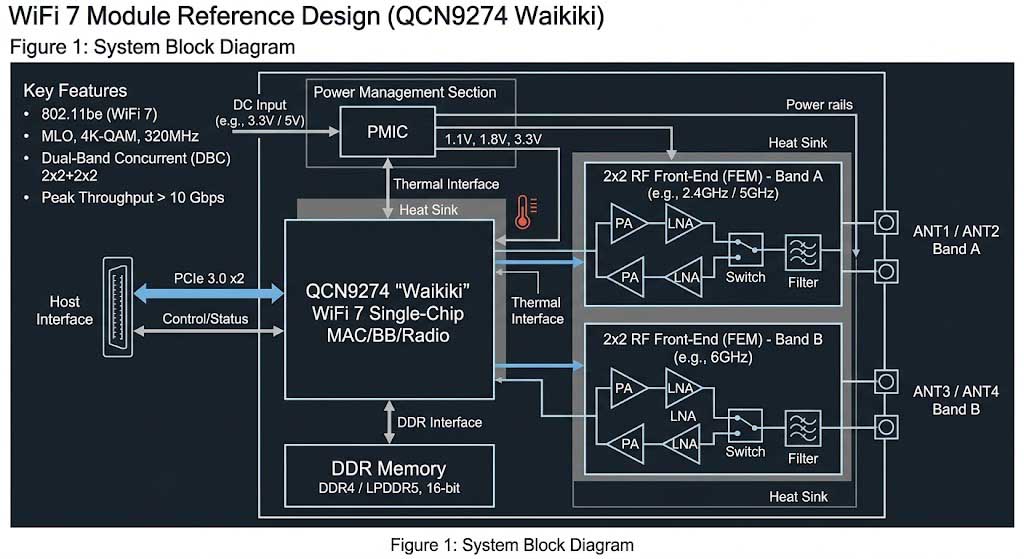
Integrating any WiFi 7 module — whether Compex or Zukaka — requires attention to the following areas:
- PCIe 3.0 signal integrity. WiFi 7 modules use PCIe 3.0 for host interface, requiring controlled-impedance traces (85 ohm differential) and AC coupling capacitors on the carrier board. Keep PCIe trace length under 6 inches and avoid routing near clock generators or switching power supplies.
- Thermal management. WLE7002 modules dissipate 8-8.7W in a Mini PCIe form factor. In a sealed enclosure without active airflow, the module requires a thermal pad to the enclosure chassis or a dedicated heatsink. The QCN9274’s junction temperature must stay below 105°C for reliable operation.
- Antenna isolation for DBDC. Dual-band concurrent operation requires two independent antenna pairs. Antenna-to-antenna isolation must exceed 20 dB to prevent desensitization between bands. For co-located antennas (same enclosure), maintain at least 1/2 wavelength spacing at the lower operating frequency.
- ath12k driver integration. The ath12k driver is the Linux kernel driver for QCN9274. Verify that your kernel version (5.15+ recommended) includes ath12k support. For QSDK-based builds, Qualcomm provides the ath12k backport package.
Frequently Asked Questions
Q: Are Zukaka’s ZK-WLE7002 modules drop-in replacements for Compex WLE7002?
Yes. Zukaka’s ZK-WLE7002 series uses the same Qualcomm QCN6224/QCN6274/QCN9274 chipsets on the same Waikiki reference designs (WK01.5, WK03.2). Pinout, PCIe interface, driver support, and RF performance are identical. No hardware or software changes are required.
Q: What is the difference between QCN6274 and QCN9274 in these modules?
Both chipsets share the same core DBDC 2×2 architecture and deliver 4.32 Gbps per band. The QCN9274 adds additional hardware acceleration features for advanced WiFi 7 capabilities like preamble puncturing and enhanced MLO scheduling. Compex and Zukaka both use the same chipset variant per model, as noted in the product specifications.
Q: Can I use a Zukaka WiFi 7 module with an existing QSDK build?
Yes. Zukaka WiFi 7 modules use the same ath12k driver and QSDK packages as Compex modules. Your existing QSDK build configuration and firmware settings work without modification. If you have a custom QSDK build for a Compex WLE7002 module, the same binary is compatible with the Zukaka equivalent.
Q: Does Zukaka offer the WLE7000E series (4×4 single-band) as alternatives?
Yes. Zukaka offers alternatives for the entire WLE7000 series — including the 4×4 single-band variants (WLE7000E2 2.4 GHz, WLE7000E5 5 GHz, WLE7000E6 6 GHz). These are covered in the main category hub. This guide focuses on the 2×2 DBDC WLE7002 sub-family.
Q: What are typical lead times for WiFi 7 module samples?
Standard sample orders for ZK-WLE7002, ZK-WLTE7002, and ZK-WLTB7002 series modules ship within 3-5 business days. Production lead times depend on volume and any ODM customization requirements. Contact Zukaka for current lead time information.
- Best Compex WiFi Module Alternatives — Category Hub — Full product mapping across all Compex Wi-Fi 5/6/7 modules
- Compex WLE7000 Series Guide — Mini PCIe WiFi 7, all 7 models including WLE7002E series
- Compex WiFi 7 M.2 Module Series — WLTB7000 & WLTE7000 complete guide (11 models)
- WISP Guide: WLE7002E55 for PtP Backhaul — Deep dive on 5+6 GHz backhaul deployment