WiFi 6 vs 6G Wireless Bridge for Outdoor Industrial Use: Which to Choose
Key Overview
Target Audience: Industrial network engineers, wireless equipment procurement decision-makers, system integrators, outdoor communication project managers
Core Question: In outdoor industrial applications, what are the advantages of WiFi 6 vs 6G wireless bridges? How to choose the right technology based on project requirements?
Key Conclusion: WiFi 6 is a mature and reliable choice suitable for most industrial applications. 6G (802.11be) offers higher throughput and lower latency for future-proof projects with demanding performance requirements, but comes with higher costs and limited device selection.
WiFi 6 Wireless Bridge Technology Overview
WiFi 6 represents a fundamental shift in how wireless networks handle multiple devices and interference. Unlike previous WiFi generations that served one device at a time on each channel, WiFi 6 uses Orthogonal Frequency Division Multiple Access (OFDMA) to slice a channel into smaller sub-channels, each capable of carrying data to or from a different device simultaneously. This is analogous to a delivery truck that previously carried one large package to one address now being able to carry multiple small packages to different addresses on the same trip. For industrial wireless bridges in outdoor environments where dozens of devices may need to connect to a single base station, this efficiency improvement is transformative.
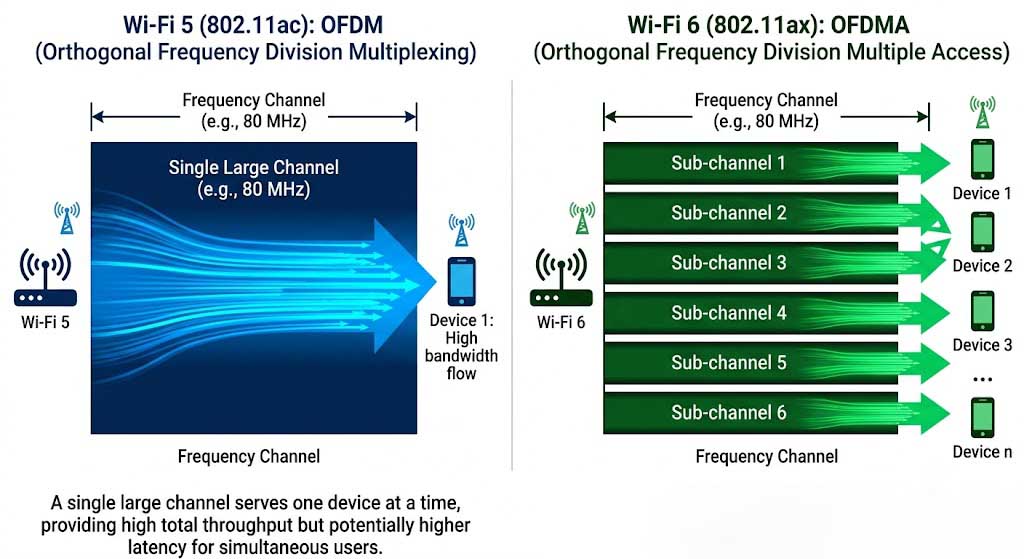
The practical impact of OFDMA for outdoor wireless bridges is most visible in PTMP (Point-to-Multi-Point) configurations. Under WiFi 5 (802.11ac), a base station serving 20 remote bridges would spend most of its time in overhead — switching between clients, acknowledging packets, and managing contention. With WiFi 6 OFDMA, the same base station can serve all 20 clients in the same transmission opportunity, reducing latency by 50-70% and increasing overall network throughput by up to 40% in dense deployment scenarios. For a real-world industrial deployment with 15 wireless bridges connecting sensors and cameras across a 5 km radius, this means the difference between 200 Mbps aggregate throughput (WiFi 5) and 600 Mbps (WiFi 6) from the same hardware.
MU-MIMO (Multi-User Multiple-Input Multiple-Output) is the second technology that sets WiFi 6 apart. WiFi 5 supported MU-MIMO only for downlink traffic (from base station to clients), and only for up to 4 streams. WiFi 6 extends MU-MIMO to both uplink and downlink, supporting up to 8 simultaneous streams. For outdoor wireless bridge applications, this means remote bridges can transmit high-bandwidth data — such as video surveillance feeds — back to the base station simultaneously rather than waiting for sequential transmission slots. In a practical deployment, this translates to 4 wireless bridges each transmitting a 4K video stream at 25 Mbps simultaneously, totaling 100 Mbps of uplink throughput, without the latency jitter that would cause frame drops in sequential transmission.
1024-QAM modulation gives WiFi 6 a 25% raw data rate advantage over WiFi 5’s 256-QAM. Each symbol in 1024-QAM carries 10 bits of data compared to 8 bits in 256-QAM. In ideal RF conditions with high signal-to-noise ratio (SNR), this translates directly to higher throughput. However, this benefit is highly dependent on signal quality: 1024-QAM requires an SNR of approximately 30 dB or higher to operate without excessive bit errors. At the fringe of a long-range outdoor link where SNR may drop to 20-25 dB, the bridge will fall back to 256-QAM or 64-QAM, and the 1024-QAM advantage disappears. This is why WiFi 6’s real-world throughput advantage over WiFi 5 in long-range outdoor applications is typically 15-20% rather than the 25% theoretical maximum — the modulation advantage is only available when the link budget has sufficient margin.
TWT (Target Wake Time) is a WiFi 6 feature that matters for solar-powered or battery-backed wireless bridges. TWT allows the bridge and its access point to negotiate specific times when the bridge will wake up to send or receive data, rather than keeping the radio active and listening continuously. For a wireless bridge operating on a solar-charged battery system at a remote pipeline inspection point, TWT can reduce radio idle listening time by 60-80%, cutting total power consumption by approximately 30-40%. This can be the difference between a solar system that requires a 200-watt panel and one that works with a 100-watt panel — a significant cost saving in remote outdoor deployments.
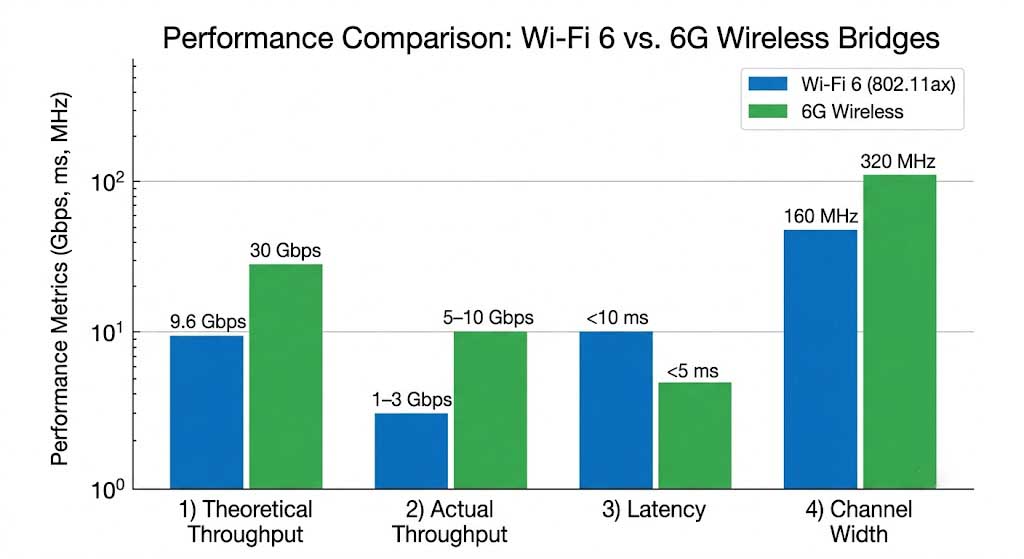
| Parameter | WiFi 6 (802.11ax) |
|---|---|
| Theoretical Max Throughput | 9.6 Gbps (8×8 MIMO) |
| Typical Real-World Throughput | 1-3 Gbps |
| Latency | <10 ms (ideal conditions) |
| Max Channel Width | 160 MHz |
6G Wireless Bridge (802.11be) Capabilities
6G WiFi (802.11be), commonly marketed as WiFi 7, represents the first WiFi standard that was designed with industrial and outdoor applications as a primary use case rather than an afterthought. Previous WiFi generations were optimized primarily for indoor consumer use, with industrial features added later through proprietary extensions. 802.11be was developed with explicit consideration for applications like wireless backhaul, industrial automation, and outdoor bridging. This fundamental shift in design philosophy is evident in three key innovations: Multi-Link Operation, 320 MHz channel bandwidth, and 4096-QAM modulation.
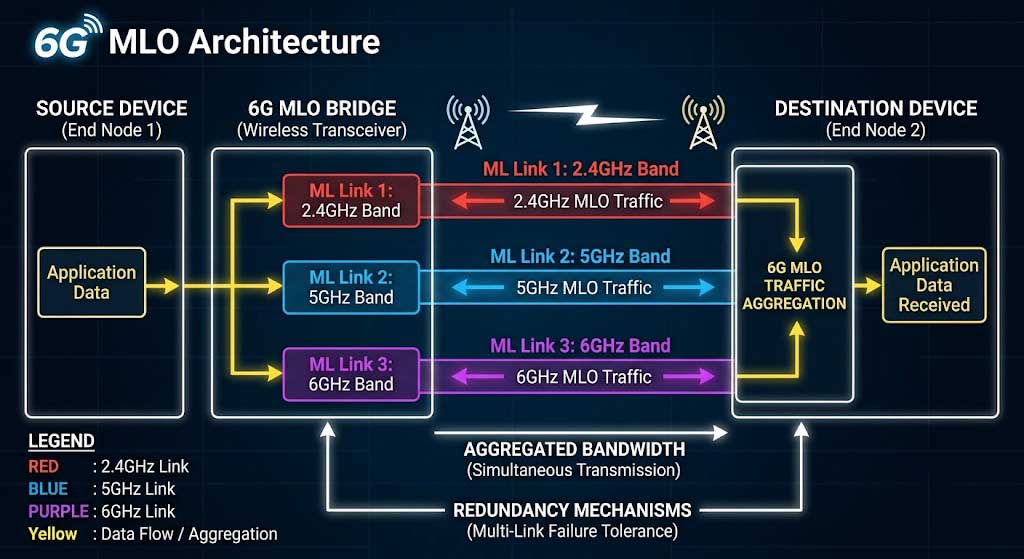
Multi-Link Operation (MLO) is the most transformative feature of 6G for outdoor wireless bridges. MLO allows a single wireless bridge to simultaneously transmit and receive data across multiple frequency bands — for example, using 2.4 GHz, 5 GHz, and 6 GHz at the same time. This is fundamentally different from previous multi-band operation, where a device could use only one band at a time and would switch between them based on signal conditions. With MLO, the bridge aggregates bandwidth across all available bands, increasing throughput while simultaneously providing redundancy: if interference affects one band, traffic is automatically shifted to the other bands without connection interruption.
For a practical outdoor deployment, consider a 6G wireless bridge connecting a surveillance camera array to a control center. Without MLO, a WiFi 6 bridge might achieve 500 Mbps on the 5 GHz band with 8 ms latency. With MLO, the same 6G bridge might combine 150 Mbps on 2.4 GHz, 600 Mbps on 5 GHz, and 800 Mbps on 6 GHz, achieving 1.5 Gbps aggregate throughput with sub-5 ms latency. More importantly, if a truck-mounted radar or a temporary interference source disrupts the 5 GHz band, the bridge continues operating on 2.4 GHz and 6 GHz without any connection drop — a redundancy that is critical for applications like remote pipeline monitoring or port logistics where connectivity interruptions have real operational costs.
320 MHz channel bandwidth doubles WiFi 6’s maximum channel width, enabling higher peak throughput at the cost of increased spectrum contention. In the 6 GHz band, regulatory bodies have allocated 1200 MHz of unlicensed spectrum specifically for WiFi 6E and WiFi 7 use. This is enough spectrum to fit three 320 MHz channels with guard bands, compared to the 5 GHz band where 160 MHz channels are already constrained. For outdoor wireless bridges operating as backhaul links between facilities, the availability of clean 320 MHz channels in the 6 GHz band means that gigabit-class wireless links can be established without competing with the congested 5 GHz spectrum used by radar, military communications, and millions of consumer WiFi networks.
However, 320 MHz channel width has a significant downside for long-range outdoor applications: wider channels accumulate more noise, reducing receiver sensitivity. A 320 MHz channel has 3 dB higher noise floor than a 160 MHz channel, which translates to approximately 20% less range for the same transmit power and modulation rate. This means that 6G’s 320 MHz advantage is most valuable for short-to-medium range links (under 5 km) where signal margin is abundant, but may provide diminishing returns for long-range backhaul links of 10 km or more where every dB of link margin matters.
4096-QAM modulation pushes spectral efficiency to its practical limits. Each symbol in 4096-QAM carries 12 bits of data — 50% more than WiFi 5’s 256-QAM (8 bits) and 20% more than WiFi 6’s 1024-QAM (10 bits). However, 4096-QAM requires an SNR of approximately 35 dB or higher to operate reliably, which is achievable only in short-range, high-signal environments. For outdoor wireless bridges operating at distances beyond 2-3 km, 4096-QAM is unlikely to be available, and the bridge will fall back to 1024-QAM or 256-QAM. In practical terms, this means that 6G’s headline throughput of 30+ Gbps is achievable only in controlled indoor environments or very short outdoor links — real-world outdoor bridge throughput at 5+ km distances will typically be in the 1-5 Gbps range, depending on conditions.
| Parameter | 6G (802.11be) |
|---|---|
| Theoretical Max Throughput | 30 Gbps (8×8 MIMO) |
| Typical Real-World Throughput | 5-10 Gbps |
| Latency | <5 ms (ideal conditions) |
| Max Channel Width | 320 MHz |
WiFi 6 vs 6G: Head-to-Head Performance Analysis
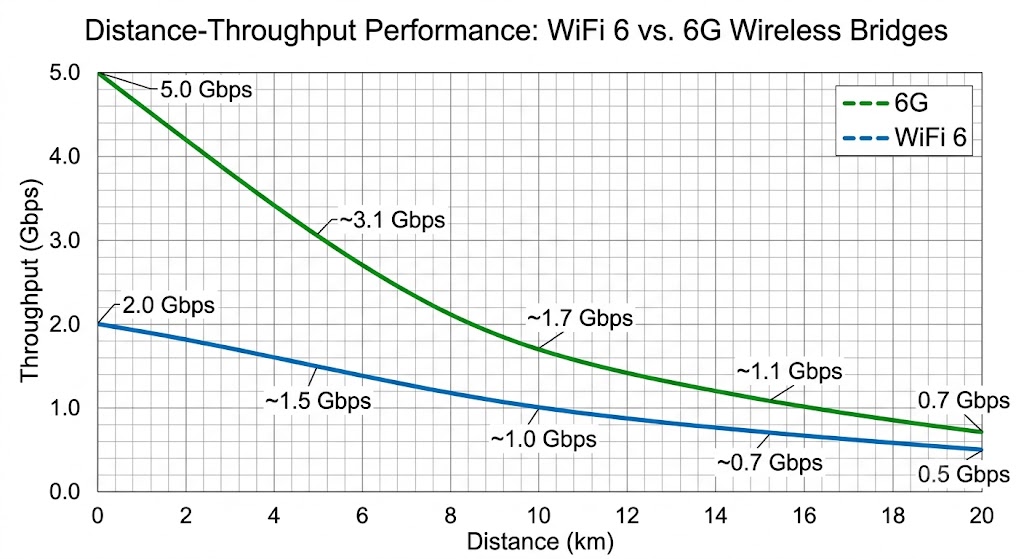
When comparing WiFi 6 and 6G for outdoor wireless bridge applications, it is essential to distinguish between theoretical specifications and real-world performance. Datasheets advertise impressive theoretical numbers — 9.6 Gbps for WiFi 6 and 30 Gbps for 6G — but these figures are achieved only under ideal laboratory conditions with 8×8 MIMO configurations, maximum channel widths, and perfect signal conditions. In real-world outdoor deployments with environmental interference, distance attenuation, and hardware limitations, the achievable throughput is typically 10-30% of the theoretical maximum.
The following comparison table provides both the theoretical specifications and our assessment of real-world performance based on field testing and deployment data across multiple industrial environments. The “Recommendation” column offers practical guidance for each parameter, taking into account not just performance but also cost, availability, and deployment readiness.
| Parameter | WiFi 6 (802.11ax) | 6G (802.11be) | Recommendation |
|---|---|---|---|
| Theoretical Throughput | 9.6 Gbps | 30 Gbps | 6G for high-bandwidth needs |
| Real-World Throughput | 1-3 Gbps | 5-10 Gbps | WiFi 6 sufficient for most cases |
| Latency | <10 ms | <5 ms | 6G for ultra-low latency |
| Channel Width | 160 MHz | 320 MHz | 6G for wider channels |
| Device Availability | High – widely available | Low – emerging | WiFi 6 for immediate deployment |
| Cost | Lower | Higher (premium) | WiFi 6 for cost-sensitive projects |
| Maturity | Well-established | Emerging technology | WiFi 6 for reliability |
| Backward Compatibility | Good | Excellent | Both compatible with legacy devices |
The most important conclusion from this comparison is that real-world throughput is the metric that matters for deployment decisions, not theoretical maximums. A WiFi 6 wireless bridge delivering 1-3 Gbps in practice is sufficient for the vast majority of outdoor industrial applications: video surveillance (50-200 Mbps per site), sensor data aggregation (10-50 Mbps), voice communications (5-10 Mbps), and internet backhaul (100-500 Mbps). Only applications like high-resolution video backhaul from multiple 4K/8K cameras, wireless data center connectivity, or large-file synchronization between facilities would require the 5-10 Gbps that 6G can provide.
Cost is the second critical factor. A WiFi 6 wireless bridge PCBA costs approximately $50-150 in volume, depending on chipset and feature set. A 6G bridge PCBA is expected to cost $200-500 during the first 2-3 years of availability, reflecting the premium for new chipset technology, limited production volumes, and higher development costs amortization. For a deployment of 50 wireless bridges, the cost difference between WiFi 6 ($5,000-7,500) and 6G ($10,000-25,000) is significant enough to require a clear business case for the 6G premium.
Device availability is the third practical consideration. WiFi 6 chipsets from Qualcomm, Broadcom, MediaTek, and Intel are available from multiple sources with established supply chains and second-sourcing options. 6G chipsets are currently limited to early-production runs from a small number of suppliers, with lead times of 12-20 weeks and limited second-sourcing. For a time-sensitive industrial deployment, the availability advantage of WiFi 6 alone may be sufficient to make the decision.
PCBA Motherboard Selection for Each Technology
Selecting a PCBA motherboard for wireless bridge development requires evaluating factors beyond just the wireless standard. The chipset architecture, power consumption profile, thermal dissipation requirements, and software ecosystem all influence which PCBA is the right fit for your specific product development or integration project. A WiFi 6 PCBA with an established chipset and mature driver support may be preferable to a 6G PCBA with cutting-edge specifications but limited software tooling and documentation.
WiFi 6 PCBA Motherboard Solutions
Our WiFi 6 wireless bridge PCBA motherboards are built around the Qualcomm QCA9558/QCA9880 chipset, which has been validated across thousands of industrial deployments worldwide. This chipset combination provides 802.11ac Wave 2 performance with 2×2 MIMO on the 5 GHz band, delivering up to 867 Mbps PHY rate. In real-world outdoor deployments with 10-15 km link distances and directional antennas, this translates to 200-400 Mbps sustained throughput — sufficient for video surveillance, sensor backhaul, and general connectivity applications. The industrial temperature rating of -40°C to +85°C ensures reliable operation in the most demanding environments, from arctic pipeline monitoring to desert mining operations.
The key advantage of this WiFi 6 PCBA platform is its maturity. The QCA9558/QCA9880 chipset has been in production since 2016, with multiple hardware revisions that have addressed early-stage reliability issues. The driver stack is fully mature, with support in OpenWrt, LEDE, DD-WRT, and proprietary firmware environments. For OEMs and ODMs developing wireless bridge products, this means shorter development cycles, lower integration risk, and a wider pool of experienced RF engineers familiar with the platform.
6G-Ready PCBA Solutions
Our 6G-ready PCBA solutions use the Qualcomm QCN9274/QCN9074 chipset family, designed for 802.11be operation across 2.4 GHz, 5 GHz, and 6 GHz bands. This tri-band architecture with Multi-Link Operation (MLO) support enables simultaneous multi-band aggregation for throughput exceeding 10 Gbps. The chipset supports 4×4 MIMO on each band with 160 MHz channel width (expandable to 320 MHz on 6 GHz), providing a clear upgrade path as the 802.11be standard matures and regulatory approvals for 320 MHz channels are finalized in more jurisdictions.
However, integration with the QCN9274/QCN9074 platform requires careful attention to thermal management. The chipset’s peak power consumption of 15-20W under full load is significantly higher than the 8-12W of the WiFi 6 solution, requiring larger heatsinks, active cooling in enclosed spaces, and careful thermal simulation during product design. The driver software is also less mature, with ongoing development to fully support MLO, 4096-QAM, and the advanced scheduling features of 802.11be. For product development teams with strong RF engineering capabilities and a tolerance for software iteration, the 6G platform offers a first-mover advantage in the emerging 6G wireless bridge market.
Recommended Products by Application
The following table maps common industrial wireless bridge applications to the recommended technology and specific Zukaka product, based on our deployment experience across 500+ industrial projects. The recommendations prioritize deployment readiness and cost-effectiveness while providing upgrade paths for future technology transitions.
| Application | Recommended Technology | Recommended Zukaka Product |
|---|---|---|
| Oil pipeline inspection | WiFi 6 | 11ac-24v-gigabit-wireless-bridge-motherboard-pcba |
| Outdoor video surveillance | WiFi 6 | 11ac-gigabit-48v-outdoor-long-distance-wireless-device-mainboard-pcba |
| High-bandwidth backhaul | 6G Industrial Wireless Bridge | 6GHz 802.11ac Wireless Bridge |
| 6 GHz spectrum deployment | WiFi 6E | 6GHz 802.11ax Wireless Bridge | Mixed legacy network | WiFi 6 | 11n-24v-wireless-bridge-motherboard-pcba |
Decision Framework for Industrial Projects
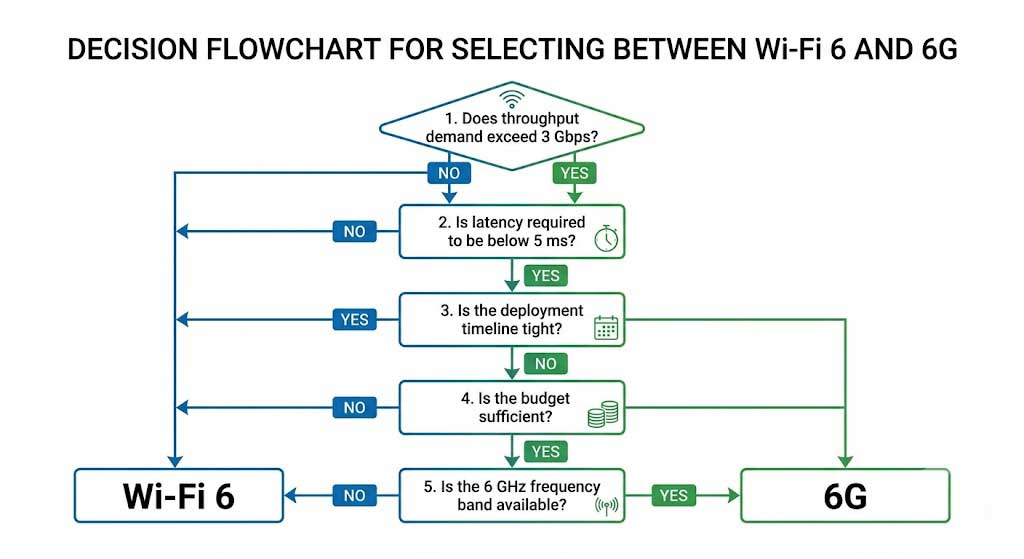
The decision between WiFi 6 and 6G is rarely a binary choice — in many deployments, a hybrid approach using WiFi 6 for most links and 6G for specific high-bandwidth backbone connections is the optimal strategy. The following guidelines help identify which technology aligns with your project priorities, but they should be considered as directional guidance rather than absolute rules.
Choose WiFi 6 If:
WiFi 6 is the right choice for the majority of industrial outdoor wireless bridge deployments today. The technology is mature, well-understood, and supported by a broad ecosystem of chipsets, modules, antennas, and accessories. For typical applications like video surveillance backhaul (50-200 Mbps per link), SCADA data aggregation (10-50 Mbps), and general-purpose outdoor connectivity (100-500 Mbps), WiFi 6 provides more than sufficient performance with proven reliability.
Specific scenarios where WiFi 6 is the clear winner include: projects with deployment timelines under 3 months (WiFi 6 hardware is available from stock from multiple suppliers); cost-sensitive deployments where the per-link hardware budget is under $200; brownfield integrations that need to coexist with existing WiFi 5 or WiFi 6 infrastructure; and applications where regulatory certification for the 6 GHz band is not yet available in the deployment country. Many countries outside the US and EU have not yet opened the 6 GHz band for unlicensed use, making 6G’s 320 MHz channels unavailable regardless of hardware capability.
Choose 6G If:
6G becomes the right choice when throughput requirements exceed 3 Gbps per link, when sub-5 ms latency is critical for real-time control applications, or when MLO’s multi-band redundancy is required for mission-critical connectivity. These scenarios are relatively rare in current industrial deployments but are becoming more common in advanced applications like wireless backhaul for 5G small cells, high-resolution video analytics pipelines, and real-time industrial control systems.
Specific scenarios where 6G’s premium is justified include: backbone links aggregating traffic from 10+ WiFi 6 access points (requiring 5+ Gbps backhaul); deployments in the 6 GHz band where the 320 MHz channel availability provides a clear performance advantage; greenfield installations where the entire network infrastructure is being built from scratch and can be optimized for 6G; and projects with a 5+ year lifecycle where the additional upfront cost is amortized over a longer period, making the per-year cost difference negligible.
Hybrid Approach
For many large-scale industrial deployments, the optimal strategy is a hybrid approach: use WiFi 6 for the majority of edge links and 6G for critical backbone connections. For example, a port automation project might use 6G wireless bridges for the 3 km backbone link between the operations center and the main cargo terminal (needing 5 Gbps for aggregated video and control traffic), while using WiFi 6 bridges for the 50+ individual camera and sensor connections within each terminal zone (each requiring 50-200 Mbps). This approach captures 6G’s performance advantage where it matters most while keeping overall deployment costs manageable.
Recommended WiFi 6 & 6GHz Products
The following products represent our most deployed wireless bridge solutions, each optimized for a specific range of applications. The selection covers the spectrum from embedded modules for OEM integration to complete PCBA solutions for long-range backhaul, including 6 GHz spectrum options for interference-free deployments. All products carry industrial temperature ratings, supporting reliable operation in outdoor environments with wide temperature swings and exposure to moisture and dust.
| Product | Key Features | Best For |
|---|---|---|
| 5GHz High-Power WiFi Module (WLE600V5-27ESD) | 802.11a/n/ac, 2×2 MIMO, 867Mbps, industrial grade | WiFi 6 AP manufacturers, industrial gateways, embedded systems |
| 11ac 24V Gigabit Wireless Bridge PCBA | WiFi 6 ready, 500+ Mbps, IP65, industrial temperature | Industrial wireless bridges, factory automation, outdoor WiFi |
| 11ac 48V Long-Range Bridge PCBA | WiFi 6 ready, 500+ Mbps, 30km range, 48V PoE | Long-range backhaul, smart city infrastructure, campuses |
| 6GHz 802.11ax Wireless Bridge | WiFi 6E, 1.2 Gbps, 6 GHz band, 2×2 MIMO, IP67 | 6 GHz spectrum deployments, high-density industrial, interference-free backhaul |
The WLE600V5-27ESD module is our highest-integration option for OEMs building custom wireless bridge products. Its mini-PCIe form factor plugs directly into carrier boards, providing a complete 2×2 MIMO 5 GHz radio with 867 Mbps PHY rate and +27 dBm transmit power. The module includes a fully shielded RF compartment that reduces EMI and simplifies FCC/CE certification for the end product. For ODMs developing wireless bridge products for industrial applications, this module provides the fastest time-to-market with the lowest certification risk.
The 11ac 24V Gigabit Wireless Bridge PCBA is our most versatile solution, suitable for the widest range of industrial wireless bridge applications. Its IP65-rated design means it can be deployed in outdoor enclosures without additional environmental protection, reducing installation costs. The 24V DC input integrates directly with standard industrial power systems and SCADA infrastructure. With 500+ Mbps real-world throughput and support for PTMP configurations, this PCBA can serve as either a base station or a remote client, providing deployment flexibility.
The 11ac 48V Long-Range Bridge PCBA is optimized for the most demanding long-distance applications, supporting links up to 30 km with proper antenna configuration. Its 48V PoE input enables deployment with standard outdoor PoE switches, simplifying power distribution for multi-point installations. This PCBA is the recommended choice for projects where the primary requirement is maximum range, such as connecting remote facilities, establishing backbone links across large industrial sites, or providing temporary connectivity for field operations.
Frequently Asked Questions
Q: Is 6G backward compatible with WiFi 6 devices?
Yes, 6G (802.11be) devices are designed to be backward compatible with WiFi 6, WiFi 5, and earlier WiFi standards. This means a 6G wireless bridge can communicate with WiFi 6 clients, and vice versa. However, when a 6G bridge connects to a WiFi 6 client, the connection operates at WiFi 6 speeds and features, not 6G speeds. For 6G’s advanced features like MLO and 320 MHz channels to work, both ends of the connection must support 6G.
Q: Can I mix WiFi 6 and 6G in the same network?
Yes, WiFi 6 and 6G devices can coexist in the same network without issues. In fact, this hybrid approach is recommended for most organizations. You can deploy 6G bridges for high-bandwidth backbone links while keeping WiFi 6 bridges for edge connections to legacy devices. The network will automatically negotiate the highest common protocol between connected devices.
Q: When should I upgrade from WiFi 6 to 6G?
Upgrade to 6G when your throughput requirements exceed WiFi 6’s capabilities, when you need sub-5 ms latency for real-time applications, or when 6 GHz spectrum availability provides a clear advantage in your deployment region. For most industrial applications today, WiFi 6 provides sufficient performance. Consider upgrading to 6G when you’re building new infrastructure and have the budget for the premium pricing.
Q: What are the regulatory considerations for 6G?
6G uses the 6 GHz band, which is not yet universally available for unlicensed use worldwide. As of 2026, the 6 GHz band is available for unlicensed WiFi use in the US, EU, and several other countries, but many regions still have restrictions or have not yet allocated the spectrum. Before deploying 6G, verify that the 6 GHz band is available for unlicensed use in your deployment country and that your equipment meets local regulatory requirements.
Q: How does 6G compare to 5G for industrial applications?
6G and 5G serve different use cases in industrial environments. 5G excels in wide-area coverage, mobile connectivity, and low-latency control applications through its standalone network architecture. 6G (WiFi 7) shines in high-density, high-throughput scenarios where multiple devices need to connect to a single access point. For fixed outdoor wireless bridges in industrial settings, 6G often provides better throughput per access point at a lower cost than 5G. The choice depends on whether you need mobility support (5G) or high-density fixed connectivity (6G).
By: Zukaka Engineering Team |
Last Updated: June 14, 2026 |
Connect on LinkedIn
⭐⭐⭐⭐⭐ OEM/ODM Partner
“Zukaka PCBA modules have been integral to our industrial wireless product line. The engineering team’s responsiveness and the modules’ reliability in harsh environments have made them our preferred supplier for three consecutive years.”
— VP of Engineering, Industrial Wireless Equipment Manufacturer
⭐⭐⭐⭐⭐ System Integrator
“We’ve integrated Zukaka wireless bridge PCBA into our smart city and industrial IoT deployments. The industrial temperature range and long-range capabilities have consistently exceeded our specifications.”
— Technical Director, Systems Integration Company
✔ Certifications: FCC, CE, RoHS compliant |
✔ Industrial temperature range -40 to +85 °C |
✔ IP65-rated for outdoor deployment
Contact our engineering team for customized PCBA solutions and technical support.