Key Overview
WiFi 7 (IEEE 802.11be), also called Extremely High Throughput (EHT), is the sixth major WiFi generation, ratified in September 2024. It delivers up to 46 Gbps theoretical peak throughput through 320 MHz channel bandwidth, 4096-QAM modulation, 16 spatial streams, and Multi-Link Operation (MLO). This complete guide covers the 802.11be standard foundation, chipset architecture (Qualcomm QCN9274/CN6274, MediaTek Filogic 880/860), module selection criteria across form factors (MiniPCIe, M.2, onboard), application scenarios for enterprise AP, industrial IoT, and smart infrastructure, and provides a comprehensive catalog of Zukaka’s 18 WiFi 7 module products. Whether you’re an OEM/ODM sourcing engineer, a system architect designing next-gen wireless products, or a technical buyer evaluating WiFi 7 module options, this guide serves as the central hub for all WiFi 7 content.
WiFi 7 (802.11be) Complete Guide: Chipsets, Modules, Selection & Applications
Also see: Wireless AP Design Guide •
WiFi Module Case Studies Hub
Table of Contents
- What is WiFi 7? Standard Foundation & Key Features
- WiFi 7 Chipset Ecosystem: Qualcomm, MediaTek & Realtek
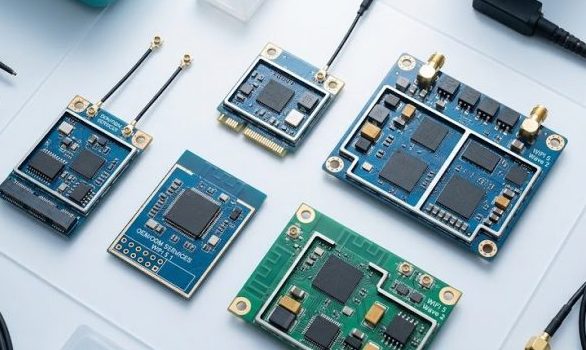
- WiFi 7 Module Form Factors: MiniPCIe, M.2 & Onboard
- WiFi 7 Module Selection Guide: How to Choose the Right Module
- WiFi 7 Application Scenarios: Enterprise, Industrial, Smart Infrastructure
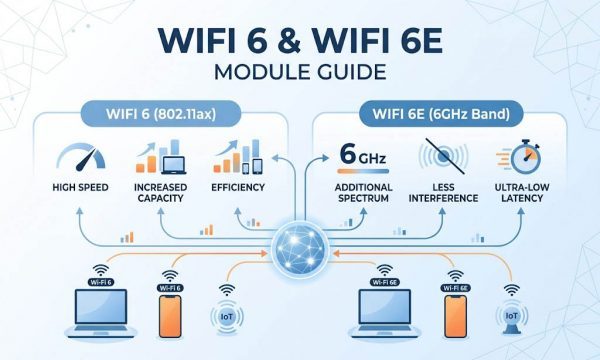
- WiFi 7 vs WiFi 6 vs WiFi 6E: Key Technical Comparison
- WiFi 7 Product Catalog: Zukaka WiFi 7 Module Series
- WiFi 7 Deployment Considerations: Power, Thermal, Regulatory
- WiFi 7 Module Certification & Compliance
- Frequently Asked Questions
1. What is WiFi 7? Standard Foundation & Key Features
WiFi 7, standardized as IEEE 802.11be-2024 and marketed under the Wi-Fi Alliance’s “WiFi 7” designation, represents a generational leap in wireless networking performance. The standard was ratified in September 2024 after five years of development by the IEEE 802.11be Task Group (TGbe). The Wi-Fi Alliance launched its “Wi-Fi CERTIFIED 7” program in January 2024 based on draft 3.0, enabling early product certification before full ratification.
Key 802.11be Features
- 320 MHz Channel Bandwidth: Doubles WiFi 6/6E’s 160 MHz ceiling in the 6 GHz band, delivering a direct 2x PHY throughput increase under identical modulation and MIMO configurations.
- 4096-QAM (4K QAM) Modulation: 12 bits/symbol vs. 10 bits/symbol in WiFi 6 (1024-QAM), providing ~20% better spectral efficiency.
- Multi-Link Operation (MLO): Simultaneous data transmission and reception across multiple frequency bands. Three MLO modes: STR, eMLSR, and NSTR.
- 16 Spatial Streams: Doubles WiFi 6’s 8-stream ceiling.
- Multiple Resource Unit (MRU): Allows a single station to receive multiple resource units in an OFDMA transmission.
- Preamble Puncturing: Enables transmitters to skip partially occupied subchannels within a wide bandwidth allocation.
- 512 Compressed Block Ack: Reduces acknowledgment overhead in high-throughput configurations.
For a deeper technical breakdown: What is 802.11be WiFi 7? Speed, Features & Use Cases.
2. WiFi 7 Chipset Ecosystem: Qualcomm, MediaTek & Realtek
Qualcomm QCN9274 & CN6274 Series
Qualcomm’s flagship QCN9274 delivers 4×4 MU-MIMO per band with peak aggregate PHY throughput >30 Gbps across tri-band operation. The CN6274 is a cost-optimized mid-range variant at ~20 Gbps aggregate. Both are built on 7nm process and support the full WiFi 7 feature set.
Complete technical breakdown: CN6274 / QCN9274: WiFi 7 Chipset Overview.
MediaTek Filogic 880 & 860 Series
MediaTek’s Filogic 880, built on 6 nm process, targets high-end enterprise AP platforms with 4×4 320 MHz MLO and peak PHY >30 Gbps. The Filogic 860 serves mainstream enterprise APs with 4×4 on 5/6 GHz.
Realtek RTL8922AE
A dual-band 2×2 WiFi 7 module targeting consumer and commercial embedded systems with USB 3.0/PCIe interfaces.
3. WiFi 7 Module Form Factors: MiniPCIe, M.2 & Onboard
MiniPCIe (Half-Mini / Full-Size)
The most common form factor for industrial and enterprise WiFi 7 modules. MiniPCIe offers standardized pinout, PCIe 3.0 interface support, and robust mechanical retention. Zukaka’s WLE, WLTE, and WLTB MiniPCIe series cover all band configurations.
M.2 (Key B+M / Key E / Key M)
M.2 WiFi 7 modules require careful thermal management due to higher power draw. See: M.2 E-Key vs B+M-Key WiFi Modules Full Comparison.
Onboard / PCBA Module
Best thermal integration and lowest BOM cost for high-volume OEM/ODM deployments.
4. WiFi 7 Module Selection Guide
Key selection dimensions specific to WiFi 7:
- Band Configuration: Dual-band 2.4+5 GHz (markets without 6 GHz), Dual-band 5+6 GHz (best performance), Tri-band (maximum capability). See: Dual Band Module Application Scenarios.
- Spatial Streams: 2×2 delivers up to 4.3 Gbps for most clients; 4×4 for high-density APs.
- Chipset: QCN9274 for enterprise flagship, CN6274 for cost-optimized, Filogic 880 for integrated AP SoC.
- MLO Requirements: STR mode requires band isolation; eMLSR for single-radio designs.
Complete selection framework: WiFi Module Complete Selection Guide.
5. WiFi 7 Application Scenarios
- Enterprise & High-Density AP: Multi-AP MLO roaming, 50+ clients per AP, 8K video conferencing.
- Industrial IoT: AGV/AMR real-time control (sub-2ms MLO), AI vision 4K feeds, factory sensor networks.
- Wireless Backhaul: Multi-gigabit PTP/PTMP with 320 MHz 6 GHz channels, smart city surveillance.
Detailed scenario analysis: 802.11be WiFi 7 Application Scenarios.
6. WiFi 7 vs WiFi 6 vs WiFi 6E: Key Technical Comparison
| Parameter | WiFi 5 | WiFi 6 | WiFi 6E | WiFi 7 |
|---|---|---|---|---|
| Ratification | 2013 | 2019 | 2020 | 2024 |
| Max Channel BW | 160 MHz | 160 MHz | 160 MHz | 320 MHz |
| Max Modulation | 256-QAM | 1024-QAM | 1024-QAM | 4096-QAM |
| Spatial Streams | 4 (DL only) | 8 (UL+DL) | 8 (UL+DL) | 16 (UL+DL) |
| Peak PHY (2×2) | 867 Mbps | 1.2 Gbps | 1.2 Gbps | 5.8 Gbps |
| MLO | No | No | No | Yes |
Detailed comparison: WiFi 6 vs 6E vs 7: What’s the Difference.
7. WiFi 7 Product Catalog: Zukaka WiFi 7 Module Series
Zukaka offers 18 WiFi 7 modules across three series. Below is a structured catalog:
Dual-Band 2.4+5 GHz MiniPCIe (Diplexer Design)
- WLE7002E25 — Qualcomm QCN6224/QCN6274/QCN9274, 2×2 MU-MIMO, up to 4324 Mbps
- WLTE7002E25 — Extended temp variant
- WLTB7002E25 — Low-profile variant
Dual-Band 5+6 GHz MiniPCIe
- WLE7002E56 — 2×2 MU-MIMO, up to 5.765 Gbps
- WLE7002E55 — 5 GHz optimized
- WLE7002E26 — 6 GHz optimized
- WLTE7002E55 — Extended temp 5 GHz
- WLTE7002E26 — Extended temp 6 GHz
- WLTE7002E56 — Extended temp 5+6 GHz
- WLTB7002E26 — Low-profile 6 GHz
- WLTB7002E55 — Low-profile 5 GHz
- WLTB7002E56 — Low-profile 5+6 GHz diplexer
Single-Band Modules
- WLE7000E2 — Single-band 2.4 GHz
- WLE7000E5 — Single-band 5 GHz
- WLE7000E6 — 4×4 single-band 6 GHz
- WLTE7000E2 — Extended temp 2.4 GHz
- WLTE7000E5 — Extended temp 5 GHz
- WLTE7000E6 — Extended temp 6 GHz
Module Selection Matrix
| Application | Recommended Module | Band | Peak Rate |
|---|---|---|---|
| Enterprise AP | WLE7002E56 | 5+6 GHz | 5.8 Gbps |
| Industrial Gateway | WLE7002E25 | 2.4+5 GHz | 4.3 Gbps |
| Outdoor CPE | WLE7002E55 | 5 GHz | 2.9 Gbps |
| Wide Temp (-40~85C) | WLTE7002E25 | 2.4+5 GHz | 4.3 Gbps |
8. WiFi 7 Deployment Considerations
- Power Consumption: WiFi 7 modules with MLO active draw 1.5–3x more power than WiFi 6 modules at equivalent throughput. Plan for adequate thermal management in enclosure designs.
- Thermal Management: 4×4 MLO configurations with 320 MHz processing generate significant heat. Use thermal pads and heatsinks for sustained operation above 70°C ambient.
- Regulatory: 6 GHz band availability varies by country. The US (FCC), EU (ECC Decision 2023), and select APAC markets support 6 GHz for WiFi 7. China has allocated 6 GHz but with restrictions. Check local regulations.
- Antenna Design: MLO requires antenna isolation between bands (typically >20 dB). For guidance, see our Wireless AP Antenna Design Guide.
9. WiFi 7 Module Certification & Compliance
- Wi-Fi CERTIFIED 7: Wi-Fi Alliance certification program ensures interoperability across vendors.
- FCC / CE / IC: Modular certification for 2.4 GHz and 5 GHz bands. 6 GHz certification is region-dependent.
- Pre-certified Modules: Zukaka WiFi 7 modules come with pre-certification for FCC and CE in most band configurations, reducing OEM certification costs.
Frequently Asked Questions
Q: Is WiFi 7 backward compatible with WiFi 6 and WiFi 5?
A: Yes. WiFi 7 modules are fully backward compatible with WiFi 6/6E (802.11ax), WiFi 5 (802.11ac), WiFi 4 (802.11n), and WiFi 3 (802.11g). They automatically negotiate the best common standard with the access point.
Q: When should I choose a dual-band 2.4+5 GHz WiFi 7 module over a 5+6 GHz module?
A: Choose 2.4+5 GHz when your target market doesn’t have 6 GHz regulatory approval, or when you need maximum range (2.4 GHz) combined with high throughput (5 GHz). Choose 5+6 GHz when 6 GHz is available and you need maximum WiFi 7 performance with MLO.
Q: What’s the real-world throughput difference between WiFi 7 and WiFi 6?
A: In typical 2×2 configurations, WiFi 7 delivers 2.5–4x the throughput of WiFi 6 under equivalent conditions, primarily due to 320 MHz channels and 4096-QAM. With MLO, the gap can widen to 3–5x in dual-band aggregation scenarios.
Q: Do I need WiFi 7 AP infrastructure to use a WiFi 7 client module?
A: Yes, to get WiFi 7 features (320 MHz, MLO, 4096-QAM), both client and AP must support WiFi 7. When connected to a WiFi 6 or earlier AP, the module will fall back to the highest common standard and operate as a WiFi 6/6E device.
Q: What is the typical power consumption of a WiFi 7 module?
A: Typical active power consumption for a 2×2 MLO-enabled WiFi 7 module ranges from 3.5–6W depending on band configuration and traffic pattern. This compares to 1.5–3W for a comparable WiFi 6 module. Sleep mode power is similar to WiFi 6 (~50-200 μW).
Q: Can I use a WiFi 7 module in an existing MiniPCIe/M.2 slot designed for WiFi 6?
A: In most cases, yes — the PCIe and USB interfaces are backward compatible. However, you must ensure the host platform provides adequate power delivery (3.3V at >2A) and thermal dissipation for the higher power draw. Check your carrier board’s power budget before upgrading.
Q: Which WiFi 7 module do you recommend for a 5 GHz-only CPE design?
A: The WLE7002E55 (single-band 5 GHz optimized) or WLE7002E25 (diplexer design with 2.4+5 GHz MLO) depending on whether you need simultaneous 2.4 GHz fallback. For maximum throughput in pure 5 GHz, the WLE7000E5 single-band module offers the best cost-value ratio.
Related Resources:
• WiFi Module Complete Selection Guide —
• WiFi 6 vs 6E vs 7 Comparison —
• QCN9274/CN6274 Chipset Deep Dive —
• WiFi 7 Application Scenarios —
• What is 802.11be WiFi 7? —
• Wireless AP Design Guide —
• WiFi Module Case Studies Hub