Mass Production Debugging Process for Wireless AP Motherboards
Key Overview
Who this article is for: Manufacturing engineers, quality assurance teams, production managers, and technical support personnel involved in wireless AP manufacturing.
Core Issue: How to efficiently debug and ramp up mass production of wireless AP motherboards while maintaining quality and yield.
Key Conclusions: Successful mass production requires systematic debugging, automated testing, and continuous process improvement. Early detection of issues through pre-production validation significantly reduces production costs.
Mass production debugging is critical for ensuring wireless AP motherboards meet quality standards and production yield targets. The transition from prototype to mass production often reveals issues not apparent in small-scale testing. As a core component of how to balance RF performance and cost in wireless AP motherboard development, efficient mass production processes are essential for commercial success. Why is mass production debugging important? What are the typical challenges? How can you optimize production yield? This article provides comprehensive guidance.
Why Mass Production Debugging Matters
Mass production debugging is critical for several reasons:
- Quality Assurance: Ensures every product meets specifications and performance requirements.
- Cost Control: Early detection of issues reduces waste and rework costs.
- Yield Optimization: Maximizes production yield to improve profitability.
- Time-to-Market: Efficient debugging enables faster production ramp-up.
- Customer Satisfaction: Consistently high-quality products build customer trust.
Typical Mass Production Process Flow
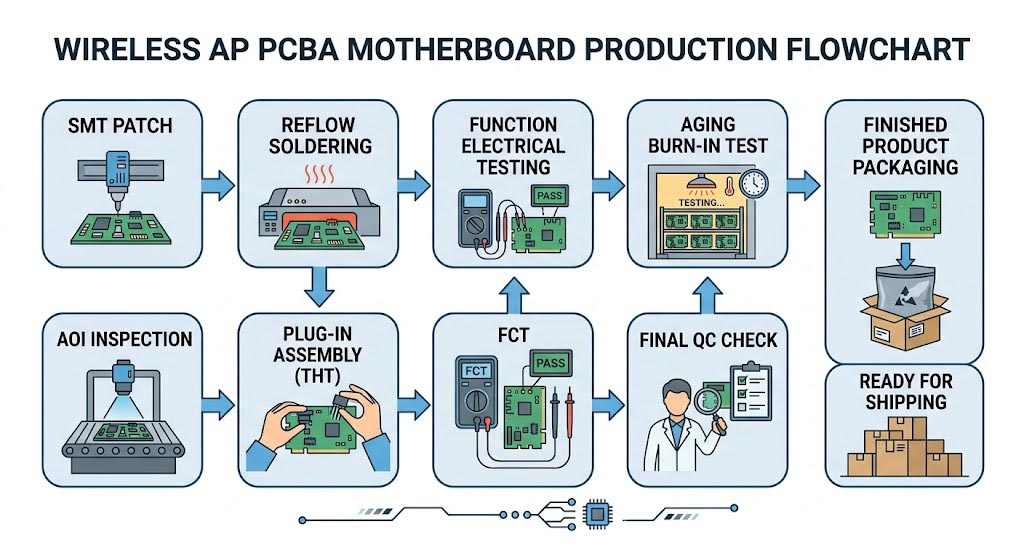
Typical mass production process flow:
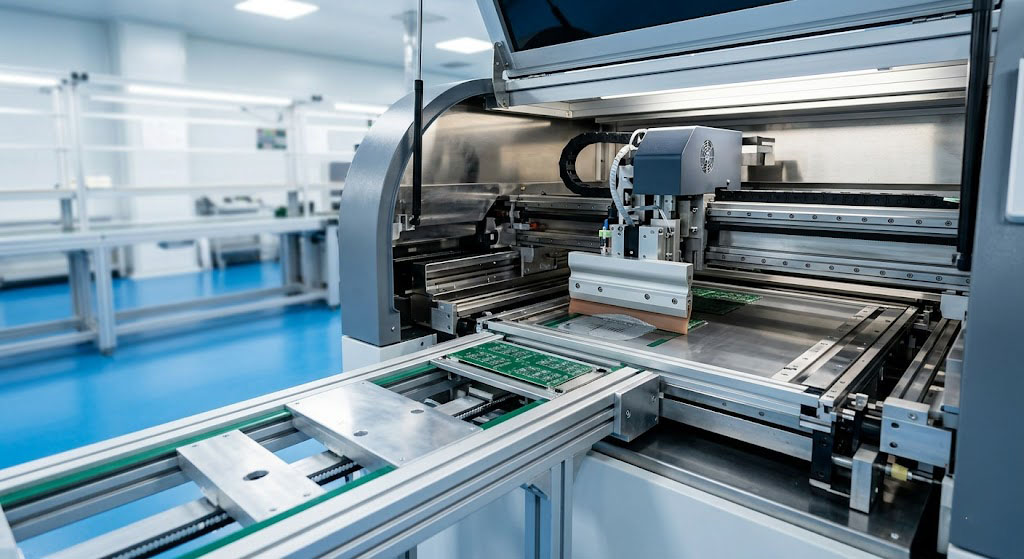
- SMT Assembly: Surface mount component placement
- Reflow Soldering: Component soldering
- Visual Inspection: Automated and manual inspection
- ICT (In-Circuit Test): Component connectivity testing
- Functional Testing: Power-on and basic functionality test
- RF Testing: Radio performance verification
- Calibration: Performance optimization
- Final Inspection: Comprehensive quality check
- Packaging: Product packaging and labeling
| Production Stage | Key Activities | Typical Yield Loss |
|---|---|---|
| SMT Assembly | Component placement, solder paste printing | 2-5% |
| Reflow | Soldering, thermal profile optimization | 1-3% |
| ICT Testing | Component connectivity, shorts detection | 1-2% |
| Functional Testing | Power, basic functionality | 1-3% |
| RF Testing | Performance verification, calibration | 2-5% |
| Final Inspection | Quality verification | < 1% |
Pre-Production Validation
Pre-production validation activities:
- DFM (Design for Manufacturing) Review: Ensure design is optimized for mass production.
- First Article Inspection (FAI): Verify first production units meet specifications.
- Process Validation: Validate SMT, reflow, and testing processes.
- Sample Testing: Comprehensive testing of pre-production samples.
- Supplier Qualification: Verify component suppliers meet quality standards.
Production Testing Strategy
Production testing strategy:
- Automated Optical Inspection (AOI): Detect solder defects and component placement issues.
- In-Circuit Test (ICT): Verify component connectivity and basic functionality.
- Functional Test: Test power management, boot sequence, and basic operations.
- RF Test: Measure transmit power, receive sensitivity, EVM, and other RF parameters.
- Calibration: Adjust RF parameters for optimal performance.
- Environmental Test: Test under different temperature and voltage conditions.
| Test Type | What It Tests | Defects Detected |
|---|---|---|
| AOI | Solder joints, component placement | Solder bridges, missing components, misalignment |
| ICT | Component connectivity | Open circuits, shorts, wrong components |
| Functional | Basic functionality | Power issues, firmware problems, connectivity |
| RF Testing | Radio performance | Low power, poor sensitivity, calibration issues |
| Environmental | Environmental robustness | Thermal issues, voltage sensitivity |
Common Production Issues and Debugging Techniques
Common production issues and solutions:
| Issue | Cause | Debugging Technique | Solution |
|---|---|---|---|
| Solder Bridges | Excessive solder paste, poor stencil design | AOI inspection, microscope examination | Adjust stencil aperture, optimize reflow profile |
| Missing Components | SMT machine error, component feed issues | AOI, ICT testing | Check component feeders, calibrate SMT machine |
| Power Issues | Short circuits, defective PMIC, poor solder joints | Power-on testing, voltage measurement | Check power rails, inspect PMIC soldering |
| RF Performance Issues | Poor matching, component variation, calibration | RF testing, spectrum analysis | Optimize matching networks, improve calibration |
| Connectivity Issues | Bad connectors, faulty Ethernet PHY | Network testing, cable testing | Inspect connectors, verify PHY configuration |
| Firmware Issues | Corrupted firmware, incorrect version | Firmware verification, boot log analysis | Ensure correct firmware, verify flashing process |

Yield Optimization Strategies
Yield optimization strategies:
- Root Cause Analysis: Use 5-Whys and fishbone diagrams to identify root causes of failures.
- Process Optimization: Continuously refine SMT, reflow, and testing processes.
- Component Quality Control: Implement incoming inspection for critical components.
- Automated Testing: Increase test coverage and reduce manual inspection.
- Statistical Process Control (SPC): Monitor production metrics and detect trends.
- Feedback Loop: Use production data to improve design and processes.
Test Automation and Efficiency
Test automation strategies:
- Automated Test Equipment (ATE): Use dedicated ATE systems for high-volume testing.
- RF Test Automation: Automate RF parameter measurement and calibration.
- Software Testing: Automate firmware validation and functional testing.
- Data Logging: Collect and analyze test data for continuous improvement.
- Parallel Testing: Test multiple units simultaneously to increase throughput.
Quality Control and Assurance
Quality control measures:
- Incoming Inspection: Inspect components before assembly.
- In-Process Inspection: Check products at each production stage.
- Final Inspection: Comprehensive quality check before packaging.
- Sampling Plans: Use statistical sampling for batch verification.
- Traceability: Track components and production history for each unit.
- Continuous Improvement: Regularly review quality metrics and implement improvements.
Summary
Mass production debugging is essential for wireless AP manufacturing success:
- Pre-production validation prevents issues: DFM review, FAI, and process validation catch problems early.
- Comprehensive testing is essential: AOI, ICT, functional, and RF testing ensure quality.
- Root cause analysis drives improvement: Identify and fix underlying issues, not just symptoms.
- Automation improves efficiency: Automated testing increases throughput and consistency.
- Continuous improvement is key: Monitor metrics and refine processes continuously.
As a core component of how to balance RF performance and cost in wireless AP motherboard development, mass production processes must be coordinated with PCB layout, EMC certification, and BOM cost optimization to achieve optimal product quality at scale.
References
Frequently Asked Questions
Q: What’s the typical production yield target for wireless APs?
Typical production yield targets range from 95-99% depending on product complexity. Higher-end enterprise APs with more components may have slightly lower targets, while simple home APs should achieve 98%+ yield.
Q: How long does it take to ramp up mass production?
Ramp-up time varies depending on product complexity and production volume. Typically, it takes 4-8 weeks to go from pre-production to full mass production. Thorough pre-production validation can shorten this timeline significantly.
Q: What’s the most common production issue for wireless APs?
The most common issues are typically related to RF performance variation due to component tolerances and PCB manufacturing variations. These issues can be mitigated through careful design, calibration processes, and robust testing.