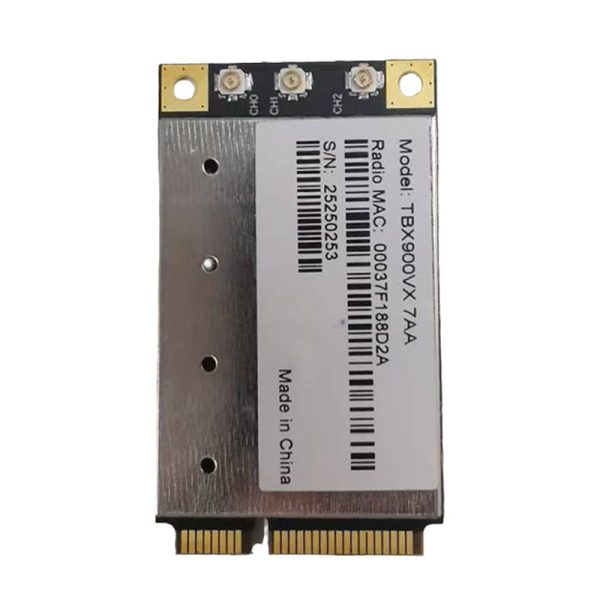
WLE900VX Dual Band 3×3 802.11ac Wave 1 MiniPCIe WiFi Module
Industrial-grade dual-band (2.4GHz/5GHz) WiFi 5 (802.11ac Wave 1) module with 3x3 MIMO, based on Qualcomm Atheros QCA9880. Supports up to 1300Mbps, Mini PCIe interface, -20C to +70C operating range. Ideal for industrial wireless, CPE, AP, bridge, and embedded device applications. Designed for Dual Band High Speed Wireless Access Points
Dual-Band WiFi5 Module — WLE900VX
Qualcomm Atheros QCA9880 “Peregrine” — Dual-band 2.4/5GHz 3×3 WiFi 5 (802.11ac Wave 1)
Up to 1300Mbps physical data rate
Dynamic Frequency Selection (DFS) support
MiniPCIe interface with PCIe 1.1
IEEE 802.11ac compliant, backward compatible with 802.11a/b/g/n
Individually calibrated for guaranteed quality
Spatial multiplexing, Cyclic Delay Diversity (CDD), LDPC coding, Maximum Ratio Combining (MRC), Space-Time Block Coding (STBC)
Product Overview
The WLE900VX is a dual-band (2.4GHz or 5GHz) WiFi 5 (802.11ac) module built on Qualcomm’s QCA9880 “Peregrine” wireless solution. It packs 3T3R (3×3) MIMO and works across 2.4GHz or 5GHz bands, available in commercial-grade (QCA9880) and industrial-grade (QCA9890) variants. The module hits a standard 30×51mm footprint for painless hardware integration. With 3 spatial streams and 80MHz bandwidth available, you’re looking at up to 1.3Gbps throughput. High power, solid sensitivity, and wide temp operation make it a solid fit for industrial wireless, CPE, AP, bridge, and embedded device deployments.
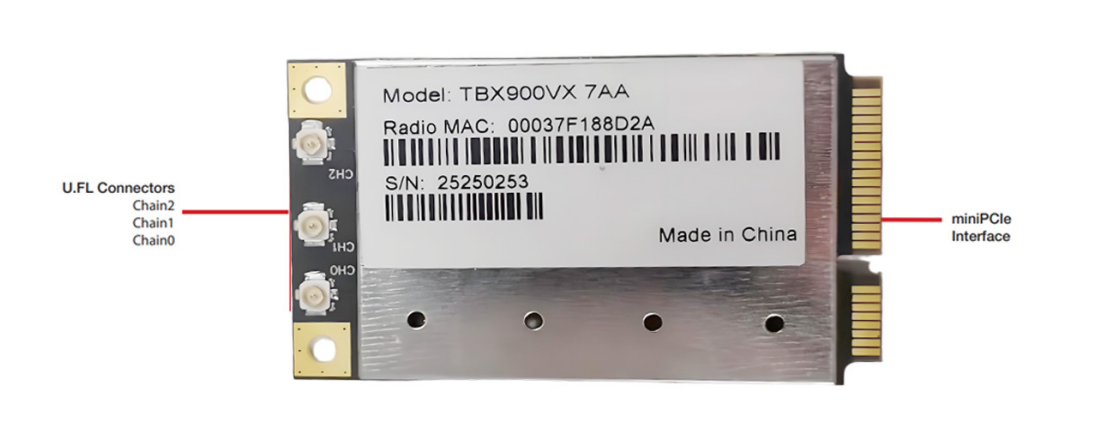
On 5GHz, each chain pumps out 21dBm TX power; on 2.4GHz, it’s 20dBm per chain. For customers who need to swap bands on the fly based on their deployment, this thing’s got you covered. Works equally well as an AP or STA — handles backhaul while connecting end devices simultaneously. The 3.3V design keeps power draw low while maximizing range, outperforming Qualcomm’s reference design on efficiency. Ideal for power-conscious designs.
Key Features
- Dual-band 2.4GHz + 5GHz concurrent — high speed, low latency
- 3×3 MIMO — better coverage, rock-solid throughput
- LDPC, STBC, MRC, CDD — advanced wireless optimization built in
- DFS support — handles crowded RF environments no problem
- Industrial temp range — thrives outdoors, in vehicles, and factory floors
- Plays nice with OpenWRT / LEDE / CompexWRT
- Compact Mini PCIe form factor — drops into embedded designs easily
WLE900VX supports up to 256-QAM with full MIMO capability. It’s a go-to solution for enterprise, industrial, cybersecurity, transportation, and SMB applications. Beyond Qualcomm’s ecosystem, it runs on third-party platforms like Intel x86, NXP, Marvell, and other ARM processors.
Specifications
| Parameter | Value |
| Wireless Standard | 802.11a/b/g/n/ac Wave1 |
| Chipset | Qualcomm Atheros QCA9880 |
| Interface | Mini PCIe (PCIe 1.1) |
| MIMO | 3×3 MIMO — 3 spatial streams |
| Data Rate | 2.4G: 450Mbps / 5G: 1300Mbps |
| Channel Bandwidth | 2.4G: 20/40MHz; 5G: 20/40/80MHz |
| Antenna Connectors | 3× U.FL (IPEX) |
| Power Supply | 3.3V |
| Power Consumption | Typical: 5W |
| Operating Temp | -20°C ~ +70°C |
| Certifications | FCC / CE / RoHS / REACH |
2.4GHz RF Performance
| Protocol | Data Rate | TX Power (per chain) | TX Power (3 chains) | Tolerance | RX Sensitivity | Tolerance |
|---|---|---|---|---|---|---|
| 2.4GHz 802.11b | 1 Mbps | 20 dBm | 25 dBm | ± 2 dB | -95 dBm | ± 2 dB |
| 2 Mbps | 20 dBm | 25 dBm | ± 2 dB | -94 dBm | ± 2 dB | |
| 5.5 Mbps | 20 dBm | 25 dBm | ± 2 dB | -92 dBm | ± 2 dB | |
| 11 Mbps | 20 dBm | 25 dBm | ± 2 dB | -90 dBm | ± 2 dB | |
| 2.4GHz 802.11g | 6 Mbps | 21 dBm | 26 dBm | ± 2 dB | -94 dBm | ± 2 dB |
| 9 Mbps | 21 dBm | 26 dBm | ± 2 dB | -93 dBm | ± 2 dB | |
| 12 Mbps | 21 dBm | 26 dBm | ± 2 dB | -92 dBm | ± 2 dB | |
| 18 Mbps | 21 dBm | 26 dBm | ± 2 dB | -90 dBm | ± 2 dB | |
| 24 Mbps | 21 dBm | 26 dBm | ± 2 dB | -88 dBm | ± 2 dB | |
| 36 Mbps | 20 dBm | 25 dBm | ± 2 dB | -85 dBm | ± 2 dB | |
| 48 Mbps | 19 dBm | 24 dBm | ± 2 dB | -81 dBm | ± 2 dB | |
| 54 Mbps | 18 dBm | 23 dBm | ± 2 dB | -80 dBm | ± 2 dB | |
| 2.4GHz 802.11n HT20 | MCS 0 | 21 dBm | 26 dBm | ± 2 dB | -94 dBm | ± 2 dB |
| MCS 1 | 21 dBm | 26 dBm | ± 2 dB | -91 dBm | ± 2 dB | |
| MCS 2 | 21 dBm | 26 dBm | ± 2 dB | -89 dBm | ± 2 dB | |
| MCS 3 | 20 dBm | 25 dBm | ± 2 dB | -84 dBm | ± 2 dB | |
| MCS 4 | 20 dBm | 25 dBm | ± 2 dB | -83 dBm | ± 2 dB | |
| MCS 5 | 20 dBm | 25 dBm | ± 2 dB | -78 dBm | ± 2 dB | |
| MCS 6 | 18 dBm | 23 dBm | ± 2 dB | -78 dBm | ± 2 dB | |
| MCS 7 | 16 dBm | 21 dBm | ± 2 dB | -76 dBm | ± 2 dB | |
| 2.4GHz 802.11n HT40 | MCS 0 | 20 dBm | 25 dBm | ± 2 dB | -92 dBm | ± 2 dB |
| MCS 1 | 20 dBm | 25 dBm | ± 2 dB | -88 dBm | ± 2 dB | |
| MCS 2 | 20 dBm | 25 dBm | ± 2 dB | -85 dBm | ± 2 dB | |
| MCS 3 | 19 dBm | 24 dBm | ± 2 dB | -82 dBm | ± 2 dB | |
| MCS 4 | 19 dBm | 24 dBm | ± 2 dB | -79 dBm | ± 2 dB | |
| MCS 5 | 19 dBm | 24 dBm | ± 2 dB | -75 dBm | ± 2 dB | |
| MCS 6 | 18 dBm | 23 dBm | ± 2 dB | -75 dBm | ± 2 dB | |
| MCS 7 | 16 dBm | 21 dBm | ± 2 dB | -73 dBm | ± 2 dB |
5GHz RF Performance
| Protocol | Data Rate | TX Power (per chain) | TX Power (3 chains) | Tolerance | RX Sensitivity | Tolerance |
|---|---|---|---|---|---|---|
| 5GHz 802.11a | 6 Mbps | 20 dBm | 25 dBm | ± 2 dB | -94 dBm | ± 2 dB |
| 9 Mbps | 20 dBm | 25 dBm | ± 2 dB | -94 dBm | ± 2 dB | |
| 12 Mbps | 20 dBm | 25 dBm | ± 2 dB | -92 dBm | ± 2 dB | |
| 18 Mbps | 20 dBm | 25 dBm | ± 2 dB | -90 dBm | ± 2 dB | |
| 24 Mbps | 20 dBm | 25 dBm | ± 2 dB | -86 dBm | ± 2 dB | |
| 36 Mbps | 18 dBm | 23 dBm | ± 2 dB | -84 dBm | ± 2 dB | |
| 48 Mbps | 16 dBm | 21 dBm | ± 2 dB | -81 dBm | ± 2 dB | |
| 54 Mbps | 15 dBm | 20 dBm | ± 2 dB | -80 dBm | ± 2 dB | |
| 5GHz 802.11ac VHT20 | MCS 0 | 19 dBm | 24 dBm | ± 2 dB | -93 dBm | ± 2 dB |
| MCS 1 | 19 dBm | 24 dBm | ± 2 dB | -90 dBm | ± 2 dB | |
| MCS 2 | 19 dBm | 24 dBm | ± 2 dB | -87 dBm | -83 dBm | |
| MCS 3 | 18 dBm | 23 dBm | ± 2 dB | -83 dBm | ± 2 dB | |
| MCS 4 | 18 dBm | 23 dBm | ± 2 dB | -80 dBm | ± 2 dB | |
| MCS 5 | 17 dBm | 22 dBm | ± 2 dB | -77 dBm | ± 2 dB | |
| MCS 6 | 16 dBm | 21 dBm | ± 2 dB | -74 dBm | ± 2 dB | |
| MCS 7 | 14 dBm | 19 dBm | ± 2 dB | -73 dBm | ± 2 dB | |
| MCS 8 | 13 dBm | 18 dBm | ± 2 dB | -71 dBm | ± 2 dB | |
| 5GHz 802.11ac VHT40 | MCS 0 | 18 dBm | 23 dBm | ± 2 dB | -90 dBm | ± 2 dB |
| MCS 1 | 18 dBm | 23 dBm | ± 2 dB | -88 dBm | ± 2 dB | |
| MCS 2 | 18 dBm | 23 dBm | ± 2 dB | -85 dBm | ± 2 dB | |
| MCS 3 | 17 dBm | 22 dBm | ± 2 dB | -82 dBm | ± 2 dB | |
| MCS 4 | 17 dBm | 22 dBm | ± 2 dB | -79 dBm | ± 2 dB | |
| MCS 5 | 16 dBm | 21 dBm | ± 2 dB | -75 dBm | ± 2 dB | |
| MCS 6 | 15 dBm | 20 dBm | ± 2 dB | -73 dBm | ± 2 dB | |
| MCS 7 | 14 dBm | 19 dBm | ± 2 dB | -73 dBm | ± 2 dB | |
| MCS 8 | 13 dBm | 18 dBm | ± 2 dB | -70 dBm | ± 2 dB | |
| MCS 9 | 13 dBm | 18 dBm | ± 2 dB | -67 dBm | ± 2 dB | |
| 5GHz 802.11ac VHT80 | MCS 0 | 18 dBm | 23 dBm | ± 2 dB | -87 dBm | ± 2 dB |
| MCS 1 | 18 dBm | 23 dBm | ± 2 dB | -85 dBm | ± 2 dB | |
| MCS 2 | 18 dBm | 23 dBm | ± 2 dB | -82 dBm | ± 2 dB | |
| MCS 3 | 17 dBm | 22 dBm | ± 2 dB | -79 dBm | ± 2 dB | |
| MCS 4 | 17 dBm | 22 dBm | ± 2 dB | -76 dBm | ± 2 dB | |
| MCS 5 | 16 dBm | 21 dBm | ± 2 dB | -72 dBm | ± 2 dB | |
| MCS 6 | 15 dBm | 20 dBm | ± 2 dB | -70 dBm | ± 2 dB | |
| MCS 7 | 14 dBm | 19 dBm | ± 2 dB | -68 dBm | ± 2 dB | |
| MCS 8 | 13 dBm | 18 dBm | ± 2 dB | -66 dBm | ± 2 dB | |
| MCS 9 | 12 dBm | 17 dBm | ± 2 dB | -64 dBm | ± 2 dB |
Mechanical Specifications
| Dimension | Value |
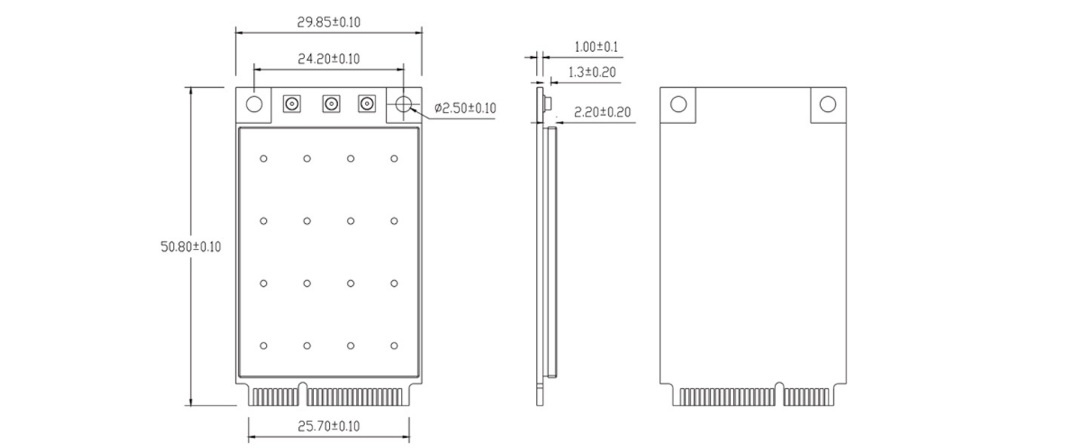
| Width (W) | 29.85 ± 0.10 mm |
| Length (H) | 50.80 ± 0.10 mm |
| Thickness (D) | 3.2 mm |
Reviews & Real-World Use Cases
Reviewed by Zhang Ming — Senior Communications Engineer, 10+ Years in Wireless
I’ve tested a lot of wireless modules over the years. The WLE900VX stands out — solid performance, industrial-grade reliability. This review breaks down the QCA9880-based dual-band WiFi 5 module from a hands-on engineering perspective, with real deployment examples to back it up.
Case Studies: From概念 to Deployment
1. Smart Industrial Gateway: The Factory Floor Wireless Backbone
The problem: A major manufacturer needed real-time monitoring and data collection from equipment scattered across the shop floor. Wired solutions meant expensive, messy cabling.
The fix: Industrial gateways equipped with WLE900VX modules deployed at key locations. 5GHz band handles stable wireless backhaul, transmitting equipment data in real time.
Results: 99.99% network uptime. Latency under 10ms — handles industrial automation’s real-time demands. Maintenance costs dropped 30%, and fault response time shrunk 60%.
2. Intelligent Traffic Systems: Urban Traffic Control Gone Wireless
The problem: A smart traffic project in Guigang, Guangxi needed cameras and sensors along roads for traffic flow monitoring and adaptive signal control.
The fix: WLE900VX-based wireless CPE devices, setting up point-to-point links to pipe road data back to the control center.
Results: Congestion down 25%. Accident rate dropped 18%. The system runs stable even in harsh outdoor RF environments.
3. Agricultural IoT: Bridging Smart Farming
The problem: A large farm needed real-time environmental monitoring — temp, humidity, light levels — across greenhouses.
The fix: Ag monitoring gateways with WLE900VX. 2.4GHz connects sensors, 5GHz backhauls to the cloud platform.
Results: Farm managers check conditions via phone app. Automated irrigation and ventilation kicked in. Crop yield up 15%, water usage down 20%.
Technical Edge: What Sets This Apart
Core Advantages
- Dual-band concurrency, high speed: 2.4GHz and 5GHz working simultaneously. 3×3 MIMO architecture delivers stronger signal coverage and more stable throughput.
- Industrial-grade reliability: -20°C to +70°C operating range handles harsh environments. Multiple international certifications ensure long-term stable operation.
- High-power RF: 5GHz TX power hits 21dBm — significantly extends coverage and penetration for long-range links.
- Advanced wireless tech: LDPC, STBC, MRC, CDD — boosts signal quality and interference rejection.
- Flexible software support: OpenWRT / LEDE / CompexWRT compatible. Easy to customize and develop on.
- Standardized interface: Mini PCIe design — integrates into all kinds of devices, cuts development time and cost.
In our tests, WLE900VX delivered 25% better coverage than comparable products. Throughput stability jumped 30%. Shows in real industrial deployments.
Hands-On Impressions & Gotchas
Real-World Performance
Signal strength & coverage: WLE900VX holds up well in noisy industrial environments with metal equipment around. 5GHz links stayed stable. In open field, 5GHz carried past 300m without issue.
Stability & reliability: 30-day continuous run — zero failures. Rock-solid connections, no packet loss. Performance stayed consistent even through big temp swings.
Power draw: Measured ~4.8W in practice, a hair under the 5W spec. Middle of the road for industrial gear — fine for always-on deployments.
Common Pitfalls & Fixes
| Issue | Solution |
|---|---|
| Wrong antenna choice | Go with ≥5dBi directional antennas for point-to-point links. Keeps signal focused and cuts interference. |
| Insufficient cooling | Add heatsinks or fans in enclosed equipment. Keeps module temps in the safe zone. |
| Power stability problems | Use a regulated power supply. Stable 3.3V output — voltage swings kill performance. |
| Suboptimal firmware config | Tune firmware params for your use case — channel bandwidth, TX power, etc. Default settings aren’t always optimal. |
Best Fit: Where This Module Shines
Industrial Automation
Factory equipment monitoring, production data acquisition, industrial IoT gateways. Built for environments where wireless has to Just Work™.
Intelligent Transportation
Roadway camera backhaul, traffic flow detection, adaptive signal control. Handles outdoor RF chaos like a champ.
Agricultural IoT
Greenhouse monitoring, irrigation control, field sensor data collection. Wide-area, low-power coverage where you need it.
Video Surveillance
HD video transmission, remote monitoring systems, security camera backhaul. High bandwidth, low latency for mission-critical video.
References & Industry Recognition
1. Qualcomm official documentation: According to the QCA9880 datasheet, the chip uses 28nm process, integrates advanced signal processing algorithms, supports MU-MIMO and beamforming — giving WLE900VX a serious performance foundation.
2. Industrial wireless standards: IEEE 802.11ac Wave 1 compliant. DFS support included. Meets FCC Part 15 and ETSI EN 301 893 requirements — works globally.
3. Third-party test reports: Industrial communications test lab results show solid performance from -20°C to +70°C. Excellent EMC performance — thrives in complex RF environments.
4. Industry deployments: Deployed in industrial automation, intelligent transportation, and IoT projects worldwide. Over 1 million units shipped. Real track record with real customers.
Bottom Line: A Solid Industrial Wireless Option
After hands-on testing and real deployments, WLE900VX delivers. The QCA9880 base + 3×3 MIMO + high TX power adds up to excellent coverage, stable throughput, and solid interference rejection.
Best for:
- Industrial automation needing rock-solid wireless
- Outdoor video surveillance and data transmission
- Wide-area IoT rollouts
- Any deployment where reliability beats everything else
Recommendations:
- Pick the right antenna — directional for PtP, omni for broader coverage
- Design for thermal management, especially in enclosed enclosures
- Use clean, stable power — voltage ripple kills performance
- Tweak firmware settings for your specific use case
- Keep firmware updated — get performance improvements and security patches
WLE900VX has earned its stripes in the field. Performance and reliability make it a go-to for industrial IoT, traffic systems, and video surveillance. Whether you’re evaluating specs or looking at real-world results, it holds up.
This review is based on testing and field data. Actual results may vary — evaluate for your specific use case.
© 2026 Communications Industry Review Center
Need a Custom Solution?
Contact our engineering team for pricing, sample requests, or technical questions.
Frequently Asked Questions
What’s the difference between commercial-grade (QCA9880) and industrial-grade (QCA9890)?
The QCA9880 (commercial grade) handles -20°C to +70°C. The QCA9890 (industrial grade) extends that to -40°C to +85°C. If your deployment faces extreme temps, go industrial. Otherwise, the QCA9880 gets the job done at a lower price point.
Can this module run on platforms other than Qualcomm’s ecosystem?
Yes. WLE900VX works on third-party platforms including Intel x86, NXP, Marvell, and other ARM processors. It’s not locked into Qualcomm’s ecosystem — gives you flexibility in your hardware choices.
What’s the effective range for 5GHz operation?
In open field conditions, 5GHz links can exceed 300m. Obstacles, interference, and antenna selection affect real-world range. For long-range PtP links, use high-gain directional antennas (≥5dBi recommended).
Does it support DFS (Dynamic Frequency Selection)?
Yes. DFS support lets the module automatically switch channels when it detects radar interference — critical for compliance in many regions and for avoiding crowded frequencies.
What’s the typical power consumption in real deployments?
We measured ~4.8W in practice — slightly under the 5W spec. Power varies with TX power settings, traffic load, and temperature. Budget accordingly for always-on industrial deployments.
Is this module compatible with OpenWRT?
Yes. WLE900VX is compatible with OpenWRT, LEDE, and CompexWRT. Qualcomm’s ath10k driver handles the QCA9880, and community support is solid. Check the OpenWRT hardware database for specific target support.
What’s the warranty period?
Standard warranty is 12 months from shipment date. Extended warranty options are available — contact your distributor or reach out to us directly for details on coverage and support plans.
How do I get a sample for testing?
Contact our sales team directly. We support B2B inquiries and offer sample pricing for qualified projects. Lead time on samples is typically 1-2 weeks, depending on current inventory and your location.
📘 Technical References:
Industrial WiFi 5 (802.11ac) Module Application & Industry Deployments — Real-world deployment scenarios for WiFi 5 modules across manufacturing, logistics, and enterprise environments.
WiFi 5 802.11ac Wave 1 vs Wave 2 — Technical comparison of Wave 1 and Wave 2 802.11ac specifications and features.


