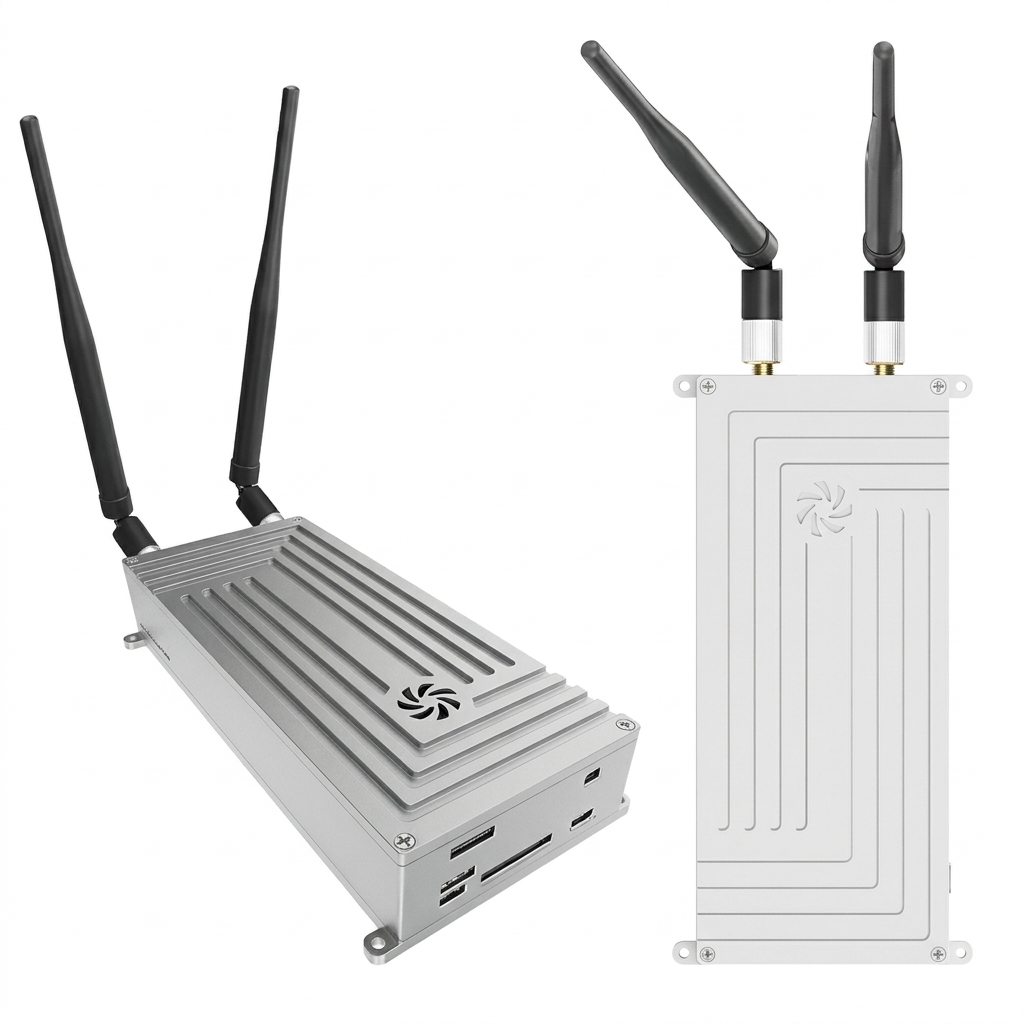
YNW 7520B SDR FPGA Airborne Mesh Radio | 300km LOS, 160Mbps, 10Wx2
YNW 7520B SDR FPGA airborne MESH Ad-Hoc radio. Software-Defined Radio with FPGA hardware acceleration. 10Wx2 transmit power, 160Mbps throughput, 300km line-of-sight range, Mach 6+ high mobility support, 2T2R MIMO, dual-band (1.4GHz+500MHz), same-frequency networking. Tactical airborne manet for UAV swarm, convoy, maritime, firefighting, border defense.
YNW 7520B SDR FPGA Airborne Mesh Radio — 10Wx2, 300km LOS, 160Mbps
1. Product Overview
Software-Defined Radio with FPGA Hardware Acceleration
The YNW 7520B is built on a Software-Defined Radio (SDR) architecture with FPGA (Field-Programmable Gate Array) hardware acceleration. The FPGA handles real-time physical-layer signal processing 鈥?including modulation/demodulation (QPSK/16QAM/64QAM), forward error correction (FEC), beamforming, and MIMO encoding 鈥?at deterministic latency, while the embedded processor runs the higher-layer MESH networking stack (routing, scheduling, encryption, protocol handling). This SDR+FPGA combination delivers the flexibility of software-configurable frequency bands, modulation schemes, and network parameters, coupled with the wire-speed performance and low jitter of dedicated hardware 鈥?essential for maintaining reliable multi-hop links at Mach 6+ speeds.
The YNW 7520B airborne radio supports arbitrary network topologies including Point-to-Point (P2P), Point-to-Multipoint (P2MP), chain relay, full Mesh, and hybrid dynamic topologies. The network operates on a same-frequency networking principle combined with multi-hop relay technology. Each node can move rapidly and randomly, while the network topology updates and reconfigures dynamically without disrupting ongoing transmissions.
The complete network is easy to deploy, flexible to use, simple to operate, and convenient to maintain. It provides reliable, timely, efficient, and secure all-IP broadband services including high-definition video transmission and visualized command-and-control dispatch — meeting user needs under complex scenarios involving rapid mobility and NLoS obstruction.
Broadband ad hoc networks find widespread applications across military, public security, armed police, fire rescue, civil defense, power utilities, petroleum, mining, transportation, water conservancy, forestry, broadcasting & television, healthcare, and maritime/aeronautical/terrestrial communication sectors. The YNW 7520B delivers rich integrated services including data, video, and visualized command-and-control to maximize satisfaction of wireless broadband communication requirements in both routine and emergency situations, truly enabling "anytime, anywhere, on-demand communication."
- Robotics / Unmanned Vehicles, Reconnaissance / Surveillance / Counter-Terrorism / Monitoring
- Air-to-Air, Air-to-Ground, Ground-to-Ground Communications; Public Security / Special Operations
- Urban Networks, Emergency Support / Daily Patrol / Traffic Management
- Indoor & Outdoor Structures, Fire / Rescue / Disaster Relief / Forest / Civil Defense / Earthquake Response
- Broadcasting & Live Streaming Video
- Maritime Communications / High-Speed Ship-to-Shore Transmission
- Low-Level Deck Wireless Networks / Shipborne Landing Operations
- Mine / Tunnel / Basement Connectivity
2. Product Views
3. Key Features
4. Technical Specifications
4.1 System Specifications
| Category | Parameter | Specification |
|---|---|---|
| System Specifications | Operating Frequency Band | 1420–1530 MHz, 566–678 MHz |
| RF Channels | 2 Transmit / 2 Receive (2T2R) | |
| Transmit Power | 10W × 2 | |
| Networking Topology | Star topology, up to 1 + 256 nodes | |
| Communication Range | 100–300 km (Line-of-Sight) | |
| Channel Bandwidth | 3 MHz / 5 MHz / 10 MHz / 20 MHz | |
| Modulation Scheme | QPSK / 16QAM / 64QAM | |
| Peak Throughput | Shared uplink/downlink: 160 Mbps | |
| Transmission Latency | Node-to-Central Node: ≤ 10 ms (DRX disabled) | |
| Timeslot Configuration | Central node DL/UL ratio supports 2D3U / 3D2U / 4D1U / 1D4U; near-field and far-field modes selectable | |
| Transmission Mode | Supports Carrier Aggregation (CA, up to 40 MHz bandwidth) and MIMO | |
| Adaptive Power Control | Access nodes adaptively adjust transmit power | |
| Mode Switching | Configurable switching between P2P and P2MP networking modes | |
| System Control | Transmit power / frequency / bandwidth (real-time configurable); frequency band (non-real-time configurable) | |
| Receiver Sensitivity | Service sensitivity: −98 dBm / −99 dBm Non-CA/MIMO (star topology): 20 MHz −94 dBm / 10 MHz −92 dBm / 5 MHz −90 dBm (test condition: 5 Mbps) CA/MIMO mode: 20 MHz −96 dBm / 10 MHz −97 dBm / 5 MHz −93 dBm Receiver sensitivity (20 MHz): −97 dBm |
4.2 Encryption & Anti-Jamming
| Category | Parameter | Specification |
|---|---|---|
| Encryption & Anti-Jamming | Communication Encryption | Three optional algorithms: ZUC, SNOW 3G, AES |
| Automatic Frequency Selection | Auto-detects interfering signals and selects the optimal frequency channel in real time | |
| Adaptive Modulation & Coding (AMC) | Automatically adjusts channel modulation scheme based on real-time signal quality | |
| Frequency Hopping | Supports inter-band and intra-band frequency hopping |
4.3 System Capacity
| Category | Parameter | Specification |
|---|---|---|
| System Capacity | Node Capacity (Star Topology) | Up to 1 + 256 nodes |
| Automatic Retransmission | Supports HARQ (Hybrid Automatic Repeat reQuest) mechanism for enhanced data reliability | |
| Roaming Handover | Supports neighbor cell detection and measurement; node handover between central nodes with handover time < 500 ms (network deployed within 3 frequency channels) | |
| Automatic Antenna Selection | Selects the optimal transmit antenna in real time based on obstruction conditions |
4.4 Physical & Electrical Characteristics
| Category | Parameter | Specification |
|---|---|---|
| Mechanical | Dimensions | 138 × 126 × 54 mm |
| Weight | Approx. 820 g | |
| Electrical | Operating Voltage | 18–32 VDC (10W × 2) |
| Rated Power Consumption | ≤ 35 W | |
| Protection Circuits | Reverse-polarity protection, overvoltage protection, overcurrent protection | |
| Environmental & Reliability | Operating Temperature | −40°C to +80°C |
| Storage Temperature | −40°C to +85°C | |
| Humidity | 5% to 95% (non-condensing) |
4.5 Interface Definitions
| Category | Parameter | Specification |
|---|---|---|
| Service Interfaces | UART | UART × 3 (default: UART0, UART1 serial ports; UART2 as RS232) |
| USB / HSIC | USB 2.0 High Speed; supports HSIC-to-LAN signal conversion | |
| I2C | I2C × 2 (I2C1, I2C3) | |
| GPIO | Multiple configurable GPIOs (power control, PA enable, LNA enable, status indicators, etc.) | |
| MIPI | MIPI CSI/DSI (reserved, not supported by default firmware) | |
| SD Card | SD / MMC (reserved) | |
| Extension Interfaces | Voice / Auxiliary | MIC, SPK, PTT, GND, RS485/422, USB 2.0 OTG |
| Network Extension (Optional) | Public network routing / 4G LTE, WB-NB integration, fiber optic, satellite | |
| Video Extension (Optional) | Low-latency HDMI / SDI / CVBS; supports 4K / 2K / 1080P / 720P / D1 | |
| Antenna Interfaces | Main Antenna | PIN71 ANT_MAIN (I/O) |
| Secondary Antenna | PIN34 ANT_SUB (I/O); IPEX Generation 4 RF connector available via pad-resistor modification on module | |
| RF Control | PA/LNA Enable | DBB_RFGPO8 (TX high / RX low), DBB_RFGPO9 (RX high / TX low), DBB_RFGPO18, DBB_RFGPO19 (timing configured via code tables) |
| 1PPS Signal | DBB_RFGPO32 (1PPS signal input) | |
| Power Supply | Operating Voltage | 18–32 VDC (10W × 2) |
4.6 Management Functions
| Category | Parameter | Specification |
|---|---|---|
| Management Functions | WEBUI Configuration | Supports basic configuration, status reporting, and query functions via WEBUI |
| OTA Upgrade | Supports OTA (Over-The-Air) upgrades; both local and remote upgrade modes available |
5. Hardware Interface Description
Below is the description of hardware interfaces and functional modules of the airborne mesh ad hoc network radio.
5.1 Front Panel Indicators
| Indicator | Color | Status Description |
|---|---|---|
| RSSI / Link Quality | Green steady | Excellent link quality |
| Blue steady | Good link quality | |
| Yellow steady | Moderate link quality | |
| Red steady | Poor link quality or link interruption | |
| Off | Link down / not joined to network | |
| Link Status | Red flashing | Booting / not connected to network |
| Green steady | Connected to network | |
| Green flashing | Voice PTT pressed |
5.3 Power Supply
The device supports a wide DC input range of 14.8V to 24V (typical 18V), with a rated power consumption of ≤ 35W. Integrated interfaces incorporate reverse-polarity, overvoltage, and overcurrent protection circuits, enabling direct connection to airborne power systems.
6. Applications
The YNW 7520B airborne mesh radio adopts a distributed centerless ad hoc networking architecture with same-frequency operation and multi-hop relay capabilities. Each node can move rapidly and randomly while the network topology updates in real time. Purpose-built for airborne platforms, it tolerates high-speed mobility and supports broadband multimedia communications in air-to-air, air-to-ground, and ground-to-ground scenarios. It finds broad applicability across military, public security, armed police, fire rescue, border & coastal defense, emergency response, and related sectors.
1. Convoy MESH Ad-Hoc Wireless Communications
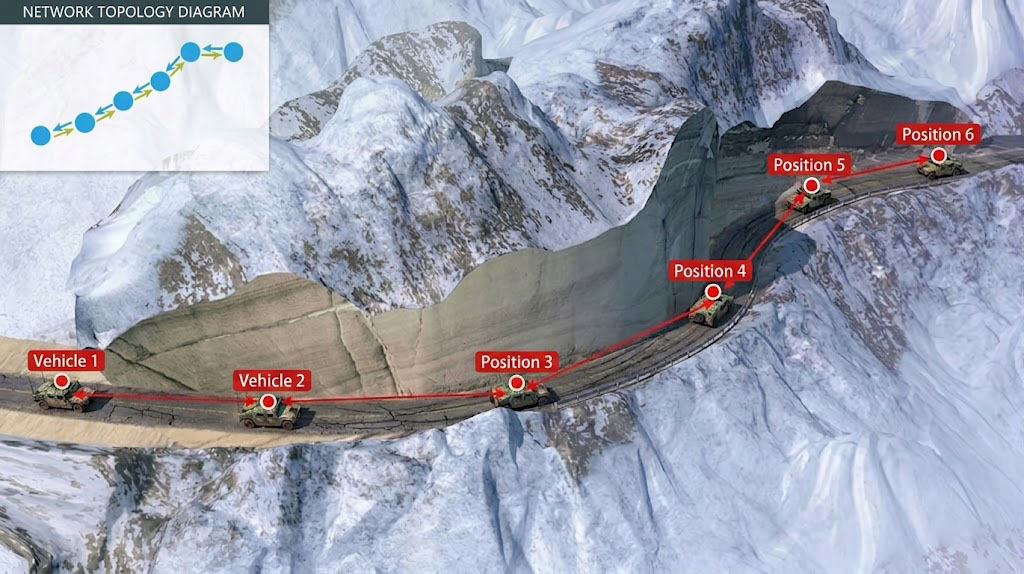
Convoy road marching, material transport, tourism-area vehicle monitoring, mining-area vehicle dispatch, roadway vehicle mobile monitoring, and logistics fleet coordination — mobile scenarios. As inter-vehicle distances constantly change and road conditions are complex, conventional communications cannot guarantee stable real-time links between convoy members.
Deployment Solution
- Vehicle-to-vehicle direct networking: A YNW-7520B is deployed on each vehicle, and links are automatically established over MESH Ad-Hoc networking without depending on fixed base stations or public networks.
- Automatic roaming handover: Under high-speed vehicle movement (speed >260 km/h), handover is autonomously determined by signal strength between base stations without service interruption.
- Concurrent multi-service: Supports HD video backhaul, voice intercom, and vehicle position sharing; 2×2 MIMO high throughput satisfies broadband service requirements.
- Relay extension: Multi-hop MESH relay extends coverage for seamless regional coverage.
Application Value
While in motion, HD video, voice intercom, and location information are shared in real time between vehicles, and the command vehicle can grasp the full convoy situation for integrated formation command and coordinated dispatch. In mining, roadway, and tourism vehicle-mobile-monitoring scenarios, it provides a public-network-independent dedicated channel, significantly improving mobile command and surveillance coverage.
2. Border & Coastal Defense Airborne Mesh Ad Hoc Network Communications
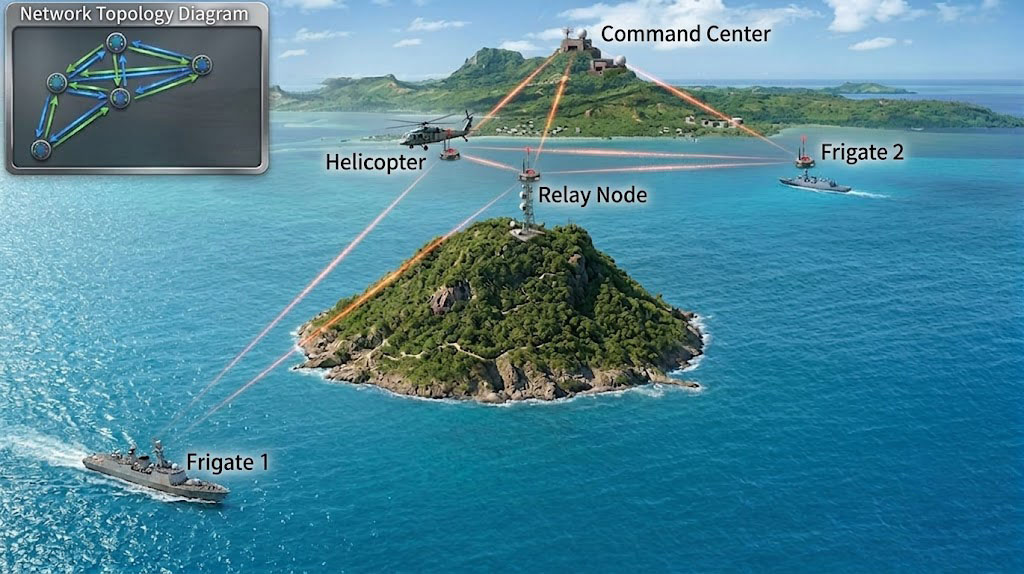
Long-distance, wide-coverage three-dimensional border/coastal communication scenarios including aerial border patrol, aerial coastal surveillance, air-based border checkpoint management, air support for coastline alerting, air-ground interconnection for border outposts, and communication between maritime law-enforcement vessels and aerial formations. China has extensive land borders and coastlines with diverse, complex terrain where traditional public networks cannot achieve comprehensive coverage. Dedicated broadband communication capabilities are critically needed to support border defense command and dispatch.
Deployment Solution
- Dual-band multi-module networking: The YNW-5800 2.4GHz/5GHz dual-band, multi-module design supports multi-hop cascade deployment along borderlines or coastlines to build a long-range, centerless dedicated broadband network; any node going offline triggers automatic switching so the network never drops.
- Diverse node types: Fixed installation at border outposts, vessel deployment on patrol boats, mobile command-vehicle installation, and follow-along personnel terminals form a free Ad-Hoc network achieving integrated "shore–sea–air" coverage.
- Ring network design: A flexible ring topology can be deployed without concern for ring congestion, improving network redundancy and reliability.
Application Value
Border patrol aircraft, outposts, and patrol vessels can transmit high-definition video, voice intercom, and data in real time, maintaining uninterrupted command links even in remote areas without public network coverage. Command centers gain real-time situational awareness of aerial, ground, and sea activity along borders, substantially enhancing border defense situational awareness and rapid response capabilities.
3. Urban Airborne Emergency Mesh Ad Hoc Network Communications
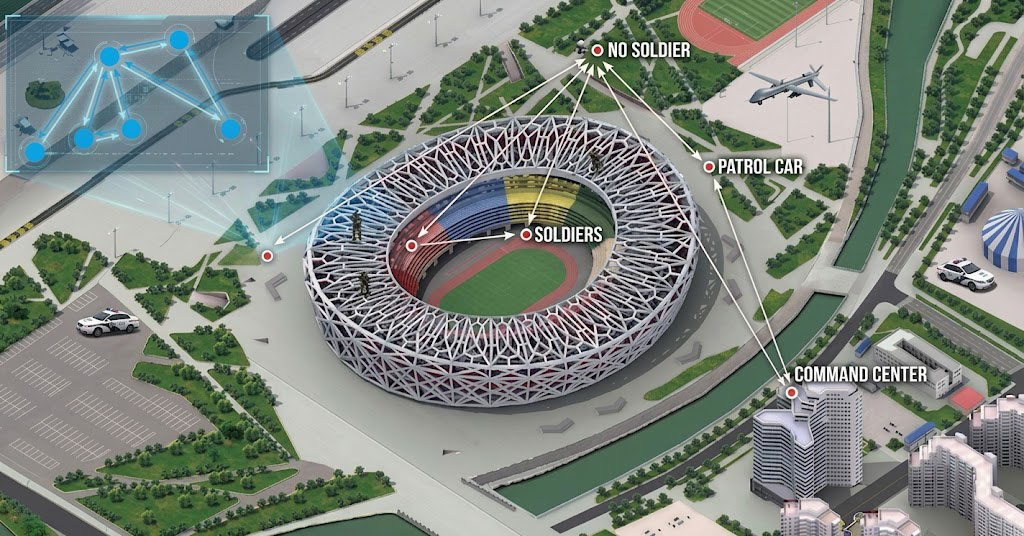
Urban public security scenarios including aerial security for major events, temporary air support for controlled deployment, aerial monitoring for armed patrols, aerial reconnaissance for counter-terrorism and incident response, aerial command during mass gatherings, and aerial traffic inspection. These scenarios demand exceptionally high capabilities in rapid deployment, temporary private networks, multi-channel video backhaul, and resistance to public network congestion.
Deployment Solution
- Rapid temporary private network: The YNW-5800 rapidly builds a wireless IP MESH network dynamically on-site without configuration, establishing a dedicated broadband network completely independent of the public network.
- Centerless architecture: The centerless Ad-Hoc architecture keeps the network running even if any device goes offline, maintaining communications under traffic congestion or public-network outage emergencies.
- Multi-terminal integrated access: Body-worn terminals, vehicle terminals, and temporary surveillance cameras converge through the MESH network, backhauling multiple real-time video streams to the command center.
- Secure encryption: Supports WPA/WPA2-PSK/AES and 802.1x/WAPI multi-layer encryption for secure public-security private-network information transmission.
Application Value
In major event security, temporary deployments, armed patrols, and other public security scenarios, the system delivers real-time aerial and ground situational awareness to command decision-makers, with stable multi-channel high-definition video, voice intercom, and data transmission. The centerless architecture ensures communication continuity even under extreme conditions such as public network outages or congestion, enhancing rapid response and cooperative operation capabilities.
4. Fire Rescue & Disaster Relief Airborne Mesh Ad Hoc Network Communications
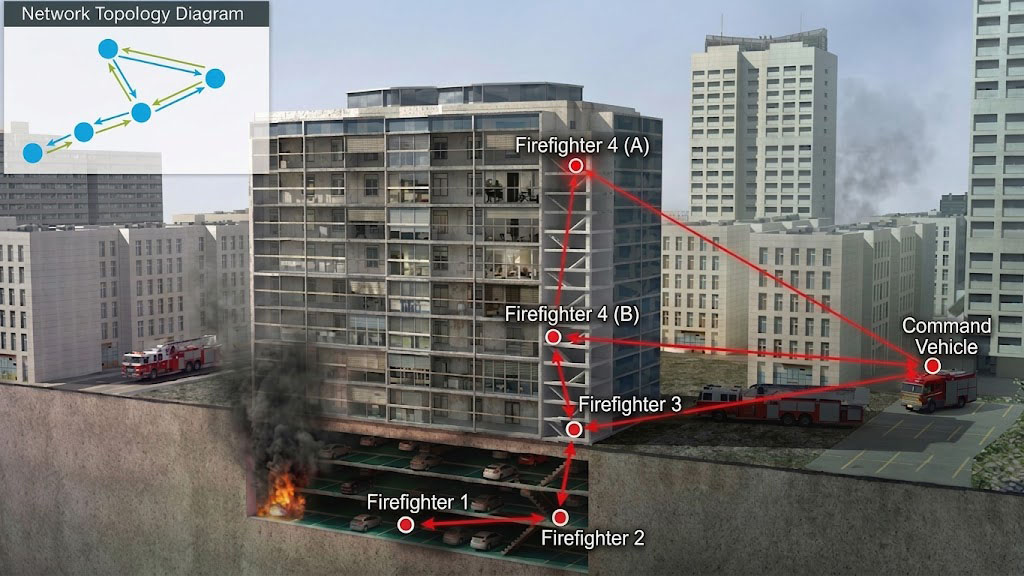
Communication support at disaster sites including forest fire aerial reconnaissance, building fire aerial command, earthquake rescue aerial support, accident emergency aerial monitoring, and hazardous chemical leak aerial detection. Public network communications at disaster sites are often interrupted or severely congested; aerial communication capabilities are urgently needed to overcome ground obstacles and ensure rescue command continuity.
Deployment Solution
- Rapid on-site deployment: The YNW-5800 can be rapidly deployed on command vehicles, temporary base stations, and body-worn equipment at the disaster site without any infrastructure, quickly building a dedicated broadband Ad-Hoc network.
- Body-worn-to-vehicle-to-command tiered networking: Rescuers carry portable MESH devices into the scene and backhaul HD video to the on-site command vehicle and rear command center via relays.
- Self-healing / damage resilience: When a node is damaged or moves, the network automatically reconfigures, and remaining nodes re-establish routing without communication interruption, sustaining rescue continuity.
Application Value
Enables rear command centers to rapidly gain an aerial overview of disaster sites, scientifically dispatch rescue forces, and improve rescue efficiency and safety. Provides reliable three-dimensional communication support during the "Golden 72 Hours" rescue window, saving critical time for life-saving operations.
5. Natural Disaster Emergency Aerial Command Mesh Ad Hoc Network Communications
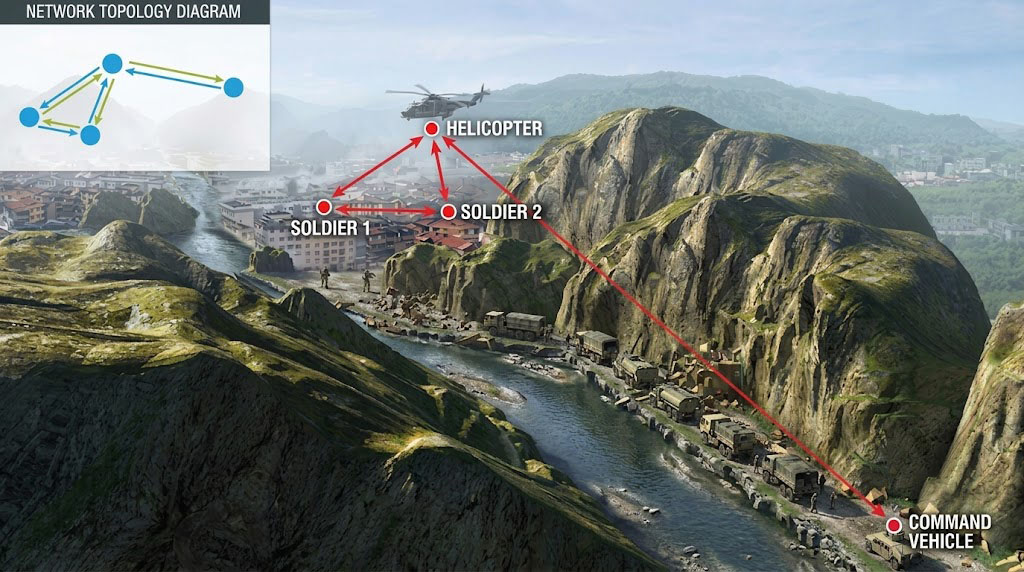
Emergency command communication support for sudden natural disasters including earthquakes (particularly M7+), floods, mudslides, landslides, and typhoons. Such disasters often cause extensive damage to communication infrastructure, resulting in complete public network outages and "information silo" dilemmas for emergency commanders.
Deployment Solution
- Rapid disaster-area deployment: Rescue teams carry YNW-5800 into affected areas, leveraging dual-band multi-module and wireless Ad-Hoc characteristics to rapidly erect temporary communication nodes and achieve wide-area coverage through multi-hop MESH relay.
- Air-ground integrated networking: Combined with UAV airborne relay platforms, an "air-ground" three-dimensional Ad-Hoc network overcomes complex terrain such as mountains and ruins for whole-disaster-area coverage.
- Self-healing / damage resilience: Self-healing ensures automatic network reconfiguration as nodes move, equipment is damaged, or new nodes join, with no manual intervention.
- Multi-service convergence: Converges disaster-area video backhaul, disaster data reporting, rescue-team position sharing, and command-instruction issuance.
Application Value
Delivers stable, reliable three-dimensional communication support for emergency command and dispatch during sudden natural disasters. Transmits disaster zone video, damage data, and rescue team positions in real time to both forward and rear command posts. Enables comprehensive situational awareness of disaster zones, scientific dispatch of rescue forces, improved rescue efficiency, and minimizes casualties and property losses.
6. Forest Fire Prevention Airborne Mesh Ad Hoc Network Communications
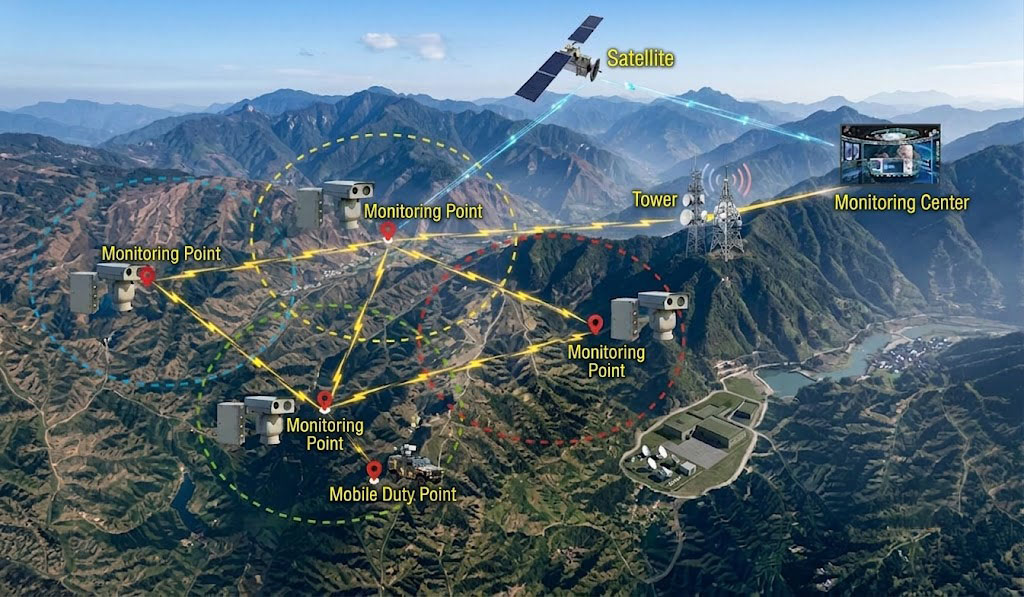
Forest scenario applications including aerial patrol for forest fire prevention, aerial relay for observation towers, aerial communication for forest rangers, aerial command at firefighting frontlines, aerial situational feedback of fire scenes, and primitive forest monitoring. China's vast forest resources are predominantly distributed in mountainous and remote regions with weak public network coverage, presenting longstanding challenges in coverage and network deployment for forest fire prevention communications.
Deployment Solution
- Multi-point forest-area deployment: YNW-5800 units can be deployed at watchtowers, fire checkpoints, and land-management stations to build a broadband Ad-Hoc private network covering vast forest areas.
- Multi-hop relay overcoming terrain: Dual-band multi-module devices combined with multi-hop relays overcome forest-line-of-sight blocking and terrain undulation for wide-area coverage in hills, mountains, and canyons.
- Watchtower–UAV–body-worn coordination: Fixed watchtower monitoring, patrol UAV aerial inspection, and on-site firefighting personnel form a three-position coordinated network, backhauling video and alarms to the fire-prevention command center in real time.
- Automatic fire alarm: Interfaces with smoke detectors and infrared thermal-imaging fire-monitoring devices; automatic fire alarms are backhauled to the command center over the MESH network for early detection, early reporting, and early response.
Application Value
Constructs an integrated sky-ground broadband ad hoc private network covering vast forests, transmitting aerial patrol, observation tower, and firefighting frontline video and alarm information to fire prevention command centers in real time. Provides reliable communication support for aerial command during firefighting operations, enhancing cooperative firefighting efficiency and safety assurance.
7. Maritime Shipborne/Airborne Mesh Ad Hoc Network Communications
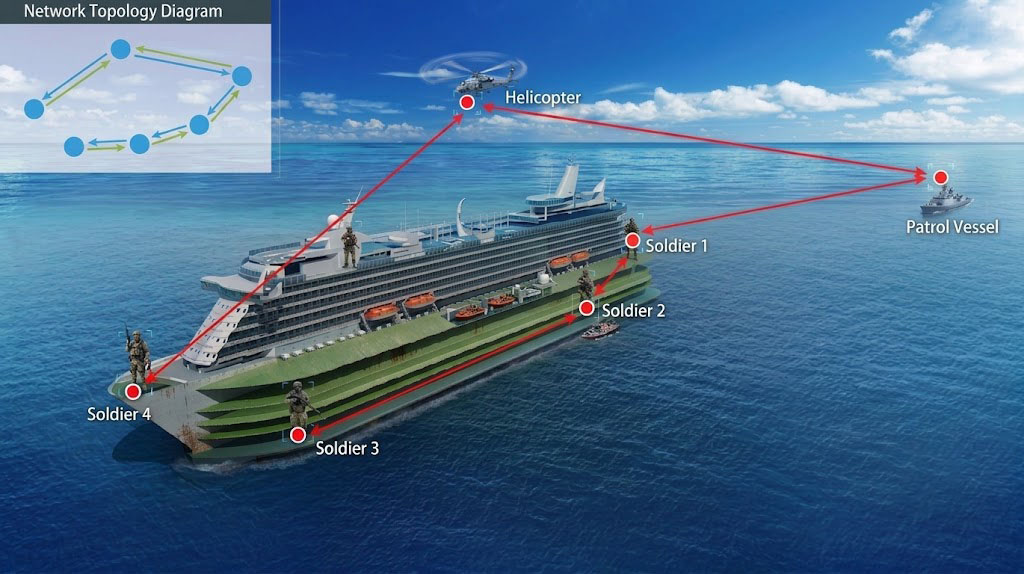
Maritime task scenarios including maritime law-enforcement shipborne/airborne coordination, boarding inspection aerial support, cross-ship cooperative aerial command, fleet air-sea integrated communications, maritime patrol aerial relays, and coast guard aerial cruise communications. The maritime communication environment is challenging due to ocean swell, severe multipath interference, and continuously changing relative positions between vessels and aircraft.
Deployment Solution
- Vessel-to-vessel coordinated networking: A YNW-5800 is deployed on each vessel; broadband MESH Ad-Hoc links form automatically between vessels to support formation coordination and integrated communications.
- Dual-band anti-interference: The 2.4GHz/5GHz dual-band design switches frequencies under interference, effectively countering maritime multipath reflections to maintain link stability.
- Fast roaming convergence: Automatic roaming handover reconfigures the network as vessel relative positions change, without communication interruption.
Application Value
Establishes stable air-sea broadband ad hoc links between ships and aircraft during maritime law enforcement, boarding inspections, reconnaissance, and evidence-gathering operations. Enables real-time transmission of on-site high-definition video and voice, providing reliable communication support for maritime law enforcement and tactical coordination — significantly enhancing maritime operation safety and cooperative efficiency.
7. Frequently Asked Questions
Q: What is the maximum mobility speed the YNW 7520B can support?
The YNW 7520B supports Mach 6+ mobility (over 7200 km/h). Its proprietary fast roaming and dynamic topology reconfiguration algorithms maintain uninterrupted MESH links even when nodes are moving at hypersonic speeds, making it suitable for high-speed airborne platforms including fighter aircraft, UCAVs, and hypersonic glide vehicles.
Q: How does same-frequency (concurrent) MESH networking work?
Unlike traditional PtP/PtMP radios that require separate frequencies for uplink and downlink, the YNW 7520B uses the same frequency for all nodes (same-frequency networking). Combined with TDD time-slot scheduling, this doubles spectral efficiency and enables true ad hoc mesh topology where any node can relay traffic for others 鈥?no central base station required. Network topology reconfigures dynamically as nodes join, leave, or move.
Q: What is the effective communication range?
Under Line-of-Sight (LOS) conditions, the YNW 7520B provides 100鈥?00 km operational range depending on antenna configuration and elevation. Typical air-to-air links between UAVs or aircraft achieve 150鈥?00 km, while air-to-ground relay links achieve 100鈥?50 km. For Non-Line-of-Sight (NLoS) scenarios, the multi-hop relay capability extends effective range by chaining intermediate nodes.
Q: How many nodes can one MESH network support?
The YNW 7520B supports star topology with up to 1 + 256 nodes (one central node plus 256 access nodes). For pure ad hoc mesh topology, the practical node count depends on traffic density and relay depth. The system automatically manages node discovery, authentication, and topology updates without manual configuration.
Q: What encryption and security does the YNW 7520B use?
The YNW 7520B implements multi-layer encryption including AES-256 bit encryption for air interface data, physical-layer encryption, and application-layer encryption for command-and-control traffic. The system supports national-level encryption algorithms upon request and provides secure boot, firmware integrity verification, and encrypted management channels 鈥?meeting military-grade security requirements.
Q: Does the YNW 7520B support Non-Line-of-Sight (NLoS) communication?
Yes. The distributed centerless ad hoc architecture enables NLoS communication through multi-hop relay. When direct LOS is blocked by terrain, buildings, or other obstacles, nearby nodes automatically relay the signal. The network reconfigures dynamically without dropping ongoing transmissions. Combined with the dual-frequency design (1.4GHz + 500MHz band), the system maintains reliable links in mountainous, urban, and forested environments.
Q: What is the latency and throughput performance?
Peak throughput reaches 160 Mbps (shared uplink/downlink). Single-hop latency from node to central node is 鈮?0 ms with DRX disabled. These performance characteristics make the YNW 7520B suitable for real-time HD video transmission, VoIP, telemetry, and command-and-control dispatch applications.


