Industrial Wireless Solutions for Underground Mining & Tunnel Operations
Key Overview
Who this is for: Mining IT managers, underground operations engineers, safety compliance officers, and OEMs evaluating wireless PCBA modules for mining equipment.
Core Issue: Underground mines block conventional WiFi with rock, dust, and moisture — so what wireless architecture actually works at depth, and how do you deploy it without constant maintenance?
Key Conclusions: Mesh networking is the proven architecture for underground mining wireless. It handles multi-hop relay through tunnels, self-heals when nodes drop, and supports both safety monitoring and asset tracking on a single infrastructure. For demanding environments, look for NLOS-capable hardware with ATEX/IECEx certification and industrial temperature ratings (-40°C to +85°C).
Why Mining Needs Different Wireless
Surface WiFi assumes open air and clear line of sight. An underground mine reverses both assumptions. You’re dealing with curved tunnels, 90-degree turns, rising dust, condensation, and in some cases explosive gas — methane pockets are a real hazard in coal and hard-rock mining.
Standard enterprise access points weren’t designed for this. Their antennas are tuned for open offices, their enclosures aren’t sealed against mineral dust, and their operating temperature range tops out well below what you’ll see near working faces.
What changes underground
- Signal propagation: Rock and ore absorb RF differently depending on mineral content. A 2.4 GHz signal might punch through 50 meters of dry granite but only 10 meters of wet shale. You can’t predict coverage without site surveying.
- Environmental stress: Underground ambient temps can hit 45°C near deep workings, with humidity near 100%. Add conductive dust and you’ve got a recipe for corrosion and short circuits.
- Safety requirements: Equipment in potentially explosive atmospheres needs ATEX (EU) or IECEx (international) certification. Standard commercial gear won’t pass inspection.
Frequency band considerations
| Band | Penetration | Bandwidth | Best For |
|---|---|---|---|
| 900 MHz (Sub-GHz) | Best through rock | Low (<1 Mbps) | Sensor backhaul, telemetry |
| 2.4 GHz | Good through multiple walls | Medium (up to 300 Mbps) | Mesh backbone, voice, video |
| 5 GHz | Poor through rock | High (up to 1 Gbps) | Surface-to-shaft, line-of-sight links |
| LoRa (868/915 MHz) | Excellent penetration | Very low (<50 kbps) | Environmental sensors, gas detection |
Mesh Networking for Underground Mining
In a traditional star topology, every AP needs a wired backhaul to the switch. That’s impractical underground — you’d need to run thousands of meters of trenching or cable trays through active mining zones. Mesh solves this by making each node transmit to the next, creating a daisy chain that extends as far as you need.
The key spec to look for is multi-hop relay capacity. Consumer mesh systems typically support 3-4 hops before latency becomes unusable. Industrial mesh nodes like Zukaka’s YN300A support 10+ hops with under 50 ms latency per hop, which is critical for real-time safety monitoring and voice communication.
How underground mesh differs from surface mesh
- Non-line-of-sight (NLOS) operation: Underground tunnels aren’t straight. NLOS-capable nodes maintain links around corners and through obstacles using MIMO and adaptive beamforming.
- Self-healing: If a node fails (cave-in, power loss, damage), mesh automatically reroutes through alternate paths. This matters when losing a link could mean losing contact with miners.
- Mobile ad-hoc (MANET) mode: Some nodes support dynamic networking for moving equipment. A load-haul-dump (LHD) vehicle moving through a tunnel can relay through nearby mesh nodes as it passes, maintaining its connection to the control room.
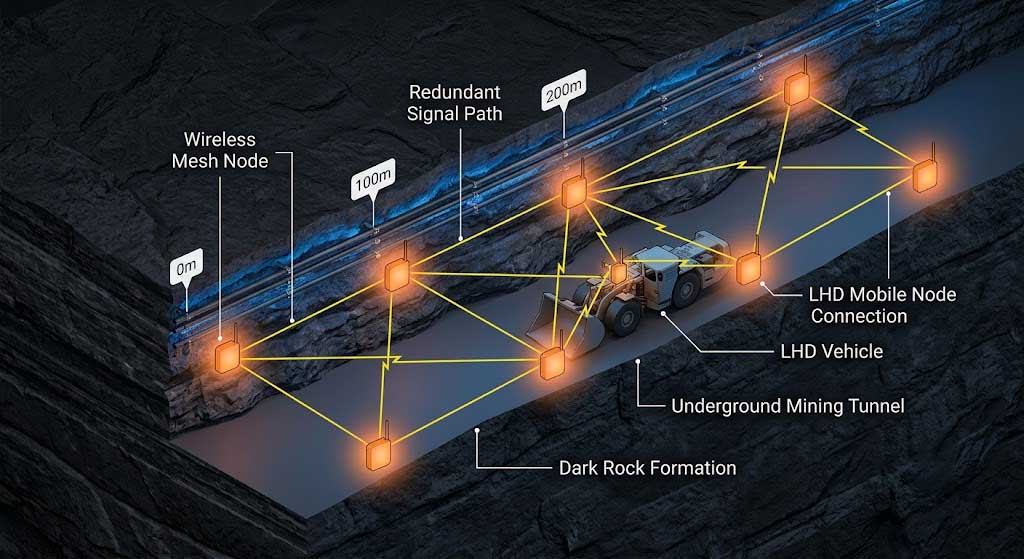
Typical mesh node specs for mining
| Parameter | Consumer Mesh | Industrial Mining Mesh |
|---|---|---|
| Max hop count | 3-4 | 10+ |
| Operating temp range | 0°C to 40°C | -40°C to +85°C |
| Enclosure rating | IP30 (indoor) | IP65+ |
| TX power | 20 dBm (FCC limit) | 30 dBm (with certification) |
| NLOS support | Limited | Full (adaptive MIMO) |
| Certification | FCC/CE only | ATEX/IECEx optional |
| Self-healing time | 10-30 seconds | <1 second |
Zukaka hardware for underground mesh
| Product | Key Specs | Best For |
|---|---|---|
| 2.4G Wireless Mesh Motherboard (YN300A) | NLOS, MANET 50+ nodes, 10+ hop relay, 30 dBm TX, self-healing mesh | Permanent underground mesh backbone, tunnel coverage, emergency comms |
| 2.4G Wireless Ad-Hoc Network Motherboard (YN300C) | NLOS, Ad-Hoc mode, 30 dBm TX, 10-20 km range, rapid deployment | Emergency temporary networks, mobile operations, rescue scenarios |
| 11n 24V Wireless Bridge PCBA | IP65, 29 dBm TX, -40°C to +65°C, iPoll protocol, rugged enclosure | Surface-to-underground links, safety camera backhaul, harsh environments |
Mine Safety Monitoring Systems
Mine safety regulations (MSHA in the US, MDG 1035 in Australia, ATEX directives in the EU) all require some form of continuous environmental monitoring and personnel accountability. Historically these ran on separate wired systems — leaky feeder cables for voice, discrete sensor loops for gas detection. Modern wireless converges them onto one network.
What a wireless safety system covers
- Gas detection: Methane (CH₄), carbon monoxide (CO), hydrogen sulfide (H₂S), and oxygen deficiency sensors reporting over LoRa or 2.4 GHz links. Alerts can trigger automatic equipment shutdown (power trip) within seconds.
- Personnel tracking: Cap lamps with integrated RFID or BLE tags report location as miners pass mesh nodes. The control room sees a real-time board showing who’s underground, where they are, and how long they’ve been there.
- Emergency alerts: Two-way panic buttons on miner wearables. When activated, the system logs the miner’s last known location, broadcasts an evacuation alert to all underground nodes, and notifies surface response teams.
- Ventilation monitoring: Airflow sensors at key junctions ensure ventilation is adequate. If airflow drops below threshold, the system can adjust fans or trigger alarms before gas builds up.
Latency requirements for safety data
| Data Type | Max Acceptable Latency | Mesh Suitability |
|---|---|---|
| Gas alarm (critical) | < 2 seconds | Yes, with priority QoS |
| Personnel location update | < 30 seconds | Yes, easily |
| Voice communication | < 150 ms | Yes, within 10 hops |
| Video surveillance | < 500 ms | Yes, with dedicated backhaul |
| Environmental telemetry | < 60 seconds | Yes, low-bandwidth |
Underground Asset Tracking
In a typical underground operation, mobile equipment — LHDs, drill rigs, personnel carriers — moves constantly between zones. Without tracking, operators waste time calling around to locate a specific machine. Tools and components get lost in working sections and end up replaced unnecessarily.
Wireless asset tracking over the mine mesh network solves this with minimal added hardware. Tags attach to equipment and report position as they pass mesh nodes. The control room sees a live equipment map alongside the personnel board.
Tracking technology trade-offs
| Technology | Typical Range | Accuracy | Tag Battery Life | Cost per Tag |
|---|---|---|---|---|
| Passive RFID | 1-5 m | High (gate-level) | No battery | Low |
| Active RFID / BLE | 50-200 m | Zone-level | 1-3 years | Low |
| WiFi (RSSI triangulation) | 100 m | 10-30 m | 6-12 months | Medium |
| UWB | 10-30 m | < 1 m | 6-12 months | High |
For most mining operations, a combination works best: passive RFID at chokepoints (portal entries, refueling stations) for high-accuracy check-ins, plus BLE beacons on mobile equipment for zone-level tracking through the mesh network.
Hardware Selection & Certification
When evaluating wireless PCBA modules or complete nodes for mining deployment, the spec sheet tells you most of what you need. These are the critical parameters, ranked by importance:
- Operating temperature range: Underground mines run hot. Look for industrial-rated components (-40°C to +85°C minimum). Commercial-grade (0°C to 40°C) parts will fail in deep workings during summer.
- Enclosure protection: IP65 at a minimum. IP67 is better for wash-down areas. The enclosure must seal against fine conductive dust — mineral dust can bridge PCB traces and cause intermittent shorts.
- Safety certification: ATEX Zone 1 or 2 (gas) and IECEx for international operations. Without these, your wireless system can’t legally operate in explosive atmospheres. Certification is per device, not per module, so the final enclosure design matters.
- Protocol support: Mesh nodes should support standard 802.11s or proprietary MANET protocols. Proprietary protocols often outperform 802.11s for multi-hop NLOS but lock you into a single vendor.
- TX power and antenna diversity: Higher TX power (30 dBm vs. standard 20 dBm) extends hop distance. Dual-polarized or MIMO antennas improve NLOS reliability around corners.
Common certification requirements by region
| Region | Safety Standard | Radio Compliance | Notes |
|---|---|---|---|
| USA | MSHA (30 CFR) | FCC Part 15 | MSHA approval for underground equipment |
| EU | ATEX 2014/34/EU | CE (RED Directive) | ATEX certification for explosive zones |
| International | IECEx | Varies by country | IECEx recognized in most mining regions |
| Australia | MDG 1035 / AS/NZS | ACMA | IECEx accepted; additional site-specific requirements |
| China | GB 3836 (CCC Ex) | SRRC | Separate certification required |
References
- MSHA – Mine Safety and Health Administration — U.S. mining safety regulations and equipment standards
- IECEx – International Electrotechnical Commission System for Certification — Explosive atmosphere equipment certification
- ATEX Directive 2014/34/EU — EU equipment for explosive atmospheres
- NSW Resources Regulator – Mine Safety — Australian mining safety standards and MDG guidance
- IEEE 802.11s-2011 – Mesh Networking Standard — Wireless LAN mesh networking protocol specification
- Zukaka Mining & Underground Wireless Solutions — Architecture planning and deployment best practices
Frequently Asked Questions
Q: What wireless technology works best in underground mines?
Mesh networking on 2.4 GHz is the most practical choice for most underground mines. It handles multi-hop relay through tunnels, self-heals when nodes fail, and supports both safety monitoring and asset tracking on one infrastructure. For low-bandwidth sensor networks, LoRa on sub-GHz bands offers better rock penetration.
Q: How far apart should mesh nodes be spaced in a mine tunnel?
In main tunnels with reasonable clearance, 100-150 m spacing works. Near working faces where the environment changes constantly, 50 m spacing is safer. Always do a site survey — rock composition affects range significantly.
Q: What safety certifications do mining wireless devices need?
For explosive atmospheres, you need ATEX (EU) or IECEx (international) certification per device. In the US, MSHA approval is required for underground mining equipment. Standard FCC/CE certification alone isn’t sufficient for underground mining.
Q: Can wireless completely replace wired communication in mines?
Wireless can replace most wired connections for monitoring, voice, and data. But critical safety functions — emergency stop circuits, independent gas detection backups — still need physical wiring for guaranteed fail-safe operation.
Q: How does wireless mining communication improve safety outcomes?
Real-time gas detection alerts, personnel location tracking, and two-way emergency communication are the three main safety benefits. Together they let control rooms respond to hazards in seconds rather than minutes, and they account for every person underground during evacuations.
Q: What power options work for wireless nodes in remote underground areas?
PoE (Power over Ethernet) is common where cabling exists. Battery-powered nodes with solar or energy harvesting work for remote sensor networks. Some mines use compressed-air generators or dedicated DC loops. For permanent backbone nodes, mine-grade armored cable with UPS backup is standard.
By: Zukaka Engineering Team |
Last Updated: July 14, 2026 |
Connect on LinkedIn
⭐⭐⭐⭐⭐ OEM/ODM Partner
“Zukaka PCBA modules have been integral to our industrial wireless product line. The engineering team’s responsiveness and the modules’ reliability in harsh environments have made them our preferred supplier for three consecutive years.”
— VP of Engineering, Industrial Wireless Equipment Manufacturer
⭐⭐⭐⭐⭐ System Integrator
“We’ve integrated Zukaka wireless bridge PCBA into our smart city and industrial IoT deployments. The industrial temperature range and long-range capabilities have consistently exceeded our specifications.”
— Technical Director, Systems Integration Company
✔ Certifications: FCC, CE, RoHS compliant |
✔ Industrial temperature range -40 to +85 °C |
✔ IP65-rated for outdoor deployment
Contact our engineering team for customized PCBA solutions and technical support.