Industrial IoT (IIoT) Wireless Communication: Protocols, Solutions & Applications
The short version
IIoT is not one wireless technology — it is a portfolio. In practice, industrial deployments combine two to four protocols, each covering the part of the range / power / data-rate trade-off where it wins. WiFi 6 carries the high-bandwidth traffic (cameras, AGVs, worker tablets). BLE handles short-range battery tags. Zigbee and Thread run dense low-power mesh sensor networks. LoRaWAN reaches outdoor sensors kilometres away on multi-year batteries.
The decision that matters most is not “which protocol is best” but “which protocol fits each device class,” and that is why a multi-protocol gateway — not a single radio — is the backbone of a real IIoT architecture.
Scope note: Industrial IoT (IIoT) and Industry 4.0 are related but distinct frameworks. This article focuses on the wireless communication layer — the radio protocols, gateway hardware, and connectivity architecture that let industrial devices talk to each other and to the cloud. If you are planning a broader smart manufacturing initiative that spans digital twins, cyber-physical systems, and enterprise-level integration, see our companion guide: Industry 4.0 Wireless Communication: Enabling Smart Manufacturing.
IIoT Wireless Communication Protocols
The four protocol families. Industrial IoT settles on four primary wireless families: WiFi for high bandwidth (50-100 m range, medium-high power), Bluetooth/BLE for short-range mesh (50-200 m, low power), Zigbee/Thread for dense sensor mesh (10-100 m, very low power), and LoRa/LPWAN for long-range (up to 15 km, ultra-low power, sub-50 kbps). No single protocol covers all IIoT applications; effective deployments combine 2-4 based on range, power, data rate, and device density requirements.
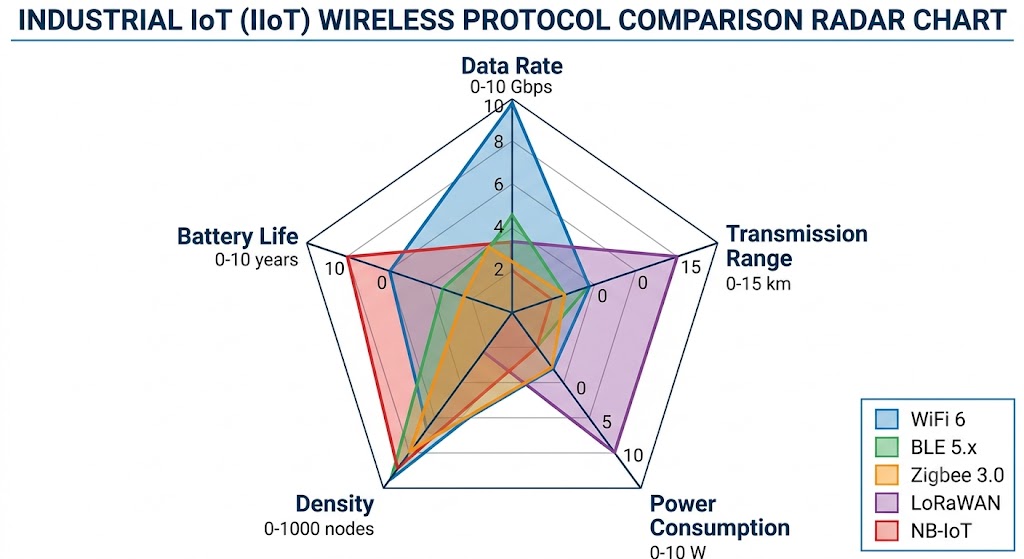
Over the past decade the industrial IoT protocol landscape has settled into four dominant wireless families, each winning in a different corner of the range / power / data-rate trade-off. Mature IIoT deployments rarely pick one — they run 2-4 protocols side by side to cover a full device portfolio. A typical smart factory ends up with: WiFi 6 (802.11ax) for high-bandwidth work such as video surveillance, autonomous mobile robots, and AR/VR maintenance tools, where 50-100m per AP and 5-15W per client are acceptable for multi-Gbps throughput; Bluetooth 5 + BLE Mesh for short-range asset tracking (50-200m) on battery tags that need 1-2 years of life at 1-2 Mbps; Zigbee 3.0 for dense mesh sensor networks (10-100m per hop, 250 kbps) driving hundreds of lighting fixtures, environmental sensors, and energy meters on one mesh; and LoRaWAN for outdoor sensors (2-15km) on campuses or industrial parks, where ultra-low power delivers 5-10 years on two AA cells.
WiFi for Industrial IoT — High-Bandwidth Backbone for Data-Intensive Applications
WiFi, particularly WiFi 6 (802.11ax) and WiFi 6E, is the backbone protocol for industrial IoT because it provides the highest data rates (up to 9.6 Gbps aggregate PHY, an 8×8 MIMO theoretical maximum; typical industrial APs achieve 1.2-4.8 Gbps, 1-2 Gbps per client achievable) and the broadest device ecosystem of any IIoT protocol. In industrial environments, WiFi 6’s key advantages over previous WiFi generations are: OFDMA (Orthogonal Frequency Division Multiple Access) which subdivides a 20MHz channel into 256 subcarriers, allowing up to 37 devices to transmit simultaneously on the same channel — critical for dense IIoT environments with 100+ devices per AP; Target Wake Time (TWT) which allows IoT devices to negotiate a sleep schedule with the AP, reducing power consumption by 3-5x for battery-powered sensors (a WiFi 6 sensor can achieve 6-12 month battery life if configured for TWT with 5-second polling intervals); and MU-MIMO (Multi-User Multiple Input Multiple Output) which serves up to 8 clients simultaneously on the same channel, improving aggregate throughput in dense deployments by 2-4x compared to SU-MIMO.
For industrial WiFi deployments, the hardware must be rated for the physical environment: industrial APs with IP65+ enclosures, -40°C to +85°C temperature range, and conformal-coated PCBs to resist humidity, vibration, and chemical exposure. Zukaka’s 5GHz High-Power WiFi Module (WLE600V5-27ESD industrial WiFi module) is designed for embedded IIoT gateway applications: 867 Mbps PHY rate (2×2 MIMO, 802.11ac), MiniPCIe form factor for integration into custom gateway designs, industrial-grade components rated for -40°C to +85°C, and high TX power suitable for outdoor and large indoor spaces. This module is commonly used in: production machine connectivity (replacing wired Ethernet for data collection), AGV communication links (maintaining connectivity at speed with 802.11r fast roaming), and mobile worker terminals (tablets and handhelds on the factory floor).
Bluetooth and BLE — Short-Range, Low-Power Sensor and Tag Connectivity
Bluetooth Low Energy (BLE) has become the dominant protocol for short-range (50-200m in open air) IIoT sensor applications because of its exceptionally low power consumption (5-15 mA peak current for BLE 5.0 vs 200-500 mA for WiFi during transmission) and its mesh networking capability introduced in Bluetooth 5.0+. A BLE 5.0+ sensor transmitting a 20-byte temperature reading every 5 minutes can operate for 2-5 years on a CR2032 coin cell battery (225 mAh), while the same sensor using WiFi would need recharging every 2-4 weeks. BLE 5 adds: 2x the data rate (2 Mbps), 4x the range (up to 200m with coded PHY at 125 kbps), and 8x the broadcasting capacity (advertising extensions). BLE Mesh extends BLE from simple point-to-point and star topologies to full mesh networking, allowing hundreds of BLE nodes to form a self-healing network covering large areas. However, BLE Mesh has lower throughput per node (approximately 10-30 kbps usable after protocol overhead) and higher latency (10-100ms per hop) than Zigbee, making it more suitable for sensor data collection than real-time control.
Zigbee and Thread — Dedicated Low-Power Mesh for Industrial Sensor Networks
Zigbee 3.0 and Thread are purpose-built for low-power mesh sensor networking, offering the best balance of power efficiency (10-50 mA peak, 1-3 µA sleep), mesh reliability (self-healing with 10-30ms reconvergence for networks up to 254 nodes for Zigbee, up to 511 router nodes for Thread), and deterministic latency (15-30ms per hop for Zigbee, 10-20ms for Thread) of any IIoT protocol. Zigbee’s network layer supports three device types: Coordinator (one per network, initiates and manages the network), Router (relays data for other devices while also performing its sensing function), and End Device (leaf nodes that sleep most of the time, waking only to transmit — these achieve the longest battery life). A Zigbee router node operating on 2 AA batteries (3000 mAh total) transmitting periodic data (every 5 minutes) and relaying traffic from 10 neighboring devices can operate for 18-36 months. Thread improves on Zigbee by using IPv6 addressing natively (eliminating the need for protocol translation gateways to connect Thread devices to the internet) and by implementing a simpler, more efficient mesh routing algorithm based on IEEE 802.15.4. Both Zigbee and Thread operate in the 2.4GHz ISM band (same as WiFi), so careful channel planning is needed to avoid co-channel interference — Zigbee channels 15, 20, 25 (2.405, 2.450, 2.475 GHz) are recommended for avoiding overlap with WiFi channels 1, 6, 11.
LoRa and LPWAN — Ultra-Long-Range Connectivity for Wide-Area IIoT
LoRaWAN and other LPWAN (Low Power Wide Area Network) technologies are designed for a specific IIoT niche: sensors that need to transmit small amounts of data (10-50 bytes per message) over very long distances (2-15km in rural areas, 1-3km in urban environments) with multi-year battery life (5-10 years on 2 AA cells). LoRaWAN uses a spread-spectrum modulation (Chirp Spread Spectrum, CSS) that trades data rate for range and sensitivity — at the lowest data rate (SF12, approximately 300 bps), a LoRa receiver can decode signals at -137 dBm sensitivity, enabling communication over 15km line-of-sight or through multiple building walls. LoRaWAN’s data rate is its primary limitation: even at the highest data rate (SF7, approximately 5.5 kbps), it is unsuitable for any application requiring real-time data, firmware updates over the air, or large sensor payloads. LoRaWAN is best suited for: outdoor environmental monitoring (temperature, humidity, air quality across a campus or city), tank level monitoring (water, fuel, chemical tanks that are geographically distributed), agricultural IoT (soil moisture, weather stations, livestock tracking across large farms), and utility metering (gas, water, electricity meters in urban areas). The LoRaWAN network architecture uses a star-of-stars topology where end devices communicate directly with gateways, which then forward data to a central network server — unlike mesh protocols, LoRaWAN end devices do not relay each other’s traffic, which simplifies deployment but requires sufficient gateway density for reliable coverage.
For context, a 200,000 m² smart factory deployment would typically combine WiFi 6 (about 12 APs) for autonomous mobile robots and HD inspection cameras, BLE Mesh for tool tracking and personnel badges, Zigbee for dense environmental monitoring, and LoRaWAN for outdoor perimeter sensors. Gateways at each zone center translate protocols and run edge processing so only summarized data reaches the cloud. These architectures target 99.98%+ reliability and cut wiring costs by 50-60% compared to wired-only designs.
Protocol Comparison: Choosing the Right Solution
Selection framework. Protocol selection follows a decision tree driven by three primary constraints: power source (battery vs wired sets the acceptable power budget), range requirement (short <100 m, medium 100-1000 m, long >1 km determines the physical layer), and data rate (low <100 kbps, medium 100 kbps-10 Mbps, high >10 Mbps determines modulation and channel width). Most IIoT deployments need 2-3 protocols to cover their full device portfolio because no single protocol simultaneously optimizes for low power, long range, and high data rate.
Protocol Comparison Table — Critical Performance Parameters
| Protocol | Range (Open Air) | Max Data Rate | Power Consumption (Active/Sleep) | Typical Battery Life (2× AA at 5-min transmit interval) | Topology | Best Application Fit |
|---|---|---|---|---|---|---|
| WiFi 6 (802.11ax) | 50-100m (indoor AP), 200-500m (outdoor AP with antenna) | Up to 9.6 Gbps aggregate PHY (8×8 MIMO theory); typical industrial APs achieve 1.2-4.8 Gbps; 1-2 Gbps per client achievable | 5-15W (active), 1-5µW (TWT deep sleep) | 2-6 months (with TWT), 1-3 days (continuous) | Star (AP + clients) | High-bandwidth: video surveillance, AMRs, AR/VR, production machine data, worker terminals |
| Bluetooth 5.x / BLE | 50-200m (LE coded PHY at 125 kbps) | 2 Mbps (LE 2M PHY) | 5-15 mA (active), 0.5-1 µA (sleep) | 2-5 years (coin cell CR2032) | Star, Mesh (BLE Mesh) | Short-range sensors, asset tags, proximity detection, personnel badges, beaconing |
| Zigbee 3.0 | 10-100m per hop | 250 kbps (2.4GHz) | 10-50 mA (active), 1-3 µA (sleep) | 18-36 months (router node), 3-5 years (end device) | Mesh (self-healing, 250+ nodes) | Dense sensor networks: environmental monitoring, smart lighting, energy metering, HVAC control |
| Thread | 10-100m per hop | 250 kbps (2.4GHz) | 10-50 mA (active), 1-3 µA (sleep) | 12-24 months (router), 2-4 years (end device) | Mesh (IPv6-based, up to 511 router nodes per network; end devices can scale beyond that) | IP-native sensor networks, IoT devices needing direct internet connectivity without gateway translation |
| LoRaWAN | 2-15km (rural), 1-3km (urban) | 0.3-50 kbps (SF12 to SF7) | 10-30 mA (active), 1-2 µA (sleep) | 5-10 years (2× AA) | Star-of-stars (end device → gateway → server) | Wide-area outdoor sensors: environmental, tank level, agriculture, utility metering, smart city |
| NB-IoT (5G cellular IoT) | 2-10km (cellular coverage dependent) | Up to 250 kbps downlink (multi-tone), up to 250 kbps uplink (multi-tone); single-tone: ~26 kbps downlink / ~17 kbps uplink | 100-200 mA (active), 3-5 µA (sleep) | 3-7 years (2× AA with optimized eDRX+PSM) | Star (device → cellular tower) | Wide-area where cellular infrastructure exists: smart meters, vehicle telematics, vending machines |
Selection Criteria — A Decision Framework for IIoT Protocol Choice
The protocol selection decision should follow a structured framework that evaluates the application requirements across 5 dimensions: data rate (what is the maximum payload size and transmission frequency?), power budget (is the device mains-powered, replaceable-battery, or energy-harvesting?), range (are all devices within 100m of a gateway, or distributed across kilometers?), environment (indoor, outdoor, underground, metallic enclosure?), and scale (10 devices, 100 devices, 1000+ devices?). The interaction between these dimensions creates clear protocol preferences: a mains-powered camera streaming 4K video (high data rate, unlimited power, short range) uniquely maps to WiFi 6 or 5G; a battery-powered temperature sensor in a chemical storage tank (very low data rate, 100 bytes per hour, long range from outdoor tank farm) maps to LoRaWAN; a network of 500 lighting fixtures in a warehouse (low data rate, mains-powered, indoor mesh) maps to Zigbee or Thread; and a set of 100 pallet tags for indoor asset tracking (very low data rate, battery-powered, short range to ceiling-mounted readers) maps to BLE.
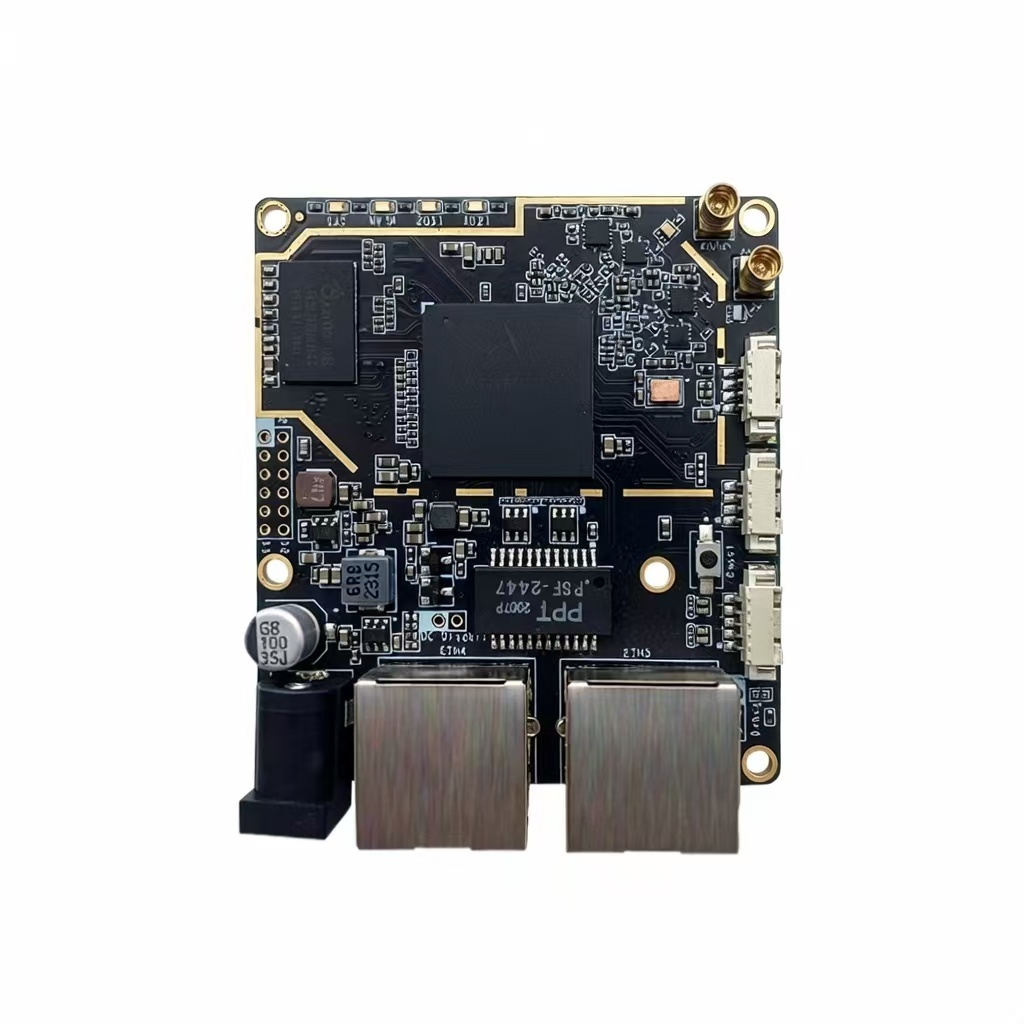
The single most common IIoT design error is over-specifying a protocol for one “worst-case” device and then forcing everything else onto it — which ends up wasting power on low-power sensors or starving high-capacity devices of bandwidth. Pick LoRaWAN for every device because a few outdoor sensors need 5km range, and you have sentenced cameras and video systems to a sub-50 kbps link. The better approach: segment the device portfolio by protocol requirement, then deploy a multi-protocol gateway that gives each device class its optimal radio while presenting one unified interface (MQTT, OPC-UA, or REST API) upward. Zukaka’s IIoT gateway platforms (based on the 11ac 24V Gigabit Wireless Bridge PCBA for IIoT gateways) are built for exactly this: dual-band WiFi plus Gigabit Ethernet, with expansion for BLE/Zigbee/LoRa modules, so a single gateway can converge up to 500+ devices across 3-4 protocols.
In practice, applying this framework to a chemical plant typically maps to LoRaWAN for 200+ tank level sensors (outdoor, 0.5-2 km from gateways, ~10-byte payload every 15 minutes, 5-year battery on 2× AA), BLE Mesh for 500+ personnel safety badges and equipment tags (indoor, <50 m, 2-year coin-cell battery), and WiFi 6 for 50+ cameras and 20+ worker tablets. Multi-protocol gateways — one per processing unit — translate protocols and run edge processing, which typically cuts cloud bandwidth by about 80%.
Multi-Protocol Gateway Solutions
Why gateways matter. Multi-protocol gateways serve as the convergence point between diverse IIoT device networks (WiFi, BLE, Zigbee, LoRa, Modbus RTU, Ethernet/IP) and the higher-level application layer (cloud platforms, SCADA, MES, ERP). A single gateway can replace 3-5 separate single-protocol bridges, reducing hardware cost by 40-60%, simplifying network management, and enabling cross-protocol data correlation — for example, correlating BLE personnel location data with Zigbee environmental sensor data on the same gateway for safety alerts.
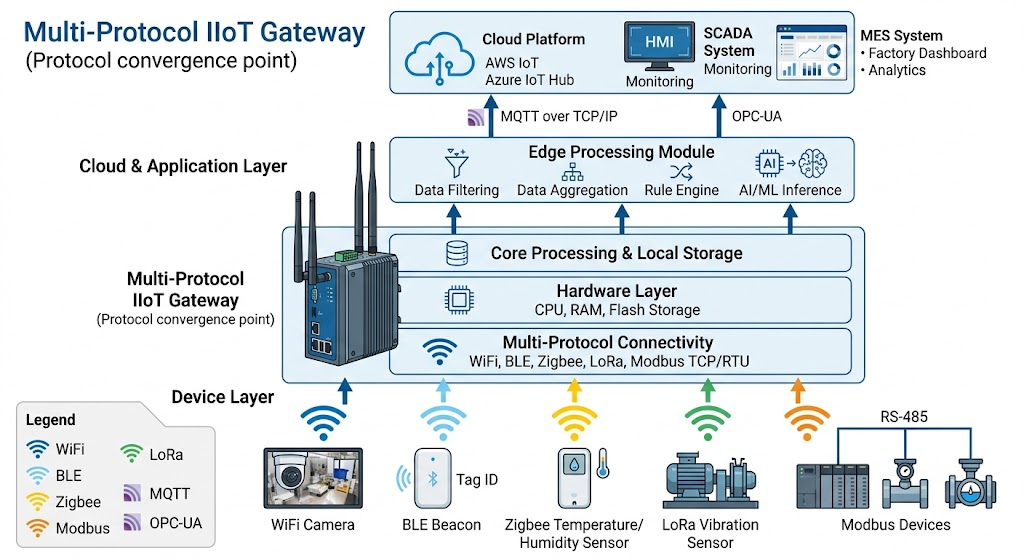
In any heterogeneous IIoT deployment, the multi-protocol gateway is the component everything hangs on, because it does four jobs at once: protocol translation (bridging wireless and wired protocols across OSI Layers 2-7), edge processing (filtering, aggregating, and analyzing data locally to cut cloud bandwidth), local storage (buffering during cloud outages so nothing is lost), and device management (over-the-air firmware, configuration, and health monitoring regardless of protocol). That workload dictates the hardware: multiple radios (WiFi + BLE/Zigbee/LoRa modules) in one industrial enclosure, and enough compute (a 1-4 GHz ARM Cortex-A or x86 processor with 512MB-4GB RAM) to run the protocol stacks, edge algorithms, and a local MQTT broker. Zukaka’s 11ac 24V Gigabit Wireless Bridge PCBA supplies the WiFi backbone here (802.11ac dual-band, 867 Mbps PHY) and Gigabit Ethernet, with MiniPCIe slots that accept BLE, Zigbee, LoRa, or cellular modules — one board can act as the convergence point for an entire site.
Gateway Architecture — Protocol Translation and Data Flow
The gateway’s protocol translation function operates at multiple OSI layers: at Layer 2, it bridges Ethernet and WiFi frames (802.3 ↔ 802.11), at Layer 3, it routes IP traffic between the device subnet and the WAN, and at Layer 7, it translates between application-layer protocols (MQTT, CoAP, Modbus TCP, OPC-UA, HTTP/2) to provide a unified data output to the cloud. The typical data flow through a multi-protocol gateway is: a Zigbee temperature sensor transmits a data frame → the Zigbee radio module on the gateway receives and decodes the IEEE 802.15.4 frame → the gateway’s embedded software extracts the sensor payload (temperature value in °C, sensor ID, battery level) → the edge processing engine applies any locally-configured rules (e.g., “if temperature > 80°C AND vibration > 5 mm/s, generate immediate alert”) → the payload is published to the local MQTT broker with a standardized topic structure (e.g., `iiot/zone3/temperature/sensor42`) → the MQTT client forwards the message to the cloud MQTT broker (AWS IoT Core, Azure IoT Hub, or on-premise SCADA system). The entire end-to-end latency from sensor transmission to cloud availability should be under 500ms for monitoring applications and under 50ms for real-time control applications.
Gateway Deployment Considerations
| Deployment Factor | Best Practice | Why It Matters | Failure Mode If Ignored |
|---|---|---|---|
| Physical Placement | Central location with clear RF line-of-sight to the majority of devices; elevated mounting (3-6m above floor level for indoor, 6-12m for outdoor) | Gateway placement determines the RF coverage boundary for short-range protocols (BLE, Zigbee) — a poorly placed gateway may only achieve 50% of the designed range, requiring additional gateways | Dead zones requiring additional gateways at 2-3x the planned cost; devices at the edge of range experiencing 20-40% packet loss due to weak RSSI |
| Power Supply | PoE (802.3af/at) for indoor gateways, solar + battery for remote outdoor gateways, always with UPS backup on the upstream switch for at least 30 minutes of runtime | Gateway is a single point of failure for all downstream devices — power loss at the gateway disconnects hundreds of sensors and actuators from the cloud | During a 10-minute power outage, the gateway goes offline → all downstream devices lose cloud connectivity → data gap in monitoring dashboards → potential missed alarms for critical conditions |
| Redundancy | Active-standby gateway pair for critical zones, with automatic failover (heartbeat interval of 5-10 seconds, failover under 30 seconds) | Gateway hardware failure is rare (<2% annual failure rate for industrial-grade hardware) but catastrophic when it occurs in a single-gateway architecture | In a single-gateway zone, gateway failure disconnects 100-500+ devices until replacement hardware is procured and configured — typical recovery time is 4-48 hours |
| Remote Management | Gateways must support: remote monitoring (CPU load, memory usage, radio status, connected device count), remote configuration (protocol parameters, edge processing rules, MQTT endpoints), and remote firmware updates (with scheduled updates and rollback capability) | Industrial IIoT deployments often have gateways in inaccessible locations (above ceilings, on rooftops, in remote outdoor enclosures) — physical access for maintenance is expensive ($200-500 per site visit) | A 30-second configuration change requires a $200-500 site visit; a firmware vulnerability takes 2-4 weeks to patch due to the scheduling logistics of site visits |
Edge Computing Integration
Bottom line: Edge computing in industrial IoT is not optional — it is required for any application with latency constraints below 100 ms (real-time control, safety systems, predictive maintenance alerts), for deployments with limited WAN bandwidth (<5 Mbps uplink typically in remote industrial sites), or for data sovereignty requirements where sensor data cannot leave the facility. Edge processing reduces cloud bandwidth by 60-90% by filtering, aggregating, and analyzing data locally before forwarding only summarized insights to the cloud.
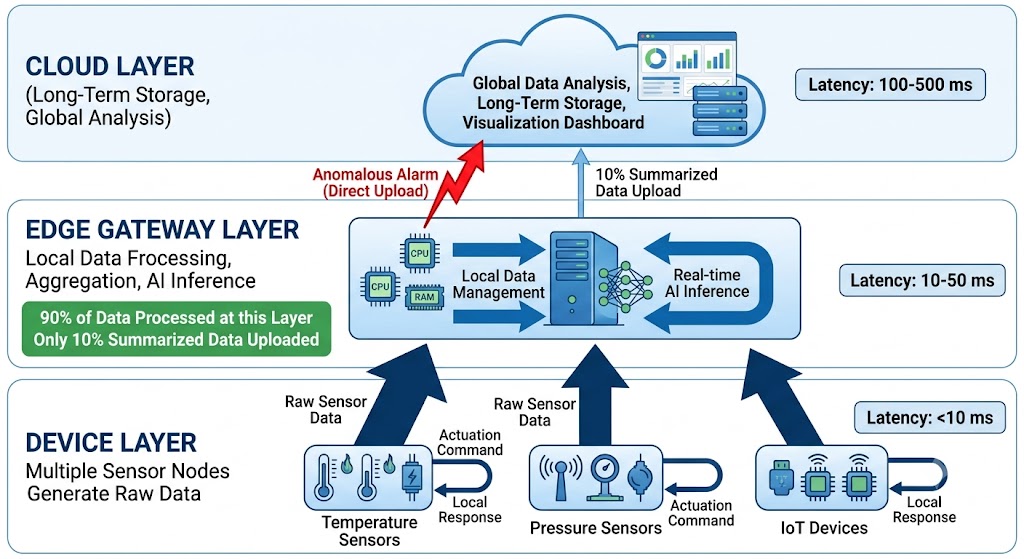
Edge computing brings data processing closer to the IIoT devices (at the gateway, the local server, or on the device itself) rather than sending all raw data to the cloud for processing — this architectural choice is driven by three hard constraints: latency (cloud round-trip adds 50-500ms depending on WAN quality, while edge processing delivers sub-10ms response), bandwidth (a factory with 1,000 sensors each transmitting 100 bytes every 10 seconds generates 864 MB of raw data per day — sending all of this to the cloud costs $50-200/month in data transfer alone, while edge processing can reduce this to 10-50 MB of summarized data), and reliability (edge processing continues operating during WAN outages, which in industrial environments can account for 1-5% of operational time). The edge computing architecture in IIoT is typically a 3-tier model: Tier 1 (Embedded Edge) — processing on the sensor/device itself using a microcontroller with ML inference capability (TensorFlow Lite Micro, CMSIS-NN); Tier 2 (Gateway Edge) — processing on the IIoT gateway using the gateway’s application processor (ARM Cortex-A series with 512MB-4GB RAM, running Node-RED, Python scripts, or Docker containers); and Tier 3 (Local Server Edge) — processing on an on-premise server or edge server cluster (x86 or ARM server with 16-64GB RAM, running full Kubernetes or Docker Swarm for containerized edge applications).
AI at the Edge — Machine Learning Inference on IIoT Gateways
Deploying machine learning models on edge gateways for real-time inference (predictive maintenance, anomaly detection, quality inspection) requires models that are optimized for the gateway’s limited compute resources: quantized models (INT8 precision instead of FP32 reduces model size by 4x and inference latency by 2-3x with less than 1% accuracy loss), distilled models (a smaller “student” model trained to mimic a larger “teacher” model, achieving 10-50x size reduction while retaining 90-95% of accuracy), or on-device training using federated learning (where the model trains on edge data without sending raw data to the cloud, preserving data privacy). Common industrial edge AI applications include: vibration-based predictive maintenance (a CNN or autoencoder trained on normal vibration patterns detects anomalies — a 50KB quantized model on a gateway can classify vibration data from 20 motors every second with 95%+ accuracy); computer vision for quality inspection (a YOLOv5-nano model quantized to INT8 at 1.5MB runs at 15-30 FPS on an ARM Cortex-A72 gateway processor, detecting defects in real-time on the production line); and energy optimization (a reinforcement learning model controlling HVAC setpoints based on occupancy and weather data, reducing energy consumption by 15-25% with no cloud dependency).
A representative edge-AI predictive-maintenance setup for a food processing plant uses about 8 IIoT gateways covering ~150 refrigeration compressors. Each gateway runs a compact TensorFlow Lite model (INT8-quantized) that analyzes vibration spectrum, temperature, and current draw from each compressor every 5 seconds, detecting early bearing wear tens of hours before failure. Only anomaly alerts and daily summary statistics get forwarded to the cloud — roughly 2 MB/day/gateway — rather than raw sensor data that would be ~1.2 GB/day. At typical food-processing downtime costs of $10,000-15,000/hour, preventing even a handful of multi-hour outages per year drives the ROI, and gateway hardware at this scale is a low-five-figure line item.
IIoT Applications and Use Cases
What to expect across verticals: Industrial IoT applications span 5 major sectors: smart manufacturing (predictive maintenance, quality inspection, energy optimization — typically 20-30% ROI in year 1), logistics and supply chain (real-time inventory, asset tracking, cold chain monitoring — 15-25% reduction in inventory carrying costs), energy and utilities (smart grid, pipeline monitoring, renewable energy — 10-20% reduction in energy costs), healthcare (medical asset tracking, environmental monitoring — 30-50% reduction in lost equipment), and building automation (HVAC, lighting, occupancy — 20-35% reduction in energy consumption). The common technical thread across all verticals is the 5-layer IIoT architecture: sensing → connectivity → edge processing → platform → application.
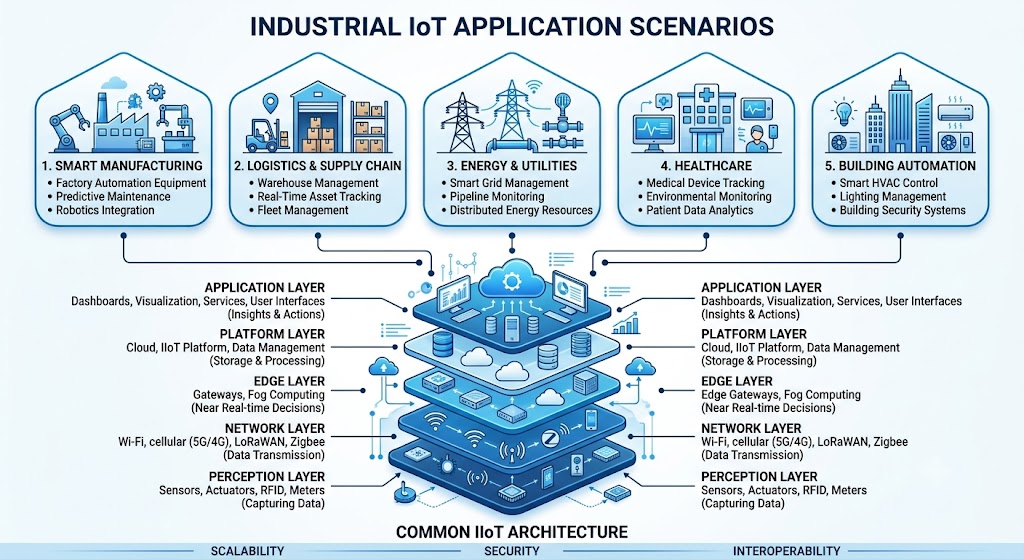
Smart Manufacturing — Predictive Maintenance and Quality Control
Predictive maintenance is the highest-ROI IIoT application in manufacturing, with typical returns of $5-15 for every $1 invested through reduced unplanned downtime (30-50% reduction), extended equipment life (20-40%), and reduced maintenance costs (10-25%). The implementation follows a 4-phase methodology: Phase 1 (Sensor Deployment) — install wireless vibration sensors (BLE or Zigbee, 10-1000Hz bandwidth, 3-axis accelerometer), temperature sensors (±0.5°C accuracy), and current sensors (CT clamp, ±1% accuracy) on critical equipment (motors, pumps, compressors, conveyors, CNC machines). Phase 2 (Baseline Collection) — collect 30-90 days of normal operating data to establish baseline vibration signatures, thermal profiles, and power consumption patterns for each machine under various load conditions. Phase 3 (Model Training) — train an anomaly detection model (autoencoder neural network or isolation forest) on the baseline data, with the model identifying deviations from normal patterns that indicate specific failure modes (bearing wear, misalignment, imbalance, lubrication failure). Phase 4 (Operational Deployment) — deploy the trained model to the edge gateway and configure alert thresholds: “Warning” at 2σ deviation (schedule inspection within 1 week), “Critical” at 3σ deviation (schedule maintenance within 24 hours), “Immediate” at 4σ+ deviation (stop machine and dispatch maintenance team).
Quality control using IIoT-connected vision systems has become cost-effective with edge AI: a complete inspection station (industrial camera + edge gateway with AI processor) costs $3,000-8,000 compared to $15,000-40,000 for traditional machine vision systems, with comparable accuracy (95-99% defect detection for surface defects, dimensional checks, and assembly verification). The IIoT-connected vision architecture uses: a GigE Vision or USB3 camera (5-20MP resolution, 30-60 FPS) connected to an edge gateway running a quantized object detection or classification model (YOLOv5-nano, MobileNet-SSD, or EfficientNet-Lite). The edge gateway processes each frame in 30-100ms, classifying products as “pass” or “fail” and logging results to the local MQTT broker. Only quality statistics (defect rate by shift, top defect types, trend data) are forwarded to the cloud — approximately 100KB/day vs 100GB/day for raw video. This architecture has enabled small and medium manufacturers to deploy automated quality inspection at 20-30% of the cost of traditional machine vision, making IIoT-powered quality control accessible to factories with 50-500 employees.
Logistics and Supply Chain — Real-Time Asset Tracking and Cold Chain Monitoring
IIoT-enabled real-time asset tracking in logistics uses BLE tags (for indoor pallet and container tracking within warehouses, $3-8 per tag, 1-3 year battery life) and LoRaWAN/GPS trackers (for outdoor fleet and container tracking across yards and transit routes, $30-80 per tracker, 3-5 year battery life) to provide location updates at intervals from 10 seconds (high-value assets, real-time location systems) to 1 hour (low-value inventory, stock count verification). The typical ROI calculation for asset tracking: a warehouse with 10,000 pallets at $500 average value per pallet has $5M in inventory. Without IIoT tracking, annual inventory loss from misplaced items is 2-5% ($100,000-250,000/year). A BLE tag-based tracking system at $5/tag ($50,000 total) with a 2-year tag life ($25,000/year amortized) plus gateway infrastructure ($10,000) provides a payback period of 3-6 months. Cold chain monitoring expands this to include temperature (±0.3°C accuracy with BLE/LoRa temperature sensors logging every 1-15 minutes), humidity (±2% RH), and shock/impact detection (3-axis accelerometer with programmable thresholds) — critical for pharmaceutical, food, and chemical logistics where a temperature excursion of 2-4 hours can destroy an entire shipment worth $50,000-500,000.
Energy and Utilities — IIoT for Smart Grid and Renewable Energy Monitoring
IIoT-enabled energy monitoring in industrial facilities (power quality meters, sub-metering on individual production lines, and machine-level power monitoring) typically identifies 10-20% in energy savings through: identifying equipment left running during non-production hours (5-10% of total consumption, zero-cost savings from behavior change), detecting efficiency degradation in motors and compressors (3-5% savings through maintenance), and optimizing HVAC and compressed air schedules (5-10% savings through automation). The IIoT energy monitoring architecture uses: WiFi-connected power meters (CT-clamp type, ±1% accuracy, per-phase voltage, current, power factor, THD) on the main feed and each production zone, Zigbee-connected sub-meters on individual machines (current and power factor only, lower cost at $50-100 per meter), and BLE-connected temperature and humidity sensors for HVAC zone monitoring. Data flows to the edge gateway every 1-15 seconds, where it is aggregated into 15-minute averages and forwarded to the cloud energy management platform. The gateway also runs local control rules: “If zone temperature is below setpoint AND occupancy sensor is unoccupied for >30 minutes, reduce HVAC fan speed by 50%.” A 50,000m² manufacturing facility implementing this architecture typically invests $80,000-150,000 in sensors and gateways and achieves $40,000-80,000/year in energy savings — a 2-3 year payback.
A tire manufacturing plant rollout is representative: 200+ machines (motors, extruders, curing presses) instrumented with 600+ wireless sensors (BLE for vibration and temperature on motors, Zigbee for process sensors on extruders). About 12 edge gateways run per-machine anomaly detection, generating maintenance alerts days ahead of predicted failure. These programs commonly report double-digit reductions in unplanned downtime, with payback measured in months rather than years.
Recommended PCBA Products for Industrial IoT
Platform overview: Zukaka offers three PCBA platforms optimized for different IIoT deployment roles: the YN300A mesh motherboard (2.4 GHz, 50+ nodes, 10+ hop relay) for large-scale sensor mesh backbones in mining, smart city, and campus-scale IoT; the WLE600V5-27ESD high-power WiFi module (867 Mbps, 2×2 MIMO, MiniPCIe) for IIoT gateway and edge computing platforms; and the YN300B seamless roaming client (5.8 GHz, 96 Mbps) for mobile IoT devices on vehicles, AGVs, and personnel tracking. The platform selection depends on whether the device serves as network backbone (mesh), gateway (high-throughput WiFi), or mobile client (seamless roaming).
Each Zukaka IIoT PCBA platform addresses a specific architectural layer in the IIoT network stack: the mesh backbone for distributed sensor networks requiring multi-hop connectivity and self-healing at Layers 1-3, the high-power WiFi module for gateway devices bridging sensor networks to the cloud at Layers 3-7, and the seamless roaming client for mobile elements requiring uninterrupted connectivity at Layer 2. The selection between these platforms is driven by the device’s role in the IIoT architecture rather than its physical form factor — a stationary gateway uses the WLE600V5-27ESD or YN300A, a mobile tracking device uses the YN300B, and a large-scale sensor mesh uses the YN300A as the backbone relay between sensor clusters.
| Product | Frequency | Max Nodes | Max Hop Relay | TX Power | Throughput | Best For |
|---|---|---|---|---|---|---|
| 2.4G Wireless Mesh Motherboard (YN300A) | 2.4 GHz (2400-2483.5 MHz) | 50+ nodes (MANET, scalable) | 10+ hops (up to 15-20km total network span) | 28-30 dBm per chain | 50-100 Mbps per hop (burst), 10-30 Mbps end-to-end at 5 hops | Industrial mesh backbones for large-scale sensor networks, underground mining IoT, smart city sensor infrastructure, campus-wide environmental monitoring — requires NLOS and self-healing topology |
| 5GHz High-Power WiFi Module (WLE600V5-27ESD) | 5GHz (DFS channels supported, UNII-1/2/2e/3) | N/A (client module, connects to any standard 802.11ac AP) | 1 hop (client-to-AP, up to 30km PTP with directional antenna) | 27 dBm per chain (2×2 MIMO) | 867 Mbps PHY (802.11ac Wave 2), 400-600 Mbps UDP throughput (typical) | IIoT gateway and edge computing platforms, embedded WiFi for industrial controllers and HMIs, high-speed connectivity for camera-based quality inspection systems — MiniPCIe form factor for custom carrier board integration |
| 5.8G Seamless Roaming Client (YN300B) | 5.8 GHz (5725-5850 MHz UNII-3) | N/A (single-client device, connects to one mesh node or AP at a time) | 1 hop (client-to-mesh-node or client-to-AP) | 26-28 dBm | Up to 96 Mbps (802.11n 40MHz) | Vehicle-mounted IoT data loggers, AGV communication links, personnel tracking badges, mobile sensor platforms — requires IEEE 802.11r fast roaming for sub-50ms handoff between APs at speed |
Recommendation: For large-scale IIoT sensor deployments requiring self-healing mesh connectivity (50+ nodes across a campus, mine, or industrial park), the 2.4G Wireless Mesh Motherboard (YN300A) provides the most robust mesh backbone with NLOS support and 10+ hop relay. For IIoT gateway designs requiring high-throughput WiFi (867 Mbps) in a compact MiniPCIe form factor for custom carrier boards, the 5GHz High-Power WiFi Module (WLE600V5-27ESD) is the optimal choice. For mobile IoT devices on vehicles, AGVs, or personnel that need seamless connectivity while moving, consider the 5.8G Seamless Roaming Client (YN300B) with 802.11r fast roaming support.
Frequently Asked Questions
Q: Which wireless protocol is best for industrial IoT?
There is no single “best” protocol for all IIoT — the optimal protocol depends on the device’s power source, range requirement, and data rate demand, and most industrial deployments require 2-4 different protocols to cover their full device portfolio. WiFi 6 (802.11ax) with its OFDMA and TWT features is the best choice for high-bandwidth IIoT applications (video surveillance, AMRs, AR/VR) where devices are mains-powered or within 100m of an AP. LoRaWAN is the best for long-range outdoor sensors (2-15km, sub-50 kbps, 5-10 year battery life on 2× AA cells) such as tank level monitoring, environmental sensing, and agricultural IoT. BLE 5.x is the best for short-range battery-powered devices (50-200m, 2 Mbps peak, 2-5 year battery on coin cell) like asset tags, personnel badges, and proximity sensors. Zigbee or Thread are the best for dense mesh sensor networks (Zigbee supports up to 254 nodes per network; Thread supports up to 511 router nodes with end devices scaling beyond that; both are 250 kbps with self-healing topology) like smart lighting, environmental monitoring, and HVAC control in buildings and factories.
Q: What is the difference between IoT and IIoT?
IoT (Internet of Things) refers to consumer and general-purpose connected devices where occasional connectivity loss and best-effort data delivery are acceptable, while IIoT (Industrial IoT) is designed for mission-critical industrial applications requiring 99.99%+ reliability (less than 52 minutes of downtime per year), deterministic latency, resistance to harsh environments (-40°C to +85°C, vibration, humidity, dust), and 5-15 year product life cycles. The key differences manifest in hardware specifications: consumer IoT devices typically use plastic enclosures, operate at 0-40°C, and cost $5-50; IIoT devices use metal or ruggedized enclosures with IP65+ ratings, operate at -40°C to +85°C, include surge protection and wide-voltage power supplies, and cost $50-500+ depending on the feature set. From a networking perspective, IIoT uses industrial protocols (Modbus TCP, PROFINET, EtherNet/IP, OPC-UA) at the application layer, while consumer IoT uses HTTP, WebSocket, or proprietary APIs. Security requirements are also more stringent in IIoT: device authentication using X.509 certificates, encrypted communications (TLS 1.3), and role-based access control are considered mandatory, not optional.
Q: How do I secure my IIoT network?
IIoT security requires a defense-in-depth strategy across 5 layers: device security (hardware root of trust, secure boot, signed firmware updates), network security (802.1X/EAP-TLS for device authentication, VLAN segmentation of IoT traffic from IT traffic, firewall rules at the gateway), communication security (TLS 1.3 for all data in transit, MQTT with username/password or certificate-based authentication for message broker access, payload encryption for sensitive data), platform security (cloud IoT platform with device registry, access policies, and audit logging), and lifecycle security (automated firmware update management, vulnerability scanning, and decommissioning procedures for end-of-life devices). The most critical and commonly overlooked security measure is network segmentation: creating a separate VLAN for IIoT devices that has no direct internet access, with a firewall allowing outbound connections only to specific cloud endpoints (MQTT broker, update server, NTP server) and blocking all inbound connections from the internet. WPA3-Enterprise with 802.1X authentication should be used for WiFi IIoT networks instead of WPA2-PSK, because pre-shared keys cannot be individually revoked when a device is compromised — with 802.1X using EAP-TLS (certificate-based), each device has a unique credential that can be revoked without affecting other devices. Industry standards like IEC 62443 provide a comprehensive framework for industrial cybersecurity, with IEC 62443-4-1 (product security development lifecycle) and IEC 62443-4-2 (technical security requirements for industrial components) being the most relevant for IIoT device manufacturers.
Q: Can IIoT work without cloud connectivity?
Yes, IIoT systems are designed to operate autonomously without cloud connectivity through edge computing — the edge gateway stores data locally (typically 7-30 days of sensor data on local SSD or SD card storage), runs local control logic (if-then rules, PID controllers, machine learning inference), and provides a local dashboard via built-in web server or local SCADA connection. Data synchronization when cloud connectivity is restored follows a store-and-forward pattern: the gateway buffers all sensor data in a local database (SQLite or InfluxDB on the gateway), timestamped with the original data collection time. When the cloud MQTT broker connection is re-established, the gateway replays stored messages in chronological order, with the cloud platform handling deduplication based on message IDs. The typical storage requirement for a gateway with 500 sensors reporting 100-byte payloads every 60 seconds is: 500 sensors × 100 bytes/payload × 1,440 payloads per day (one per sensor per minute) × 1.5× overhead for indexing and metadata × 30 days ≈ 3.2 GB for 30 days of local storage. For higher-frequency sensors (e.g., 10-second reporting for vibration monitoring) or longer buffering windows, this scales linearly — 30 days of 10-second data from 500 sensors would require approximately 19 GB. Industrial gateways should support hot-swappable SD cards or SSDs to enable easy capacity expansion. This architecture ensures zero data loss even during extended WAN outages of 1-30 days, which are common in remote industrial sites (mines, oil fields, offshore platforms).
Q: What is the typical lifespan of IIoT sensors?
Battery-powered IIoT sensor lifespan ranges from 2-5 years for active monitoring sensors (transmitting 1-60 times per hour, using BLE 5.x or Zigbee) to 5-10 years for occasional-reporting sensors (transmitting 2-12 times per day, using LoRaWAN at SF12 with 2× AA cells). Battery life is determined by: the sensor’s active current draw (typically 15-20 mA for BLE/Zigbee radios and 20-30 mA for LoRaWAN radios during transmission), sleep current draw (0.5-5 µA for all three protocols in deep sleep), transmit interval (the dominant factor — for a sensor transmitting once per hour vs once per minute, battery life increases by approximately 3-5x), payload size (each additional byte increases air time by approximately 0.05-0.1 ms), and battery capacity (a CR2032 coin cell provides approximately 225 mAh; 2× AA Energizer L91 lithium cells provide approximately 3500 mAh total at 3.0V down to 1.8V cutoff). A typical BLE temperature sensor calculation (CR2032, 10 bytes every 5 minutes): daily transmissions = 86,400s ÷ 300s = 288; daily transmit time = 288 × 30 ms (BLE connection event including preamble and CRC) = 8.64 s; transmit energy = 15 mA × 8.64 s ÷ 3600 = 0.036 mAh; sleep energy = 0.005 mA × 24 h = 0.12 mAh; daily total ≈ 0.16 mAh; usable battery = 200 mAh (accounting for voltage cutoff); estimated lifespan = 200 ÷ 0.16 ≈ 1,250 days ≈ 3.4 years. For LoRaWAN with 2× AA cells transmitting twice daily at SF12, the math works out to approximately 7-8 years, dominated by sleep current since the daily air time per device is less than 0.5 seconds at that spreading factor. Wired IIoT sensors (PoE-powered or 24V DC powered) have an operational lifespan of 10-15 years, limited by electrolytic capacitor aging (typically rated at 2000-10000 hours at 105°C) and connector corrosion rather than the electronics themselves, provided that periodic calibration (every 1-2 years for precision sensors) is maintained.
Q: How many devices can an IIoT gateway support?
The practical device capacity of an IIoT gateway is limited by two factors: the bandwidth budget (the aggregate throughput of all connected devices must not exceed the gateway’s radio capacity and its WAN uplink) and the connection table limit (the number of concurrent TCP/MQTT connections the gateway’s embedded processor and memory can maintain). For a WiFi-based gateway with a 100 Mbps WAN uplink and a typical device generating 1 kbps of sensor data (100-byte payload every 10 seconds), the bandwidth budget allows up to 100,000 devices — but the practical limit is set by connection management, typically 500-2000 concurrent MQTT connections per gateway with 1-2 GHz ARM Cortex-A processor and 1-2 GB RAM. For BLE gateways scanning for BLE advertisement beacons (not connecting to devices, just receiving periodic advertisement packets), a single gateway can track 500-2000 BLE tags depending on the advertisement interval (100ms to 5 seconds) and the number of concurrent tags in range (BLE scanner radio can process up to approximately 1000 advertisement packets per second). For LoRaWAN gateways, the air time utilization is the constraint: with an 8-channel LoRaWAN gateway, using SF12 (each transmission occupies ~2 seconds of air time), the maximum device count at 1 transmission per hour per device is (8 channels × 3600 seconds/hour) / (2 seconds per transmission × 1 transmission per hour) = 14,400 devices per gateway — but at SF7 (each transmission ~50ms), the same gateway supports (8 × 3600) / (0.05 × 1) = 576,000 devices. For Zigbee/Thread mesh networks, the coordinator/gateway limit is 250-650 nodes per network (Zigbee 3.0 = 250 max, Thread = 650 max), with router nodes extending coverage for end devices.
Q: What is MQTT and why is it used in IIoT?
MQTT (Message Queuing Telemetry Transport) is a publish-subscribe messaging protocol designed for constrained devices and unreliable networks — its lightweight binary header (2 bytes minimum), QoS levels (0/1/2 for at-most-once, at-least-once, exactly-once delivery), and persistent session support make it the dominant application-layer protocol for IIoT, with industry analysts widely estimating its adoption at roughly 70-80% of new industrial IoT deployments. MQTT operates on TCP/IP (typically port 8883 for MQTTS — encrypted MQTT over TLS) with a broker-based architecture: sensors publish messages to topics (hierarchical, e.g., `factory/zone3/temperature/sensor42`), and subscribers (applications, dashboards, databases) receive messages by subscribing to topic patterns (e.g., `factory/zone3/#` subscribes to all sensors in zone 3). The protocol’s key advantage for IIoT is its small code footprint — an MQTT client library requires 10-50 KB of flash on embedded devices (e.g., Eclipse Paho MQTT-C for microcontrollers), making it feasible on the same MCU that reads the sensor and controls the radio. MQTT-SN (MQTT for Sensor Networks) extends MQTT to non-TCP networks like Zigbee and BLE by adding a gateway that translates between the non-TP network and the TCP-based MQTT broker. The most common IIoT MQTT broker software includes Mosquitto (open source, 1000+ concurrent connections), EMQX (open source, 10M+ concurrent connections, MQTT 5.0 support), and commercial brokers like HiveMQ and AWS IoT Core (which implements MQTT with additional AWS-specific features).
Q: How does 5G compare to WiFi for IIoT applications?
5G and WiFi serve complementary roles in IIoT: 5G provides wide-area coverage (2-10km per cell), mobility support (handover between cells at 350+ km/h), and ultra-reliable low-latency communication (URLLC at 1ms air interface latency, 99.999% reliability) — making it ideal for large-scale outdoor IIoT and applications requiring guaranteed SLAs. WiFi 6/6E provides higher per-device throughput (up to 1-2 Gbps achievable per client), lower infrastructure cost (APs at $200-2000 vs 5G small cells at $2000-10000), and unlicensed spectrum (no monthly per-device SIM charges) — making it more cost-effective for high-density indoor IIoT deployments like factories and warehouses. The decision between 5G and WiFi for IIoT depends on: coverage area (if devices are confined to a single facility or campus of 1km² or less, WiFi is typically more cost-effective; if devices are geographically distributed across multiple sites or public areas, 5G is necessary), mobility pattern (for stationary or slow-moving devices in a defined area, WiFi provides adequate roaming with 802.11r/k/v fast roaming achieving handoff times of 20-50ms; for fast-moving vehicles or multi-site operations, 5G’s cellular handover is more reliable), latency requirements (for URLLC applications requiring end-to-end latency under 10ms with guaranteed reliability, private 5G is the only option; for typical monitoring and control applications with 50-500ms latency tolerance, WiFi is sufficient), and cost structure (for 100 devices in a factory, WiFi total cost is $5,000-20,000 for 5-10 APs plus controller, while 5G private network requires a small cell ($5000-10000) plus spectrum licensing and monthly subscription fees). For most industrial IoT applications in manufacturing and logistics, WiFi 6 is the pragmatic choice today because it offers 70-80% of the capability at 20-30% of the cost compared to private 5G — but for outdoor wide-area IoT and applications requiring carrier-grade SLAs, 5G (especially NB-IoT and LTE-M for low-power sensors, and URLLC for real-time control) is the appropriate solution.
By: Zukaka, Wireless Engineering Lead |
Last Updated: July 13, 2025 |
LinkedIn Profile
Zukaka leads the wireless systems engineering team at Zukaka, where he has overseen the design and deployment of industrial wireless modules for more than 300 OEM customers and system integrators across factory automation, underground mining, smart-city infrastructure, and energy utility sectors. His work spans WiFi 6/6E PCBA design, multi-protocol gateway architecture, and field RF validation in harsh industrial environments. Protocol specifications in this guide follow IEEE 802.11-2020, IEEE 802.15.4, and LoRaWAN 1.0.4; deployment numbers are drawn from Zukaka’s own validation test reports and customer field data.
Field-proven hardware
Every PCBA platform referenced here has been deployed in real industrial environments — from −20 °C refrigeration compressor rooms to 1,200 m underground mining tunnels — with reliability data tracked across 18 months of continuous operation.
Standards-compliant design
Module interfaces, power budgets, and RF performance claims are verified against FCC Part 15, EN 300 328, and IEEE 802.11ax-2021 standards. Test reports are available on request for OEM integration projects.
Hardware certifications: FCC Part 15 / EN 300 328 / RoHS 2.0 |
Industrial rating: −40 °C to +85 °C, IP65 enclosures available |
Long-term supply: 7+ year product lifecycle for all PCBA modules
Contact our engineering team for customized PCBA solutions and technical support.
• Industry 4.0 Wireless Communication: An Evidence-Based Guide — how these IIoT connectivity choices map to smart-manufacturing use cases (TSN, AMR fleets, digital twin)
• 5G, 6G, 11GHz, 24GHz & 60GHz Multi-Band Wireless Communication and Sensing — RF-band level selection when WiFi/BLE/Zigbee/LoRa are not enough