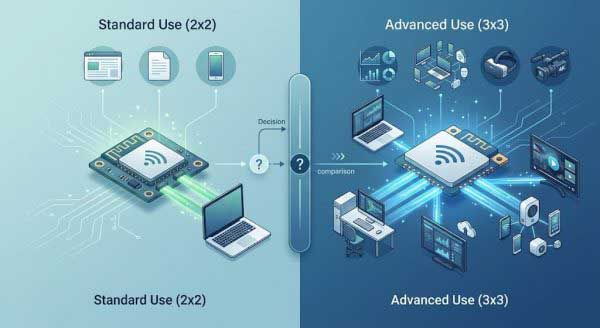
When to Choose 3×3 WiFi Module Instead of 2×2: Decision Framework for Product Designers
A five-dimension decision methodology for engineers choosing between 2x2 and 3x3 MIMO WiFi modules: antenna integration complexity, FCC certification impact, design tradeoffs across thermal/mechanical constraints, and a decision matrix for embedded system design.
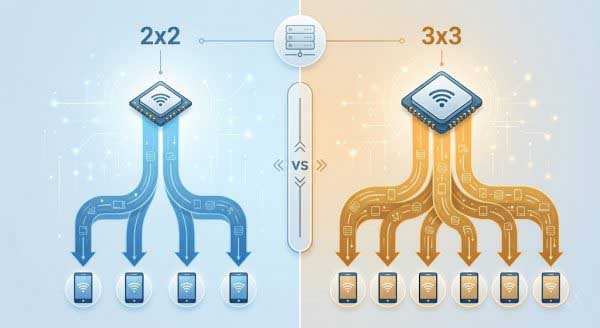
2×2 vs 4×4 WiFi 6/6E Modules: What Changes in Real Throughput and Client Capacity
Performance whitepaper comparing 2x2 vs 4x4 MIMO on WiFi 6/6E: real-world TCP throughput benchmarks, concurrent client capacity, power/thermal scaling, and a three-stage bandwidth planning methodology for enterprise and industrial networks.

MiniPCIe WiFi Module Installation Guide: 2×2 & 3×3 MIMO Driver Deployment & Troubleshooting
Comprehensive technical comparison of 2×2 vs 3×3 MIMO MiniPCIe WiFi modules — spatial streams, speed, coverage, power, compatibility, and full hands-on installation, driver, and troubleshooting guide for engineers.

MiniPCIe vs M.2 WiFi Modules: Which is Better for Industrial?
Full technical comparison of MiniPCIe vs M.2 WiFi modules for industrial use. Covers physical size, slot architecture, wide-temperature reliability, vibration resistance, bus protocol, driver support, lifecycle, and selection decision framework for IPC, PLC, industrial gateway, and embedded automation projects. Based on PCI-SIG MiniPCIe & M.2 specifications, Intel/Qualcomm/MediaTek industrial datasheets, and IPC hardware design standards.
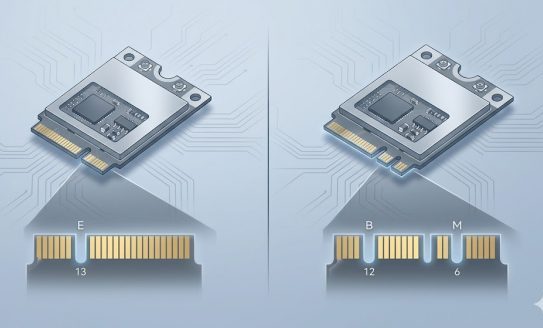
M.2 E Key vs B+M Key WiFi Modules: Full Comparison
Complete technical comparison of M.2 E Key and B+M Key WiFi modules. Covers pinout definitions, notch positions, PCIe/USB interface differences, Wi-Fi/BT protocol support, slot compatibility, device applicability, and selection guidelines. Based on PCI-SIG M.2 Specification Rev 3.0 and industry datasheets from Intel, Qualcomm, and MediaTek.

802.11be WiFi 7 Dual Band WiFi Module Application Scenarios
IEEE 802.11be (Wi‑Fi 7/EHT) was officially ratified in 2024 as the seventh-generation wireless standard. It hits a peak 46.1 Gbps throughput, 4.8 times faster than Wi‑Fi 6, powered by 320 MHz bandwidth, 4096-QAM and 16×16 MU-MIMO. Featuring MLO multi-link operation, preamble puncturing and 1–5 ms low latency, it covers 2.4 GHz, 5 GHz and full 6 GHz bands. Widely applied in industrial IoT, AR/VR, connected vehicles and enterprise scenarios, Wi‑Fi 7 chipsets from Qualcomm, MediaTek and Realtek are set for massive shipment growth in 2025.
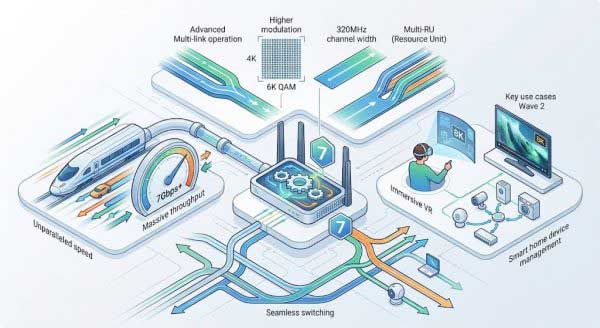
What is 802.11be WiFi 7? Speed, Features & Use Cases ?
IEEE 802.11be (WiFi 7, EHT) is the 7th-gen wireless standard ratified in 2024, delivering a theoretical peak of 46.1 Gbps, nearly 4.8× faster than WiFi 6. It leverages 320 MHz channel bandwidth, 4096‑QAM modulation and 16×16 MU‑MIMO with up to 16 spatial streams. Key upgrades include Multi-Link Operation (MLO), preamble puncturing and 1–5 ms ultra-low latency. Supporting 2.4 GHz, 5 GHz and full 6 GHz spectrum, WiFi 7 serves industrial IoT, AR/VR, connected vehicles and dense enterprise scenarios, with mainstream chipset shipments expanding rapidly from Qualcomm, MediaTek and Realtek.

WiFi 6 vs WiFi 6E vs WiFi 7 Modules: What’s the Difference?
In-depth technical comparison of WiFi 6 vs WiFi 6E vs WiFi 7 PCBA modules. Covers IEEE 802.11ax/802.11be standards, hardware specs, OEM/ODM customization, PCB RF layout, firmware tuning, mass production & reliability testing for industrial IoT, embedded systems, and commercial gateway applications.
OEM/ODM Customization for WiFi 5 Wave1 / Wave2 PCBA Modules
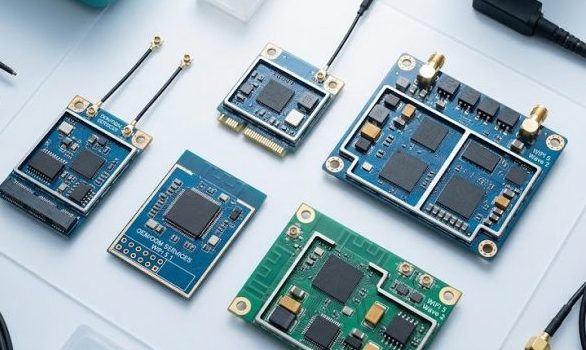
WiFi 5 802.11ac Wave 1 and Wave 2 PCBA modules remain mainstream for 2026 industrial and embedded OEM/ODM deployments, balancing throughput, stability and cost without WiFi 6 upgrades. Wave 1 supports SU-MIMO up to 1.3 Gbps; Wave 2 adds downlink MU-MIMO, 160 MHz bandwidth and 4×4 spatial streams. Mini PCIe form factors feature industrial -40°C to +85°C temperature tolerance, 18–23 dBm RF power, and distinct real-world UDP throughput. Customizable via OEM PCB trimming and ODM schematic redesign for IoT gateways, automation controllers and wireless backhaul scenarios.

WiFi 5 Wave 2 MU-MIMO Benefit for Enterprise Router Design
WiFi 5 802.11ac Wave 2 adds mandatory downlink MU-MIMO over Wave 1, using 256-QAM OFDM and MCS 0-9. A 4×4:4 radio hits 1.73Gbps (80MHz) / 3.47Gbps (160MHz) per IEEE standard. Chipsets like Qualcomm IPQ8074 and MediaTek MT7915 run Zero-Forcing precoding, delivering 60–80% higher aggregate throughput with 4 MU-MIMO clients. 802.11ac lacks uplink MU-MIMO, creating 3:1 to 5:1 downlink-uplink asymmetry; proper RF front-end, antenna isolation and ECC performance are critical for stable multi-stream industrial deployment.

MiniPCIe & M.2 Form Factor WiFi 5 Wave 2 Module Overview – Industrial 802.11ac Embedded Wireless Solutions
MiniPCIe and M.2 form factor WiFi 5 Wave 2 modules are dominant for industrial IoT, factory automation, smart cities, and legacy retrofitting. Based on IEEE 802.11ac Wave 2, they deliver 200–400 Mbps real-world TCP/UDP throughput (80 MHz, 2x2:2 MU-MIMO). Industrial-grade, they operate at -40°C to +85°C, 18–22 dBm/chain transmit power, with 200–300m indoor/500+m outdoor coverage. MiniPCIe (full-size PCIe/USB) and M.2 (Key E/B/M, 2230/2242) offer distinct interfaces for embedded architectures, guiding engineers and buyers in selection.

Industrial WiFi 5 802.11ac Deployment Guide: 10 Application Scenarios from Factory Floor to Smart City
Industrial WiFi 5 (802.11ac) modules connect legacy industrial connectivity to modern wireless infrastructure, offering reliable MIMO throughput for industrial IoT. Operating at -40°C to +85°C, they deliver 350–600 Mbps (80 MHz bandwidth) in interference-heavy industrial settings, with 18–22 dBm per chain transmit power and 150–3000m outdoor LOS coverage. They are cost-predictable and field-proven for mid-bandwidth industrial uses not requiring WiFi 6’s throughput.