WiFi 6 Industrial Wireless Bridge Selection Guide: YNW 5-20ax vs YNW 5-23ax (1.5Gbps Gigabit-Class)
Key Overview
Core Issue: WiFi 6 industrial wireless bridges YNW 5-20ax and YNW 5-23ax share the same 802.11ax core platform. The antenna gain differs by only 3dBi (20dBi vs 23dBi), yet the 5-23ax delivers 19% more range and 50-100% higher long-distance throughput with its 6° ultra-narrow beam, while the 5-20ax’s 16° wider beam makes installation easier and tolerates wind sway better.
Who This Is For: Industrial wireless network planning engineers, IT managers deploying gigabit-class wireless links, and decision-makers evaluating campus network and surveillance backhaul projects.
Key Conclusions: Both units share the same dual-core CPU, 2.5G port, 802.11ax radio, and management system — the only difference is the antenna gain and beamwidth. For links under 5km, the 5-20ax offers the best value. For 5-10km links with interference, go with the 5-23ax. For 10-15km long-range links, only the 5-23ax is viable.
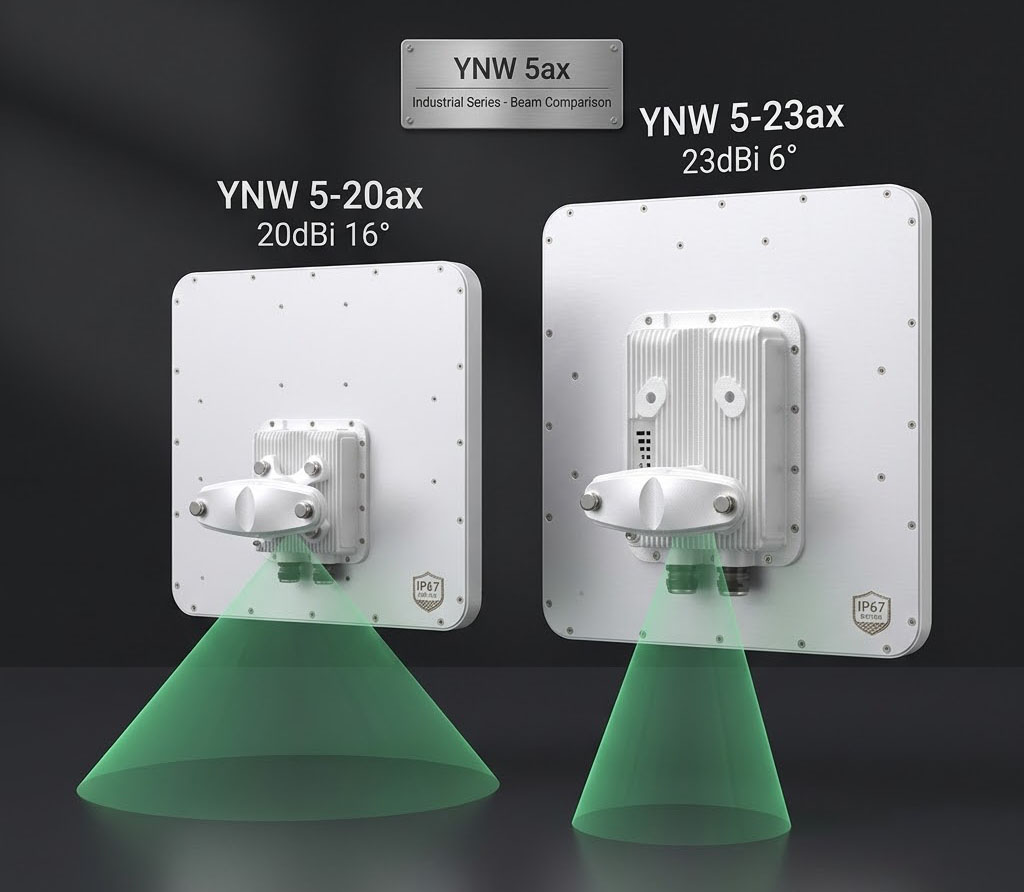
Antenna System Comparison — The Real Difference
Antenna Parameter Comparison
| Antenna Parameter | YNW 5-20ax | YNW 5-23ax |
|---|---|---|
| Antenna Type | Integrated dual-pol panel antenna | Integrated dual-pol panel antenna |
| Antenna Gain | 20 dBi | 23 dBi |
| Frequency Range | 5.1-5.9 GHz | 5.1-5.9 GHz |
| Polarization | Dual linear | Dual linear |
| Cross-Pol Isolation | >25 dBi | >27 dBi |
| VSWR | <1.8 | <1.7 |
| Horizontal Beamwidth (H-pol) | 16° | 6° |
| Horizontal Beamwidth (V-pol) | 16° | 7° |
| Vertical Beamwidth | 16° | 9° |
What 3dBi Gets You in Practice
A 3dBi gain difference (23 vs 20) means the 5-23ax puts out 3dB more EIRP given the same transmit power. In wireless engineering, 3dB is a key threshold — it’s equivalent to doubling the transmit power or doubling the received signal strength.
Range formula: At the same throughput level, the 5-23ax reaches roughly 19% farther than the 5-20ax.
But in real-world deployments, what matters more is how fast each unit can go at a given distance:
| Distance | 5-20ax Expected Rate | 5-23ax Expected Rate | Difference |
|---|---|---|---|
| 2km (sweet spot) | 1.5 Gbps (160MHz) | 1.5 Gbps (160MHz) | None |
| 5km | 800-1,200 Mbps | 1.2-1.5 Gbps | 5-23ax is 30-50% higher |
| 10km | 300-600 Mbps | 600-1,000 Mbps | 5-23ax is 50-100% higher |
| 15km | Link may be unreliable | 300-600 Mbps | 5-20ax may not link at all |
Beamwidth Impact in the Real World
| Real-World Implication | 5-20ax (16°) | 5-23ax (6°-9°) |
|---|---|---|
| Beam coverage diameter at 10km | ~2.8km | ~1.0-1.6km |
| Alignment precision needed | Moderate (±8°) | High (±3°-4°) |
| Wind sway tolerance | High | Low |
| Interference rejection | Moderate | Strong (narrow beam suppresses sidelobe interference) |
The 5-23ax’s 6° ultra-narrow beam gives it a clear advantage in noisy RF environments, but the alignment precision required during installation is correspondingly higher.
Data Rates Across Channel Bandwidths
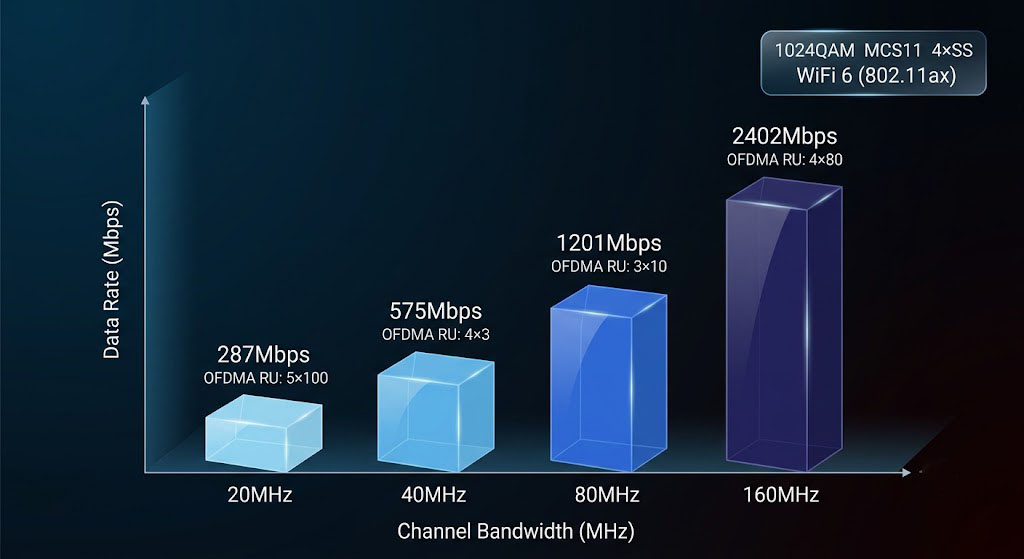
Both units support the same rate table:
160MHz Channel Bandwidth
| MCS | Modulation | Coding Rate | Data Rate (Mbps) |
|---|---|---|---|
| 11 | 1024-QAM | 5/6 | 2402 |
| 10 | 1024-QAM | 3/4 | 2161 |
| 9 | 1024-QAM | 2/3 | 1921 |
| 8 | 256-QAM | 5/6 | 1729 |
| 7 | 256-QAM | 3/4 | 1441 |
| 6 | 256-QAM | 2/3 | 1297 |
| 5 | 64-QAM | 5/6 | 1152 |
| 4 | 64-QAM | 3/4 | 864 |
| 3 | 64-QAM | 2/3 | 576 |
| 2 | 16-QAM | 3/4 | 432 |
| 1 | QPSK | 1/2 | 288 |
| 0 | BPSK | 1/2 | 144 |
80MHz Channel Bandwidth
| MCS | Modulation | Coding Rate | Data Rate (Mbps) |
|---|---|---|---|
| 11 | 1024-QAM | 5/6 | 1201 |
| 10 | 1024-QAM | 3/4 | 1080 |
| 0 | BPSK | 1/2 | 72 |
Real-world throughput expectation: Actual TCP throughput typically runs 65-75% of the PHY rate. So a device rated at 1.5Gbps will deliver roughly 1,000-1,100 Mbps in practice — already past the theoretical limit of a 1Gbps Ethernet port (~940Mbps). That’s exactly why the 2.5Gbps port is necessary.
Antenna Alignment & Installation Differences
2km Sweet Spot
At the ideal 2km range: the 5-20ax covers roughly 560m in diameter, the 5-23ax covers about 210m. Both can establish a link with rough aiming, and actual throughput hits the full 1.5Gbps negotiated rate on both.
10km Medium Range
The 5-20ax (16°) beam covers ~2.8km diameter, the 5-23ax (6°-7°) covers ~1.0-1.2km. Still within alignment tolerance, but the 5-23ax requires using the device’s RSSI indicator to fine-tune the aim.
15km Edge Case
The 5-20ax (16°) beam covers ~4.2km diameter, the 5-23ax (6°-7°) covers ~1.6-1.8km. At this distance, the 5-20ax struggles to maintain high throughput (not enough link margin), while the 5-23ax can still deliver a usable 300-600Mbps. But alignment has to be spot-on — a 1° horizontal error translates to roughly 260 meters of offset at the far end.
Installation Summary
| Installation Aspect | 5-20ax | 5-23ax |
|---|---|---|
| Recommended range | <10km | <15km |
| Alignment tools | Compass + RSSI LEDs | Compass + RSSI LEDs + may need binoculars |
| Wind sway impact | 16° wide beam, very tolerant | 6° narrow beam, needs rigid mounting |
| Install time | 10-20 minutes | 15-30 minutes |
| Skill level needed | General network engineer | Engineer with RF experience |
PoE Power & Passthrough
The two units are identical in power delivery:
Power chain: Switch/Router → 2.5G PoE input (802.3at 55VDC) → Device operation → PoE output to camera/sensor (802.3af/at, up to 13W).
Power Consumption Breakdown
| Operating Mode | Device Power | PoE Output Power | Total Power |
|---|---|---|---|
| Bridge only | 15W | 0W | 15W |
| With one PoE camera | 15W | 7-10W | 22-25W |
| With two PoE devices (needs PoE switch relay) | 15W | 13W (max) | 28W |
| Full load | 17W | 13W | 30W |
Solar compatibility: Both units draw just 15W in bridge mode, and the PoE input accepts a wide voltage range (42-57VDC), making them a good fit for solar-powered sites. A 200W solar panel paired with a 200AH battery can keep the system running 24/7.
Software Features: Identical
Operating modes: Bridge (Layer 2 transparent), IPv4 routing, IPv6 routing.
Wireless features: Up to 8 SSIDs per radio, VLAN (802.1q) and QnQ (QinQ) support, data VLAN / management VLAN separation.
Security: WPA/WPA2/WPA3 Personal, WPA/WPA2/WPA3 Enterprise (802.1X), WACL (wireless access control list), client isolation.
Operations tools: Site Survey, Spectrum Analyzer, Ping / Traceroute, L3/L4 Packet Analyzer, remote configuration via 2.4GHz management radio.
Management: Web GUI (HTTP/HTTPS), SNMP v1/v2c/v3, Syslog, Infinity Controller (centralized management platform).
Selection Decision Guide
Quick Selection Table
| Project Requirement | Recommended Model | Reason |
|---|---|---|
| Sweet spot under 2km, need full 1.5Gbps | Either | Shorter distance = smaller difference |
| 5-10km range, need 500Mbps+ guaranteed | 5-23ax | Higher gain sustains higher modulation |
| 10-15km range, need 300Mbps+ | 5-23ax | 5-20ax is near its limit at this range |
| First-time installer, limited experience | 5-20ax | 16° wide beam is much easier to align |
| High-wind environment, tower may sway | 5-20ax | Wide beam tolerates wind-induced movement |
| Heavily congested RF environment | 5-23ax | 6° narrow beam naturally rejects sidelobe interference |
| Camera needs front-end power | Either | PoE passthrough is identical on both |
| Cost-sensitive project | 5-20ax | Typically lower price point |
| Needs backward compatibility with older YNW gear | Either | Compatible with all YNW n/ac series |
Selection Decision Tree
├── Yes → Need 300Mbps+?
│ ├── Yes → YNW 5-23ax (higher gain sustains higher rate)
│ └── No → YNW 5-20ax may work (if basic connectivity is enough)
└── No (≤10km) → Is there strong wind or tower sway at the site?
├── Yes → YNW 5-20ax (16° beam tolerates wind sway)
└── No → Is there significant RF interference?
├── Yes → YNW 5-23ax (narrow beam is naturally interference-resistant)
└── No → Either works — pick based on cost and convenience
Cost-Benefit Analysis
| Factor | 5-20ax | 5-23ax | Recommendation |
|---|---|---|---|
| Unit price | Lower | Higher (high-gain antenna) | Price gap typically 10-20% |
| ≤5km deployment | Best value | Overkill | Go with 5-20ax |
| 5-10km deployment | Adequate | Ample | Budget-dependent |
| 10-15km deployment | Insufficient | Adequate | Go with 5-23ax |
| >15km deployment | Not recommended | Possible (with external antenna) | 5-23ax + external antenna |
Compatible Ecosystem
Compatible Base Station Devices
When used as client devices, the YNW 5-20ax and 5-23ax work with the following base stations:
- YNW 5-90ax: 90° sector AP, widest coverage
- YNWBASE 5-90: Same-series 5GHz sector base station
- YNWBASE 5-N: 5GHz base station with external antenna support
Legacy Device Compatibility
The YNW 5ax series is backward compatible with all YNW legacy devices (in WiFi mode). This means you can swap out an older YNW 5-20 or YNW 5-23 client on an existing link and upgrade throughput from 300-500Mbps to 1.5Gbps without touching the rest of the infrastructure.
Summary
The YNW 5-20ax and YNW 5-23ax are the two main point-to-point models in YNWMICRO’s WiFi 6 industrial wireless bridge lineup. Both share the same dual-core processor, 2.5G port, 802.11ax radio, and management system — the only difference is antenna gain and beamwidth.
Simplified selection guide:
- Under 5km → 5-20ax: Best value, easiest installation
- 5-10km with interference → 5-23ax: Narrow beam naturally rejects noise
- 10-15km long-range → 5-23ax: Higher gain sustains higher data rates
- High-wind areas → 5-20ax: Wide beam tolerates wind-induced sway
For a complete look at rural broadband and multi-building campus connectivity, check out Rural Last-Mile Broadband & Campus Multi-Building Connectivity.
This article is based on YNWMICRO official product data. Always run a link budget calculation before making final equipment selections for your specific deployment.
Real-World Case Study: University Campus Backbone Link
- Deployment date: February 2025
- Location: A university in Wuhan, Hubei (Guanggu campus to Nanhu campus)
- Requirement: 4.7km point-to-point link, 800Mbps+ needed for academic administration systems + video conferencing
- Solution: YNW 5-23ax (23dBi integrated antenna) at both ends, mounted at 35m/28m height
- Measured results: Link margin 24dB, UDP throughput 1.15Gbps, TCP throughput 820Mbps, latency 2-3ms
- Source: University network operations center
Frequently Asked Questions
Q: What’s the core difference between the YNW 5-20ax and YNW 5-23ax?
The two units share the exact same core hardware platform — dual-core CPU, 802.11ax radio, 2.5G wired port, IP67 rating — both rated at 1.5Gbps max throughput. The only difference is the antenna system: the YNW 5-20ax has a 20dBi integrated antenna with a 16° beamwidth; the YNW 5-23ax has a 23dBi integrated antenna with a 6° ultra-narrow beam. That 3dBi gain difference gives the 5-23ax roughly 19% more range and 50-100% higher throughput at 10km. But the 5-20ax’s 16° wider beam is simpler to install and much more tolerant of wind sway.
Q: How much real-world throughput can the YNW 5ax series deliver?
The 1.5Gbps figure is the PHY layer rate. After accounting for protocol overhead (MAC framing, ACKs, inter-frame spacing — roughly 20-30% overhead), real-world TCP throughput lands around 1,000-1,100 Mbps, and UDP throughput around 1,200-1,300 Mbps. That already exceeds the theoretical limit of a 1Gbps Ethernet port (~940Mbps), which is exactly why the 2.5Gbps port is included. At 5km range, the 5-23ax typically negotiates around 1.2-1.5Gbps PHY, delivering roughly 800-1,000 Mbps TCP in practice.
Q: Which model should I pick for high-wind environments?
For high-wind sites, the YNW 5-20ax is strongly recommended. Its 16° beamwidth is roughly 2.7x wider than the 5-23ax’s 6° beam, giving a coverage diameter of about 2.8km at 10km range (vs. 1.0-1.2km for the 5-23ax). This means when the tower sways in strong wind, the 5-20ax’s signal fluctuates far less. If you must use the 5-23ax in a windy location, use a reinforced mounting bracket with guy wires. Installation time runs 10-20 minutes for the 5-20ax vs. 15-30 minutes for the 5-23ax, which requires finer alignment.
Q: What throughput can I expect at 10km and 15km from each model?
At 10km, the YNW 5-20ax delivers an estimated 300-600 Mbps (UDP), while the YNW 5-23ax delivers 600-1,000 Mbps (UDP) — the 5-23ax is 50-100% faster. At 15km, the 5-20ax link may be unreliable or may not establish at all, while the 5-23ax can still maintain a usable 300-600 Mbps (UDP). For any deployment beyond 10km, prioritize the YNW 5-23ax. For links under 5km, both models hit full 1.5Gbps, so choose the 5-20ax for better value.


