Industrial Wireless Network
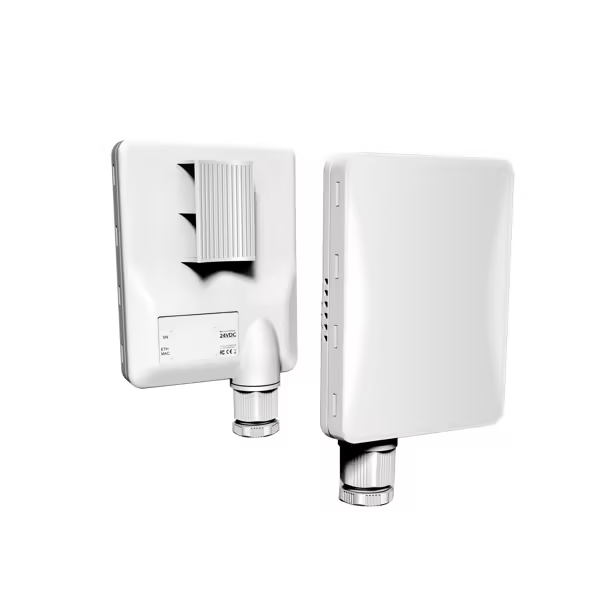
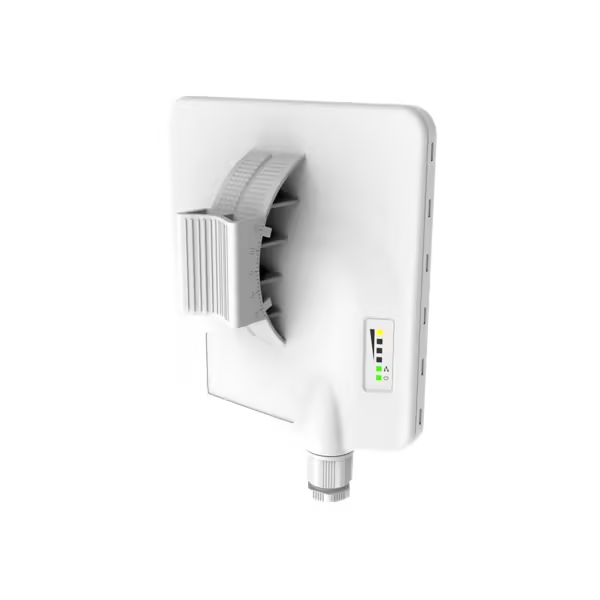
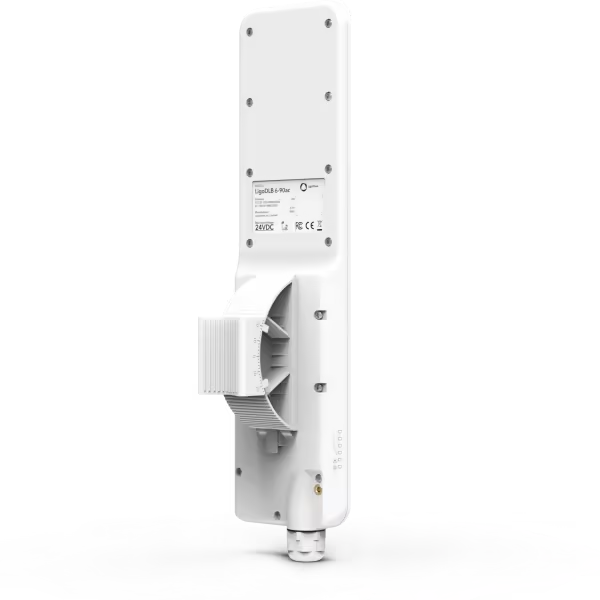
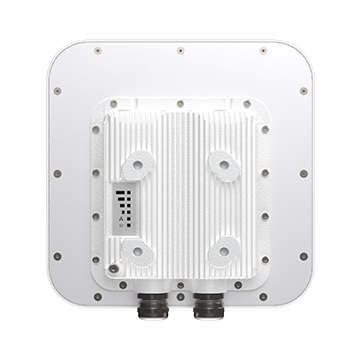
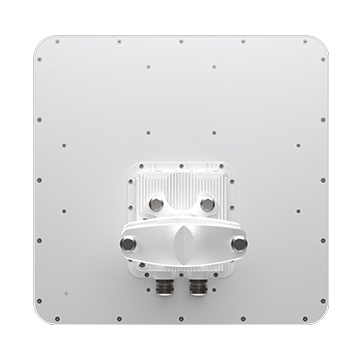
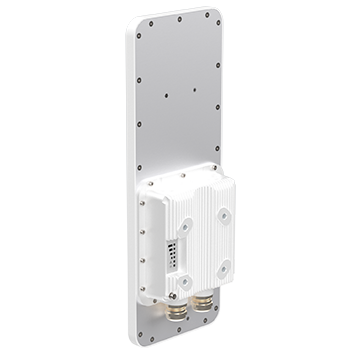
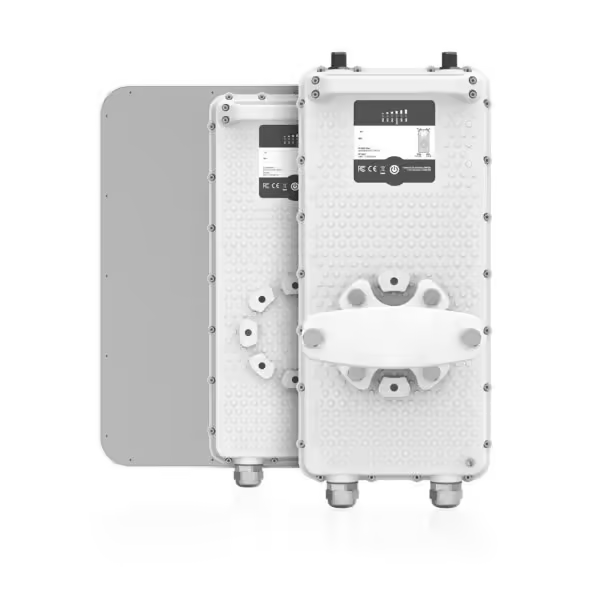
Seventeen sealed radios, one job: carry an Ethernet link across open ground where no fibre reaches. Every model on this page is a pole- or wall-mounted outdoor unit running point-to-point or point-to-multipoint, specified from −40 °C to +65 °C, and powered over the same cable that carries the data. If you are looking for a board to build such a radio rather than the finished unit, the right category is wireless networking boards.
The catalogue divides along three axes, and the model number only matters after you have fixed all three: the band (5.150–5.850 GHz, 5.9–6.4 GHz, or the full 5.900–7.125 GHz), the protocol (standard 802.11 frames driven by iPoll 3 polling, or the W-Jet V point-to-point protocol), and the antenna architecture (integrated panel, integrated 90° sector, or N-type connector for an antenna you supply). The tables below are grouped that way rather than by price.
Three conventions repeat throughout. Range written as PtP x km / PtMP y km is the manufacturer’s recommended distance with the stated antenna and a clear Fresnel zone — a planning ceiling, not a guarantee. Where a product page gives optimal / max, the first figure is the distance at which the top MCS rate still holds and the second is the longest usable link in clean spectrum. Throughput is aggregate PHY rate at 80 MHz, not TCP throughput; on a real file transfer expect roughly 55–65% of the quoted figure.
1. The four families at a glance
| Family | Models | Band | Protocol | Aggregate PHY | Designed for |
|---|---|---|---|---|---|
| Wi-Fi 5, 5 GHz | YNW 5-15ac / 5-20ac / 5-90ac | 5.150–5.850 GHz | 802.11a/n/ac + iPoll 3 | 500+ Mbps | Short to medium PtP and PtMP, interoperability with standard clients |
| Wi-Fi 5, 6 GHz | YNW 6-15ac / 6-20ac / 6-90ac / 6ac | 5.9–6.4 GHz | 802.11a/n/ac + iPoll 3 | 500+ Mbps | The same links moved above the crowded 5 GHz channels |
| Wi-Fi 6 / 6E | YNW 5ax / 5-20ax / 5-23ax / 6ax / 6-20ax / 6-23ax | 5.150–5.850 or 5.900–7.125 GHz | 802.11a/n/ac/ax | 1500+ Mbps | High-capacity backhaul on 160 MHz channels |
| W-Jet V PtP | YNWPTP 5-n / 5-23 / 6-n / 6-25 | 4.900–6.100 or 5.945–7.125 GHz | W-Jet V (proprietary) | 700+ Mbps | Dedicated long-range PtP with 2–4 ms latency |
2. 5 GHz Wi-Fi 5 with iPoll 3: the interoperable tier
iPoll 3 is a polling MAC layered on standard 802.11a/n/ac frames. Instead of letting stations contend for airtime, the master schedules a transmit slot for every slave, which is why per-client latency stays flat as subscribers are added to a sector — the tail-latency collapse you see with CSMA under load does not appear. Because the frames remain standard, an iPoll unit can associate with ordinary 802.11ac clients once the polling layer is switched off, which is what makes this tier useful in mixed fleets.
All three models share the same radio: +30 dBm transmit power (subject to national limits), 5/10/20/40/80 MHz channels, 2×2 MIMO, 500+ Mbps aggregate and 10 W draw on 24 VDC passive PoE. What separates them is the antenna and the resulting link budget.
| Model | Antenna | Range | Enclosure | Typical role |
|---|---|---|---|---|
| YNW 5-15ac | 15 dBi dual-polarised panel, 16° beamwidth | PtP 7 km / PtMP 5 km | IP65 | Compact sites, mast height below 20 m |
| YNW 5-20ac | 20 dBi dual-polarised panel | PtP 15 km / PtMP 10 km | IP66 | The general-purpose default for campus and industrial spans |
| YNW 5-90ac | 18 dBi sector, 90° horizontal | PtMP 5 km | IP66 | Base station serving many CPEs from one mast |
Pick this tier when the far end must also serve Wi-Fi clients, when you are extending an existing 802.11ac fleet, or when the link is short enough that 1500 Mbps buys nothing. Do not pick it for a 30 km backbone in a busy band — the 30 dBm radio will not compensate for interference that the wider 6 GHz spectrum simply does not have.
3. 6 GHz Wi-Fi 5: the same links, cleaner spectrum
The second tier is the same radio generation moved up to 5.9–6.4 GHz, the seam between the top of the 5 GHz band and the bottom of the 6 GHz band. Two consequences matter in the field. The band sits above the 5.15–5.85 GHz block where every outdoor access point, CPE and legacy microwave link competes, so noise floors are typically 10–15 dB lower. And in the United States the 5.925–7.125 GHz block is open to standard-power outdoor fixed links under AFC registration, so a registered link no longer drops when radar is detected. Confirm the sub-band and power limit your own regulator permits before ordering: units ship locked to the channel plan you specify.
| Model | Antenna | Range | Enclosure |
|---|---|---|---|
| YNW 6-15ac | 15 dBi panel, 35° beamwidth | PtP 7 km / PtMP 5 km | IP65 |
| YNW 6-20ac | 20 dBi panel | PtP 15 km / PtMP 10 km | IP65 |
| YNW 6-90ac | 18 dBi sector, 90° | PtMP 5 km | IP65 |
| YNW 6ac | 2× N-type female — 15 dBi panel to 30 dBi dish | PtP up to 15 km with external antenna | IP65 |
All four run at 30 dBm with 500+ Mbps aggregate on 80 MHz and 10 W on 24 VDC passive PoE. The 6ac is the one to choose when the antenna has to be aimed at a tower 300 m away and the mast has room for a dish rather than a panel.
4. Wi-Fi 6 and 6E: 1500 Mbps class
160 MHz channels, 1024-QAM and a 2×2 radio produce 1500+ Mbps aggregate PHY, roughly three times the 802.11ac generation. Two engineering caveats decide whether you actually see it. First, a 160 MHz channel needs 320 MHz of clean spectrum to avoid partial overlap; on a crowded tower the units fall back to 80 MHz and land at 700–900 Mbps, still double the AC tier. Second, the radio is specified at +24 dBm rather than +30 dBm, so distance comes from antenna gain: the integrated 20 and 23 dBi panels hold the published 10 and 15 km figures, while the connectorised 5ax and 6ax reach 30+ km only with a 30 dBi dish.
Power changes with this tier: 802.3at active PoE at 55 VDC, 15 W without PoE-out and 30 W with it, and the second port delivers 802.3af/at at 13 W to a downstream camera or second radio. Enclosure is IP67 across all six models.
| Model | Band | Antenna | Range (optimal / max) |
|---|---|---|---|
| YNW 5-20ax | 5.150–5.850 GHz | 20 dBi panel | 2 / 10 km |
| YNW 5-23ax | 5.150–5.850 GHz | 23 dBi panel | 4 / 15 km |
| YNW 5ax | 5.150–5.850 GHz | 2× N-type, external | 30+ km with dish |
| YNW 6-20ax | 5.900–7.125 GHz | 20 dBi panel | 2 / 10 km |
| YNW 6-23ax | 5.900–7.125 GHz | 23 dBi panel | 4 / 15 km |
| YNW 6ax | 5.900–7.125 GHz | 2× N-type, external | 30+ km with dish |
5. W-Jet V point-to-point: 700 Mbps at 2–4 ms
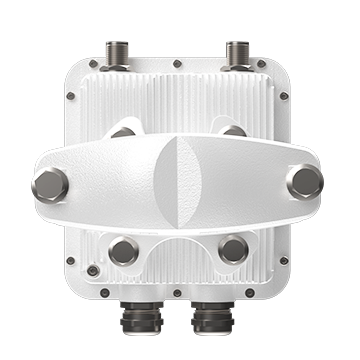
W-Jet V is not 802.11. It is a time-division duplex point-to-point MAC with its own framing, hardware AES-128, BCC and LDPC forward error correction and automatic transmit-power control. That is how a unit holds 700+ Mbps with 2–4 ms latency over 80 MHz where a standard 802.11ac link of the same width would jitter as soon as another network appears on the channel. The trade is explicit: a W-Jet radio only talks to another W-Jet radio. There is no client association and no mixed-vendor pairing.
The hardware is a sealed cast-aluminium IP67 chassis with a GORE pressure vent, 8.6 W draw and 802.3at PoE input at 42–57 VDC, with a 802.3af PoE-out port at 12.95 W for a camera at the top of the mast.
| Model | Band | Antenna | Throughput | Range |
|---|---|---|---|---|
| YNWPTP 5-n | 4.900–6.100 GHz | 2× N-type, external | 700+ Mbps | Set by antenna |
| YNWPTP 5-23 | 4.900–6.100 GHz | 23 dBi integrated, 6°×9° | 700+ Mbps | 5–15 km |
| YNWPTP 6-n | 5.945–7.125 GHz | 2× N-type, external | 700+ Mbps | Set by antenna |
| YNWPTP 6-25 | 5.945–7.125 GHz | 25 dBi integrated | 700+ Mbps | Long-range backbone |
6. Choosing in four questions
1. Band. If the site already has 5 GHz congestion — containers, cranes, several operators on one roof — start at 6 GHz. If the far end is a standard Wi-Fi client that must stay on 5 GHz, stay at 5 GHz. 2. Protocol. One link, fixed endpoints, latency-sensitive traffic such as video or SCADA polling: W-Jet V. One master serving several subscribers, or a need to interoperate with third-party gear: iPoll 3. 3. Topology and antenna. Point-to-point wants gain and a narrow beam; a 90° sector serves a cluster of CPEs from one mast. If the mast already carries a dish, buy the connectorised model and use it. 4. Power and enclosure. 24 VDC passive PoE at 10 W is easy to inject from a small cabinet; the 802.11ax and W-Jet units need 802.3at, which changes your switch and cable budget.
7. Deployment notes that decide the outcome
Fresnel clearance. Plan 60% of the first Fresnel radius clear along the whole path, not just at the endpoints. At 10 km on 5.8 GHz that radius is roughly 12 m at midspan — a tree line or a new roof in the middle of the path matters more than another 3 dBi of antenna gain.
Alignment. Aim on RSSI and chain imbalance, then fine-tune on CCQ or MCS stability rather than on peak signal. A link that reads −58 dBm but flips between MCS 7 and MCS 4 is misaligned by a few degrees.
PoE budget and cable. The 802.11ax and W-Jet units draw up to 30 W with PoE-out enabled. On 24 AWG Cat5e that is a 3–4 V drop over 80 m; use 23 AWG or shorter runs, and remember the PoE-out port adds the downstream camera load to the same budget.
Surge and grounding. Outdoor units carry 3 kV line-to-ground and 1 kV line-to-line surge protection on the 5 GHz AC tier and 6 kV / 2 kV on the W-Jet chassis, but that protects the radio, not the building. Bond the mast to the site earth and use a shielded cable with the drain wire grounded at the entry point.
8. Questions we are asked before every order
Which model for a 20 km point-to-point link? None of the integrated-panel units. A 20 km path on 6 GHz needs roughly 130 dB of system gain once you allow for free-space loss and a 10 dB fade margin, which means the YNWPTP 6-25 with its 25 dBi panel, or a connectorised 5ax / 6ax with a 30 dBi dish. Ask us for the link-budget sheet for your coordinates and we will run the numbers with the rain zone and the antenna you intend to use.
Can a 5 GHz unit pair with a 6 GHz unit? No. Both ends must share the band, the channel width and the protocol. Mixing iPoll 3 with W-Jet V does not associate at all; mixing 5 GHz with 6 GHz hardware is a hardware mismatch, not a configuration one.
Do these need a licence? In most countries 5.150–5.850 GHz and 5.925–7.125 GHz are licence-exempt subject to power and, for 6 GHz outdoor fixed links, registration or AFC rules. The 4.900–6.100 GHz W-Jet variants overlap public-safety and fixed-service allocations in some regions and may require an assignment. We supply the RF test report and channel-plan declaration your filing needs.
Is there an OEM version? Yes. Board-level supply, custom enclosure, branded firmware and custom connector sets are available from defined volumes — see the OEM / ODM programme.
9. Read next
For the band decision in more depth, read 6 GHz versus 5 GHz: how to choose a band for an outdoor link, and for the link-budget method behind the ranges on this page see the long-range industrial wireless bridge technical guide. The wider selection framework sits in the industrial wireless bridge pillar guide. If the application needs every node to route for the others rather than a fixed PtP or PtMP topology, start from MESH ad-hoc networks instead.