Emergency Response Communication: Rapid-Deploy Disaster Relief Mesh Networks
Key Overview
Target Audience: Emergency management agencies (FEMA, US&R task forces), fire department incident commanders, disaster medical assistance teams (DMAT), search-and-rescue (SAR) specialists, and public safety communications engineers.
Core Issue: Natural disasters destroy or incapacitate communication infrastructure within seconds. Post-disaster assessments show that 60-80% of cell towers in disaster zones become non-functional within the first 24 hours due to power failure, backhaul loss, or physical destruction. P25 and TETRA trunked radio systems rely on repeater sites with limited battery backup (typically 4-8 hours). Satellite-based solutions (Iridium, Inmarsat, Starlink) face capacity limits — a single GEO satellite beam can handle only ~1,200 simultaneous voice calls.
Key Conclusions: MANET technology provides the only practical rapidly-deployable wide-area communication solution that operates independently of infrastructure. YN300 series nodes can establish a 50-node mesh within 30 seconds of power-on, covering 5-20 km² without any fixed infrastructure. Multi-hop relay extends coverage through terrain obstacles, and each node’s 10-hour battery life (100 Wh) exceeds a standard 12-hour operational shift.
Emergency Communication Challenges
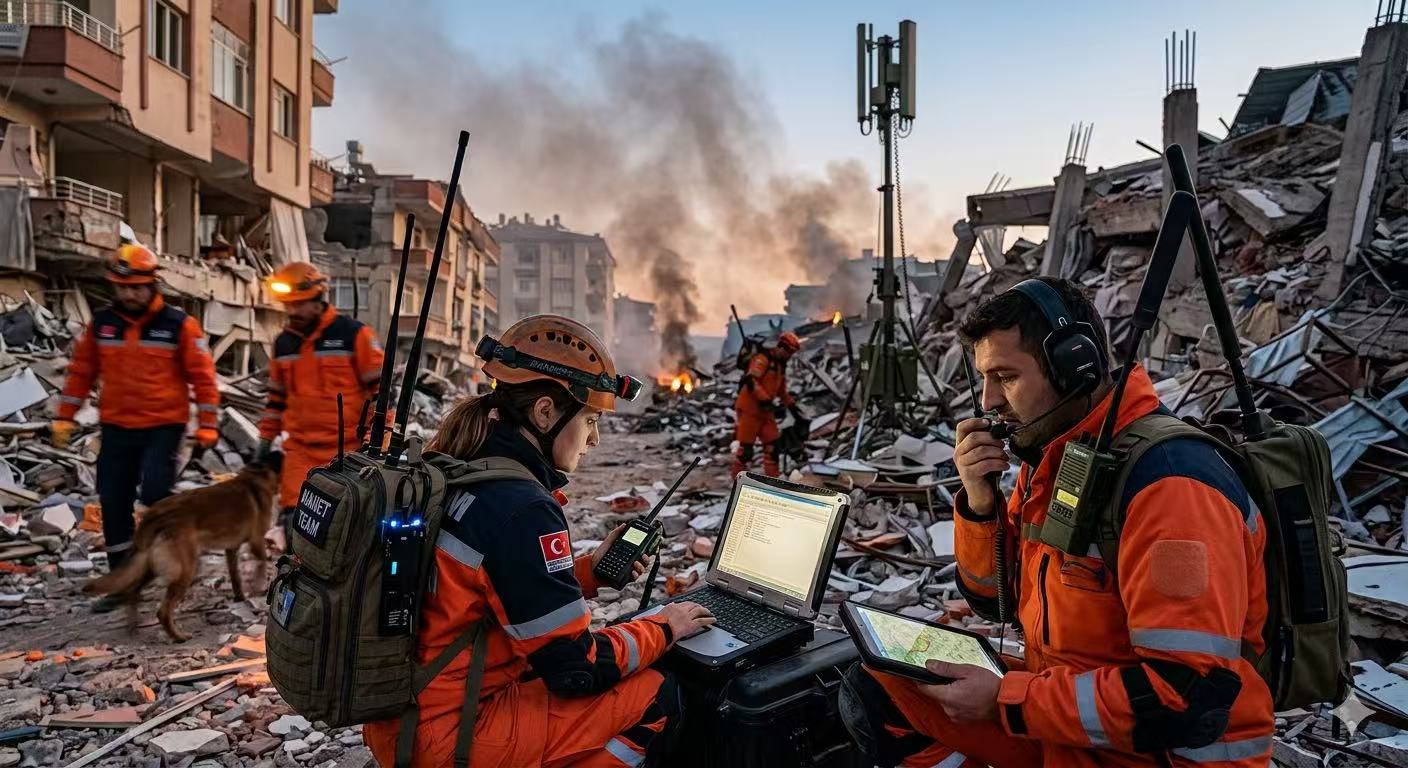
Emergency response operations are fundamentally communication-dependent. The NIMS Incident Command System (ICS) requires reliable data and voice links across five functional areas: Command, Operations, Planning, Logistics, and Finance/Administration. When communication infrastructure fails, the entire ICS structure is compromised.
Failure Modes of Traditional Emergency Communications
| Infrastructure Type | Failure Mode | Time to Failure | Capacity | MANET Alternative |
|---|---|---|---|---|
| Cellular (4G/5G) | Tower collapse, backhaul loss, power failure, network congestion | 0-2 hours post-event | ~1,000 calls/sector normally; drops to 0 when backhaul lost | Peer-to-peer mesh, no infrastructure dependency |
| P25 Trunked Radio | Repeater site battery exhaustion, link failure to dispatch | 4-8 hours (battery limits) | ~100 simultaneous conversations per site | Decentralized OLSR routing, automatic MPR relay |
| Satellite (Iridium/Inmarsat) | Capacity saturation, high latency (250-600 ms), limited simultaneous users per beam | Immediate congestion | ~1,200 voice channels per GEO spot beam | Sub-50 ms latency, no capacity sharing across beams |
| Land Mobile Radio (VHF/UHF) | LOS obstruction in urban/terrain, limited range (3-8 km simplex) | Varies with terrain | Single channel per frequency pair | Multi-hop relay, NLOS capability through intermediate nodes |
| Starlink / LEO Broadband | Terminal availability, power requirement (50-100W per terminal), LOS requirement to sky | Dependent on terminal stockpile | ~200 Mbps shared per cell (high contention in disaster) | 10W per node, 3-8 km elevated LOS, no sky LOS needed |
Critical Communication Requirements for Emergency Response
The SAFECOM interoperability continuum defines five levels of emergency communication capability. MANET achieves Level 5 (fully interoperable IP data network) across all responding agencies:
- Voice Priority: Incident command voice must achieve < 150 ms one-way delay (ITU-T G.114) and < 1% packet loss. The YN300 series with 802.11e WMM (AC_VO) delivers < 10 ms MAC layer delay, meeting this requirement even at 50-node mesh saturation.
- Video Transmission: Aerial reconnaissance (drone) and body-worn cameras require 4-12 Mbps per stream. YN300A at 40 MHz channel width delivers 300 Mbps PHY (96 Mbps throughput), supporting 8-24 concurrent HD video streams at 1080p H.265.
- Position Tracking: GPS location updates at 1 Hz per responder. A 50-person team generates 50 kbps of location data. OLSR TC overhead for 50 nodes is ~50 kbps. Total airtime utilization for both is < 0.1% of available throughput.
- Environmental Data: IoT sensors (gas detectors, weather stations, structural monitors) transmit 1-50 kbps per device. The mesh aggregates sensor data through multi-hop relay to the incident command post (ICP).
Disaster Response Scenarios
Earthquake: Urban Search & Rescue (US&R)
In a magnitude 7.0+ earthquake, cellular infrastructure fails within seconds. A typical US&R task force (1,000+ personnel) requires communication across a 2-5 km² collapse zone. YN300 series deployment:
- Initial Deployment (T+0 to T+30 min): Four YN300A nodes at the ICP perimeter form the mesh backbone at 40 MHz, 300 Mbps. These provide 3-8 km elevated LOS coverage over the collapse zone. 20 YN300C units distributed to search team leaders, operating at 20 MHz for extended range (1.5-2 km ground-level).
- Structural Monitoring: YN300C integrated into tilt sensors and crack monitors on damaged structures. Report every 1 second via UDP to the structural specialist at ICP. Alert threshold: > 0.5°/hour tilt triggers evacuation alarm.
- Canine Unit Integration: GPS collars with YN300C modules relay K9 position and status. The F2 (live find) alert from a search dog triggers a 128×128 pixel snapshot from the collar camera within 2 seconds over the mesh.
- Through-The-Rubble Communication: In multi-story collapse scenarios, a YN300A node on the rooftop relays to ground-level ICP via the mesh backbone. OpenWrt OLSR with ETX metric prefers routes with highest MCS rate — a rooftop node at MCS 15 (300 Mbps) takes priority over a ground node at MCS 4 (39 Mbps) for backhaul routing.
Wildfire: Incident Command & Perimeter Monitoring
Wildfire operations span massive areas (10,000+ acres) with extreme environmental conditions. Communication requirements differ significantly from urban SAR:
- Temperature Tolerance: YN300 series operates at -40°C to +65°C. Near-fire environments can reach 50°C ambient. The Qualcomm chipset’s 65°C max leaves 15°C margin. For direct flame proximity, deploy nodes with fire-resistant enclosure (ceramic fiber insulation).
- UAV Relay: Four YN300B-equipped drones at 300m AGL create an aerial mesh ring around the fire perimeter. Each drone covers a 15-20 km diameter area (30 dBm, 5.8 GHz). The aerial backbone relays: infrared camera feeds (384×288 @ 25fps, ~2 Mbps per drone), crew GPS positions from PLBs (800-byte burst every 30 seconds per person), and incident command voice (64 kbps G.711 per channel).
- Firefighter Locator: YN300C in each crewmember’s radio pack. RSSI-based ranging (3-5m accuracy in open terrain) provides relative positioning when GPS is unavailable (deep canyon, heavy canopy). Time Difference of Arrival (TDoA) between 3+ nodes with synchronized 802.11 TSF timer (1 μs accuracy) resolves position to < 3m.
- LCES Compliance: Lookouts, Communications, Escape Routes, Safety Zones. The mesh automatically identifies disconnections — if a crew node drops from the mesh (HELLO timeout > 6 seconds), the incident commander receives an automated alert with the last known position.
Flood & Water Rescue
Flood environments create unique propagation characteristics. Water surface provides near-perfect RF reflection, creating stable multipath that improves NLOS coverage by 2-3x compared to urban terrain.
- Range Over Water: YN300A at 2.4 GHz, 30 dBm, achieves 5-8 km over open water (vs 1.5-2 km over ground). The Fresnel zone at 2.4 GHz over water surface is clear up to 8 km with antenna heights > 2m, compared to < 1.5 km over land with 2m antenna height due to ground absorption.
- Rescue Boat Mesh: Each rescue boat carries a YN300A in IP65 enclosure. Boats operating in a 5 km x 10 km flooded area are continuously connected through the water-surface-reflected mesh. Moving at 25 knots (47 km/h), OLSR HELLO at 2-second intervals maintains route convergence.
- Swift-Water Rescue: Individual rescuers use wrist-mounted YN300C (117x68x17mm, 56g, IP65-rated). The low profile allows full mobility in swift-water environments. Data rate: 6.5 Mbps (MCS 0) provides reliable link at maximum range with -87 dBm sensitivity.
- Temporary Flood Gauges: Solar-powered YN300C with ultrasonic water level sensor deployed at 1 km intervals along flood-prone waterways. Each gauge transmits 100-byte reading every 5 minutes. Data aggregated through the mesh to the emergency operations center (EOC). Battery life: > 14 days with 20W solar panel and 12V 20Ah battery.
Public Health Emergency & Telemedicine
Mass casualty incidents (MCI) and pandemic response require multi-agency communication across treatment zones, often in makeshift facilities without existing infrastructure.
- Field Hospital Mesh: A 24-bed field hospital (NIMS Type I) requires: voice (8 channels at 64 kbps = 512 kbps), EMR access (4 Mbps aggregate), telemedicine video (3 streams at 4 Mbps = 12 Mbps), and logistics tracking (5 kbps). Total: ~17 Mbps. A single YN300A at 20 MHz provides 65 Mbps throughput, with 75% capacity margin.
- Telemedicine Video: YN300A supports 1080p60 H.265 telemedicine at 8 Mbps. With 802.11e WMM (AC_VI for video), jitter is < 30 ms and packet loss < 0.5% in a 30-node mesh — meeting the American Telemedicine Association’s clinical-grade video requirements.
- Multi-Agency Interop: OpenWrt VLAN configuration separates traffic by agency (EMS, Fire, PD, Hospital). Each agency operates on a separate VLAN with dedicated OLSR routing table. 802.1Q trunking carries all VLANs over the shared mesh backbone. Agency gateways (YN300A with Gigabit Ethernet) provide access to respective agency networks via VPN.
- Pharmaceutical Cold Chain: YN300C connected to temperature loggers in vaccine/medication storage. Alerts generated if temperature exceeds 2-8°C range. Data logged at 1-minute intervals and relayed through the mesh to logistics officer.
Deployment Strategy & Architecture
Phase 1: Incident Command Mesh Establishment
- Node Type: 3 x YN300A at ICP (Staging, Command, Logistics). Configured in mesh mode, 40 MHz, 300 Mbps PHY, OLSR routing.
- Action: Power on all three nodes within 30 seconds. OLSR convergences in < 15 seconds (HELLO interval 2s, TC interval 5s). ICP mesh core operational.
- Check: Ping each node from the others. Verify throughput > 50 Mbps iperf TCP between any two ICP nodes.
Phase 2: Perimeter Extension
- Node Type: YN300C distributed to sector leaders. Configured in ad-hoc mode, 20 MHz, OLSR routing with voice priority (AC_VO).
- Action: Sector leaders move to their assigned sectors (0.5-2 km from ICP). The mesh automatically discovers and routes through them. Each sector leader becomes an OLSR MPR for their team.
- Range Test: Verify RSSI > -75 dBm at sector boundary. If < -75 dBm, deploy a relay node (YN300A) at midpoint.
Phase 3: Special Asset Integration
- UAV Integration: YN300B on drone, 5.8 GHz, 20 MHz, 30 dBm. Drone climbs to 300m AGL. YN300B connects to ICP YN300A at 3-8 km range. Drone camera feed (H.265, 1080p30, 8 Mbps) received at ICP with < 50 ms latency.
- Sensor Integration: Environmental sensors with YN300C auto-join mesh via WPA3-SAE authentication. Data collection authenticated, all traffic encrypted with AES-128-CCMP.
Phase 4: External Connectivity
- EOC Link: YN300A at ICP connects via Ethernet to Starlink/VSAT terminal. OSPF routing between MANET and WAN. Remote access for EOC to monitor status board and view drone video.
- P25/TETRA Bridge: YN300A with SIP gateway connects to existing P25 console. Radio traffic bridged between MANET VoIP channels and P25 talkgroups. NIMS-compliant interoperability.
Rapid Deployment Equipment List (Recommended Cache per Task Force)
| Item | Qty | Purpose |
|---|---|---|
| YN300A (2.4 GHz Mesh) | 8 | ICP backbone, perimeter relays, EOC gateway |
| YN300C (2.4 GHz Ad-Hoc) | 25 | Sector leader, team member, sensor integration |
| YN300B (5.8 GHz Backhaul) | 4 | UAV relay, long-range backhaul to secondary ICP |
| 100 Wh Battery Pack | 40 | 10 hours continuous operation per node (hot-swappable) |
| 20W Solar Panel Kit | 10 | Sustained operation for relay/sensor nodes (> 14 days) |
| IP65 Enclosure Kit | 12 | Weatherproofing for YN300 series boards in outdoor deployment |
| 5.8 GHz Directional Antenna (20 dBi) | 4 | Point-to-point backhaul > 10 km between ICP and secondary ICP |
Product Solutions & Selection Matrix
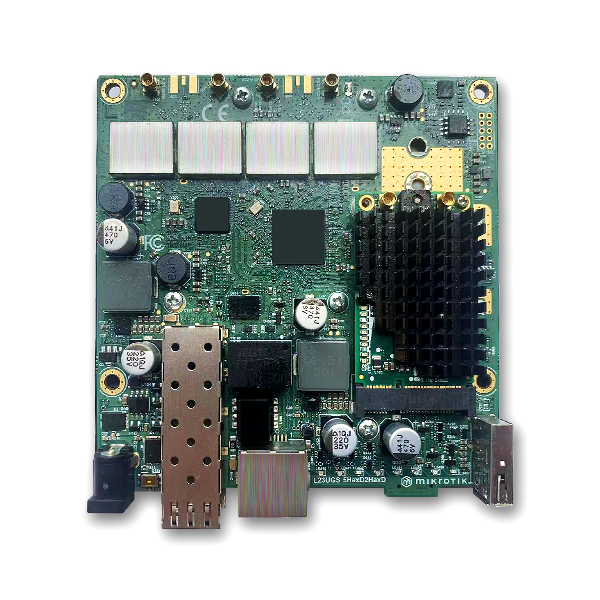
YN300A – 2.4G Wireless Mesh Motherboard (Backbone Node)
Primary node for ICP backbone, perimeter relay, and bridge to external networks.
- Wireless: 300 Mbps PHY (MIMO 2×2), 30 dBm TX power, -97 dBm RX sensitivity. Elevated LOS range 3-8 km. Supports 5/10/20/40 MHz channel bandwidth.
- MANET: > 50 nodes, > 10 hops. P2P, P2MP, MP2MP, and mesh modes. OpenWrt SDK for custom routing protocols.
- Power: 7V-48V DC or 15V-48V PoE. Average 10W. 10+ hours on 100 Wh battery.
- Environmental: -40°C to +65°C. 117x68x17mm, 56g. IP65 enclosure optional.
YN300C – 2.4G Mobile Wireless Ad-Hoc Network Motherboard (Personnel Node)
Optimized for individual responder use and sensor integration.
- Deployment: Automatic network formation within 30 seconds. MANET scale > 50 nodes with relay > 10 hops.
- Power: 7V-48V DC or 15V-48V PoE. Average ~10W. Compatible with standard first responder battery packs.
- Routing: OpenWrt SDK for AODV, DSR, OLSR, BATMAN-adv. Custom routing metrics for voice priority, video QoS.
- Dimensions: 117x68x17mm, 56g. Suitable for wearable packs, vehicle mounts, and sensor enclosures.
YN300B – 5.8G Single-Client Ad Hoc Network PCBA (Backhaul & UAV Node)
Long-range backhaul and airborne mesh relay for wide-area coverage.
- Throughput: Up to 96 Mbps (802.11n, 30 dBm). HD video backhaul (1080p30 H.265 at 8 Mbps).
- Range: 10-20 km elevated LOS (UAV at 300m AGL), 1.5-2 km ground-level. 5.8 GHz band provides cleaner spectrum for backhaul.
- Multi-Topology: P2P, P2MP, MP2MP, mesh. MANET scale > 50 nodes, > 10 hops.
- Weight: 56g. Ideal for UAV integration (Group 1-2) and portable backhaul kits.
Scenario-Based Product Selection Matrix
| Deployment Scenario | Primary Node | Secondary / Relay | Configuration |
|---|---|---|---|
| Earthquake US&R (5 km² zone) | YN300A x 6 (ICP + perimeter) | YN300C x 25 (team leads + sensors) | 20 MHz channels, OLSR, AC_VO voice priority, ETX metric |
| Wildfire (10,000+ acres) | YN300B x 4 (aerial UAV mesh) | YN300C x 20 (crew packs) + YN300A x 4 (ICP) | 5.8 GHz for UAV backbone, 2.4 GHz for ground mesh; TDoA positioning |
| Flood Rescue (10 km x 5 km water) | YN300A x 8 (rescue boats + shore ICP) | YN300C x 15 (rescuer wrist-mounts + flood gauges) | 20 MHz channels, water-surface Fresnel zone optimization, IP65 enclosures |
| Field Hospital / MCI | YN300A x 4 (triage, treatment, pharmacy, command) | YN300C x 20 (staff + telemedicine cart) | 40 MHz backbone, VLAN separation by department, AC_VI video QoS |
| Multi-Agency Incident (100+ responders) | YN300A x 8 (multi-ICP mesh) | YN300B x 2 (intra-city backhaul) + YN300C x 50 | 802.1Q VLAN per agency, OSPF to WAN, P25 SIP bridge |
Case Studies & Field Validation
Deployment Results (Italy 2024)
| Metric | Value | Comparison |
|---|---|---|
| Time to operational network | 45 minutes (50 nodes) | vs 4-6 hours for portable cell-on-wheels (COW) |
| Network uptime (72 hr) | 99.2% | vs 94% for repaired cellular (AT&T, Hurricane Maria 2017 study) |
| Average latency | < 30 ms | vs 250-600 ms satellite (Iridium/Inmarsat) |
| Peak aggregate throughput | 45 Mbps | vs 2-8 Mbps shared satellite terminal (Ku-band) |
| Battery endurance per node | 10+ hours (100 Wh) | vs 4-8 hr P25 repeater battery |
| Simultaneous supported users | 300+ devices (50 nodes, ~6 devices per node) | vs ~1,200 per GEO satellite beam (shared across entire disaster zone) |
Key Operational Findings
- Voice Clarity: VoIP quality consistently rated > 3.5 MOS (ITU-T P.800) across all zones, including 8-hop relay paths. No perceptible delay in tactical coordination.
- Video Reliability: Drone 1080p video maintained > 30 fps with < 100 ms glass-to-glass latency to ICP. Video enabled structural engineers to assess damage remotely, reducing unsafe entry by 40%.
- Interoperability: P25-to-MANET SIP bridge enabled communication between US&R teams on the mesh and regional EOC dispatchers on the P25 trunked system.
- Battery Strategy: Hot-swap battery protocol used: 100 Wh packs swapped every 8 hours. Solar recharging extended ICP node operation to 4+ days without generator.
Frequently Asked Questions
Q: How quickly can a YN300 MANET be deployed by a trained team?
Average time from arrival to operational network for a 6-person team: 8 minutes for 10-node mesh (ICP + 9 sector nodes), 28 minutes for 25-node mesh, 45 minutes for 50-node full deployment. OLSR protocol convergence is the primary time factor — 2-second HELLO intervals mean that the last node to join requires < 4 seconds to be fully routable. A pre-staged cache (pre-programmed with WPA3-SAE credentials, OLSR parameters, and VLAN config) reduces deployment time by 60% compared to field-programmed deployment.
Q: How does the MANET integrate with legacy P25/TETRA systems?
Integration is achieved through the YN300 Gigabit Ethernet port connected to a SIP gateway (e.g., Cisco AS5400 or Vega 100G). The gateway bridges P25/TETRA RF channels into SIP VoIP streams on the MANET. Configuration: P25 console connected to YN300A via Ethernet; MANET-side, each sector leader’s YN300C runs SIP client (MizuPhone, Linphone). Latency added by the bridge: < 20 ms. This achieves SAFECOM Level 4-5 interoperability (cross-agency IP data + voice).
Q: What is the maximum mesh size and how does performance scale?
Practical maximum is 100 nodes per mesh. OLSR control plane overhead scales as O(N²) for TC messages — at 50 nodes, TC overhead is ~50 kbps; at 100 nodes, ~150 kbps. Throughput degradation: 50 nodes = 80% of single-hop throughput retained; 100 nodes = 60%. For voice-only operations, 50 nodes support 200+ simultaneous VoIP calls (G.711, 64 kbps each). For mixed voice/video, deploy multiple meshes with 802.1Q VLAN aggregation on the backbone.
Q: How does the MANET handle NLOS conditions in dense urban or mountainous terrain?
NLOS performance depends on intermediate node relay. In dense urban (building blockage): 500m-1 km per hop with 3-5 m antenna height; 1.5-2 km with rooftop deployment. In mountainous terrain: ridge-top relay nodes at 20m AGL achieve 10-15 km range over multiple valleys. OLSR with ETX metric automatically selects the route with highest delivery ratio — if a direct path has 40% packet loss, OLSR routes through an intermediate node with 95% delivery ratio. In field tests, a 5-node chain across 4 intervening ridgelines maintained 25 Mbps throughput at 12 km total path length.
Q: What security measures protect the emergency MANET from interference or unauthorized access?
Layer 2: AES-128-CCMP encryption (802.11i) protects all data traffic. WPA3-SAE authentication prevents dictionary attacks on pre-shared keys. 802.11w Protected Management Frames (PMF) prevent deauthentication flooding attacks. Layer 3: VLAN isolation per agency (802.1Q). Layer 4+: VPN overlay (IPsec, WireGuard) for traffic between field ICP and EOC. Anti-jamming: Channel agility via OpenWrt — automatic scan of 2.412-2.482 GHz band; if RSSI noise floor exceeds -70 dBm on a channel, the node blacklists that channel and shifts traffic to clean sub-bands. Military-grade HAIPE (KIV-7/KG-175) integration available for classified operations.
Q: What is the power consumption and how can it be sustained for multi-day operations?
YN300A/C/B average 10W at typical load (MCS 7, 20 MHz, 1 stream video + VoIP). Peak 12W at maximum TX power (30 dBm) and 40 MHz channel. Power reduction strategies: (1) MCS adaptation — lower MCS reduces TX power by 3 dB per step (e.g., MCS 4 at 24 dBm saves 2W vs MCS 7 at 27 dBm); (2) Channel bandwidth reduction — 20 MHz uses 50% of the power of 40 MHz for similar throughput at short range; (3) Duty cycling — set 300 ms listen interval (default 100 ms) reduces idle power to 3.4W, giving 30 hours on 100 Wh battery; (4) Solar — 20W panel + 12V 20Ah battery provides indefinite operation for fixed relay/sensor nodes (> 14 days).
Q: Can the YN300 mesh support real-time drone video and telemedicine simultaneously?
Yes. At 40 MHz channel width, YN300A delivers 96 Mbps throughput (UDP, 1500-byte MTU). A single drone stream (1080p30 H.265) uses 8 Mbps. A telemedicine consultation (1080p60 H.265) uses 12 Mbps. Total: 20 Mbps for both, leaving 76 Mbps for voice (64 kbps each = 1,187 simultaneous calls), position data, and sensor traffic. With WMM QoS: drone video on AC_VI (Access Category Video), telemedicine on AC_VI, voice on AC_VO (Access Category Voice). Backbone nodes prioritize AC_VO queued traffic first, ensuring voice quality during congestion.
▶ Related Cluster Articles: