MANET Mesh Networking: Complete Guide to Decentralized Wireless Architecture
Key Overview
Target Audience: Network engineers, IoT architects, system integrators, and developers implementing decentralized wireless solutions.
Core Issue: Traditional centralized networks fail in dynamic environments requiring rapid deployment, mobility, and resilience.
Key Conclusions: MANET mesh networking combines the best of mobile ad hoc networks with mesh topology, enabling self-organizing, infrastructure-free wireless networks that automatically adapt to changing conditions. This makes it ideal for military communications, emergency response, smart cities, and connected vehicles.
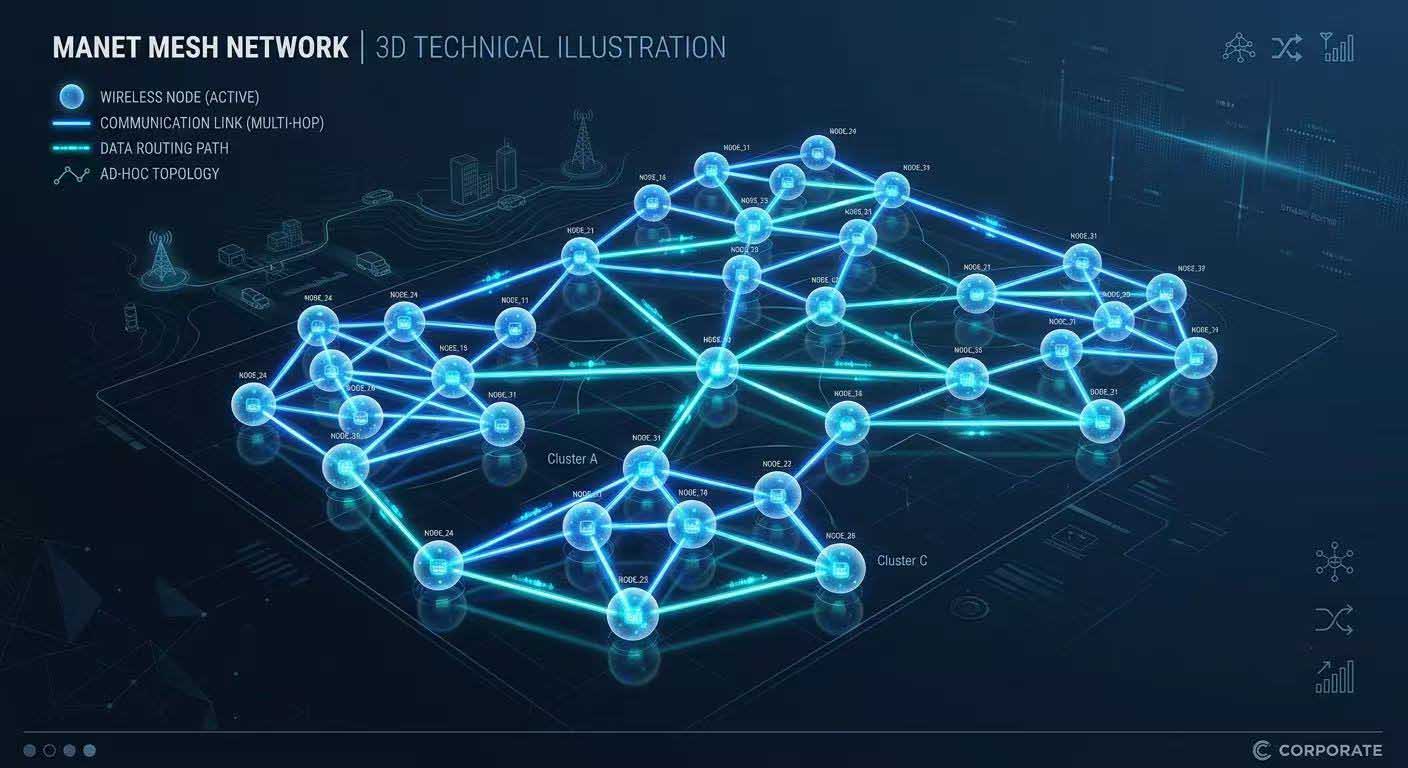
Mesh Networking Fundamentals
Mesh networking represents a fundamental paradigm shift from traditional star-topology networks. In a mesh network, every device (node) connects to multiple other nodes, creating multiple paths for data to travel. This decentralized approach provides inherent redundancy and resilience that is critical for mission-critical applications.
Core Mesh Network Characteristics
- Decentralized Architecture: No central controller or base station. Each node acts as both a host and a router, forwarding packets for other nodes.
- Self-Organizing: Nodes automatically discover neighbors using beacon packets and establish connections without manual configuration.
- Self-Healing: When nodes fail or move, the network automatically reroutes traffic through alternative paths within milliseconds.
- Multi-Hop Routing: Data traverses multiple nodes to reach destinations. Each hop can be up to several kilometers depending on radio power.
- Redundant Paths: Multiple routes exist between any two nodes, ensuring network continuity even with node failures.
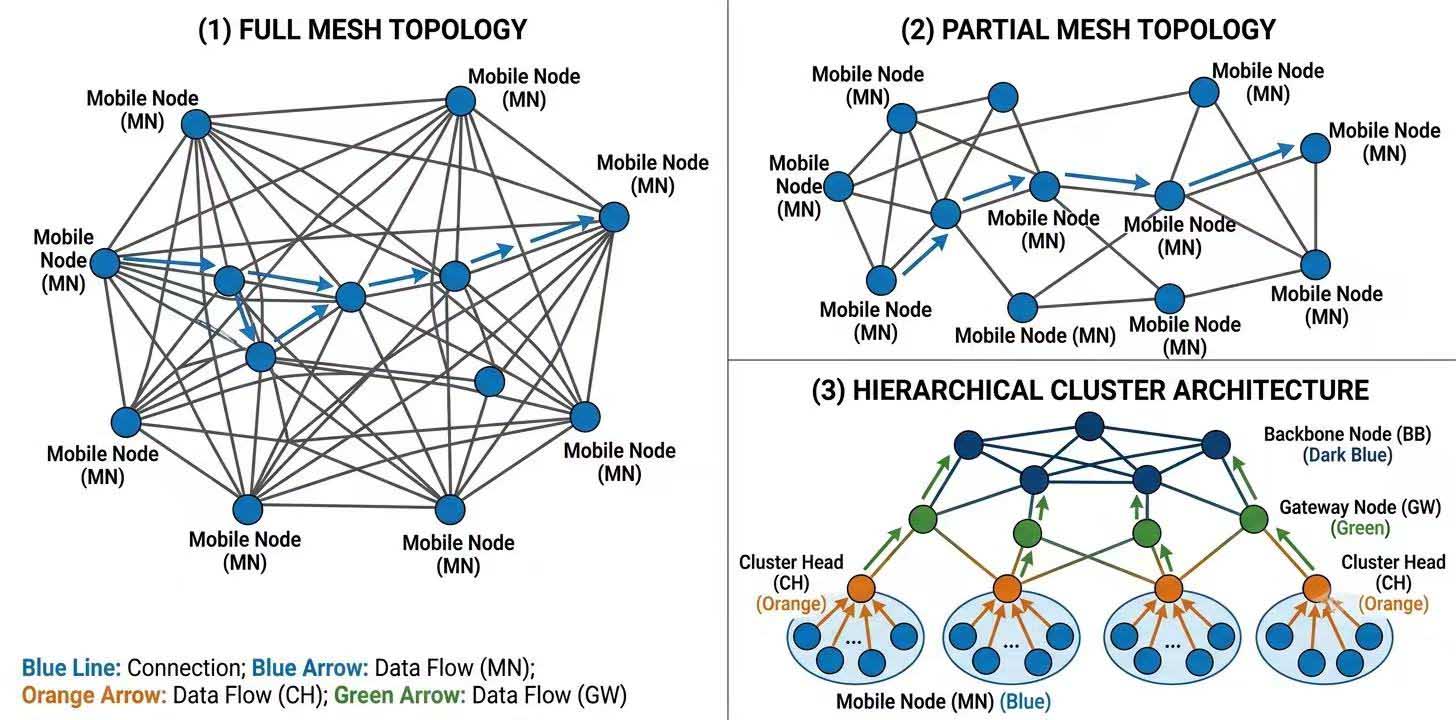
Mesh Network Topologies
| Topology Type | Characteristics | Use Cases | Scalability | Reliability |
|---|---|---|---|---|
| Full Mesh | Every node connects to every other node. O(n²) connections. | Small networks (n < 10), high reliability requirements | Limited (O(n²) complexity) | Maximum |
| Partial Mesh | Nodes connect to some but not all other nodes. Typically 3-5 connections per node. | Large networks (n > 100), balance of redundancy and efficiency | High (linear scaling) | High |
| Hybrid Mesh | Combination of mesh (backbone) and star (access) topology | Enterprise networks, smart cities, campus networks | Very High | High |
Technical Specifications & Performance Metrics
• Network Diameter: 2-8 hops (depending on deployment)
• Average Path Length: 3-5 hops for optimal performance
• Node Density: 10-50 nodes/km² (urban) to 1-5 nodes/km² (rural)
• Radio Range: 100m-5km (depending on power and environment)
• Throughput per Node: 1-50 Mbps (shared across mesh)
• Latency per Hop: 10-50 ms (processing + propagation)
• Failure Recovery Time: < 1 second (with fast rerouting) • Packet Delivery Ratio (PDR): > 95% (under normal conditions)
Wireless Technologies for Mesh Networks
Mesh networks can utilize various wireless technologies depending on requirements:
- IEEE 802.11 (Wi-Fi): 2.4GHz (longer range, more interference) or 5GHz (higher bandwidth, less range). 802.11s standard for mesh.
- IEEE 802.15.4 (Zigbee): Low-power mesh for IoT applications. Ideal for sensor networks with hundreds/thousands of nodes.
- Bluetooth Mesh: Short-range mesh for consumer electronics and smart home applications.
- Cellular (5G/4G): Hybrid mesh-cellular architectures for wide-area coverage.
- Proprietary Radios: Custom protocols for specific use cases (military, industrial).
MANET Mesh Architecture Diagram
MANET vs. Traditional Mesh Networks
While both MANET and traditional mesh networks use mesh topology, MANET is specifically designed for mobile environments where nodes can move freely and the network topology changes rapidly. This requires fundamentally different routing algorithms and network management strategies.
Key Technical Differences
| Aspect | MANET | Traditional Mesh |
|---|---|---|
| Node Mobility | High – all nodes mobile (0-120 km/h typical) | Low – typically fixed or semi-fixed |
| Topology Stability | Rapidly changing (> 10 changes/sec possible) | Relatively stable (changes measured in hours/days) |
| Routing Protocols | Dynamic (AODV, DSR, OLSR, TORA) | Static or semi-static (OSPF, RIP) |
| Infrastructure | None required – fully ad hoc | May have fixed backbone or gateways |
| Power Management | Critical – battery-powered mobile nodes | Less critical – mains-powered nodes |
| Scalability | Limited by routing overhead | High – hierarchical designs possible |
| Quality of Service | Dynamic QoS with adaptive routing | Static QoS configurations |
| Use Cases | Military, emergency, VANET, drones | Smart cities, enterprise networks, campus |
MANET Mesh Architecture Components
• Wireless transceiver (radio): 2.4/5/5.8GHz with MIMO support
• Routing processor: ARM/RISC-V with hardware crypto acceleration
• Memory: Minimum 256MB RAM, 512MB flash for protocol stacks
• Network interface: 802.11a/b/g/n/ac/ax compliant
• Mobility management module: GPS/IMU integration for position awareness
• Power management subsystem: Battery monitoring, low-power modes
Key Protocol Layers (OSI Model):
• Layer 1 (Physical): OFDM modulation, adaptive power control
• Layer 2 (MAC): CSMA/CA with RTS/CTS, EDCA for QoS, 802.11e
• Layer 3 (Network): AODV/DSR/OLSR routing, IP encapsulation
• Layer 4 (Transport): UDP for low latency, TCP for reliability
• Layer 7 (Application): MANET-specific services, discovery protocols
MANET-Specific Technical Challenges
- Hidden Terminal Problem: Nodes cannot detect ongoing transmissions outside their radio range, causing collisions.
- Exposed Terminal Problem: Nodes unnecessarily defer transmissions due to distant ongoing transmissions.
- Link Breakage: Rapid node movement causes frequent link failures requiring fast rerouting.
- Network Partitioning: Mobility can split the network into disconnected components.
- Power Constraints: Mobile nodes rely on batteries, requiring energy-efficient protocols.
Mesh Routing Protocols
Protocol Classification
- Proactive Protocols: Maintain routing tables continuously by periodically exchanging routing information. Low latency but high overhead.
- Reactive Protocols: Establish routes only when needed through route discovery. Low overhead but higher latency for first packet.
- Hybrid Protocols: Combine proactive routing within clusters and reactive routing between clusters.
MANET routing protocols fall into three categories — proactive, reactive, and hybrid. The table below provides a quick overview. For an in-depth comparison with performance benchmarks, see the dedicated cluster article: VANET Routing Protocols Performance Comparison (protocol mechanics apply to MANET generally).
| Category | Protocols | Best For | Key Trade-Off |
|---|---|---|---|
| Proactive | OLSR, DSDV | Stable, large networks; low-latency applications | Higher overhead, lower discovery latency |
| Reactive | AODV, DSR | High-mobility, sparse traffic; battery-powered nodes | Lower overhead, higher first-packet latency |
| Hybrid | ZRP | Large-scale MANETs with hierarchical clustering | Complex configuration, best balance |
For VANET-specific routing (GPSR, GPCR, MOPR, CLWPR), refer to VANET Routing Protocols Deep Comparison.
Network Architecture Design
Design Considerations – Technical Parameters
- Node Density: Optimal spacing between 50m-500m depending on radio range. Higher density improves redundancy but increases interference.
- Power Management: Battery life estimation based on transmit power, duty cycle, and sleep modes. Solar harvesting integration for permanent deployments.
- Security: End-to-end encryption (AES-256), mutual authentication, intrusion detection systems, secure routing protocols.
- Scalability: Hierarchical clustering for networks exceeding 200 nodes. Cluster size optimization (10-30 nodes per cluster).
- Interoperability: Support for standard protocols (IPv4/IPv6, 802.11) for integration with existing infrastructure.
Hierarchical Mesh Architecture
For large-scale deployments (200+ nodes), hierarchical clustering reduces routing overhead from O(n²) to O(n). Node roles are organized into layers: Leaf Nodes → Cluster Members → Cluster Heads → Gateways → Backbone. For detailed architecture design guidance, see the deployment sections in Military and Smart City IoT cluster articles.
Topology Optimization Techniques
- Topology Control: Adjust transmit power to maintain connectivity while minimizing interference.
- Link Quality Estimation: Use metrics like RSSI, SNR, and packet loss rate for route selection.
- Load-Aware Routing: Distribute traffic based on node capacity and current load.
- Geographic Routing: Use GPS coordinates for efficient route discovery in large networks.
Implementation Best Practices
Network Planning Checklist – Technical Requirements
- Define coverage requirements (area, minimum signal strength, reliability)
- Determine node density based on traffic patterns and redundancy needs
- Select appropriate frequency band (2.4GHz for range, 5GHz for bandwidth, 5.9GHz for V2X)
- Choose routing protocol based on mobility profile and network size
- Plan power management strategy (battery capacity, charging, sleep modes)
- Implement security measures (encryption, authentication, key management)
- Design monitoring and management system for network visibility
- Test scalability with simulated and real-world load testing
Performance Optimization
- Adaptive Power Control: Adjust transmit power dynamically based on distance. Target RSSI: -60 to -70 dBm.
- Load Balancing: Distribute traffic across multiple paths using bandwidth and queue-length metrics.
- Quality of Service: Implement EDCA for traffic prioritization (voice/video → AC_VO/AC_VI).
- Rate Adaptation: Dynamic MCS selection based on channel conditions.
Deployment Guidelines
• Beacon Interval: 100-500 ms (shorter = faster discovery, higher overhead)
• Route Timeout: 30-120 seconds (adjust based on mobility)
• Max Hops: 10-20 (prevents routing loops, limits network diameter)
• Transmit Power: 10-20 dBm (balance range vs. interference)
For complete deployment checklists, refer to each use case’s cluster article.
Deployment Best Practices Diagram
Security Implementation
- Authentication: 802.1X/EAP for node authentication, certificate-based verification.
- Encryption: AES-256 for data confidentiality, WPA3-Enterprise for wireless security.
- Intrusion Detection: Monitor for anomalous traffic patterns, unauthorized nodes.
- Secure Routing: Cryptographic verification of routing information (e.g., ARAN, SAODV).
- Key Management: Distributed key distribution, periodic key rotation.
Real-World Applications
MANET technology serves critical applications across multiple verticals. Click each link below for dedicated in-depth guides:
- Military Communications — Tactical battlefield C4ISR networks connecting soldiers, vehicles, drones, and command centers with anti-jam protection.
- Emergency Response — Rapidly deployable communication for disaster zones where cellular infrastructure is destroyed.
- Smart City IoT — Large-scale urban sensor networks for lighting, traffic, environmental monitoring with zero recurring connectivity fees.
- Connected Vehicles (VANET) — V2V/V2I/V2P/V2C mesh for collision avoidance, platooning, and intelligent transportation.
- Drone Networks (FANET) — Swarm coordination and beyond-line-of-sight relay for UAV operations.
Product Solutions
YN300A – 2.4G Wireless Mesh Motherboard
Designed for robust mesh networking in industrial and commercial applications requiring reliable connectivity in challenging environments.
- Frequency Band: 2.4GHz ISM band (2.400-2.4835 GHz)
- Radio Specifications: IEEE 802.11b/g/n, MIMO 2×2
- Transmit Power: Up to 20 dBm (100mW)
- Receiver Sensitivity: -98 dBm (1 Mbps), -70 dBm (300 Mbps)
- Range: Up to 1.5 km line-of-sight
- Protocol Support: 802.11s mesh, AODV, OLSR
- Operating Temperature: -40°C to +85°C (industrial grade)
- Power Consumption: < 5W typical
- Form Factor: 100mm x 80mm, through-hole mounting
2.4G Wireless Ad Hoc Network Motherboard
Optimized for rapid deployment scenarios requiring quick network formation without pre-existing infrastructure.
- Frequency Band: 2.4GHz ISM band
- Radio Specifications: IEEE 802.11b/g, single antenna
- Transmit Power: 15 dBm (32mW)
- Receiver Sensitivity: -95 dBm
- Range: Up to 800m line-of-sight
- Self-Organizing: Automatic network formation within 30 seconds
- Protocol Support: AODV, DSR
- Power Consumption: < 3W typical
- Form Factor: Compact 60mm x 40mm module
YN300B – 5.8G Single-Client Ad Hoc Network PCBA
High-bandwidth solution for applications requiring faster data transmission with less interference.
- Frequency Band: 5.8GHz ISM band (5.725-5.850 GHz)
- Radio Specifications: IEEE 802.11a/n/ac, MIMO 2×2
- Transmit Power: Up to 23 dBm (200mW)
- Receiver Sensitivity: -96 dBm (6 Mbps), -65 dBm (867 Mbps)
- Range: Up to 2 km line-of-sight
- Throughput: Up to 867 Mbps PHY rate
- Protocol Support: 802.11s mesh, OLSR, B.A.T.M.A.N.
- Operating Temperature: -30°C to +70°C
- Power Consumption: < 8W typical
Product Selection Guide
| Product | Frequency | Range | Throughput | Best For |
|---|---|---|---|---|
| YN300A | 2.4GHz | 1.5 km | 300 Mbps | Industrial mesh networks, outdoor deployments |
| 2.4G Ad Hoc | 2.4GHz | 800m | 54 Mbps | Emergency response, rapid deployment |
| YN300B | 5.8GHz | 2 km | 867 Mbps | High-bandwidth applications, dense environments |
Frequently Asked Questions
Q: What is the technical difference between MANET and traditional mesh networks?
The key technical differences lie in mobility support and routing protocols. MANET networks are designed for highly dynamic environments where nodes can move freely at varying speeds (0-120 km/h). Traditional mesh networks typically have fixed or semi-fixed nodes. MANET requires specialized dynamic routing protocols (AODV, DSR, OLSR) that can handle rapid topology changes, while traditional mesh uses static or semi-static routing (OSPF, RIP). MANET also incorporates mobility management modules and power-efficient protocols for battery-powered nodes, which are less critical in fixed mesh networks.
Q: How many nodes can a MANET mesh network support?
The scalability of MANET mesh networks depends on several factors: routing protocol efficiency, node density, and network architecture. With flat routing protocols like AODV or DSR, networks typically support 50-200 nodes before experiencing significant performance degradation due to routing overhead. However, with hierarchical clustering (ZRP) and optimized protocols like OLSR, MANET networks can scale to thousands of nodes. The key is implementing cluster-based architectures where each cluster manages its own routing, reducing the global overhead. Typical deployments range from 10-50 nodes for small tactical networks to 500-2000 nodes for large-scale smart city deployments.
Q: What are the key security considerations for MANET mesh networks?
MANET mesh networks present unique security challenges due to their decentralized nature and mobile nodes. Key security considerations include: (1) Authentication: Using 802.1X/EAP or certificate-based verification to prevent unauthorized nodes from joining; (2) Encryption: AES-256 for data confidentiality, WPA3-Enterprise for wireless security; (3) Secure Routing: Cryptographic verification of routing information to prevent attacks like wormhole or black hole attacks; (4) Intrusion Detection: Monitoring for anomalous traffic patterns; (5) Key Management: Distributed key distribution with periodic rotation; (6) Physical Layer Security: Spread spectrum techniques to resist jamming. Military-grade MANET implementations also incorporate anti-jam technologies like frequency hopping and cognitive radio.
Q: How does MANET handle handover when nodes move?
MANET handles node mobility through several mechanisms: (1) Route Maintenance: Protocols like AODV use HELLO messages to detect link failures and trigger local repair; (2) Fast Rerouting: When a link breaks, intermediate nodes attempt local repair before initiating global route discovery; (3) Pre-emptive Route Discovery: Some protocols proactively discover alternative routes before links fail; (4) Neighbor Caching: Nodes maintain lists of neighboring nodes to accelerate reconnection; (5) Handover Optimization: For high-mobility scenarios, protocols may use cross-layer optimization between MAC and network layers. The goal is to minimize packet loss and latency during handover, with typical handover times ranging from 50-200 milliseconds depending on the protocol and network conditions.
Q: What frequency band should I choose for my MANET deployment?
The choice of frequency band depends on your specific requirements: (1) 2.4GHz ISM Band: Best for longer range (1-2 km), better penetration through obstacles, but more susceptible to interference from Wi-Fi, Bluetooth, and other devices; (2) 5GHz ISM Band: Higher bandwidth (up to 867 Mbps), less interference, but shorter range (500m-1.5 km); (3) 5.9GHz DSRC Band: Reserved for V2X communication, 75 MHz bandwidth in most regions, optimized for vehicle-to-vehicle communication; (4) Sub-GHz Bands (433MHz, 868MHz, 915MHz): Very long range (3-10 km), low data rates, ideal for IoT sensor networks. For most general-purpose MANET deployments, 2.4GHz offers the best balance of range and compatibility, while 5GHz is preferred for high-bandwidth applications in less congested environments.
Q: What are the typical latency and throughput characteristics of MANET mesh networks?
MANET mesh network performance depends on several factors including routing protocol, number of hops, and traffic load. Typical characteristics include: (1) Per-hop latency: 10-50 ms (processing + propagation delay); (2) End-to-end latency: 50-500 ms depending on number of hops; (3) Throughput per node: 1-50 Mbps (shared across the mesh); (4) Packet Delivery Ratio (PDR): > 95% under normal conditions, > 90% in high-mobility scenarios; (5) Jitter: 10-100 ms depending on traffic patterns. For real-time applications like voice or video, it’s important to limit the number of hops (typically < 5) and use QoS mechanisms to prioritize time-sensitive traffic.
▶ Cluster Articles (in-depth coverage):
- Tactical Military Communications — Battlefield C4ISR MANET deployment
- Emergency Response Mesh Networks — Disaster relief rapid-deploy communication
- Smart City IoT Mesh — Large-scale urban sensor network architecture
- VANET V2V/V2I/V2P/V2C Protocols — Connected vehicle communication
- VANET Routing Protocols Comparison — AODV, DSR, OLSR, GPSR, GPCR benchmarks
- IEEE 802.11p MAC Layer — VANET channel access mechanisms
- DSRC vs C-V2X Comparison — V2X technology selection guide


