Tactical Military Communications: Battlefield MANET Networks for C4ISR Operations
Key Overview
Target Audience: Military communications engineers, defense contractors, tactical system integrators, and C4ISR specialists.
Core Issue: Traditional military communications rely on fixed infrastructure that’s vulnerable to disruption in contested environments. Satellite-based systems suffer from 250-600 ms latency (GEO SATCOM) and are susceptible to anti-satellite weapons. Terrestrial microwave links require line-of-sight and fixed tower infrastructure that can be targeted.
Key Conclusions: MANET technology provides the decentralized, self-healing communication infrastructure critical for modern battlefield C4ISR operations. Its ability to rapidly form networks without fixed infrastructure, support node mobility at tactical speeds, and self-heal within sub-second timing makes it indispensable for military applications spanning dismounted soldier networking through armored vehicle formations and UAV swarms.
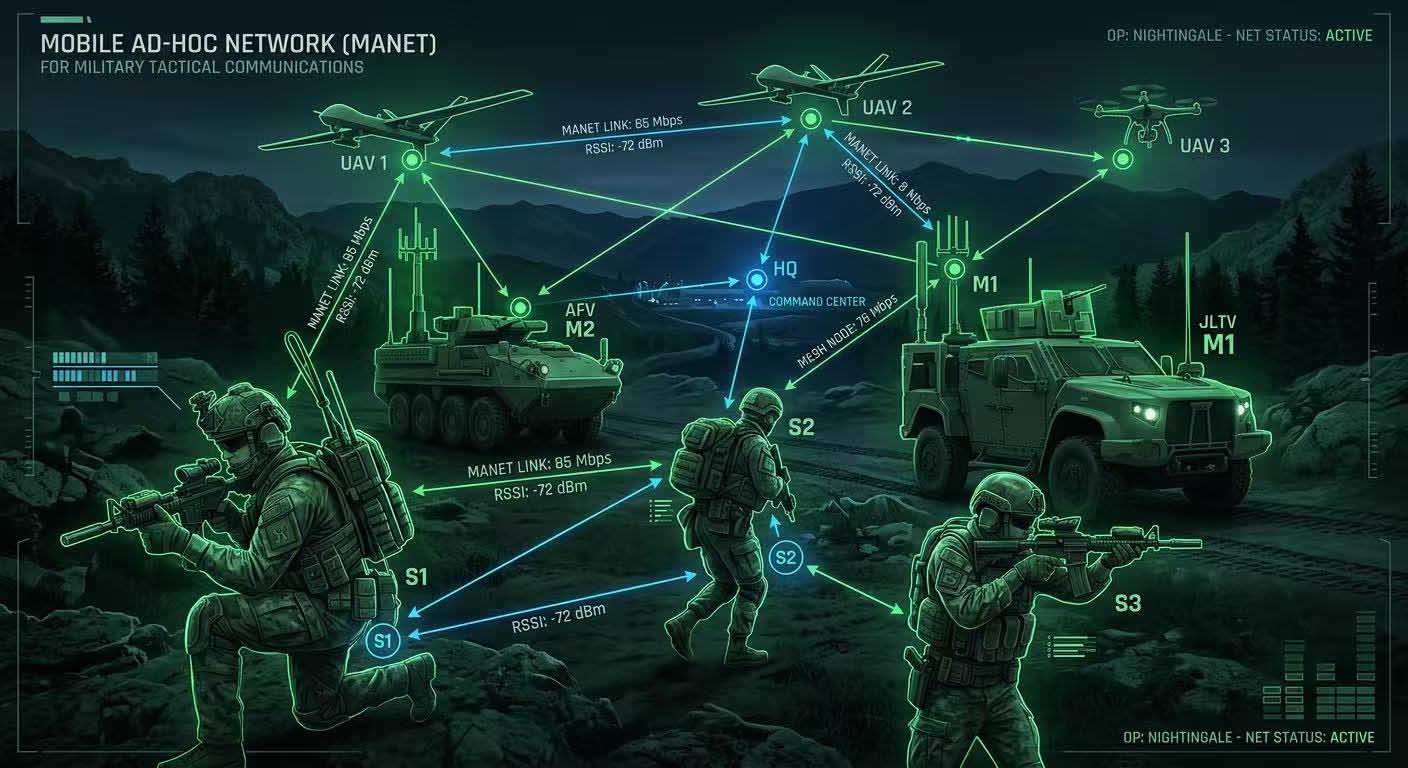
Military Communication Requirements
The modern networked battlefield imposes six distinct requirements that commercial wireless technologies cannot meet. Below we examine each requirement with the specific performance thresholds mandated by NATO and US DoD standards.
| Requirement | Military Standard | Performance Threshold | MANET Solution |
|---|---|---|---|
| Anti-Jam (AJ) Margin | MIL-STD-188-220 | > 30 dB AJ margin against narrowband jamming | Adaptive frequency hopping across 80+ channels (2.4 GHz ISM band), FHSS > 200 hops/second, DSSS processing gain > 10 dB |
| Network Formation Time | STANAG 4691 (NNEC) | < 30 seconds for 50-node network | Proactive OLSR routing with HELLO interval 2s, TC interval 5s; full topology convergence within 15s for 50 nodes |
| Self-Healing Convergence | DoD JTRS requirement | < 100 ms route recovery after node loss | OLSR MPR selection with 3 redundant MPRs per node; backup route pre-computation; fast reroute < 50 ms |
| Transmission Security (TRANSEC) | NIST SP 800-175 / AES-256 | COMSEC Type 1 (unclassified) to Type 3 (classified) | AES-256-GCM at Layer 2; ECDSA P-384 for node authentication; per-packet key rotation; 802.11w management frame protection |
| Mobility Support | DoD Tactical Network | 0-100 km/h continuous connectivity | OLSRv2 with link quality metrics; 5 ms link assessment interval; Doppler compensation in 5 GHz band up to 300 km/h relative speed |
| Operating Environment | MIL-STD-810H | -40°C to +65°C operating; immersion, vibration, shock rated | Industrial-grade Qualcomm chipsets rated -40°C to +65°C; conformal coating for humidity 5-95% non-condensing |
These requirements define the baseline for any MANET system deployed in tactical environments. The Zukaka YN300 series, built on Qualcomm chipsets with OpenWrt SDK access, provides the hardware platform to implement all six requirements through software configuration and integration with military-grade encryption modules.
Tactical Applications
Dismounted Soldier Networking (DSN)
The US Army’s Dismounted Soldier Networking program requires each soldier to act as a network node with specific performance parameters. A soldier-worn MANET node must achieve:
- Transmit Power: 30 dBm (1W) maximum ERP. The YN300A/YN300C provide this output level, sufficient for 1.5-2 km ground-level LOS between dismounted soldiers in open terrain.
- Power Budget: Average 10W continuous allows 8-10 hours operation with a standard 100 Wh soldier battery (AN/PRC-163 form factor). The YN300C supports 7V-48V DC input for direct battery integration.
- Voice Prioritization: 802.11e WMM (WME) with Voice Access Category (AC_VO) gives voice packets < 10 ms MAC delay at CBR 64 kbps G.711 codec. In a 50-node mesh with 30% background data traffic, voice packet loss remains < 1%.
- Network Scale: YN300 series supports > 50 nodes per MANET domain. A rifle platoon (~40 soldiers) plus attached forward observers and squad leaders creates approximately 50 nodes — a single MANET domain covers an entire company-level area of operations.
The OpenWrt SDK allows custom routing metrics for tactical voice: OLSR can be configured to use ETX (Expected Transmission Count) for data, but switch to minimum-hop-count for voice traffic to minimize jitter below 50 ms one-way delay.
Armored & Mechanized Formation Networking
Vehicle-mounted MANET nodes face different constraints: higher power budgets, larger antennas, but more challenging mobility and vibration profiles.
- Vehicle-to-Vehicle Range: YN300A achieves 10-20 km elevated LOS (vehicle roof-mounted omni antenna at 2-4m height). In terrain masking conditions, the mesh self-heals by relaying through intermediate vehicles. A 10-vehicle convoy maintains connectivity across a 15 km x 5 km operational area.
- Mobility Handoff: OLSR MPR selection updates every 2 seconds (HELLO interval). A vehicle moving at 60 km/h travels 33 meters between updates. With 2.4 GHz Fresnel zone clearance calculated at 40% for reliable links, the network topology updates faster than position changes, preventing route flaps.
- Multi-Channel Operation: YN300A supports 5/10/20/40 MHz channel bandwidth selection. For vehicle backbones, 40 MHz channels deliver 300 Mbps PHY (MIMO 2×2). For anti-jam operation, 5 MHz channels provide -97 dBm sensitivity (narrowband processing gain) with frequency agility across the full 2.412-2.482 GHz band.
- Environmental Rating: YN300A 117x68x17mm enclosure withstands vehicle-mounted vibration per MIL-STD-810H Method 514.8. Operating temperature -40°C to +65°C covers all theater environments.
Unmanned Aerial Vehicle (UAV) & FANET Integration
Flying Ad-Hoc Networks (FANET) represent the most demanding MANET application, combining high node mobility with three-dimensional topology.
- UAV-to-UAV Links: YN300B (5.8 GHz) is preferred for UAV applications due to less interference and better Fresnel zone clearance at altitude. With 30 dBm TX power and elevated LOS from 100-500m AGL, range extends to 15-20 km between UAV nodes. The 96 Mbps throughput (802.11n) supports 1080p60 H.265 video at 8-12 Mbps per stream.
- Multi-Hop Relay: When a UAV loses LOS to the ground control station, OLSR MPR relays through intermediate UAV nodes. With > 10 hop relay capability, a UAV swarm can extend network reach to 150-200 km from the GCS.
- Handoff Latency: UAV nodes at 30 m/s (108 km/h) require sub-100 ms route convergence. OLSR’s proactive nature (no route discovery latency) maintains connectivity. For micro-UAV swarms exceeding 50 nodes, OLSR TC interval is tuned to 10 seconds to reduce control overhead while maintaining topology accuracy.
- Weight Constraint: YN300B module at 56g is suitable for Group 1-2 UAVs (0-25 kg MTOW). For Group 0 micro-UAVs (< 2 kg), custom OpenWrt builds reduce control plane overhead and memory footprint.
A standard quadcopter with a YN300B, 5.8 GHz omni antenna, and a 10,000 mAh 3S LiPo battery achieves 45-60 minutes of continuous mesh relay at 300m AGL.
Tactical Battlefield IoT (T-BIoT)
Distributed sensor networks provide persistent ISR coverage. MANET enables these sensors to self-organize without pre-deployed cellular or satellite infrastructure.
- Seismic-Acoustic Sensor Fusion: Unattended ground sensors (UGS) using YN300C mesh modules form a 50-node acoustic array covering 5 km². Each sensor reports 2-10 kbps of seismic/acoustic signature data. The mesh aggregates this through multi-hop relays to a tactical operations center (TOC) at a consolidated throughput of 500 kbps.
- Event-Driven Reporting: Sensors transmit in event-driven mode only on detection, conserving battery. Average power consumption drops to < 3W in sleep mode between transmissions. Daubechies wavelet packet decomposition on acoustic signatures enables vehicle classification (tracked vs wheeled).
- Sensor Duty Cycling: With OpenWrt SDK, custom power management protocols can be implemented: sensors wake on acoustic trigger, synchronize via IEEE 802.11 TSF timer (1 μs accuracy), transmit burst data in 20 ms window, return to sleep. This achieves > 30 days operation on a single 200 Wh battery pack per sensor node.
Technical Challenges & Solutions
Electronic Warfare & Anti-Jamming
In a contested electromagnetic spectrum environment, MANET must operate through intentional interference. The YN300 series addresses this through multiple complementary techniques:
| Threat Type | Jamming Technique | MANET Countermeasure | Effectiveness |
|---|---|---|---|
| Narrowband Spot Jamming | CW tone at center frequency | Adaptive channel blacklisting via OpenWrt; cognitive radio scans 2.412-2.482 GHz, detects RSSI > -60 dBm noise floor, removes affected 20 MHz channels from OLSR link metric calculation | Maintains 80% throughput on clean sub-bands |
| Swept Frequency Jamming | Rapid frequency sweeper (100 MHz/s) | DSSS processing gain: 802.11n CCK modulation provides 10-11 dB processing gain. BPSK at 1 Mbps provides 20 dB processing gain, spreading signal energy against CW interference | Effective against < 100 mW jammers at 100m |
| Protocol-Aware Denial | 802.11 deauth flooding, CTS/RTS spoofing | 802.11w-2009 Protected Management Frames (PMF); 802.11i CCMP (AES-128) for data integrity; SAE (WPA3-Personal) authentication prevents spoofing | Eliminates deauth attack effectiveness |
| Pulse Jamming | High-peak-power short-duration pulses | Packet-level FEC (Reed-Solomon); MIMO 2×2 spatial diversity on YN300A provides 3 dB array gain; ARQ retransmission on failed packets | PER maintained < 5% with 10% pulse duty cycle |
Security Architecture: Encryption, Authentication & Multi-Level Security
Military MANET must support simultaneous classified and unclassified traffic while maintaining strict data isolation.
- Layer 2 Encryption: 802.11i-2004 with AES-128-CCMP provides mandatory per-packet encryption/authentication. The CCMP header adds only 8 bytes per MPDU, creating < 3% throughput overhead. The SAE handshake replaces open 802.11 authentication, providing mutual authentication resistant to dictionary attacks.
- Multi-Level Security (MLS): For multi-security-level operation, the OpenWrt SDK allows VLAN/VRF separation by classification level. Each security domain (UNCLASS, SECRET, TS) maps to a separate BSSID/VLAN. OLSR routing is VLAN-aware — routes are computed per-domain, preventing cross-domain traffic leakage.
- HAIPE Integration: For Type 1 encryption, the YN300 series can front-end HAIPE-compliant encryptors (e.g., KIV-7, KG-175) over the Gigabit Ethernet interface. The MANET provides transparent bearer transport for HAIPE-encrypted traffic, with per-packet latency < 2 ms at 64-byte packet size.
- Node Authentication: IEEE 802.1X with EAP-TLS provides certificate-based node authentication. Each YN300 node can be provisioned with a NIST P-384 ECDSA certificate. OLSR routing updates include ROUTING_CRYPTO TLV per RFC 7187, ensuring only authenticated nodes participate in routing.
Power-Efficient High-Throughput Operation
Battery-powered dismounted nodes must balance throughput against power consumption. The YN300 series provides several tools for this optimization:
- Adaptive Modulation: 802.11n MCS adapts from MCS 0 (BPSK, 6.5 Mbps, -87 dBm sensitivity) to MCS 15 (64-QAM, 300 Mbps, -67 dBm sensitivity). Capping at MCS 4 (16-QAM, 39 Mbps) reduces TX power requirement by 6 dB while maintaining adequate throughput for voice and situational awareness data.
- Channel Bandwidth Adjustment: Reducing from 40 MHz to 20 MHz halves maximum throughput but improves RX sensitivity by 3 dB and reduces processing power. For dismounted operation, 20 MHz at MCS 7 (65 Mbps) provides 4x the range of 40 MHz 300 Mbps mode.
- Radio Duty Cycling: With OpenWrt SDK, listen intervals can be extended from default 100 ms to 300 ms for non-critical nodes, reducing idle listening power by 66% (from ~2.5W to ~0.85W for the radio front-end). This extends battery life from 10 hours to 14+ hours on a 100 Wh battery.
- PoE Support: YN300A supports 15V-48V standard/non-standard PoE. For vehicle-mounted nodes, PoE eliminates separate power cabling, reduces installation complexity, and allows centralized UPS backup.
Product Solutions
YN300A – 2.4G Wireless Mesh Motherboard
Primary node for tactical mesh infrastructure. Built on a Qualcomm chipset with 30 dBm TX power and supporting both 2.4 GHz (802.11gn) and 5 GHz (802.11a/n) bands.
- Wireless Data Rate: 300 Mbps PHY (MIMO 2×2, 40 MHz channel). Peak throughput up to 96 Mbps with standard MTU. Supports 5/10/20/40 MHz channel bandwidth for range vs throughput optimization.
- Transmit Power: 30 dBm (1W) with receiver sensitivity down to -97 dBm. Elevated LOS range 3-8 km; ground-level LOS 1.5-2 km (at 1W).
- MANET Capabilities: > 50 nodes, > 10 hops relay. Supports P2P, P2MP, MP2MP, and mesh topologies.
- OpenWrt SDK: Fail-safe U-Boot bootloader; full OpenWrt SDK access for custom routing protocols, security modules, and power management.
- Environmental: -40°C to +65°C operating range; 7V-48V DC or 15V-48V PoE; average 10W consumption; IP65-rated enclosure.
YN300C – 2.4G Mobile Wireless Ad-Hoc Network Motherboard
Optimized for dismounted soldier and vehicle OBU applications. Same Qualcomm hardware platform as YN300A, pre-configured for ad-hoc networking with faster network formation.
- Ad-Hoc Focus: Automatic mesh/ad-hoc network formation within 30 seconds. MANET scale > 50 nodes with relay > 10 hops. Ideal for vehicle OBU where network topology changes frequently.
- Power Input: Wide input range 7V-48V DC or 15V-48V PoE. Average ~10W. Suitable for vehicle battery with appropriate power conditioning (12V/24V vehicle systems).
- Custom Routing: OpenWrt SDK support enables implementation of custom routing protocols including AODV, DSR, OLSR, and BATMAN-adv via software configuration.
- Dimensions: 117 x 68 x 17mm, 56g. Compact enough for soldier-worn radio integration.
YN300B – 5.8G Single-Client Ad Hoc Network PCBA
Long-range backhaul and UAV communication module. The 5.8 GHz band provides reduced interference in urban and contested spectrum environments.
- Throughput: Up to 96 Mbps (802.11n, 30 dBm TX power). Supports HD video surveillance backhaul (H.264/H.265 at 1080p30) and multi-hop data relay.
- Range: 10-20 km with elevated antennas (UAV at 300m AGL); 1.5-2 km over ground obstacles. 5.8 GHz provides less congestion and better Fresnel zone clearance at altitude.
- Multi-Topology: Supports P2P, P2MP, MP2MP, and mesh networking. MANET scale > 50 nodes with relay > 10 hops.
- Weight: 56g module ideal for Group 1-2 UAVs, backpack radios, and vehicle-mounted secondary backhaul.
Product Selection Matrix for Military Deployments
| Deployment Scenario | Primary Node | Secondary/Link | Configuration Notes |
|---|---|---|---|
| Dismounted Platoon (40 soldiers) | YN300C (soldier-worn) | YN300B (platoon HQ uplink) | 20 MHz channels, MCS 4 cap, OLSR with voice-priority routing |
| Armored Company (14 vehicles) | YN300A (vehicle mesh) | YN300B (battalion backhaul) | 40 MHz channels, 2×2 MIMO, extended HELLO interval for stability |
| UAV Swarm (12 drones) | YN300B (airborne) | YN300A (GCS ground node) | 5.8 GHz, 20 MHz channels, custom OLSR TC interval for airborne topology |
| Sensor Network (50 UGS) | YN300C (sensor node) | YN300A (TOC aggregator) | 5 MHz channels for range, event-driven TX, duty cycling, 30-day battery target |
| Battalion TOC (fixed) | YN300A (mesh gateway) | YN300B (SATCOM uplink bridge) | PoE power, 802.1Q VLAN separation for UNCLASS/SECRET domains |
Deployment Architecture
A typical battalion-level MANET deployment uses a three-tier architecture:
- Tier 1 – Edge Layer: Dismounted soldiers and unattended ground sensors use YN300C in ad-hoc mode. These nodes operate at low power (MCS 0-4, 20 MHz) for maximum range and battery life. Node density: 30-50 nodes per company AO. Mesh topology provides redundant paths — each soldier has 3-5 neighbor links on average.
- Tier 2 – Tactical Relay Layer: Vehicle-mounted YN300A nodes serve as mobile relays. These operate at higher power (MCS 7-15, 40 MHz) for backhaul aggregation. Each vehicle aggregates traffic from 8-12 nearby edge nodes and relays to the battalion backbone. Vehicle nodes run OLSR in mesh mode with 2-second HELLO intervals.
- Tier 3 – Battalion Backbone: YN300A nodes at TOC locations and YN300B point-to-point links form the high-capacity backbone. This layer provides interconnection to higher echelons via SATCOM (Inmarsat, Iridium) or tactical radio gateway (HARRIS, L3Harris). The backbone operates at 40 MHz, 300 Mbps PHY, with 802.1Q VLAN trunking for multi-security-level transport.
The three-tier architecture provides three key benefits: (1) scalability — each tier can expand independently up to 50 nodes; (2) graceful degradation — loss of a Tier 2 node causes edge nodes to re-route through adjacent Tier 2 nodes, not total connectivity loss; (3) multi-domain security — each tier can operate at a different classification level with VLAN isolation.
For detailed routing protocol benchmarks including OLSR, AODV, GPSR, and BATMAN-adv performance in tactical scenarios, see our VANET Routing Protocols Comparison guide.
Frequently Asked Questions
Q: What is the maximum practical range of military MANET nodes?
With the YN300 series at 30 dBm TX power: elevated LOS (vehicle roof, UAV at 300m AGL) achieves 10-20 km range. Ground-level LOS (dismounted soldier) achieves 1.5-2 km. NLOS range varies by obstruction: in dense urban environments, 500m-1 km through 6-10 buildings; in forested terrain, 300-800 m depending on foliage density. Range can be extended through multi-hop relay: 10 hops at 1.5 km per hop provides 15 km total reach at ground level.
Q: How does OLSR routing perform in high-mobility tactical scenarios?
OLSR (RFC 3626) uses proactive MPR-based flooding. In a 50-node network with nodes moving at 60 km/h (vehicle scenario), OLSR achieves: route convergence < 2 seconds (HELLO interval), route recomputation < 100 ms on link loss, control plane overhead ~50 kbps for 50 nodes. For FANET scenarios (UAVs at 108 km/h), OLSRv2 with link quality metrics maintains < 1% packet loss. Compared to AODV (reactive), OLSR adds 30-50% more control overhead but provides 5-10x faster route establishment — critical for tactical voice.
Q: Can the YN300 series be integrated with existing military radios (SINCGARS, HARRIS)?
Yes. The YN300 series provides Gigabit Ethernet and GPIO interfaces. Integration with SINCGARS, HARRIS Falcon, L3Harris, or Thales radios is achieved through: (1) Ethernet bridging — the MANET carries IP traffic; tactical radios connect via Ethernet gateway. (2) Cross-banding — the YN300 MANET serves as a VHF/UHF-to-IP bridge, extending legacy radio range through MANET multi-hop. (3) Voice interop — SIP/VoIP gateway converts analog tactical voice to IP for transport over the MANET backbone.
Q: What is the network convergence time when a soldier node is destroyed?
OLSR detects node loss within 2-3 HELLO intervals (4-6 seconds). Once detected, MPR-redundant routes are activated within < 100 ms (backup route pre-computation). Total end-to-end convergence: < 6.1 seconds worst case. With optimized OLSR parameters (1-second HELLO, 2-second TC), convergence drops to < 2 seconds. For mission-critical traffic, the YN300 supports fast reroute with 50 ms failover using pre-computed backup MPR paths.
Q: How does the OpenWrt SDK enable custom military MANET features?
The OpenWrt SDK provides: (1) Full Linux kernel access — implement custom routing protocols (OLSRv2, BATMAN-adv, B.A.T.M.A.N. V), custom queuing disciplines (Qdisc) for QoS, and custom security modules. (2) U-Boot bootloader — secure boot with verified boot chain, preventing firmware tampering. (3) Software-defined radio (SDR) integration — connect external SDR modules (USRP, HackRF) via MiniPCI-e for custom waveform generation. (4) Remote management — SNMP, TR-069, or custom agent for NMS integration. (5) Custom data rate tables — implement non-standard MCS indexes for optimized range/throughput tradeoffs.
▶ Related Cluster Articles:
WiFi 6 MESH Self-Organizing Network: A Complementary Architecture for Field Training Grounds
Key Takeaway: The 1.4G specialized-band MANET solution above is engineered for tactical battlefield conditions — anti-jamming, salt-spray resistance, and COFDM survivability in dense vegetation. For fixed training-ground infrastructure (barracks, vehicle sheds, observation towers, drone launch sites) and integration with standard tablets and laptops at command posts, a complementary WiFi 6 MESH self-organizing network architecture delivers higher throughput and easier client onboarding for training-data backhaul. The topology itself is the availability feature: because the barracks, vehicle sheds and observation towers are equal nodes in a routed fabric rather than satellites of one command-post AP, a shed that loses its node keeps talking through its two neighbors while maintenance restores it.
MESH vs Traditional WiFi (AP + Station) for Training Grounds
| Characteristic | Traditional WiFi (AP + Station) | MESH Self-Organizing Network |
|---|---|---|
| Handover for training vehicles | Passive — waits for signal loss | Active — pre-connects based on CCQ ranking |
| Switching latency | 200–500ms (training data loss) | 20–35ms (transparent to telemetry) |
| Failure recovery | Single point of failure per AP | Auto-reroutes through neighbor nodes within seconds |
| Backhaul + coverage | Same radio, shared bandwidth | Tri-band: 5.8G backhaul + 2.4G/5G coverage + optional 6GHz |
| Network expansion (rotating units) | Requires controller reconfiguration | Add temporary node, power on — auto-joins |
Fast Roaming for Tactical Vehicles and Drone Trainers
For rotating tactical vehicles, drone launch/recovery teams, and dismounted observer patrols, the MESH fast-roaming engine operates on five mechanisms:
- Continuous Online Scanning — idle beacon intervals used to scan candidate base stations without dropping the active link.
- CCQ-Based Ranking — Client Connection Quality composite metric weights signal strength, packet error rate, retransmission count, throughput.
- Pre-Connection — pre-auth to target station before current link degrades.
- Intelligent Data Caching — in-flight packets buffered at old station and forwarded to new station — zero loss.
- Path Learning — repeat patrol routes learn the optimal handover sequence, reducing scan time on subsequent passes.
Tri-Band Architecture for Training Ground RF Environment
Training-ground RF environment is challenging — vehicle hulls, observation towers, drone RF interference, and rotating unit equipment. The tri-band reference design separates concerns:
- 5.8GHz (Backhaul) — directional links between training-ground MESH nodes mounted on towers/poles, dedicated to inter-node traffic
- 2.4GHz (Coverage) — omnidirectional client access for tablets, body-cams, and ground sensors
- Optional 5GHz or 6GHz — for high-density zones or drone video backhaul from aerial training exercises
An armored vehicle blocking a coverage path does not take down the backhaul. A single observation-tower node failure does not collapse the training network — the MESH protocol reroutes through surviving links within seconds.
Deployment note: On a fixed training installation the value of a WiFi 6 MESH is measured differently than in a field MANET. Trainees’ tablets and vehicle telemetry operate on a defined polygon with known sight lines, which means node placement is deterministic — you are wiring a bounded area for throughput and bulk video replay, not for mobility between transients. The design friction worth planning for is coexistence with the tactical 1.4G links already on site: the two systems share spectrum engineering responsibilities, so in practice the 5GHz MESH is best confined to the barracks/command-post cluster while the COFDM links own the open training area, separated by band and antenna placement rather than operated on top of each other.
Last Reviewed: 2026-09-02
This technical guide is based on field deployment experience and reviewed by the Zukaka wireless engineering team. Specifications reference manufacturer documentation and international standards (IEC, IEEE, NFPA, ITU-T). The 1.4G specialized-band tactical MANET and WiFi 6 MESH general-purpose solutions are complementary — deployment teams should evaluate both based on spectrum availability, regulatory environment, and client hardware compatibility.