Monetization Strategies for Wireless AP Products
Blog 2026-06-01
Monetization Strategies for Wireless AP Products
Key Overview
Core Issue: How to develop effective monetization strategies for wireless AP products in a competitive market.
Key Conclusions: Successful monetization requires a combination of hardware sales, software subscriptions, services, and ecosystem partnerships. The most successful companies leverage recurring revenue models and ecosystem integration.
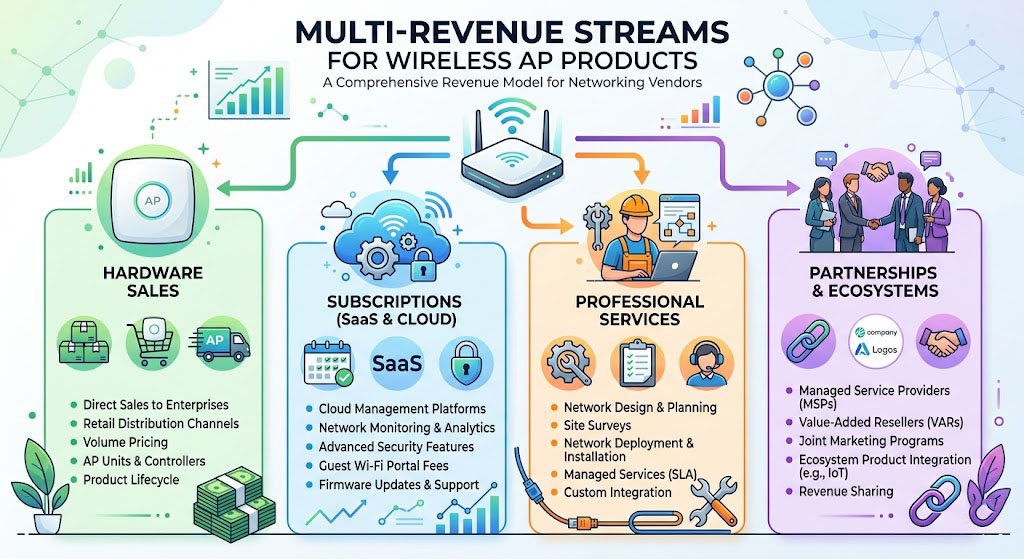
Monetizing wireless AP products requires more than just selling hardware. Successful companies are leveraging multiple revenue streams including subscriptions, services, and ecosystem partnerships. As the wireless networking market becomes more competitive, innovative monetization strategies are essential for long-term profitability. As a core component of how to balance RF performance and cost in wireless AP motherboard development, monetization strategy must align with product capabilities. Why is traditional hardware-only monetization no longer sufficient? What new revenue models are emerging? How can companies transition to more sustainable business models? This article provides comprehensive guidance.
Introduction: The Evolving Wireless AP Market
Market trends driving monetization evolution:
- Hardware Commoditization: Falling hardware costs and increased competition reduce margins on hardware sales.
- Cloud Adoption: Growing demand for cloud-managed networking solutions.
- Subscription Economy: Customers prefer pay-as-you-go models over large upfront investments.
- Security Concerns: Increased demand for managed security services.
- IoT Integration: Need for integrated smart home/business ecosystems.
Traditional Hardware Sales Model
Traditional hardware sales characteristics:
| Characteristic | Description |
|---|---|
| Revenue Model | One-time upfront payment for hardware |
| Margin Structure | Higher upfront margins, but declining over product lifecycle |
| Customer Relationship | Transaction-based, limited ongoing engagement |
| Scalability | Limited by unit sales volume |
| Customer Retention | Dependent on product quality and brand loyalty |
Subscription-Based Models
Subscription-based monetization options:
| Subscription Type | Description | Target Market |
|---|---|---|
| Cloud Management | Centralized network management via cloud | SMB, Enterprise |
| Security Services | Advanced threat detection, content filtering | All markets |
| Analytics & Reporting | Network performance analytics, usage reports | Enterprise, SMB |
| Support & Maintenance | 24/7 support, firmware updates | Enterprise, SMB |
| Feature Unlocks | Premium features via subscription | All markets |
Value-Added Services
Value-added services:
- Professional Installation: Expert installation and configuration services.
- Network Design Consulting: Custom network design for complex environments.
- Training Services: Employee training on network management.
- Managed Services: Outsourced network management.
- Custom Development: Custom firmware or integration development.
Ecosystem Partnerships
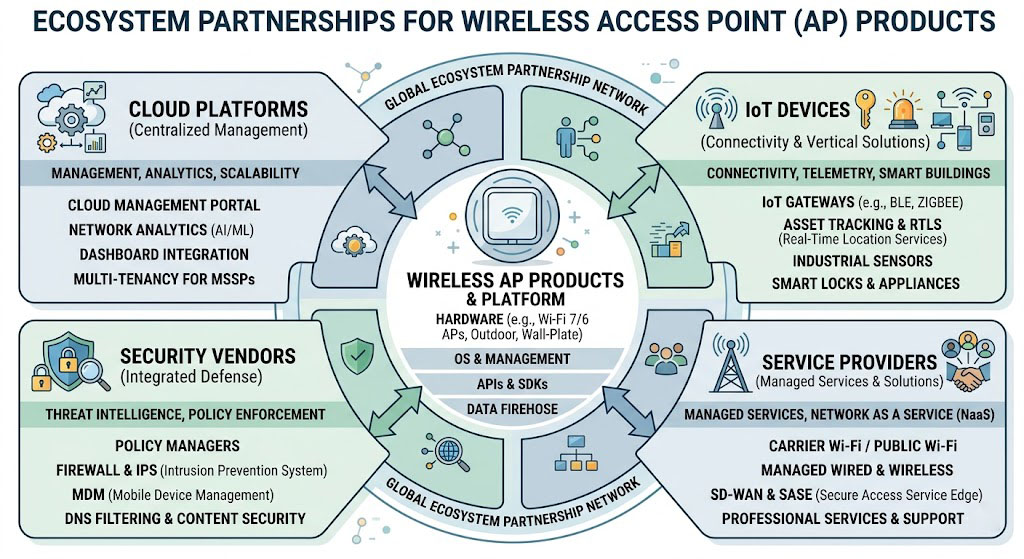
Ecosystem partnership opportunities:
| Partnership Type | Description | Revenue Opportunity |
|---|---|---|
| Cloud Platform Integration | Integrate with major cloud providers | Referral fees, integration revenue |
| IoT Device Integration | Integrate with smart home/business devices | Platform fees, data revenue |
| Security Vendor Partnerships | Integrate third-party security solutions | Revenue sharing |
| Channel Partnerships | Distributor and reseller partnerships | Volume discounts, incentives |
| Service Provider Partnerships | Partner with ISPs and MSPs | White-label opportunities |
—
【Image Placeholder Start】
– Image Position: After H2 “Ecosystem Partnerships”
– Visual Concept: Diagram showing ecosystem partnerships for wireless AP products
– AI Prompt: Diagram showing ecosystem partnerships for wireless AP products – cloud platforms, IoT devices, security vendors, and service providers, clean business diagram style
【Image Placeholder End】
—
Hybrid Monetization Models
Hybrid monetization approaches:
- Hardware + Subscription Bundle: Sell hardware with included subscription period.
- Freemium Model: Basic features free, premium features via subscription.
- Hardware-as-a-Service (HaaS): Monthly fee includes hardware, support, and services.
- Usage-Based Pricing: Charge based on usage metrics like data volume or connected devices.
| Model | Description | Pros | Cons |
|---|---|---|---|
| Hardware + Subscription | Upfront hardware + recurring subscription | Immediate revenue + recurring revenue | Requires ongoing service infrastructure |
| Freemium | Basic features free, premium paid | Low barrier to adoption | Conversion challenges |
| HaaS | All-inclusive monthly fee | Predictable recurring revenue | High upfront hardware costs |
| Usage-Based | Pay per use | Aligns cost with value | Unpredictable revenue |
Pricing Strategies
Effective pricing strategies:
- Value-Based Pricing: Price based on perceived value to customer.
- Tiered Pricing: Offer different feature levels at different price points.
- Volume Discounts: Discounts for large orders or long-term commitments.
- Promotional Pricing: Introductory offers for new customers.
- Bundling: Combine hardware, subscriptions, and services at a discount.
Case Studies: Successful Monetization
Case study examples:
- Company A: Transitioned from hardware-only to hybrid model with 30% of revenue from subscriptions.
- Company B: Launched HaaS offering, increasing customer retention by 50%.
- Company C: Built ecosystem partnerships, creating new revenue streams through referral fees.
Challenges and Considerations
Key challenges:
- Customer Acceptance: Convincing customers to adopt subscription models.
- Infrastructure Investment: Building cloud and service infrastructure.
- Channel Conflict: Managing relationships with traditional distributors.
- Data Security: Ensuring customer data privacy in cloud services.
- Service Reliability: Maintaining high uptime for cloud services.
Summary
Key insights for monetization strategy:
- Move beyond hardware-only sales: Hardware remains important but must be complemented with recurring revenue streams. See home vs enterprise AP comparison for product positioning considerations.
- Embrace subscription models: Recurring revenue provides stability and improves customer retention.
- Build ecosystem partnerships: Partnerships create new revenue opportunities and enhance product value.
- Offer value-added services: Services provide high margins and deepen customer relationships.
- Adopt hybrid models: Most successful companies combine multiple revenue streams.
As the wireless AP market evolves, companies must adapt their monetization strategies to remain competitive and profitable. For more on product development considerations, see how to balance RF performance and cost in wireless AP motherboard development.
References
Frequently Asked Questions
Q: How do I transition from hardware-only to subscription-based monetization?
Start by identifying high-value features that can be delivered as services. Begin with a freemium model to lower adoption barriers. Invest in cloud infrastructure incrementally. Communicate the value of subscriptions clearly to customers.
Q: What are the most profitable subscription services for wireless APs?
Cloud management, security services, and analytics are typically the most profitable. These services leverage existing hardware investments and provide ongoing value to customers.
Q: How do I price subscription services?
Price based on perceived value, not just cost. Research competitor pricing, understand customer willingness to pay, and offer tiered pricing to accommodate different customer segments.


