6GHz Band Industrial Wireless Bridge & W-Jet V Protocol Deep Dive
Article Overview
Who this is for: Network engineers, system integrators, and industrial IT managers evaluating long-range wireless backhaul solutions for mission-critical infrastructure.
Core Issue: The 5GHz band is increasingly congested. DFS restrictions and co-channel interference degrade industrial wireless link performance — how do you build a truly high-performance long-range wireless backbone from both the spectrum and protocol design perspectives?
Key Conclusions: The 6GHz band (5.850-6.450GHz) delivers a noise floor as low as -110dBm (10-15dB lower than 5GHz) with 30+ non-overlapping channels. Combined with the W-Jet V proprietary protocol’s active scheduling and adaptive modulation, it achieves 600-700Mbps real-world throughput, 2-4ms latency, and 99.9% link availability — the current benchmark for long-range industrial wireless backhaul.
Introduction
In industrial wireless communications, spectrum is the foundation that determines system performance. As the 5GHz band grows increasingly crowded — with WiFi networks, ISM devices, radar systems, and wireless surveillance all sharing the same space — interference has become the single biggest factor limiting industrial wireless link performance and reliability.
The 6GHz band changes that. It offers a clean spectrum playground with a noise floor as low as -110dBm (10-15dB lower than 5GHz) and 30+ non-overlapping channels. YNWMICRO’s W-Jet V proprietary protocol is built to squeeze every bit of performance out of this spectrum.
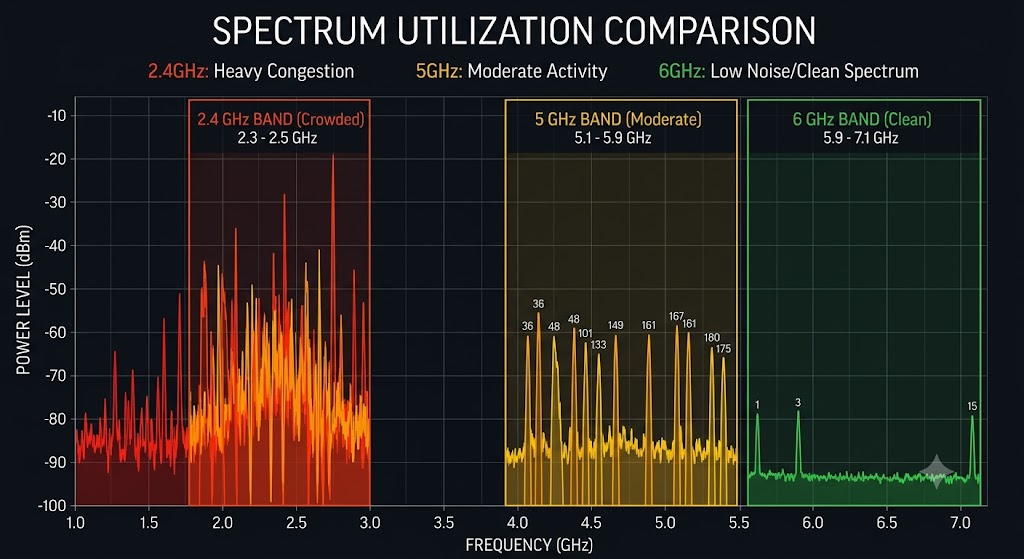
This article breaks down the 6GHz band’s technical characteristics and the W-Jet V protocol design principles, helping you understand why the 6GHz + W-Jet V combination is the best choice for long-range industrial wireless backhaul. For a broader framework, see the Complete Guide to Industrial Wireless Bridges.
Technical Advantages of the 6GHz Band
2.1 Spectrum Resources at a Glance
The YNWPTP RapidFire and YNW 6ac series operate in the 5.850-6.450GHz range, covering the lower portion of the 6GHz band. Usage is governed by national regulators. The FCC designates 5.925-6.425GHz (U-NII-5 through U-NII-8) for unlicensed use under [FCC 47 CFR Part 15] and [FCC 20-51]. ITU-R Recommendation [ITU-R P.530-18] provides authoritative guidance on propagation loss calculation for terrestrial line-of-sight links.
Unlike the 2.4GHz and 5GHz bands, the 6GHz band has a relatively simple history of use:
| Band | Primary Historical Users | Interference Level | Channel Availability | Industrial Bridge Suitability |
|---|---|---|---|---|
| 2.4GHz | WiFi, Bluetooth, ZigBee, microwave ovens, ISM devices | Very High | 3 non-overlapping channels | Poor |
| 5GHz | WiFi, radar, ISM, satellite ground stations | High | ~20 channels (DFS required) | Moderate |
| 6GHz | Fixed satellite service (FSS), radio location, limited microwave links | Low | ~30+ channels | Excellent |
2.2 What a Low-Noise Environment Actually Means
Noise floor comparison: In typical urban or industrial environments, the 2.4GHz band noise floor runs between -85dBm and -95dBm, while 5GHz sits between -90dBm and -100dBm. The 6GHz band pushes that down to -100dBm to -110dBm. In link budget terms, every 3dB reduction in noise floor means the receiver can detect a weaker signal — or achieve a higher SNR at the same signal strength.
How SNR drives throughput: Take an 802.11ac system running 256-QAM 5/6 coding (roughly 780Mbps on an 80MHz channel). It needs about 30dB SNR. In the 5GHz band (noise floor -95dBm), that means RSSI must be above -65dBm. In the 6GHz band (noise floor -105dBm), you only need -75dBm to hit the same SNR. This means:
- Coverage extends significantly at the same transmit power and antenna gain
- Or you can run higher-order modulation at the same distance for more throughput
2.3 Rich Channel Resources
Within the 600MHz of usable spectrum from 5.850-6.450GHz, you can plan:
- 12 x 40MHz channels — good for PtMP deployments in moderate-interference environments
- 6 x 80MHz channels — ideal for maxing out 802.11ac performance, with zero overlap between channels
- 3 x 160MHz channels — reserved for 802.11ax ultra-wide channel configurations
5GHz has plenty of channels on paper too, but DFS (Dynamic Frequency Selection) — the requirement to detect and avoid radar signals — renders many of them unusable in practice. The 6GHz band carries no DFS requirement in most countries, so channel planning is far more predictable.
2.4 Real-World Value in Industrial Environments
For industrial deployments, the 6GHz band’s low-interference profile translates to concrete benefits:
- Better link availability: Fewer dropped packets and retransmissions. Availability jumps from 99.0-99.5% on 5GHz to 99.9%+ on 6GHz.
- Stable latency: No collision backoff or retransmission jitter. In industrial control, reliable low latency (jitter <1ms) often matters more than raw low latency.
- Predictable capacity: Clean spectrum means link capacity is easier to forecast and guarantee — no sudden throughput drops from co-channel interference.
- Multi-base-station co-location: Plenty of non-overlapping channels let you co-locate multiple base stations on the same tower or in the same area without interference, simplifying network expansion.
[FCC 47 CFR Part 15] / [FCC 20-51]. Link propagation calculations can reference the [ITU-R P.530-18] terrestrial line-of-sight model. Link availability can reach 99.9%+.
W-Jet V Protocol Deep Dive
3.1 Protocol Design Background
W-Jet V is YNWMICRO’s proprietary wireless transmission protocol, now in its fifth generation. Unlike the standard IEEE 802.11 CSMA/CA (Carrier Sense Multiple Access with Collision Avoidance) mechanism defined in [IEEE 802.11ac-2013] and [IEEE 802.11ax-2021], W-Jet V is purpose-built for high-performance point-to-point (PTP) and point-to-multipoint (PTMP) deployments. Its core design goals:
- Maintain link stability in heavy-interference environments
- Deliver ultra-low, consistent latency
- High packet-per-second (PPS) forwarding rates
- Efficient transmission over long distances
3.2 Protocol Architecture & How It Works
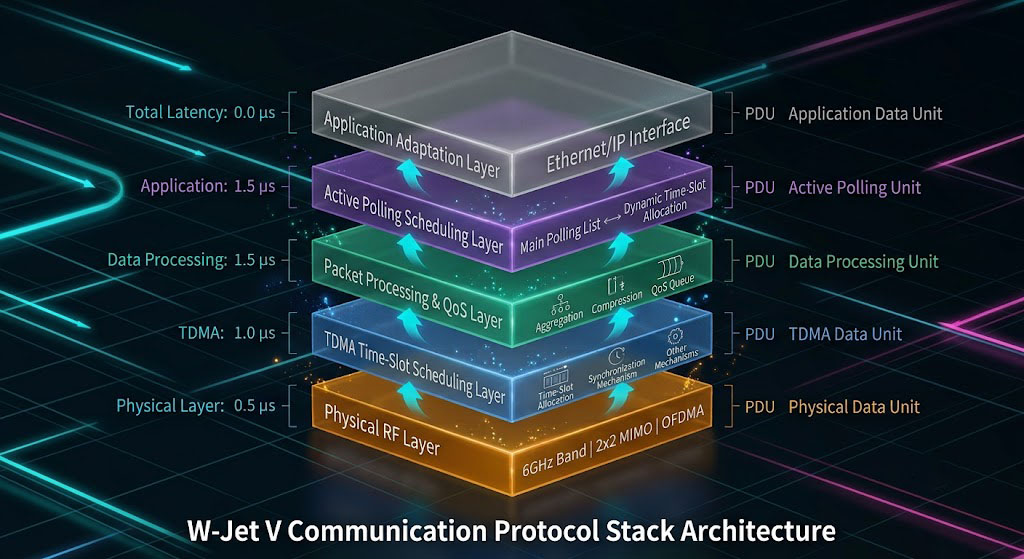
W-Jet V uses a four-layer architecture, with clear separation of concerns at each layer:
├─ Master maintains polling list
├─ Time slots allocated by bandwidth weight
└─ Eliminates collisions and backoff delay
├─ Network-wide time synchronization
├─ Uplink/downlink slot separation
└─ Guarantees latency <1ms
├─ Frame aggregation A-MSDU/A-MPDU
├─ Header compression
└─ Selective ARQ retransmission
├─ Adaptive ACK timeout adjustment
├─ Frame bursting
└─ Supports 300km+ in long-range mode
3.2.1 Active Scheduling Mechanism
Unlike 802.11’s listen-before-talk contention approach, W-Jet V uses active polling scheduling in PtMP mode:
- The master maintains a polling list of all connected devices
- The master sends downlink data plus a polling token to each device in sequence or by dynamic priority
- When a device receives the token, it transmits uplink data in its assigned timeslot
- The master acknowledges and moves to the next device
The math is straightforward: In CSMA/CA, collision probability grows exponentially with the number of competing stations. In W-Jet V’s polling system, every device gets a deterministic transmission opportunity, so total system throughput doesn’t degrade as more devices connect.
3.2.2 Frame Aggregation & Block ACK
W-Jet V supports advanced frame aggregation, sending multiple data frames in a single transmission opportunity with Block ACK for batch confirmation:
- A-MPDU (Aggregate MAC Protocol Data Unit): Bundles multiple MPDUs into a single PHY frame, reducing preamble and inter-frame spacing overhead
- A-MSDU (Aggregate MAC Service Data Unit): Bundles multiple MSDUs into one MPDU, reducing MAC-layer overhead
On a typical 80MHz channel with 256-QAM, aggregation efficiency pushes real throughput to 80-85% of the PHY rate — well above the 60-70% typical of standard 802.11 systems.
3.2.3 Adaptive Modulation & Coding (AMC)
W-Jet V supports the full modulation range from BPSK (lowest rate, best interference resilience) to 256-QAM (highest rate, lowest interference tolerance), and switches automatically based on real-time link quality:
| MCS Index | Modulation | Coding Rate | Data Rate @80MHz | Min SNR |
|---|---|---|---|---|
| 9 | 256-QAM | 5/6 | 866Mbps | ~30dB |
| 8 | 256-QAM | 3/4 | 780Mbps | ~28dB |
| 7 | 64-QAM | 5/6 | 650Mbps | ~25dB |
| 6 | 64-QAM | 3/4 | 585Mbps | ~23dB |
| 5 | 64-QAM | 2/3 | 520Mbps | ~21dB |
| 4 | 16-QAM | 3/4 | 390Mbps | ~17dB |
| 3 | 16-QAM | 1/2 | 260Mbps | ~14dB |
| 2 | QPSK | 3/4 | 195Mbps | ~11dB |
| 1 | QPSK | 1/2 | 130Mbps | ~8dB |
| 0 | BPSK | 1/2 | 65Mbps | ~5dB |
AMC switching speed is a key W-Jet V optimization. Backed by the RapidFire’s 1.2GHz CPU, the protocol can switch modulation schemes in milliseconds — so the link always runs at the maximum usable throughput even as weather or other conditions cause signal fluctuations.
3.2.4 Low-Latency Design
W-Jet V achieves 2-4ms ultra-low latency through several mechanisms:
- Reduced buffering: The proprietary protocol gives finer control over how long packets sit in the transmit queue
- Fast ACK: No need to wait out standard 802.11 SIFS/DIFS timing intervals
- Priority preemption: High-priority traffic (video key frames, industrial control commands) can interrupt lower-priority transmissions
In real-world deployments, RapidFire links show end-to-end latency (including over-the-air and wired-side processing) of 2-5ms with jitter within ±1ms — well within the requirements for live video surveillance, VoIP, and most industrial control applications.
3.3 W-Jet V vs. Standard 802.11 Protocol Comparison
| Dimension | W-Jet V (Proprietary) | Standard 802.11ac/n |
|---|---|---|
| Channel Access | Active polling (PtMP) / Deterministic scheduling (PTP) | CSMA/CA contention |
| Collision Handling | Token-based, collisions avoided outright | Collision detection + backoff retry |
| Latency (over-the-air) | 2-4ms, ultra-low jitter | 5-20ms+, high jitter |
| PPS Capacity | 200,000+ (with 1.2GHz CPU) | 30,000-80,000 (typical) |
| Long-Distance Optimization | Proprietary algorithm for long-range ACK timing | ACK timeout tuning needed, distance-limited |
| Interference Resilience | Strong (proprietary error correction + retransmission) | Moderate (standard retransmission) |
| Multi-Device Efficiency | High (polling efficiency barely degrades) | Low (contention overhead grows with node count) |
| Device Compatibility | Between YNWMICRO devices | Any WiFi-standard device |
3.4 W-Jet V vs. iPoll 3: What’s the Difference?
Within YNWMICRO’s product lineup, the RapidFire series runs W-Jet V, while the YNW 6ac series runs iPoll 3. Here’s the nutshell: W-Jet V is optimized for PTP backbone performance; iPoll 3 focuses on PtMP multi-user efficiency.
Key differences at a glance:
| Dimension | W-Jet V | iPoll 3 |
|---|---|---|
| Target Scenario | High-performance PTP / backbone | PtMP access |
| Design Focus | Throughput, latency, PPS | Multi-user scheduling, fairness |
| Applicable Products | RapidFire 6-N/6-25, YNWBASE | YNW 6-15ac/YNW 6-20ac/YNW 6-90ac |
| Max Throughput | 700Mbps | 500Mbps |
| CPU Requirement | 1.2GHz high-performance CPU | 750MHz QCA 9563 |
But both share the same core design philosophy: active scheduling replaces contention-based access. This is the fundamental reason YNWMICRO devices outperform generic WiFi gear in industrial connectivity scenarios.
[IEEE 802.11ac-2013]), achieving 2-4ms latency and 200K+ PPS forwarding. Frame aggregation efficiency reaches 80-85% (standard 802.11 manages 60-70%). AMC supports BPSK through 256-QAM with millisecond switching. iPoll 3 focuses on PtMP multi-user efficiency — both share the same technical DNA.
The Combined Advantage: 6GHz + W-Jet V
When the 6GHz band’s clean spectrum meets W-Jet V’s efficient protocol, the synergy goes beyond what either technology delivers alone.
4.1 Signal Propagation & Protocol Adaptation
A quick physics note: Compared to 5GHz, 6GHz has slightly higher free-space path loss — about 1.5-2dB more at the same distance. But that difference is negligible compared to the noise floor advantage. The 6GHz band’s interference floor is roughly 10dB lower than 5GHz, which translates to significantly better SNR.
W-Jet V’s AMC mechanism makes the most of this. In the 6GHz band’s low-noise environment, the protocol stays locked on high-order modulation (256-QAM), pushing throughput close to the physical limit. Run the same link on 5GHz, and the 10dB higher noise floor may force the system down to 64-QAM or even 16-QAM — a throughput loss of 50-70%.
4.2 Real-World Link Performance Comparison
The table below shows expected performance for different band and protocol combinations under identical conditions (30km line-of-sight, 30dBm transmit power, 25dBi antennas):
4.3 The Value of Avoiding DFS
DFS on the 5GHz band is a persistent headache for industrial wireless bridge deployments:
- DFS requires immediate channel switching when radar is detected
- Channel switching causes roughly 30 seconds of service interruption
- In areas with frequent radar activity (coastal zones, near airports, military zones), DFS events can be frequent
The 6GHz band has no DFS requirement in most countries. W-Jet V runs on stable channels with zero risk of DFS-triggered interruptions. For mission-critical industrial links like power grid monitoring or oil and gas pipeline SCADA, this is invaluable.
Spectrum Analysis & Deployment Tuning
5.1 Built-in Spectrum Analyzer
Both the RapidFire and YNW series include an integrated spectrum analysis tool that displays signal activity as waveform and waterfall graphs. Engineers use it for:
- Spectrum scanning: Survey the target band before installation to identify potential interference sources
- Channel selection: Compare noise floor levels across channels to pick the cleanest one
- Link quality verification: After link setup, confirm no new interference has appeared
- Troubleshooting: When link quality drops, quickly determine if external interference is the cause
The spectrum analyzer is fully accessible through the Web GUI — no need for external spectrum analysis hardware.
5.2 Recommended 5-Step Deployment Workflow
├─ Run spectrum analysis at the installation location (5-10 minutes recommended)
├─ Record noise floor levels for all channels
└─ Mark channels with periodic or continuous interference signals
├─ Select the 80MHz channel block with the lowest noise floor
├─ For co-located base stations, use non-overlapping 80MHz channels
└─ Record the chosen channel frequencies
├─ Mount equipment and roughly align antennas
├─ Use the built-in antenna alignment tool (RGB LED indicators)
└─ Fine-tune antenna angles until RSSI is optimal
├─ Run throughput tests (iperf or built-in tools)
├─ Verify latency and jitter are within acceptable ranges
└─ Record baseline performance metrics
├─ Configure SNMP monitoring or Infinity controller
├─ Set alert thresholds for RSSI and throughput
└─ Re-run spectrum analysis periodically (e.g., quarterly) to check for environmental changes
Regulatory & Licensing Considerations for 6GHz
6.1 Global Spectrum Regulation Overview
6GHz band availability differs by country and region. Always check local regulations before planning a link:
| Country / Region | Available Spectrum | Usage Conditions |
|---|---|---|
| United States (FCC) | 5.925-6.425GHz (U-NII-5 to U-NII-8) | Some bands require AFC; others are unlicensed |
| European Union (ECC) | 5.945-6.425GHz | Low-power indoor (LPI) / Very low power (VLP) |
| China | 5.925-6.425GHz | License or registration required per MIIT regulations |
| Japan | 5.925-6.425GHz (partial) | Specific certification required |
| Australia | 5.925-6.425GHz | Unlicensed (subject to ACMA rules) |
The RapidFire series supports a 5.900-6.400GHz range, covering frequency allocation needs across different countries. Units can be band-limited at the factory based on the target market.
6.2 Deployment Compliance Process
- Check licensing requirements: Early in the project, confirm with local regulators whether the 6GHz band requires a license
- Select compliant channels: Enable only the channel list that matches local regulations in the device settings
- Control transmit power: Make sure output power stays within local limits (RapidFire supports software power capping)
- Document and register: For licensed scenarios, complete frequency use applications ahead of time
Coexistence with Other Band Technologies
7.1 Hybrid Network: 6GHz Backbone + 5GHz Access
For large campuses and wide-area coverage, the best approach is often a multi-band hybrid network:
- Backhaul layer: 6GHz + W-Jet V (RapidFire series) handles multi-kilometer backbone transport at hundreds of Mbps to Gbps
- Access layer: 5GHz (YNW 5ac/5ax series) connects end-user devices
This layered design makes the most of each band’s complementary strengths:
- 6GHz’s clean spectrum ensures backbone stability and high capacity
- 5GHz’s broad compatibility keeps client device costs and deployment complexity low
7.2 Fiber vs. Wireless: Cost Comparison for 6GHz Links
For 10-50km long-distance links, 6GHz wireless bridges have a clear cost advantage over fiber:
| Cost Item | Fiber Solution | 6GHz Wireless (RapidFire) |
|---|---|---|
| Infrastructure | ~$15,000-70,000/km (including installation) | One-time equipment cost ~$700-2,000 |
| Deployment Timeline | Weeks to months (permits, trenching, etc.) | Hours to days |
| Maintenance | Fault localization is difficult, repair cycles are long | Remote monitoring, fast issue identification |
| Expansion Flexibility | Requires transceiver upgrade or new cabling | Swap equipment or upgrade antennas |
| Service Interruption Risk | High risk from third-party damage (excavation, etc.) | Only affected by extreme weather |
Of course, fiber remains irreplaceable for ultra-high capacity (100Gbps+) and ultra-low latency. But for the vast majority of industrial connectivity needs (100Mbps-1Gbps), 6GHz wireless offers a far more practical cost-performance ratio. According to the [IHS Markit Industrial Wireless Survey 2024], over 60% of surveyed enterprises prioritize wireless for long-distance campus interconnection, with cost savings and deployment speed as the top two decision factors.
Conclusion
The combination of the 6GHz band and the W-Jet V protocol represents one of the most advanced directions in long-range industrial wireless communications today. The 6GHz band provides abundant spectrum and a low-interference environment, while W-Jet V extracts maximum performance from that clean canvas through active scheduling, frame aggregation, and adaptive modulation.
For network planners, choosing 6GHz + W-Jet V means:
- Higher link reliability — no DFS disruptions or co-channel interference from the 5GHz band
- More predictable performance — in a clean spectrum environment, throughput and latency fluctuations are minimal
- Lower TCO — fewer interference-related troubleshooting trips and site visits
- A future-proof choice — as WiFi 6E and WiFi 7 devices enter the 6GHz band, device compatibility and ecosystem support will only grow stronger
Industrial wireless has moved from “nice to have” to “must have.” Choosing a reliable, high-efficiency band and protocol with long-term viability is a decision every network planner needs to get right. 6GHz + W-Jet V is an answer worth serious consideration.
[IHS Markit Industrial Wireless Survey 2024], over 60% of enterprises prefer wireless over fiber for long-distance interconnection.
Representative Scenario: 6GHz Airport Perimeter Security Wireless Link
- Scenario: Airport perimeter security video backhaul
- Requirement: ~6km perimeter security video backhaul (32 channels of 1080p), low latency required, zero tolerance for radar interference
- Design: YNWPTP 6-N on the 6GHz band, leveraging W-Jet V to avoid interference with the airport’s 5GHz radar systems
- Expected results: 6GHz noise floor at -108dBm, effective throughput ~680Mbps, video latency <50ms, zero DFS trigger events
- Note: Illustrative deployment scenario based on published product specifications; absolute figures depend on antenna gain, link distance, and local RF environment.
References
- FCC 47 CFR Part 15 — Radio Frequency Device Technical Standards
- FCC 20-51 — 6GHz Band Unlicensed Use Rules
- ITU-R P.530-18 — Propagation Data and Prediction Methods for Terrestrial Line-of-Sight Links
- IEEE 802.11ac-2013 — Wireless LAN Standard Amendment
- IEEE 802.11ax-2021 — High-Efficiency Wireless LAN Standard
- IHS Markit Industrial Wireless Survey 2024 — Industrial Wireless Market Research Report
- YNWMICRO RapidFire Series Technical White Paper — YNWMICRO Official Documentation
- YNWMICRO YNW 6ac Series Product Specifications — YNWMICRO Official Documentation
Frequently Asked Questions
Q: What’s the real-world transmission distance of a 6GHz industrial wireless bridge?
A: With RapidFire series equipment on the 6GHz band and a 25dBi integrated antenna, reliable transmission reaches 50km+ under line-of-sight conditions. With a 30dBi+ external parabolic dish antenna, that extends to 80-100km. On a 30km link using a RapidFire 6-N + 1.2m parabolic dish, real-world UDP throughput hits 600-700Mbps with 99.9% link availability. Actual distance depends on antenna gain, transmit power, Fresnel zone clearance, and local climate — always run a full link budget calculation before deployment.
Q: How much lower is the latency with W-Jet V compared to standard 802.11?
A: W-Jet V replaces standard 802.11 CSMA/CA contention with active polling scheduling. Over-the-air latency drops from 5-20ms+ to 2-4ms, and jitter drops from ±10ms to ±1ms. In an 8-client PtMP scenario, W-Jet V end-to-end latency stays at 3-5ms, while standard 802.11ac under the same load can hit 50-200ms. This makes W-Jet V ideal for latency-sensitive applications like live video surveillance, VoIP, and industrial control.
Q: Are there regulatory restrictions for 6GHz deployment in China?
A: China’s MIIT published a draft regulation in 2023 allocating the 5.925-6.425GHz band for wireless access systems, but the final allocation plan has not been officially published. Before formal regulations are released, check with local radio management authorities for the latest policy. YNWPTP RapidFire series supports a 5.900-6.400GHz range, can be band-limited at the factory per target market, and supports software power capping for compliance.
Q: Will 6GHz band interference get worse as more devices use it?
A: The 6GHz band offers 1200MHz of contiguous spectrum (FCC range) — more than double the 500MHz available in 5GHz. That abundance of channels makes congestion far less likely. Plus, 6GHz devices are primarily used for fixed outdoor bridge links rather than indoor WiFi, so use cases don’t overlap heavily. As WiFi 6E/WiFi 7 devices enter the band, interference will increase somewhat, but RapidFire supports automatic channel selection (ACS) and built-in spectrum analysis to dynamically switch to the best channel. Overall, 6GHz will maintain a significant interference advantage for at least the next 5-10 years.
*Technical parameters in this article are based on YNWMICRO official documentation. W-Jet V protocol details represent open technical analysis based on product performance; specific protocol implementation details are protected as trade secrets.*