OEM vs ODM for Wireless AP Motherboards: Full Comparison
Blog 2026-06-01
OEM vs ODM for Wireless AP Motherboards: Full Comparison
Key Overview
Core Issue:Choosing between OEM and ODM for wireless AP motherboard projects without understanding how each model affects R&D ownership, IP, cost structure, time to market, and supply chain control.
Key Conclusions:The right choice depends on your brand’s R&D capability, product differentiation goals, timeline, and budget. OEM gives you full design control and IP ownership but requires significant engineering investment. ODM gets you to market faster with lower upfront cost but limits customization and long-term technology accumulation. Most mature brands use a hybrid strategy — OEM for core products and ODM for volume or entry-level SKUs.
What Are OEM and ODM in Wireless AP Motherboard Context?
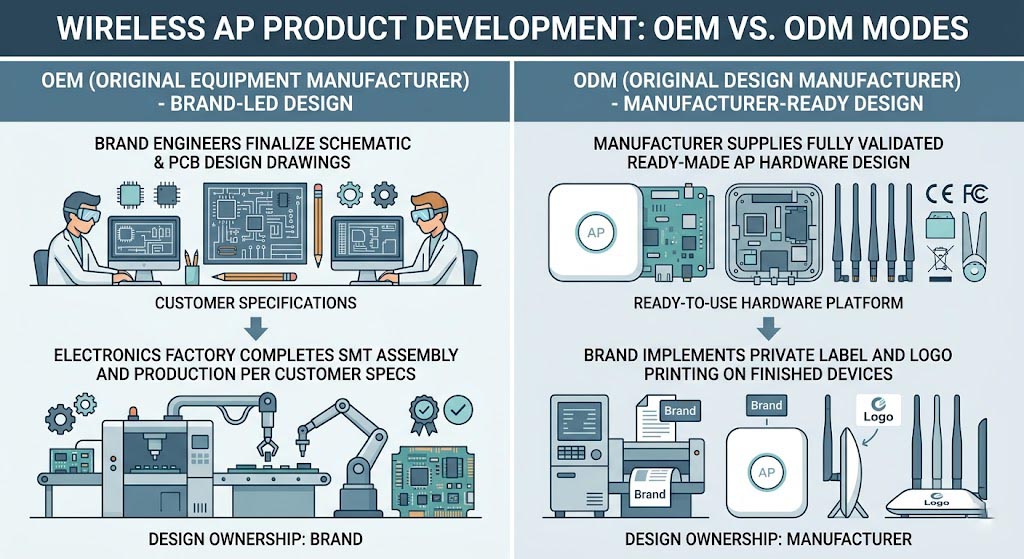
In the wireless AP motherboard industry, OEM (Original Equipment Manufacturer) and ODM (Original Design Manufacturer) represent two distinct partnership models between brands and manufacturing partners. They differ in who drives the design, who owns the IP, and how much control the brand retains over the final product.
OEM (Original Equipment Manufacturer): Your team owns the complete hardware design — schematics, PCB layout, RF tuning, firmware architecture, and mechanical enclosure. The manufacturer handles fabrication, assembly, testing, and logistics based on your specifications. You hold the bill of materials (BOM), maintain supplier relationships, and control design changes throughout the product lifecycle.
ODM (Original Design Manufacturer): The manufacturer offers a pre-engineered platform — typically a reference design they’ve built and validated internally. Your team selects from available configurations, applies cosmetic changes (enclosure, branding, packaging), and may request minor firmware or hardware adjustments. The core design, RF performance data, and most component choices stay under the manufacturer’s control.
For a broader understanding of how these models interact with overall product strategy, see our guide on how to balance RF performance and cost in wireless AP motherboard development.
Core Differences Between OEM and ODM
Here’s a side-by-side comparison of how OEM and ODM stack up across the most important decision dimensions for wireless AP motherboard projects:
| Dimension | OEM | ODM |
|---|---|---|
| Design Ownership | Brand holds full design rights | Manufacturer owns base design |
| IP Control | Brand retains all IP | IP shared or owned by ODM |
| Customization Level | Full — every component and layout decision | Limited — configuration and cosmetic only |
| R&D Investment | High — internal engineering team required | Low to medium — platform selection fee |
| Time to Market | 12–24 months | 4–8 months |
| Unit Cost (volume) | Can be lower at scale with BOM control | Higher margin built into ODM price |
| Minimum Order Quantity | Flexible, depends on factory | Often higher, tied to ODM’s production batch |
| Supply Chain Control | Brand manages suppliers | ODM manages suppliers |
| Certification Responsibility | Brand-led with manufacturer support | ODM-led with brand input |
| Product Differentiation | High — unique hardware and features | Low to medium — similar to competitors |
| Technology Accumulation | Strong — builds internal expertise | Weak — ODM accumulates knowledge |
R&D Ownership and IP Distribution
This is arguably the most strategic difference between the two models. With OEM, every PCB trace, RF tuning decision, thermal simulation, and firmware module belongs to your company. You can reuse that IP across multiple product generations, license it, or protect it with patents. Over 3–5 years, OEM builds a technology foundation that compounds.
With ODM, the manufacturer controls the reference design. If you want to add a new feature, change a chipset, or address a performance issue, you go back to the ODM — and you pay for every modification. Your engineering team learns less with each project, and the core IP stays with the manufacturer, who can sell the same platform to your competitors.
That said, not every product needs proprietary IP. BOM cost optimization strategies often favor ODM for high-volume, low-margin SKUs where speed and cost matter more than differentiation.
Cost Structure and Investment Differences
The cost profiles look very different depending on which model you choose:
| Cost Category | OEM | ODM |
|---|---|---|
| NRE (Non-Recurring Engineering) | $150K – $500K+ | $20K – $80K (platform fee) |
| Internal Engineering Team | 8–15 engineers for 12–18 months | 2–4 engineers for 4–8 months |
| Certification Cost | $50K – $150K (FCC, CE, etc.) | $10K – $40K (variations only) |
| Per-Unit Premium | Lower — brand controls BOM | 15–30% margin built into ODM price |
| Tooling & Molds | $30K – $100K | Often included in platform fee |
| Total First-Year Investment | $500K – $2M+ | $100K – $400K |
The break-even analysis is straightforward: if your projected annual volume exceeds 10,000–20,000 units, OEM typically becomes more cost-effective over a 3-year product lifecycle. Below that volume, ODM’s lower upfront investment makes more sense.
R&D Cycle and Time to Market
Typical development timelines for each model:
- OEM Timeline: 12–24 months from concept to first shipment. Includes specification definition (2–3 months), schematic and PCB design (3–4 months), RF tuning and antenna matching (2–3 months), firmware development (3–5 months), certification (2–4 months), and manufacturing ramp (1–2 months).
- ODM Timeline: 4–8 months. Includes platform evaluation and selection (1–2 months), customization and branding (1–2 months), certification variation testing (1–2 months), and manufacturing ramp (1–2 months).
For companies entering the wireless AP market for the first time, or launching into a competitive window where being early matters, ODM is often the only realistic option. Once you have market traction and revenue, you can transition to OEM for your next generation.
Customization Capability and Product Differentiation
OEM gives you complete freedom to specify every aspect of the design:
- Custom PCB form factor and layer stackup
- Unique antenna design optimized for your enclosure
- Custom PA/LNA selection and RF chain tuning
- Proprietary firmware features and management integration
- Differentiated thermal management and mechanical design
ODM customization is typically limited to:
- Enclosure color, logo, and packaging
- Firmware skinning (UI changes only)
- Pre-approved component alternates (if ODM allows)
- Region-specific certification variations
When comparing home AP vs enterprise AP hardware design differences, enterprise products almost always require OEM-level customization for reliability, performance, and integration into existing network infrastructure.
Supply Chain Control and Component Selection
With OEM, your team sources components directly, negotiates pricing with suppliers, and manages qualification of alternates. This level of control matters when:
- You need specific RF components (PA, LNA, FEM) for performance targets
- You want to lock in long-term pricing on memory, flash, or passives
- You have preferred suppliers based on existing relationships
- You need to manage component end-of-life (EOL) transitions proactively
With ODM, you rely on the manufacturer’s procurement team. The ODM selects components based on their own supply agreements, which may favor cost over performance or long-term availability. If a component goes EOL, the ODM decides the replacement — you may not even know until the change appears in your next shipment.
Certification Responsibility and Risk Sharing
Wireless AP products require FCC (US), CE (EU), IC (Canada), and often country-specific certifications. The cost and timeline can be unpredictable, especially for first-time designs.
- OEM: Your team manages the entire certification process. You select the test lab, manage the testing schedule, and handle any failures or rework. A single EMI failure can add 4–8 weeks and $20K–$50K in additional costs. Certification costs for a new design typically range from $80K–$200K depending on regions and complexity.
- ODM: The base platform is already certified. You only need to test for variations introduced by your enclosure, antennas, or region-specific requirements. This typically costs $10K–$40K and takes 4–8 weeks. The ODM also bears the risk if the base design has certification issues.
For a deeper look at compliance requirements, see our EMC certification guide for wireless AP motherboards.
When OEM Makes Sense — Typical Profiles
OEM is typically the better fit for:
| Company Profile | Why OEM Works |
|---|---|
| Established networking brands | Already have RF engineering teams, want to protect IP and maintain product differentiation |
| Enterprise-focused companies | Enterprise customers demand unique features, customization, and long-term product support |
| Companies with existing OEM programs | Can leverage existing ODM relationships while maintaining design control for flagship products |
| Vendors targeting specific vertical markets | Healthcare, military, industrial applications often require custom hardware not available from ODM platforms |
| Companies planning multiple product generations | OEM builds reusable IP that accelerates future product development and reduces per-generation costs |
When ODM Makes Sense — Typical Profiles
ODM is typically the better fit for:
| Company Profile | Why ODM Works |
|---|---|
| Startups entering the AP market | No existing RF team or certification experience; ODM gives a validated platform |
| Brands needing fast market entry | 6-month timeline vs 18-month for OEM; critical for seasonal or competitive windows |
| Low-volume or niche products | Under 5,000 units/year, OEM investment doesn’t make financial sense |
| Entry-level or value SKUs | Price-sensitive segments where differentiation is less important |
| Companies testing a new market | ODM lets you validate demand with minimal upfront investment before committing to OEM |
OEM vs ODM Decision Matrix
Answer each question honestly, then tally your scores to see which model is recommended for your situation:
| Criterion | Question | OEM (+1) | ODM (-1) |
|---|---|---|---|
| R&D Capability | Do you have an in-house RF engineering team? | Yes, 5+ engineers | No or limited team |
| Differentiation Need | Does your product need unique hardware features? | Yes, proprietary design required | Standard features acceptable |
| Volume | What is your projected annual volume? | 10,000+ units | Under 10,000 units |
| Timeline | What is your target launch timeline? | 12+ months acceptable | Need to launch in 6–8 months |
| IP Strategy | Is IP protection important for your business? | Critical — patents, proprietary design | Not a strategic priority |
Scoring: Add up your score. +3 to +5 → OEM recommended. +1 to +2 → OEM preferred but ODM could work. -1 to -2 → ODM preferred. -3 to -5 → ODM strongly recommended.
References
- TEC. (2025). OEM vs ODM: Key Differences in Electronics Manufacturing.
- IEEE. (2024). Standards for Wireless Networking Equipment.
- Gartner. (2025). Supply Chain Technology Trends in Electronics Manufacturing.
- McKinsey. (2024). Electronics Manufacturing and Supply Chain Insights.
- Forrester. (2025). Hardware Development and Sourcing Strategies.
Frequently Asked Questions
Q: Can I start with ODM and switch to OEM later?
Yes, many successful brands follow exactly this path. Start with ODM to validate the market and build revenue, then invest in OEM for the next generation once you have customer feedback and a clear product roadmap. Just be aware that switching requires building an R&D team and going through a full 12–18 month development cycle.
Q: Does OEM always cost more than ODM?
Not necessarily. OEM has higher upfront NRE costs, but at sufficient volume (typically 10,000+ units/year), the per-unit cost is lower because you control the BOM and supplier negotiations. Over a 3-year product lifecycle, OEM can be cheaper at scale. ODM is more cost-effective at lower volumes.
Q: Can I protect my IP when working with an ODM?
To some extent, but it’s limited. You can sign NDA and IP agreements, but the ODM owns the base platform design. Any modifications you request are typically shared IP unless you negotiate exclusive rights. For true IP protection, OEM is the only reliable path.
Q: How do I evaluate an ODM’s wireless AP platform?
Key evaluation criteria include: supported Wi-Fi standards (Wi-Fi 6, 6E, 7), RF performance data (TX power, RX sensitivity), certification status (FCC, CE), available customization options, minimum order quantities, and reference customer case studies. Always request a design review and performance validation before committing.
Q: What is the typical margin markup on ODM platforms?
ODM platforms typically carry a 15–30% margin markup compared to the raw BOM cost. This covers the ODM’s R&D amortization, supply chain management, certification costs, and profit. For OEM, you pay for BOM + manufacturing cost + your own engineering overhead.


