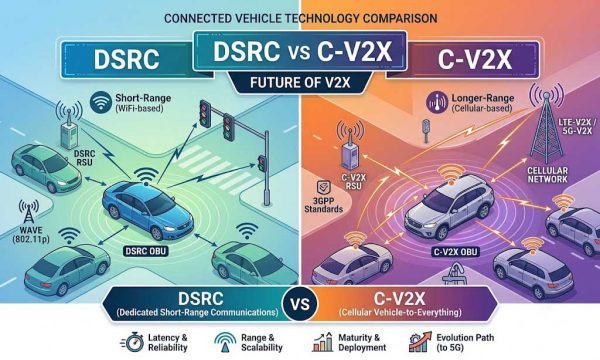
DSRC vs C-V2X: Complete Technical Comparison for Automotive Engineers
C-V2X outperforms DSRC in high-density scenarios (>50 vehicles/km²); DSRC has lower complexity and regulatory approval; the choice depends on deployment timeline, density, and infrastructure strategy.

Smart City IoT Connectivity: Large-Scale Urban Mesh Networks for Municipal Infrastructure
Eliminate high IoT connectivity costs and capacity limits in smart cities. Discover how large-scale urban mesh networks (MANET) offer zero recurring fees, high bandwidth, and proven ROI for municipal infrastructure, validated by real-world deployments.
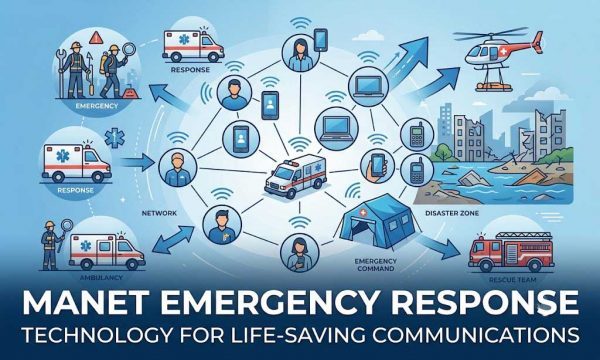
Emergency Response Communication: Rapid-Deploy Disaster Relief Mesh Networks
MANET technology provides the only practical rapidly-deployable wide-area communication solution that operates independently of infrastructure. YN300 series nodes can establish a 50-node mesh within 30 seconds of power-on, covering 5-20 km² without any fixed infrastructure. Multi-hop relay extends coverage through terrain obstacles, and each node’s 10-hour battery life (100 Wh) exceeds a standard 12-hour operational shift.
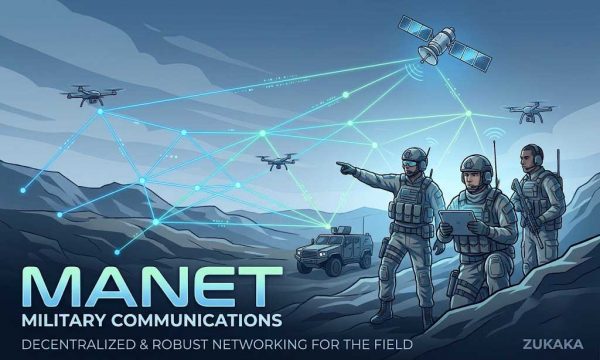
Tactical MANET Networks: Military Communications for C4ISR
Explore how MANET networks revolutionize tactical military communications for C4ISR operations. This guide covers MIL-STD compliance, anti-jamming, HAIPE integration, and Zukaka YN300 series deployment in battlefield scenarios.
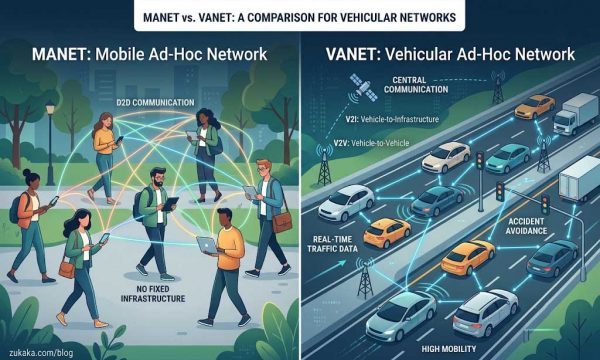
Technical Solution for Vehicular Ad-hoc Networks (VANET Mesh)
Technical guide to VANET V2X communication covering V2V collision avoidance TTC algorithm, V2I RSU SPAT/MAP protocols, V2P BLE pedestrian safety, V2C cloud telematics, DSRC 802.11p vs C-V2X comparison, and VANET routing protocols.
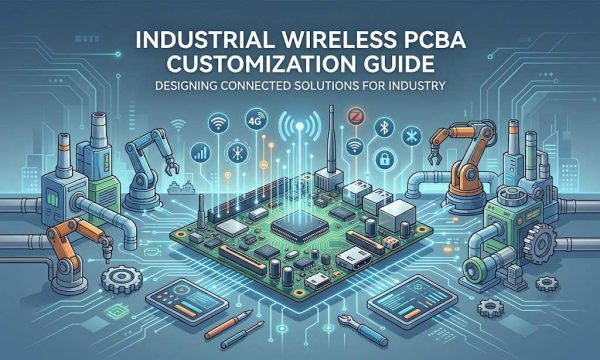
Industrial Wireless PCBA Customization: Design & Manufacturing Guide
Expert guide to industrial wireless PCBA customization services. Learn about design considerations, certification requirements, quality assurance, and OEM/ODM processes for wireless motherboards.
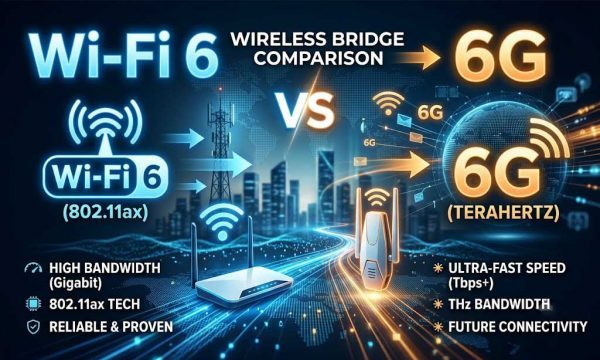
WiFi 6 vs 6G Wireless Bridge: Which is Better for Outdoor Industrial Use?
Compare WiFi 6 (802.11ax) and 6G (802.11be/WiFi 7) wireless bridges for outdoor industrial applications. Understand the differences, benefits, performance, and which technology suits your industrial wireless needs.
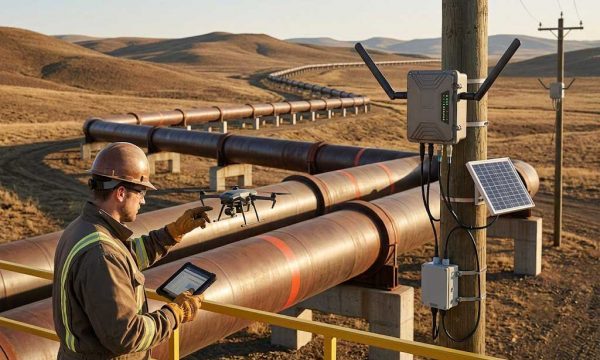
Industrial Wireless Bridges for Oil Pipelines: Selection & Deployment Guide
Navigate the complexities of oil pipeline inspection with our expert guide on industrial wireless bridges. Discover critical selection criteria, deployment best practices, and anti-interference strategies for reliable long-range communication in extreme environments.

WiFi Module Case Studies Hub – Real-World IoT Deployments
Explore 15+ WiFi module case studies across enterprise, industrial, smart city, and smart home verticals. See actual module selections, deployment challenges, and measurable results to guide your next IoT wireless design
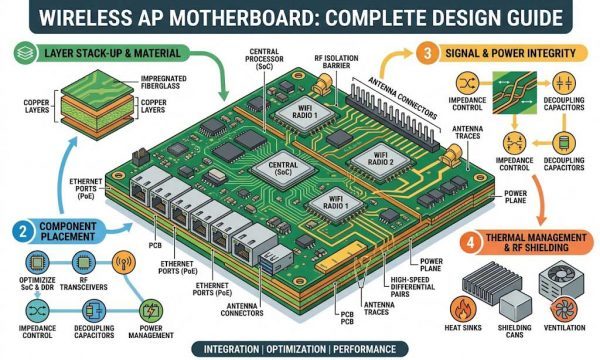
Wireless AP Motherboard Design Guide: Antenna to Production
Complete wireless access point motherboard design guide covering antenna selection, RF PCB layout, EMC certification, BOM optimization, and mass production. Free 10-part engineering series for OEM/ODM developers. Keywords: wireless AP motherboard design, access point hardware guide, AP PCB layout tutorial, RF front-end design, wireless AP development, EMC certification guide, AP antenna design, BOM cost optimization, mass production testing, wireless AP manufacturing

WiFi 7 (802.11be) Guide: Chipsets, Modules & Applications
WiFi 7 (IEEE 802.11be), also called Extremely High Throughput (EHT), is the sixth major WiFi generation, ratified in September 2024. It delivers up to 46 Gbps theoretical peak throughput through 320 MHz channel bandwidth, 4096-QAM modulation, 16 spatial streams, and Multi-Link Operation (MLO)

WPA3 WiFi Module for Enterprise & Industrial – Enhanced Security Access
Implementing WPA3 security on WiFi modules for enterprise and industrial devices. Authentication improvements and deployment considerations.